
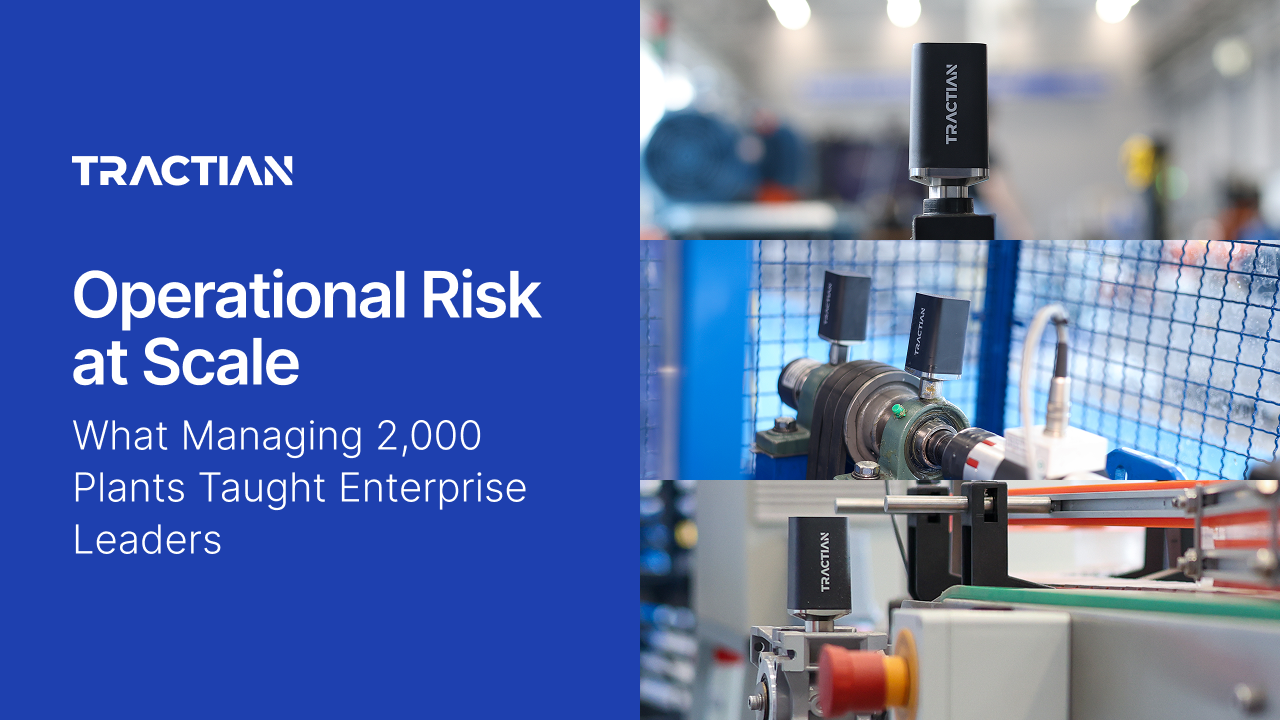
Route-based inspections hold up fine at a single site with a strong reliability team. Spread them across ten sites and they start to crack. Most multi-site industrial operations run 15 to 20 percent short on reliability headcount, and you won’t see that gap on a P&L until the thinnest team has its first major failure. Once that happens, you’re stuck tallying what the wait cost you.
That feeling is reasonable. From where I sit, it's also fixable.
Tractian sensors now run in more than 2,000+ industrial operations: food and beverage plants, automotive lines, pulp and paper mills, distribution centers, hospitals, campuses and data centers. Seeing that many operations at once teaches you something no single plant can. The failures aren't random, the same patterns repeat from site to site, industry to industry and continent to continent, and the organizations that manage risk well at scale aren't the ones with the best machines. They're the ones that stopped treating every site as its own problem.
Here's what that footprint has taught us.
Lesson one: Your risk doesn't live where your criticality list says it does
Every plant has a list of critical assets, and it's usually a good list. The primary production line, the big press, the main compressor. Those assets get the attention, the inspections and the spares.
When you look across 2,000+ operations, though, a lot of the failures that hurt most come from one step removed. It's the cooling tower pump behind the line, the air handler feeding a clean room, or the chiller that nobody thinks about until the room it cools starts climbing past spec. These are support assets, and they're critical because everything else depends on them.
This matters most in facilities, where the building is the operation. In a data center, a chiller or CRAH unit is the only thing standing between the servers and a thermal event, and between you and the service-level commitment your customers pay for. In a hospital, a failed air handler means an operating room goes dark. Facilities teams have always known what’s riding on that equipment. Now they can see a failure coming weeks out, while there’s still time to plan around it.
The takeaway for executives: if your monitoring strategy only covers the assets on the production floor, you're watching the front door and leaving the back one open.
Lesson two: The manual model breaks at scale, and it breaks quietly
Route-based inspections can carry one site with a strong reliability team. Stretch them across a network and the cracks show fast. Ten sites means ten routes, ten schedules, ten levels of expertise and ten ways of writing up the same fault. At fifty sites, you’re running fifty separate reliability programs with no way to compare them.
The failure mode here is quiet. Coverage thins out slowly, one open technician role and one skipped route at a time, and no one ever makes a call to stop inspecting. Eventually, the least-staffed site sets the risk profile for the whole network.
That's why continuous monitoring changes the math at scale. Sensors don't take vacations, skip routes or retire with twenty years of tribal knowledge in their heads. Every asset gets watched the same way, around the clock, whether it sits in your flagship plant or your smallest facility. None of this replaces the people. Maintenance teams are still the unsung heroes of this economy. It means their expertise goes to the problems that need it, instead of being spread thin walking routes.
Lesson three: An alert is not an answer
Let me be direct here, because this is where most of the industry falls short. Plenty of tools will tell you something is wrong. Far fewer will tell you what is wrong, why, and what to do about it.
An alert that says "high vibration on Pump 3" hands your team a research project. Someone has to pull the data, interpret the spectrum, guess at the cause, figure out the parts and decide how urgent it is. Multiply that across hundreds of assets and dozens of sites, and alert fatigue sets in fast. The system becomes noise, and people start ignoring it.
What 2,000+ operations have taught us is that the value lives in root cause and remediation, not detection alone. Our AI benchmarks each asset against millions of machine-hours of failure data. So when something changes, the diagnosis names the failure mode, the affected component, the severity and the window before it becomes a failure. Then it goes further: what to inspect, what to replace, which parts to have on hand and the steps to fix it, carried straight into a work order. After the repair, the same sensors confirm the fix held.
That's the difference between a technician walking up to a machine wondering what they'll find and one walking up already knowing. At one site, that saves a few hours. Across a network, it's the difference between a program that scales and one that collapses under its own alerts.
Lesson four: Speed is a risk variable
We tend to talk about operational risk in terms of whether something will fail. At scale, the more useful question is how fast you can see it and act.
There are two clocks. The first is time to value: how long between deciding to monitor a site and getting insight you can act on. If a rollout takes a year per site, a forty-site network is a multi-year project, and the risk keeps compounding the whole time. Our sensors are built to install in minutes, with no routes to design and no infrastructure projects to wait on, so coverage moves at the pace of the business. When Great Plains Industries deployed, the system caught four critical failures in the first three weeks, before any of them reached production. Four planned repairs instead of four emergency shutdowns, on assets no one had flagged as high risk.
The second clock is time to action: how long between a fault starting and someone fixing it. Every day between the first signature and the repair is a day the problem can escalate from a planned fix into an emergency. Diagnosis plus remediation plus workflow in one place shrinks that window, because nobody is stitching together three systems to figure out what to do.
Lesson five: Scale is an advantage, but only if the data compounds
Here's the part I find most exciting. The more operations we monitor, the better every one of them gets protected.
Every failure we intercept across the network improves detection for everyone on it. Tractian has now intercepted 300,000+ failures. That means the pump in your newest facility benefits from everything learned on thousands of similar pumps elsewhere, with no extra configuration on your end. When detection improves, the update reaches sensors you’ve already installed through software and firmware. No reinstall, no new hardware, no project. Your coverage compounds over time without adding headcount or capital.
The field is only half of it. In our AI lab, we deliberately run machines to failure under controlled conditions. That way the failure modes are already understood before they can cause unplanned downtime, safety incidents or missed production targets across your sites. (See inside the lab.)
For a multi-site enterprise, that adds up to two things. First, every site is protected from day one by what we’ve learned in the field and in the lab, whether it’s your oldest plant or the one you opened last quarter. Second, once every site runs on one platform, you can finally compare them. You can see which sites carry elevated risk, which teams close work orders fastest and where to send capital next, all in the same language.
That’s what operational risk at scale looks like when it’s managed well. It isn’t forty separate plant problems. It’s one portfolio, visible from the top.
Evaluate operational risk as a portfolio, not a plant
If this conversation reaches your executive team as a site-by-site maintenance update, it will stay a maintenance conversation. At scale, it needs to be framed the way you'd frame any other enterprise risk.
The executive frame comes down to three questions:
- Across our whole network, how many assets can halt revenue or break a customer commitment, including the support assets and facility systems nobody puts on the critical list?
- Is our reliability coverage the same at every site, or is our real risk profile being set by the site with the thinnest team?
- When a fault starts developing, how many days pass before someone with the right diagnosis and the right parts is standing in front of that machine?
One question for your next operations review
If you take one thing from this, make it a question: "If a critical asset started failing at any one of our sites tonight, would we know, and would we know what to do about it?"
If you can give a confident yes for every site, your organization is ahead of most. If the answer changes from site to site, you’re looking at a scale problem, and for the first time, it’s one you can solve.
2,000+ operations have made the pattern clear. If you would like to see where your network sits, we can start with a portfolio risk assessment across your sites. The data is there. The question is whether your organization is set up to act on it.