
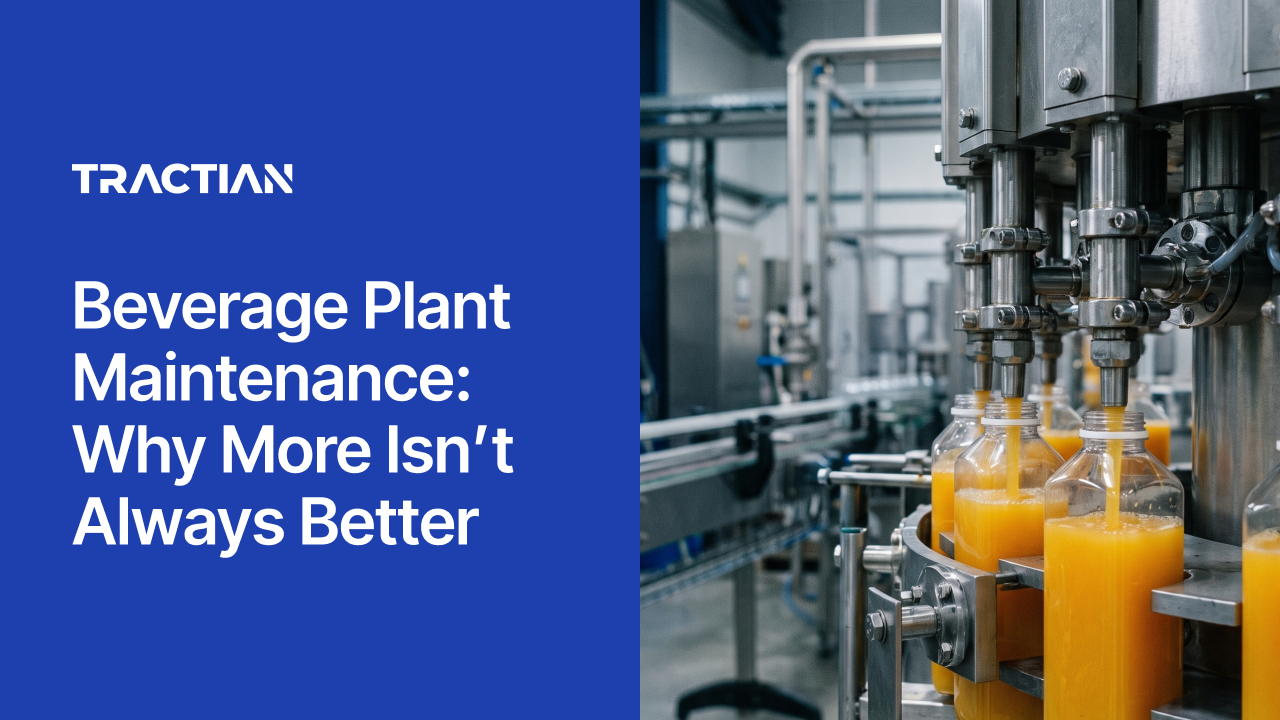
In most beverage plants, the filler stops at least once a day so someone can work through the grease points, and the line sits idle until they finish. Few teams could say with confidence that the machine needs lubrication that often, but nobody wants to be the person who skipped a round right before a bearing seized in the middle of peak season.
That instinct to treat extra maintenance as insurance came up repeatedly at a recent industry session, where two corporate maintenance leaders from a large, multi-plant bottler shared how they are rethinking reliability across their network. Their central argument was that extra maintenance often adds risk, because every time a team opens up a healthy machine, it creates a new chance for something to go wrong.
The approach they described offers a practical model for any beverage plant maintenance team trying to move from habit to evidence, and it started in the utilities room rather than on the filling line.
Start where one failure stops everything: utilities
The team's original plan was to begin condition monitoring on the filling lines, but that changed after a high-pressure air compressor failed and kept an entire plant offline for five days. In a beverage operation, high-pressure air feeds the blow molders that form PET bottles, so when that compressor goes down, bottle production stops and the fillers have nothing to fill. Low-pressure plant air usually has some redundancy built in, while high-pressure air frequently has no backup at all.
Utilities also proved to be a better place to learn. Any new monitoring program comes with a learning curve around where to mount sensors, how alerts get routed, and who is responsible for acting on them, and filling lines run too fast to work through those questions comfortably. Utilities equipment runs at a steadier pace, which gives the team room to refine the process before taking it to the lines.
For most beverage plants, utilities make a strong starting point. High-pressure compressors, chillers, and refrigeration systems are often single points of failure, the equipment is forgiving enough to let you fine-tune sensor placement and alert workflows, and one avoided compressor failure can make the case for the program to leadership.
The bathtub curve is only half the picture
Many beverage plants still run their critical assets on the calendar, so a compressor that reaches 8,000 hours gets its 8,000-hour service regardless of how it's actually performing. The trouble with that approach is that every intervention resets the bathtub curve. New parts, reassembly, and the ramp-up period that follows all bring a fresh window of early-life failures, which means pulling apart a healthy machine during the best stretch of its life can create the very problems the service was meant to prevent.
To avoid that, the team pairs the bathtub curve with the P-F interval, the window between the first detectable sign of a problem (P) and functional failure (F). One speaker compared it to the human body, where a fever and other symptoms show up well before a serious illness takes hold. Equipment behaves the same way and usually signals trouble long before it stops running.
The more failure modes you monitor through vibration, temperature, ultrasound, current, or pressure, the more precisely you can time maintenance within that window. Earlier in his career, one of the speakers cut bearing spend by about 70% in a single year at a plant with a harsh operating environment, simply by taking measurements before deciding to replace anything.
Calendar intervals also tend to run conservative because OEM manuals build in generous safety margins. Those margins protect the manufacturer, and they often lead plants to replace parts that still had plenty of useful life left.
Getting condition data into the work order
The team was clear that their biggest gains came from connecting condition data directly to their ERP, so that an alert becomes a notification, then a work order, and finally a planned job on the maintenance schedule. Without that connection, sensor readings tend to stay in a dashboard that only a handful of people ever check.
To make the data actionable, they assign every asset a health score and tie each range to a specific response:
These bands also changed how the team writes its maintenance plans, and the two compressors from earlier show how. For low-pressure plant air, where a backup is available, condition data can extend the time-based interval, so a compressor that still looks healthy at 8,000 hours can keep running before its service. For the high-pressure compressor that feeds blow molding, which has no backup, the scheduled service stays in place and condition monitoring runs alongside it, because a single slug of moisture can damage that compressor days after an overhaul.
Having the data also gives maintenance a stronger position in conversations with production. When production pushes back on a planned stop, or when maintenance wants to extend an interval, the team can point to the readings and show that the equipment is under control. As one speaker explained, the goal in those conversations is getting the best useful life out of the equipment, with cost as a secondary consideration.
The filler: rethinking the daily lube stop
Once utilities are under control, the filling line is the natural next step, although it brings a different set of challenges. High-speed rotary fillers can carry well over 100 filling valves, planned shutdowns are short, and the backlog of work waiting for those windows is long. With no time to inspect everything, the team needs to know exactly where to focus, which one speaker described as acting like a sniper who points the crew at the one spot that matters most.
Lubrication is the obvious place to begin. In Total Productive Maintenance (TPM), cleaning, tightening, and lubrication are considered the basics, and the speakers compared them to the morning cup of coffee that sets up the rest of the day. In beverage plants, though, lube schedules are mostly inherited habit, and many plants stop the filler every day to grease it without knowing whether that frequency is too high, too low, or about right.
Over-greasing creates its own problems, since technicians often keep pumping until grease comes out the other side, and excess lubricant can lead to failures just as easily as too little. Water adds another layer of risk. Rinsers, washdowns, and sanitation cycles put water all over a filling line, and water that works its way into gearboxes, servos, and bearings can cause serious damage that vibration readings may only pick up after the fact.
The team is adding ultrasound monitoring to address both issues. The decibel reading drops as grease reaches the bearing, which tells technicians when they've applied enough, and ultrasound can also flag water contamination before temperature or vibration shows any change. It also gives operators who take on lubrication through autonomous maintenance a way to confirm the job was done properly.
With that evidence in hand, the team aims to extend weekly PMs to every 10 or 15 days and move daily lube stops to every two or three days. On lines where nearly every case produced is a case sold, the recovered production time adds up quickly.
None of it works without people
Both speakers returned to this point more often than any other. A plant can have the sensors, the data, and a well-built plan, and the machine will still fail if the technician on shift isn't trained to act on the alert. With that in mind, the team trained more than 250 people across its plants to use the monitoring platform, since an alarm nobody is watching offers no protection at all.
They are also giving operators a bigger role. A skilled utilities operator can take three to five years to master the thermodynamics behind the job, so the team is using the readings operators already log at each shift handover to generate AI-driven recommendations. A high discharge temperature, for example, now comes with a specific next step such as cleaning the cooling tower, which helps newer operators build judgment much faster.
The speakers were also candid about the cultural side of this change. Most plants have veteran technicians who are used to doing things a certain way, and some still open up machines on a fixed schedule only to find everything in good condition. Shifting that mindset takes time, trust, and data that proves the new approach works, along with a shared sense that every person on the floor owns the equipment they run.
The right maintenance, at the right moment
In beverage, nearly everything a plant produces gets sold, so a line that goes down during peak season represents product that can't be made up later. The team credited their approach as part of what helped them reach record production volumes this year, and they are now working with OEMs so that new lines arrive with sensors already installed.
Doing the right maintenance at the right moment gives your crew back the hours they've been spending on work the machine never needed, and lets them put that time toward the problems that actually threaten uptime.
If your plant is still running maintenance on the calendar, let's talk about what condition-based maintenance could look like on your lines.