
Key Points
- A cellular gateway sends sensor data to the cloud over 4G/LTE, so the plant LAN and Wi-Fi stay out of the data path.
- Receiver count is set by walls, steel and distance between buildings, since one receiver can serve many sensors.
- IT still reviews security documents and the CMMS integration.
Condition monitoring without a plant network works by giving the sensors their own path to the cloud. Each vibration sensor talks to a nearby receiver over a short-range industrial radio, and the receiver forwards the data over a 4G/LTE mobile network. Plant Wi-Fi, Ethernet drops and OT switches are not part of that path.
This explainer is for the maintenance or reliability manager whose sensor project is stuck because the compressor house has no Wi-Fi or because IT will not add third-party devices to the OT network. It walks through the data path, shows the architecture, works out receiver placement for an example food plant and lists what IT typically still reviews.
Can you run condition monitoring without plant Wi-Fi?
Yes. Wireless condition monitoring systems that pair their sensors with a cellular-connected receiver send machine data off site without touching plant Wi-Fi or the plant LAN. The sensors need a receiver within radio range, and the receiver needs usable cellular signal.
This matters most in the areas Wi-Fi rarely reaches: a compressor room behind block walls, a tank farm at the edge of the property, a wastewater lift station or a boiler house with steel cladding. Running new access points or Ethernet to those spots often means a cabling quote, a change request and a wait in the IT queue.
A cellular design moves the conversation with IT from "can this device join our network" to "is this vendor's cloud secure enough for machine data." That second review is usually shorter, because the devices stay off the networks that carry PLCs, SCADA servers and office laptops.
How a cellular gateway moves sensor data
A cellular gateway system moves data in three hops: sensor to receiver over a local radio, receiver to cloud over 4G/LTE, and cloud to the maintenance team through an app, alerts and software integrations. Each hop has its own range, security and failure points.
Sensor to receiver: the local radio link
The sensor on the motor, pump or gearbox samples vibration and other signals, then sends the readings by radio to a receiver mounted somewhere in the building. Industrial systems tend to use sub-GHz radio here, because lower frequencies pass through concrete, machinery and pipe racks better than 2.4 GHz Wi-Fi or Bluetooth.
Tractian sensors use the 915 MHz ISM band with the IEEE 802.15.4g protocol, which is a standard for low-power, long-range wireless networks used in utility and industrial metering. The link between sensor and receiver is encrypted with AES at 256 bits.
Receiver to cloud: 4G/LTE backhaul
The receiver does the job a cellular gateway does in a typical IoT design: it collects radio traffic from nearby sensors and forwards it over a mobile network. In Tractian's system this device is the receiver, and it connects over LTE/4G mobile networks with no need for industrial Wi-Fi.
Because the uplink is cellular, the receiver has no reason to request an IP address on the plant LAN, a firewall rule or Wi-Fi credentials. What the receiver does need is cellular coverage at its mounting spot, which is worth checking with a phone on the same carrier before install day.
Cloud to your team: app, alerts and integrations
Once the data reaches the cloud, models analyze the vibration, ultrasound, temperature and RPM readings and raise alerts when a fault pattern appears. Planners and technicians see those alerts in the mobile app or web platform, and work orders can flow into the CMMS or ERP the plant already runs.
That last step happens in software. Tractian focuses on condition monitoring and AI asset health, and Tractian integrations with CMMS and ERP platforms connect it to tools such as MaintainX, Fiix, UpKeep, Limble, SAP and Oracle NetSuite. That connection is set up between the cloud platforms, so it is reviewed like any other cloud integration: accounts, permissions and which fields sync.
Architecture diagram: one plant, two networks
In a cellular design, the plant runs two networks side by side that stay separate: the plant LAN for PLCs, SCADA and office systems, and the sensor network that ends at the receiver and leaves the site over LTE. The diagram shows the path for three example assets.
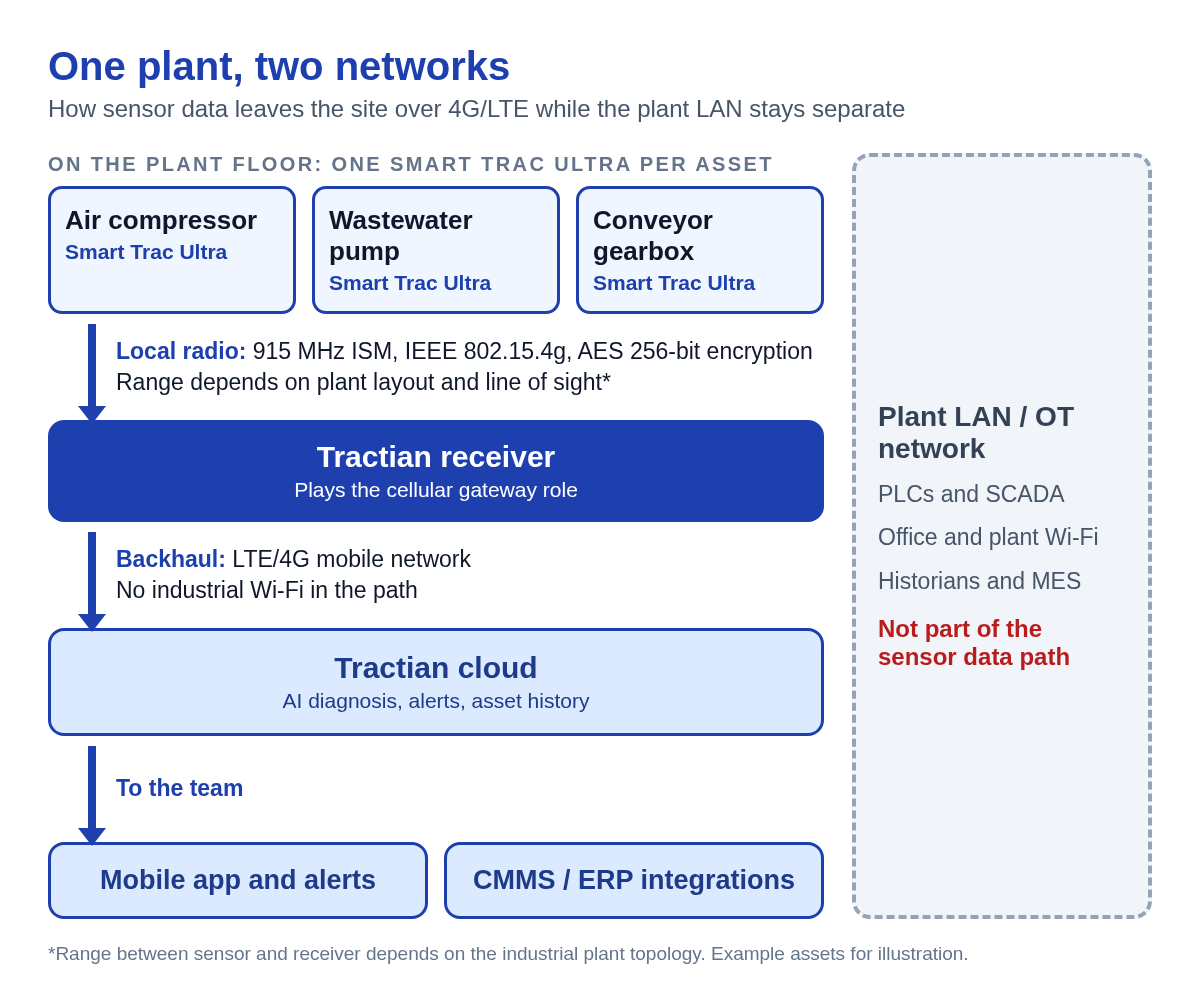
Two details in the diagram tend to matter to IT. First, the receiver has a cellular modem, not an Ethernet port into the plant LAN, so there is no bridge between the two networks. Second, the integration with the CMMS happens in the cloud, after the data has already left the site.
Range and placement: how many receivers a plant needs
Receiver count is set by distance and obstacles between the sensors and the receiver. How far a Tractian sensor can sit from its receiver depends on the plant layout and line of sight: walls, tanks and metal structures shorten the reach, and open sight lines extend it.
One Tractian receiver can serve many sensors, so in most mid-size plants the building layout decides how many receivers go in.
Here is a worked example for a food plant with three monitored areas. The layout and asset counts are illustrative; real numbers come from walking the site.
- Main production hall: 38 assets (mixers, conveyors, fans and pump motors), one Smart Trac Ultra per asset, spread over about 300 ft of open floor. One receiver mounted high near the center covers the hall within the indoor range.
- Compressor room: 5 assets (three rotary screw air compressors, a refrigerated dryer and a cooling tower fan), about 220 ft from the hall receiver through two block walls. Two masonry walls plus the compressor packages can weaken the signal, so plan a signal test before relying on the hall receiver.
- Wastewater area: 7 assets (lift pumps, a blower and two aerator gearboxes) about 900 ft away across the yard. There is a clear line of sight from the hall roof, but a parked trailer row or a new tank in the way would change that. A second receiver at the wastewater building removes the dependency.
The example comes to 50 sensors on two receivers, and the second receiver is there because of the distance to the wastewater area. Battery life also stays out of the placement math: Tractian sensors run on a lithium battery with a life of up to 5 years, so no power cabling is needed at the asset.
Learn more about wired and wireless monitoring trade-offs.
What IT still reviews
A cellular design shrinks the IT review, but IT typically still looks at data security, encryption, user access and software integrations.
| Item | Typically reviewed by IT? | Why it comes up in this plant |
|---|---|---|
| Port or IP address on the plant LAN | Not typically | Data leaves on the receiver's LTE/4G uplink, so no switch port, VLAN or DHCP reservation is requested. |
| Plant Wi-Fi credentials | Not typically | The compressor room and wastewater area have no Wi-Fi, and the sensors do not use it. |
| Firewall and outbound rules | Depends | Not needed for the sensor path; a CMMS hosted inside the corporate network may need an allowlist entry for the integration. |
| Vendor security documents | Yes | Machine data leaves the site, so IT asks for audit reports and certifications for the cloud platform. |
| Radio encryption | Yes | Security teams want to know whether traffic between sensor and receiver can be read by a nearby device. |
| App user access | Yes | Planners, technicians and contractors log in, so IT checks single sign-on, multi-factor authentication and roles. |
| CMMS or ERP integration | Yes | Work orders sync into the plant's maintenance system, which needs an integration account and agreed data fields. |
| Cellular devices on site | Depends | A few corporate policies list cellular modems as devices to register, even when they stay off the LAN. |
| 915 MHz radio use | Depends | Sites that already run license-free 900 MHz equipment, such as some wireless instruments, may track channel use. |
| Receiver mounting and power | Not typically (facilities) | Facilities or maintenance picks the spot on the hall roof and the wastewater building and confirms power there. |
For the security documents row, Tractian is ISO 27001 certified and SOC 2 Type II audited. For the access and encryption rows, the Tractian platform supports single sign-on, multi-factor authentication and role-based access controls, and data is encrypted in transit and at rest.
When a plant network still makes sense
A cellular design fits most plants that have usable mobile coverage, but some sites are better served by a wired or plant-network connection. These are the common cases.
- Weak or no cellular signal: underground mines, deep basements and remote pumping stations may not have a carrier signal strong enough for the receiver, and an external antenna or a different backhaul becomes part of the plan.
- Site policy on transmitters: some defense, pharmaceutical and secure government sites restrict cellular devices inside the fence, regardless of how the data is encrypted.
- Data that has to stay on site: plants with strict data residency or disconnected operations need a different deployment model. For these cases, Tractian offers FedRAMP High GovCloud, on-prem or edge, and air-gapped or disconnected options.
- Machine protection: turbines and large compressors with trip systems keep their hardwired protection monitors tied to the control system. Wireless condition monitoring sits alongside those systems as an early warning layer and does not replace a trip signal.
How Tractian sensors connect
Tractian sensors connect to a Tractian receiver over 915 MHz radio, and the receiver sends data to the Tractian cloud over 4G/LTE. Tractian wireless sensors install in minutes and send vibration, ultrasound, temperature and RPM data over 4G/LTE without plant Wi-Fi; IT still runs the security and integration review covered above.
- Install: Smart Trac Ultra mounts on one asset with adhesive or a drill-and-tap stud and goes live over LTE, with no plant Wi-Fi or wiring.
- Hazardous areas: the sensors are Class I Div 1 ATEX/IECEx/NFPA compliant and IP69K sealed, which suits washdown areas and classified zones in the same plant.
- Integrations: Tractian alerts reach the maintenance system planners already schedule repairs in, through the integrations described above.
- Electrical monitoring: plants that add Energy Trac for current, voltage and power factor get mechanical and electrical data on the same platform, where Janus, Tractian’s industrial AI, combines the two signal types into a single asset health view. Learn more about multimodal condition monitoring.
Pirelli's tire plant, with 2,800 people, uses this setup: its sensors run on 4G/LTE and connect directly to Tractian receivers, with no Wi-Fi or IT infrastructure involved. Sensors went in during scheduled preventive maintenance windows and planned production stops, and the program reached a 98% alert check-in rate with 77 failures identified across the asset base.
Plants with classified areas can compare hazardous location wireless condition monitoring systems side by side, and teams starting a wider evaluation can compare wireless condition monitoring sensors by range, battery and radio.
Frequently Asked Questions
Do wireless vibration sensors need plant Wi-Fi?
Not when the system uses a cellular-connected receiver. The sensors send readings by radio to the receiver, and the receiver uses a mobile network to reach the cloud. Systems whose gateways connect through plant Wi-Fi or Ethernet do depend on the plant network, so ask how the gateway reaches the internet before you buy.
What is IEEE 802.15.4g?
IEEE 802.15.4g is a wireless standard for low-data-rate, long-range networks, first written for smart utility meters. It runs in sub-GHz bands such as 915 MHz in North America, which travel farther through walls and machinery than 2.4 GHz signals. Condition monitoring sensors use it because short bursts of vibration data do not need Wi-Fi bandwidth.
Does a cellular gateway connect to the OT network?
A cellular gateway that uses LTE for its uplink does not need a connection to the OT network, so PLCs, drives and SCADA servers stay on their own segment. Some gateways on the market do offer Ethernet or Wi-Fi uplinks as an option. Confirm with the vendor which uplink is enabled on the units shipped to your site.
How many receivers does a plant need?
The site layout decides it, because one receiver can serve many sensors. Distance, masonry walls, steel structures and separate buildings set where receivers go, and a signal test on site confirms the plan. A compressor room or wastewater area in its own building often gets its own receiver even when it holds a few monitored assets.
Is cellular condition monitoring secure?
Security depends on how the radio link, the cellular uplink and the cloud platform are each protected. Look for encryption between sensor and receiver, encryption in transit and at rest in the cloud, and third-party audits such as SOC 2 Type II and ISO 27001. Tractian encrypts the sensor to receiver link with AES at 256 bits.
See How Tractian Would Connect Your Plant
Bring a site map with the buildings that have no Wi-Fi, such as the compressor room, tank farm or wastewater area, and a list of the assets in each. A Tractian specialist will walk through where receivers would sit, which items your IT team will want to review and what the sensors would catch on those machines. Book a Tractian condition monitoring demo to map receivers for your site.