
Key Points
- Industrial asset tracking software (of which you choose to deploy) determines whether a maintenance program is driven by a static registry or by real-time asset data.
- The strongest programs connect the asset record to multimodal condition data, AI diagnostics, and execution within a unified, closed-loop workflow.
- To fuel competitive advantage, the selected software (and corresponding infrastructure) should prioritize how it uses tracked data, not just whether it captures it.
- Asset tracking programs built from the ground up around sensing and diagnostics behave differently from CMMS-centric programs.
Evaluating Industrial Asset Tracking Software
Industrial asset tracking software is the system of record for the physical assets a company runs and depends on. The registry layer captures asset identity, hierarchy, location, lifecycle data, and maintenance history. The operational layer ties that record to real-time signals about how an asset is used, where it is, how it performs, and whether its condition is changing.
The strongest platforms synthesize these layers into a single workflow, where the registry is just the first step. In contrast, the weaker ones treat the registry as the destination, rather than the starting point. Such platforms leave everything that happens to the asset after it is logged on the table. There is a gap between capture and the operational realities that the data is meant to impact, resulting in delays, manual handoffs, and more.
Beyond platform differences, companies evaluating asset-tracking software tend to fall into two general buckets.
The first is CMMS-anchored platforms that handle the registry and lifecycle layers well and add real-time tracking through partner sensors, separate IoT products, or third-party integrations.
The second is closed-loop platforms that build multimodal sensing, AI fault diagnosis, and execution into the same architecture as the asset record.
The difference between these emerges operationally in what happens after a signal arrives. In the first bucket, a sensor reading typically becomes a threshold alert or a manually triaged ticket. In the second, it becomes a prioritized work order with diagnosis, severity, prescriptive guidance, and parts already attached.
What Should You Prioritize When Selecting Industrial Asset Tracking Software?
Asset tracking software is one of the few systems in which what seems like a basic data detection and capture decision actually ends up being the ceiling (self-imposed limitations) for an entire maintenance program.
Calendar-based scheduling, reactive maintenance, manual triage, and disconnected reliability data all trace back to whether the asset record is the destination or the starting point of how a facility manages equipment. The four priorities below distinguish platforms that capture asset data from those that turn it into an operational advantage.
- Closed-loop architecture across sensing, diagnosis, and execution. Asset tracking software should connect the asset record to real-time condition data and to maintenance execution natively, not through bolt-ons that surface later as integration burden, data fidelity gaps, and workflow seams as the program scales.
- First-party multimodal sensing for high-confidence diagnostics. Tracking what an asset is actually doing requires more than a single data type. Multi-modal sensors that combine vibration, ultrasound, magnetic field, and temperature provide fault detection coverage and diagnostic specificity that single-parameter IoT sensors and threshold-only alerts cannot match.
- AI fault diagnosis trained on the sensor signal itself. Predictive intelligence built on maintenance history alone has a different ceiling than intelligence built on the raw signal. Look for AI that classifies specific failure modes from sensor data, not just AI that recommends PM frequency changes based on historical patterns.
- CMMS-agnostic execution and integration. The strongest platforms work with whatever CMMS a company already runs, via APIs, SQL connectors, and custom integrations, rather than locking diagnostic intelligence into a single ecosystem or forcing a full system migration.
How Do Maintenance Programs Benefit From Industrial Asset Tracking Software?
When asset tracking software does its job, maintenance teams stop spending their days reacting to ambiguity. The asset registry ceases to be a static reference and becomes the live spine of every reliability and execution decision in the plant. The benefits that follow are the operational consequences of building the program on accurate, real-time, decision-ready data rather than on logs, schedules, and after-the-fact reports.
- Priority decisions based on asset criticality. Reliability engineers, planners, and managers can see what is actually happening with each asset in real time. Strategy decisions, capital decisions, and prioritization decisions move from gut and history to data and evidence.
- Backlogs ordered by condition, not by date. Work orders for assets trending toward failure rise to the top of the schedule. Calendar-based maintenance gives way to condition-based execution without the team having to manually retriage.
- Higher first-time-fix rate and lower MTTR. When a work order arrives with diagnosis, severity, prescriptive guidance, parts, and asset history already attached, the time spent diagnosing on the floor and returning for parts shrinks (see this in action).
- Reduced dependency on tribal knowledge and specialist labor. AI fault diagnosis, asset health monitoring, and prescriptive procedures shift more of the analytical work into the system. Teams scale coverage and depth without scaling headcount or hunting for retiring vibration analysts.
- Visibility that holds up to leadership scrutiny. Plant managers and reliability leads can answer questions about availability, MTBF, MTTR, planned-versus-reactive ratios, and ROI without manual report-building.
Industrial Asset Tracking Software at a Glance
| Capability | Tractian | UpKeep | Fiix | eMaint | Limble |
|---|---|---|---|---|---|
| First-party condition monitoring sensors | ✓ | ✓ | ✓ | ✓ | ✕ |
| Multi-modal sensor (vibration plus ultrasound, magnetic field, and temperature in a single device) | ✓ | ✕ | ✕ | ✕ | ✕ |
| AI fault diagnosis classifying specific failure modes from sensor signal | ✓ | ✕ | ✕ | ✓ | ✕ |
| Native predictive AI engine | ✓ | ✕ | ✓ | ✓ | ✕ |
| Mobile-native technician execution as the primary interface | ✓ | ✓ | ✕ | ✕ | ✓ |
| CMMS-agnostic intelligence (condition data flows into any CMMS) | ✓ | ✕ | ✕ | ✕ | ✕ |
Top Industrial Asset Tracking Software
The following is a review of five top providers evaluated against the factors we’ve previously discussed, including a brief company review, notable features, and potential downsides.
Tractian
Best for: Industrial companies that want real-time, multimodal condition data directly tied to AI fault diagnosis, prescriptive guidance, and maintenance execution, with the flexibility to feed this intelligence into an enriched CMMS for a unified workflow.
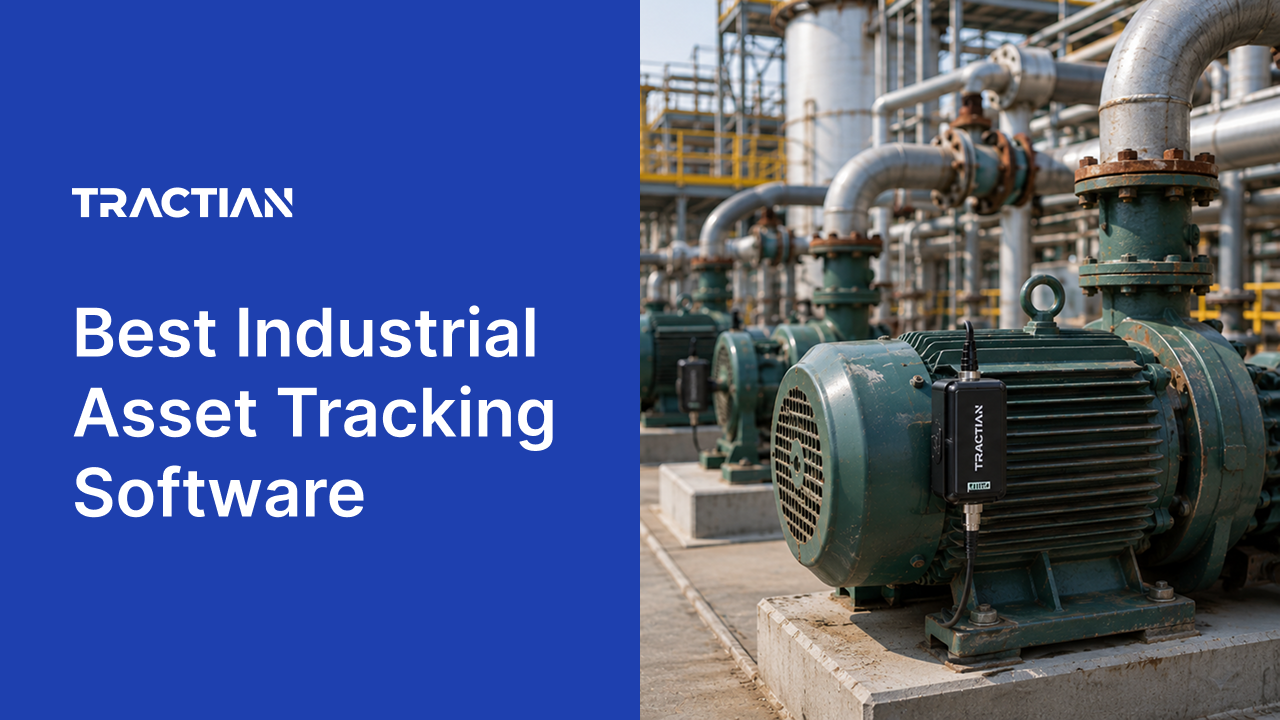
Tractian's industrial asset tracking is built around a closed-loop architecture. The Smart Trac sensor captures vibration, piezoelectric ultrasound, magnetic field for RPM, and temperature in one device, and the platform turns that data into specific failure mode diagnostics covering all major conditions, including bearing wear, misalignment, cavitation, lubrication issues, and electrical faults. Every diagnosis arrives with severity, recommended procedures, parts, and asset context attached. The asset record, the condition signal, the diagnostic, and the maintenance action live in the same system rather than in separate platforms wired together after the fact.
At the execution layer, Tractian is CMMS-agnostic. Condition-validated insights and prescriptive next steps flow into software already in use. There’s no need to rip and replace existing platforms. Monitor, diagnose, prioritize, and execute become one continuous workflow rather than three disconnected handoffs.
Tractian’s AI condition monitoring is trained on more than 3.5 billion samples collected globally, and Tractian's recently revealed AI research and development lab signals continued investment in the platform's diagnostic advantage (learn more about the engineering behind it).
Notable Features
- Multi-modal sensing with patented AI fault detection. The sensor combines vibration, ultrasound, magnetic field, and temperature in one device, and the platform's AI maps the signals to more than 75 specific failure modes using patented algorithms.
- Always Listening for intermittent and variable-speed machines. A motion-detection mode samples vibration data at precisely the right moment for machines that cycle on and off, and the proprietary RPM Encoder algorithm dynamically adapts its analysis for variable-speed equipment without external tachometers.
- CMMS-agnostic execution layer. Tractian connects condition data, diagnostics, and prescriptive guidance to any CMMS software to automate work orders, generate AI-generated SOPs, manage parts inventory, enable offline access, and enable real-time team communication. There is no synchronization layer between condition data and the work backlog because they share a single system.
- Prescriptive Procedures Library and Asset GPT. Every alert includes validated maintenance procedures, troubleshooting guidance, and OEM-recommended actions, and Asset GPT auto-completes asset specifications from a database of more than 6 million motors and 70,000 bearing models.
- Mobile-app Workforce Tools. Tractian sensors monitor your assets 24/7, detect failure signals before they become breakdowns, and send a ready-to-act work order straight to your technician's mobile CMMS app.
What Industries are Using Tractian's Industrial Asset Tracking Software?
Tractian's condition-driven asset tracking is deployed across Food and Beverage, Automotive, Chemical, Mining, Mills and Agriculture, Oil and Gas, Manufacturing, and Heavy Equipment facilities. Customers on the condition monitoring page include Weyerhaeuser, Berry, In-N-Out, Cargill, Carrier, Kraft Heinz, OneSubsea, Hyundai, Quaker, CP Kelco, CAT, Voestalpine, Owens, and LDC.
UpKeep
Best for: Maintenance teams that want work order execution across mixed asset portfolios, multi-site facilities, with IoT condition monitoring.
UpKeep provides an asset registry, hierarchy, work order management, preventive maintenance scheduling, parts and inventory tracking, and mobile-native execution with barcode scanning for asset access. The platform includes an AI assistant that performs background monitoring of CMMS data, generates work order summaries, and provides voice-first field access for technicians.
The architectural pattern places condition monitoring on a separate product surface from the core CMMS. The IoT line is purchased and deployed as a distinct product with its own dashboard, hardware, and configuration surface.
Notable Features
- Mobile with offline access. iOS and Android apps support offline work order completion, barcode and QR asset access, and inventory management at the point of work.
- AI assistant. The assistant runs background monitoring on CMMS data, autogenerates work order summaries and checklists, and provides voice-first field interactions for technicians.
- Threshold-based work order generation: Work orders fire automatically when meter readings or asset status values cross a configured threshold.
Potential Downsides
As of June 2026:
- Meter-and-threshold condition triggering: PMs fire when values cross configured thresholds. Interpretation of what those values indicate about the asset's underlying failure mode is handled outside the platform.
- Sensing and diagnostic layer through integration: Continuous condition monitoring with AI-driven failure detection is delivered through integration with external sensors and diagnostic software.
- Failure-mode diagnosis through external systems: Diagnosing specific failure modes from continuous machine signal data is provided via integration with external sensing and analytics systems, rather than as a native capability.
Fiix
Best for: Mid-sized to enterprise industrial teams, particularly those operating in or adjacent to the Rockwell Automation ecosystem, that want cloud-based PM scheduling, multi-site management, and the option to add intelligence as a separate module.
Fiix is a cloud-based CMMS platform owned by Rockwell Automation. It provides an asset registry with parent-child hierarchy, unlimited records, QR and barcode scanning, downtime tracking, work order management, preventive maintenance scheduling with multiple trigger types, and parts inventory with cycle counts and forecasting. A historical maintenance AI engine analyzes work order data, forecasts parts demand, and recommends PM frequency optimizations. A third-party partnership extends asset tracking into condition-based triggers for Rockwell-equipped facilities.
The condition data path is most direct inside the Rockwell ecosystem, where the CMMS and the automation infrastructure share a parent company. Outside that ecosystem, the lift required to bring sensor signals into the platform rises, and the diagnostic depth that flows back depends on what the connected hardware can produce. The AI engine is built primarily on maintenance history pattern analysis. The strongest fit is the mid-sized manufacturer with an existing Rockwell footprint.
Notable Features
- Asset Registry. The platform supports unlimited assets with parent-child hierarchy, downtime tracking, rotating assets, and QR or barcode access for technicians at the point of work.
- Historical PM optimization. The AI layer analyzes work order history, suggests PM frequency adjustments, forecasts parts demand, and identifies recurring breakdown patterns.
- Rockwell ecosystem. Enables condition-based triggers from PLCs and Rockwell infrastructure to flow into CMMS work orders.
Potential Downsides
- Condition-monitoring depth is tied to the Rockwell ecosystem. The sensor-to-work-order path increases the integration burden for facilities that run mixed or non-Rockwell hardware.
- Predictive intelligence centers on analyzing maintenance history patterns. The AI engine focuses on PM optimization and forecasting from historical work order data rather than on classifying specific failure modes from real-time sensor signals.
eMaint
Best for: Teams operating within the Fluke Reliability ecosystem who want a CMMS that connects to Fluke vibration sensors and AI vibration analytics.
eMaint is Fluke Reliability's CMMS. The connected reliability solution integrates multiple acquired brand lineages, resulting in a platform that includes eMaint CMMS with eMaint Condition Monitoring software, Fluke wireless IIoT sensors, and an AI vibration analytics platform.
The sensor-and-software stack is assembled from multiple integration paths, rather than being designed as a single closed-loop architecture from the ground up. AI fault detection sits in a layer that was integrated via a separate company's analytics platform. Evaluators may want to consider how a stack with multiple integration points compares against a single platform that runs sensing, AI, and execution natively.
Notable Features
- Configurable CMMS. Customizable forms, approval flows, asset hierarchies, dashboards, and reporting align the platform to specific documentation and audit requirements in regulated environments.
- Native condition monitoring. Fluke wireless sensor data and SCADA inputs feed into the platform, with AI-driven vibration diagnostics from Azima DLI integrated as Watchman Services for fault detection.
- Multi-stockroom inventory and compliance. Parts inventory tracks across unlimited stockrooms with auto-reorder and vendor management, and the work order audit trail supports FDA 21 CFR Part 11, IATF 16949, GMP, and ISO 9001 documentation needs.
Potential Downsides
- Sensor-to-software architecture. The hardware, the analytics, and the CMMS came together through corporate consolidation rather than as a unified product design.
- Value depends on a Fluke-aligned sensor strategy. The most direct sensor integration path runs through Fluke's hardware lineup. Mixed sensor environments rely on SCADA, PLC, or other third-party connections to bring data into the platform.
Limble
Best for: Small- to mid-sized maintenance teams that want a mobile-first CMMS with strong scheduling, work order, and asset record workflows.
Limble provides asset tracking with visibility into location, current condition, and usage status. PM scheduling based on asset usage or fixed intervals, work order management, parts inventory, and a mobile app with offline mode, QR code scanning, and photo attachments. Customizable dashboards and reporting offer visibility into asset utilization and maintenance costs.
Real-time condition data on the platform depends on third-party sensors and integrations rather than first-party hardware and diagnostics. The platform integrates third-party IoT and analytics layers for real-time condition data and fault detection, rather than relying on native sensor hardware, multi-modal fault classification, or a proprietary fault library trained on first-party signal data.
Notable Features
- Mobile-first workflow. The mobile app supports offline access, QR code asset scanning, photo attachments, and work order completion at the point of work, with automatic sync when connectivity returns.
- Customizable dashboards. Asset records carry location, condition, and usage data, and dashboards can be tailored to surface asset utilization, maintenance cost, and downtime metrics for specific roles.
- IoT integration paths. The platform integrates with third-party IoT sensors and ERP systems to enable condition-based triggers, and the Aveva partnership extends the predictive maintenance integration options.
Potential Downsides
- No first-party sensor or condition monitoring hardware. Real-time condition data requires engaging a third-party sensor vendor, which adds a procurement decision, a separate vendor relationship, and an additional integration layer to maintain.
- Predictive intelligence is integration-dependent. Fault detection depth and diagnostic specificity reflect the capabilities of the connected sensor and analytics layer rather than a unified platform that owns the signal end-to-end.
- Procedures are manually authored. Standard operating procedures and work order checklists rely on internal authoring rather than on AI-generated guidance from historical failures, OEM documentation, or technician input.
Frequently Asked Questions about Industrial Asset Tracking Software
How do I evaluate whether a platform's AI is doing actual fault diagnosis or just threshold alerts wrapped in AI language?
Ask for the specific list of failure modes the system classifies, such as bearing wear, misalignment, cavitation, lubrication failure, and rotor bar damage. Ask whether each alert includes severity, recommended procedures, and parts requirements. Threshold-based platforms typically tell you that a value crossed a limit. Diagnostic platforms identify what the signal pattern means and what to do about it. The vendor's documentation should name the specific signatures the AI detects, not just describe the AI in generic terms.
How do I evaluate whether an asset-tracking platform will integrate cleanly with my existing CMMS without requiring a migration?
Confirm the platform is CMMS-agnostic in architecture, not just in marketing. Ask for documented integrations with your specific CMMS, including SAP PM, IBM Maximo, MaintainX, or whatever else your facility runs. Verify the integration is supported by pre-built connectors or open APIs rather than service-billed custom work. Ask the vendor to walk through exactly how condition data, diagnoses, and prescriptive next steps land inside your existing work order workflow without disrupting it.
What is the practical difference between a platform with first-party sensors and a platform that integrates with third-party sensor vendors?
First-party means single vendor accountability, unified data fidelity, integrated firmware and AI updates, and a tighter loop from signal to diagnosis. Third-party means flexibility on hardware but adds a separate procurement decision, a vendor relationship to manage, and an integration layer that has to stay in sync as either side updates. The architectural seam shows up in year 2 or 3, when the sensor vendor changes firmware, the analytics layer changes API, or the CMMS adds a feature that the integration does not support.
How do I evaluate whether a platform's "predictive AI" actually predicts failures or just optimizes scheduling?
Ask what data the AI engine analyzes. AI built primarily on maintenance history, including work orders and breakdown patterns, optimizes when to perform work. AI built on real-time sensor signal classifies what is happening to the asset and what specific failure mode is developing. Both have value. They are not the same capability. If a vendor markets "predictive AI" and the engine is fundamentally a work-order history pattern analyzer, you are buying scheduling optimization, not failure prediction.
For a multi-site operation in which each plant runs a different CMMS, what should I prioritize during the evaluation?
A unified condition data and diagnostic layer that sits across sites independently of which CMMS each site runs locally. Ask whether the platform supports SAP at one site, Maximo at another, and an in-house CMMS at a third, without forcing the corporation to standardize. Ask whether reliability leadership can benchmark similar assets across sites in one view, regardless of the underlying CMMS. The point of asset tracking at a multi-site scale is comparability, and that breaks when condition data is locked inside each site's CMMS.
How do I validate vendor ROI claims during a pilot rather than relying on case studies?
Tie pilot KPIs directly to the claimed benchmarks. For a 3-month payback claim, define which specific costs are being measured against what baseline, including downtime hours, emergency repair labor, and expedited parts. For availability or MTBF claims, run the pilot on assets with historical data to ensure the comparison is valid. Ask the vendor to commit to the metric structure before the pilot starts. A vendor that cannot articulate what the pilot will measure is signaling that the ROI claim is positioning rather than a number you can defend internally.
