
Key Points
- Multimodal AI's competitive value for maintenance teams comes from the modalities the AI reasons across natively, not from AI branding on top of existing analytics. The stronger platforms build multimodal input into the architecture.
- The strongest platforms produce named diagnostic output (specific failure modes with severity and prescriptive procedures), not just anomaly detection or generative summaries of what changed. This determines whether the AI reduces the maintenance team's workload or shifts it into interpreting AI output.
- Decision-grade multimodal AI closes the loop from sensing through diagnosis to execution as a unified workflow, whether inside a single platform or through an intelligence layer that enriches an existing one. Programs that must choose between the two often benefit most from vendors who can support both modes.
- Ongoing AI research investment distinguishes vendors that treat AI as an inherent capability from those that treat it as a marketing layer. For maintenance programs that commit to a platform over multiple years and whose downstream production depends on the AI actually improving, evidence of dedicated in-house research is a reasonable priority.
The Value of Multimodal AI for Maintenance Teams?
Multimodal AI for maintenance teams combines multiple streams of input data under a single intelligence layer that turns raw signals into decisions. In practice, that means the AI does not operate on one signal in isolation. It correlates multimodal sensing streams (vibration, ultrasound, magnetic field, temperature, thermography) with execution history (work orders, procedures, technician notes), asset context (RPM, load, ambient conditions, criticality), and captured field input (voice, images, scans) to determine what is happening on a machine and what should happen next.
Teams evaluating multimodal AI should expect the AI to do more than surface anomalies or generate summary text. Stronger AI technology can also produce named diagnoses, prioritized work, and prescriptive next steps that reach the floor without manual translation.
Multimodal AI has widened faster than its language has clarified. Now it describes platforms that reason across genuine sensing modalities and platforms that layer generative AI over CMMS text and image inputs. Capability gaps show up when a maintenance team asks the platform what is wrong with a specific machine rather than what changed.
Platforms whose AI is trained on real industrial sensing data at scale and whose sensing layer is engineered as an inherent part of the same architecture produce named failure modes with severity ratings and prescriptive procedures. Platforms where the AI operates over CMMS-side inputs and third-party sensor integrations produce recommendations shaped by whatever those integrations expose. Both are valid, but the right choice depends on what work a maintenance program wants the AI to achieve.
What Should You Prioritize When Selecting Multimodal AI for Maintenance Teams?
A comprehensive multimodal AI capability is what determines whether a maintenance program produces trusted decisions at scale or generates a broader flow of information that still requires manual interpretation. The strongest programs treat multimodal AI as a decision engine that reasons across sensing, execution, and asset context as one system, rather than as a set of AI-branded features distributed across otherwise disconnected tools.
What to prioritize when your program's competitive advantage depends on the AI actually working.
- Native depth across the modalities the AI reasons over. The AI's usefulness is bounded by the modalities it can reason across natively. Platforms that own the sensing layer (vibration, ultrasound, magnetic field, temperature) and pair it with execution history and asset context produce a fuller picture than platforms whose sensing arrives through third-party integrations.
- Decision-grade diagnostic output. Named failure modes with severity ratings and prescriptive procedures move a program forward. Anomaly flags and generative summaries of what changed leave the diagnostic work to the team.
- Unified workflow from detection through execution. Detection, diagnosis, prioritization, prescription, and work order execution moving as a single continuous flow, whether within a single platform or as a diagnostic layer feeding an existing CMMS, removes handoff loss without forcing a rip-and-replace.
- Serious, ongoing AI research investment. In a category where "AI" is being added as a marketing layer, real in-house AI research signals that the diagnostic intelligence a buyer commits to today will continue to improve three years from now. For multi-year decisions where downstream production depends on the AI, this matters.
What Are the Practical Benefits of Multimodal AI for Maintenance Teams?
Multimodal AI earns its place when the practical consequences show up in how the team spends its time and how confident it is in the calls it makes. Teams that adopt a decision-grade multimodal AI platform tend to see the operational reality shift across five specific dimensions, all of which stack on one another over time.
- Fewer surprise breakdowns. Continuous multimodal awareness catches faults that single-modality monitoring misses, including friction and early-stage bearing wear, detected by ultrasound before they appear in vibration, and lubrication issues, detected by correlated signals before they show up in temperature alone.
- Cleaner priority calls. When the AI reasons across sensing, execution history, and asset criticality, the backlog reorders around what is actually most at risk rather than what is next on the calendar. Planners spend less time relitigating priorities and more time scheduling.
- Less dependence on scarce vibration and reliability experts. The AI absorbs interpretive work that historically required a seasoned analyst to convert spectra and trend patterns into a named diagnosis. Lean teams get broader coverage without a proportional increase in expertise.
- Faster diagnosis-to-fix cycles. Prescriptive maintenance instructions arrive attached to the alert, with severity, root cause, and the recommended procedure. Technicians walk to the machine already knowing what to do rather than starting the investigation on arrival.
- Less alert fatigue and fewer false positives. Correlated multimodal signals reduce the noise of any single modality read in isolation. Alerts that reach the team have already passed multiple internal checks, so the team's trust in the signal builds instead of eroding.
Multimodal AI Solutions at a Glance
| Feature | Tractian | UpKeep | Limble | Fiix | IFS Cloud |
|---|---|---|---|---|---|
| First-party sensor product for condition monitoring | |||||
| CMMS-agnostic AI intelligence layer | |||||
| AI extracts from OEM or technical manuals | |||||
| Conversational AI GPT/Copilot | |||||
| Ultrasound and vibration captured in single sensor |
Top Multimodal AI Solutions for Maintenance Teams
The following is a review of five top providers evaluated against the factors we’ve previously discussed, including a brief company review, notable features, and potential downsides.
Tractian
Best for: Reliability leaders and maintenance managers in asset-intensive environments who want decision-grade multimodal AI running across sensing, diagnosis, prioritization, and execution, whether adopted as a unified Tractian workflow or as an intelligence layer enriching an existing CMMS.
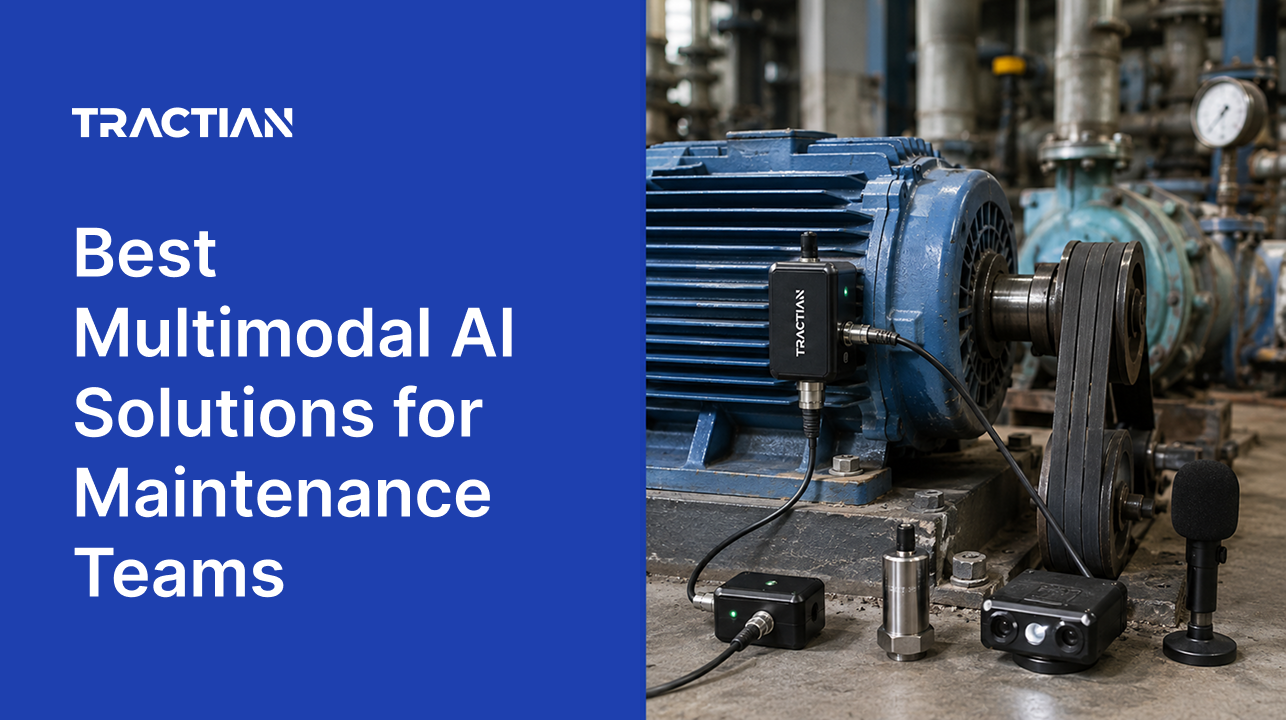
Tractian combines the multimodal Smart Trac sensor with an AI-powered condition monitoring platform trained on more than 3.5 billion samples from hundreds of thousands of monitored assets. A single Smart Trac device captures vibration, ultrasound, magnetic field, and temperature at one measurement point on the machine, and the platform's Auto Diagnosis correlates those signals with asset context (RPM, load state, ambient temperature, criticality) to identify more than 75 failure modes. Alerts arrive as named diagnoses with severity ratings and attached prescriptive procedures, not as raw spectra or threshold flags.
Diagnostic output flows directly into work order execution. Teams that adopt Tractian's full workflow get the closed loop inside a single AI-powered platform that includes CMMS, APM, and mobile execution. Teams that keep their existing CMMS get a Tractian-enriched CMMS approach, in which condition data, AI diagnostics, predictive analytics, and prescriptive guidance flow into any platform through APIs, SQL connectors, and named prebuilt integrations. The intelligence layer is the same in both modes. What differs is whether the customer wants the execution surface consolidated or the diagnostic layer added on top of what they already run.
Notable Features
- Multimodal Smart Trac wireless sensor: Vibration, ultrasound, magnetic field, and temperature captured from a single point on the machine in one IP69K-rated, ATEX/IECEx-certified device with a three-year battery life and built-in 4G/LTE connectivity, removing dependency on plant Wi-Fi. See the multimodal sensor walkthrough or Can Vibration and Ultrasound in One Sensor Redefine Predictive Maintenance?.
- AI Auto Diagnosis: Patented fault-finding algorithms convert vibration spectra and correlated multimodal signals into named diagnoses across 75+ failure modes, with severity ratings and validated maintenance procedures attached to each alert from a Procedures Library.
- Tractian Labs: A dedicated AI research and development lab that continues to advance the proprietary models behind Auto Diagnosis, Asset GPT, and the platform's other AI capabilities. When "AI" is often marketing on top of existing analytics, an in-house research organization signals ongoing investment in the diagnostic intelligence customers depend on. Watch Inside Tractian: AI for Condition Monitoring for the operating logic behind that investment.
- Tractian-enriched CMMS: Condition data, failure-mode diagnoses, and prescriptive next steps flow into whatever CMMS a plant runs, either natively through Tractian's own execution layer or via APIs, SQL connectors, and named integrations with platforms including SAP and IBM Maximo. Reliability programs upgrade without a migration.
- Patented sensing envelope: Always Listening samples intermittent machines at the exact operating moment. RPM Encoder tracks variable-speed equipment from 1 to 48,000 RPM without an external tachometer. Ultrasync correlates signals across multiple sensors on the same asset for higher-fidelity diagnostics.
What Industries are using Tractian's Multimodal AI?
Tractian supports maintenance teams across Manufacturing, Automotive, Food and Beverage, Mining, Chemicals, Oil and Gas, and Mills and Agriculture, as well as Heavy Equipment, Fleet, and Facilities operators.
The customer roster includes Kraft Heinz, Ingredion, Cargill, Carrier, Whirlpool, Kubota, In-N-Out, CP Kelco, Hyundai, and CSX, among others, across asset-intensive industries where multimodal AI must hold up under demanding operating conditions and against real production consequences.
UpKeep
Best for: Maintenance teams running work order execution on mobile devices across mixed-asset portfolios, with condition monitoring available through a separate sensor product within the same family.
UpKeep approaches AI from the work order side of the floor. Its AI is built to move administrative work faster, drafting and closing out orders, handling voice and image input, and tightening schedules, which is useful but sits a step away from reading what a machine is actually doing. Condition sensing exists, yet it runs as a separate product from the AI that acts on it, so the signal and the intelligence meet at a seam rather than within a single system.
On platforms where the sensing layer is a separate product from the CMMS-side AI, the depth of the AI's conclusions about a specific asset's condition depends on how the products connect. The sensor side is documented to sort readings into threshold states rather than to name a failure mode and rate its severity, leaving the interpretation of a reading into a diagnosis in the technician's hands rather than the AI's. For a team that wants the AI to say what is wrong and how urgent it is, they’ll need to take a close look at the impact they're hoping to achieve in their workflow.
Notable Features
- AI agent: A background agent that surfaces recommendations for approval and supports voice access for creating work orders and pulling up asset history.
- Mobile work order execution: iOS and Android apps handle work order completion, barcode and QR asset access, and inventory at the point of work, including offline.
- Edge IoT sensor product: A separate first-party sensor line covering temperature, humidity, current draw, vibration, and pressure that feeds the asset record and triggers work orders against defined thresholds.
Potential Downsides
As of July 2026:
- Condition monitoring on a separate product surface: The IoT sensing line is a distinct product from the core CMMS, so sensor data and the platform's AI meet through cross-product coordination rather than one native architecture.
- Threshold-based sensor alerting: The documented alerting model sorts readings into threshold states rather than producing named failure modes with severity as diagnostic output.
- AI oriented toward administrative acceleration: The documented AI set centers on work order generation, voice transcription, image recognition, and scheduling rather than diagnostic reasoning across sensing modalities.
Limble
Best for: Maintenance and asset management teams that want a CMMS with AI for setup and administrative workflows, where predictive maintenance runs through integration with third-party IoT sensors.
Limble treats AI as an extension of a well-run CMMS. The AI it leads with is aimed at getting a program set up and administered faster, building schedules, planning workloads, and turning photos and manuals into clean asset records. Machine condition, though, enters through third-party sensor integrations rather than a sensing layer of its own, so whatever the AI can reason about is set by the hardware a facility bolts on.
The consequence is that the multimodal part of the story belongs to the buyer as much as it does to the platform. When sensing is sourced and standardized outside the system, the depth of any condition conclusion follows what those integrations happen to expose. A facility standardizing on AI as its decision engine ends up leaning on inputs the platform itself does not provide.
Notable Features
- AI PM Builder: Reads asset manuals and drafts preventive maintenance schedules from their contents.
- Resource Planning: AI-assisted workload allocation and scheduling recommendations across the maintenance team.
- Asset Snap: Turns equipment photographs into structured asset records in the platform.
Potential Downsides
As of July 2026:
- No first-party sensing layer: Predictive maintenance relies on integration with third-party IoT sensors rather than a first-party multimodal device, so the modalities the AI reasons across are determined by the sensors the customer connects.
- AI oriented toward administrative acceleration: The documented AI features focus on drafting schedules from manuals, planning workloads, and structuring asset records rather than on diagnostic reasoning over sensing streams.
- Buyer-assembled condition signal: Because condition monitoring is integrated rather than a native input, the reasoning's multimodal quality is inherited from the customer's sensor choices and data standardization.
Fiix
Best for: Manufacturing teams, especially those already running Rockwell Automation infrastructure, that want a CMMS with AI analytics on work order history and a predictive maintenance product available as a separate add-on.
Fiix builds its intelligence mostly out of the maintenance record. Its AI looks across work order history to surface patterns and forecast parts and schedules, which is real value, though it reasons from what a facility has already logged rather than from live machine signals. Predictive maintenance on condition sits next to that as a separate piece, so a single stream from sensing to diagnosis to work order is something a facility assembles rather than switches on.
The predictive layer can feed other maintenance systems, so the platform is not tied to one CMMS, but its cleanest path from a machine signal to a work order runs through Rockwell's own automation stack. That makes the tightest version of the story hold best for plants already standardized on that ecosystem. For anyone outside it, how much of the advantage travels is the open question.
Notable Features
- Fiix AI: An AI analytics engine that identifies patterns in work order history and forecasts parts needs and PM frequency.
- Asset risk: A separate AI predictive maintenance product that operates on asset data and can integrate with any CMMS or EAM.
- FactoryTalk integration: Machine signals from Rockwell's automation ecosystem can directly trigger Fiix work orders.
Potential Downsides
As of July 2026:
- AI focused on records and asset data: The core AI analyzes work order history and forecasts on data the customer feeds in, so the multimodal element of its reasoning is inherited from the data already feeding the platform rather than from a sensor the AI reads directly.
- Predictive maintenance as a separate product: The predictive capability is a distinct add-on rather than an inherent function of the CMMS AI, so a single integrated workflow is assembled across two products.
- Tightest signal path tied to the Rockwell ecosystem: The most direct signal-to-work-order integration runs through the parent's own automation stack, so the closest coupling applies within that environment.
IFS Cloud
Best for: Companies that want an ERP and EAM platform with AI embedded across finance, HCM, procurement, manufacturing, and asset management, where predictive maintenance is one capability inside a broader system of record.
IFS Cloud approaches AI from the opposite end from Fiix. It’s a broad platform where AI is spread across many parts of the business, with maintenance being one room in a larger building. Predictive maintenance here runs as anomaly detection and forecasting over data a facility routes into the platform, not over a sensing layer the platform supplies, so the modalities available for a condition call are whatever the buyer connects.
An AI stretched across a whole business carries a different center of gravity than one built around reliability alone. On the maintenance side, it arrives as an assistive, copilot-style layer that helps people move through their work, and the depth of any condition conclusion follows the sources feeding it. For a team whose entire priority is decision-grade condition intelligence, the depth that counts lies within a unified workflow where handoffs and manual interpretations are minimized.
Notable Features
- Copilot: Embedded across modules, with support for FMECA analysis, work order execution, service report summaries, and 3D asset visualization.
- Data Foundation predictive maintenance: Anomaly detection and time-series forecasting run over data consolidated in the platform's Data Foundation.
- Digital Workers: Agentic AI that can execute multi-system workflows across the platform.
Potential Downsides
As of July 2026:
- AI spreads horizontally across the ERP: IFS.ai spans finance, HCM, projects, procurement, manufacturing, and asset management, so the maintenance-focused features operate within a broadly oriented architecture.
- No first-party sensing layer: Predictive maintenance relies on anomaly detection and time-series forecasting over data the customer supplies to the Data Foundation, so the available modalities depend on the connected sources.
- Assistive AI model: The maintenance AI is delivered through Copilot-assisted FMECA, anomaly detection, and agentic Digital Workers, an assistive model that supports people across workflows.
Frequently Asked Questions About Multimodal AI Solutions for Maintenance Teams
What makes an AI capability actually multimodal for a maintenance team, versus AI branding on top of a maintenance platform?
Multimodal AI reasons across multiple, meaningfully different input types under one reasoning layer. For maintenance, that typically means sensing streams (vibration, ultrasound, magnetic, temperature, thermal), execution history (work orders, procedures, technician notes), and asset context (RPM, load, ambient conditions, criticality) all feeding the same AI. Branding on top means one or two of those inputs (usually work order text and images) get an AI feature layered on. The tell is what the AI produces. Named failure modes with severity and prescription indicate depth. Anomaly flags and generative summaries usually indicate breadth without depth.
Do we need first-party sensors to get multimodal AI for maintenance, or can integrations with existing sensors work?
Integrations can work for programs where the customer already has strong sensing infrastructure and wants an AI layer to reason over it. First-party sensors matter more when the modalities themselves (multi-technique capture at one measurement point, sampling logic tuned for the AI, hazardous-area coverage) determine the diagnostic ceiling. When the sensing and the AI are engineered together, the model can be trained on the specific signal characteristics of that sensor at scale. When they arrive separately, the AI reasons on whatever the integration exposes.
Does adopting multimodal AI for maintenance require replacing our CMMS?
Not necessarily. Programs that own the sensing plus AI plus execution loop can be adopted end-to-end, but the same intelligence layer can also enrich an existing CMMS. A Tractian-enriched CMMS approach delivers condition data, AI diagnostics, and prescriptive guidance into SAP, IBM Maximo, or another CMMS through APIs, SQL connectors, and prebuilt integrations. Teams evaluating multimodal AI should ask each vendor whether their intelligence layer can extend the customer's existing execution surface or requires migrating to the vendor's own.
How is multimodal AI different from traditional condition monitoring with alerts?
Traditional condition monitoring fires when a measured value crosses a threshold. Someone still has to interpret whether the crossing represents a real problem, what the failure mode is, and what to do about it. Multimodal AI does more of that work upstream of the alert. It correlates modalities to identify the specific failure developing on the asset, assigns a severity based on criticality and progression, and attaches the prescriptive procedure so the alert arrives as a decision rather than as a reading.
What signals suggest a vendor's AI capability is real versus marketing on top of existing analytics?
Named diagnostic output. A visible research organization behind the AI. Training data at an industrial scale rather than customer-supplied only. Continuous learning that improves diagnostics as more assets and outcomes feed back. Specialization on the customer's actual failure modes rather than a generic anomaly model. Vendors who can walk a buyer through the AI's diagnostic reasoning on a real failure, from raw signal through named fault to prescription, usually have depth. Vendors who talk about AI in terms of dashboards and summaries usually have breadth.
How quickly does multimodal AI deliver value on the plant floor?
The AI needs a short baseline period on each asset before its diagnostics are fully calibrated, typically around two weeks for a comprehensive picture, though early condition indicators can surface within days. The faster path to value comes from platforms that arrive with a large pre-trained model and adapt to the specific asset, rather than platforms that must learn each asset from scratch. Teams evaluating vendors should ask how the AI performs from day one, how quickly it converges to full accuracy, and what the improvement curve looks like from month one to month twelve.