
Key Points
- Electrical faults like voltage unbalance, overcurrent, short circuits, and power factor issues degrade equipment quietly from the inside, often causing sudden failures long before any mechanical warning sign appears.
- Traditional electrical protection (breakers and fuses) only reacts after a fault has done its damage. Continuous electrical monitoring catches the anomaly days or weeks earlier, turning a surprise breakdown into a repair you can schedule.
- Pairing electrical protection with predictive maintenance extends asset life, points your team at the right machine with the right data, and protects the thing that actually matters: production that keeps moving and people who get to go home on time.
In industrial maintenance, the loudest problems get the fastest response. A grinding bearing, a vibrating pump, a valve that whistles when it shouldn't. You can hear those. Your team knows what they mean, and knows what to do about them.
But the failures that blindside a plant rarely make a sound. They build up quietly inside a motor, in a panel, along a winding no one ever sees. By the time the machine finally stops, the damage has been accumulating for weeks.
That is the nature of electrical faults. It is also exactly why electrical protection deserves a bigger seat at the reliability table than it usually gets. Because when an electrical issue takes down a critical asset, it does not just dent a KPI. It becomes the 2 a.m. call. The shift that runs long. The Saturday that disappears because something failed at the worst possible time. Protecting against that is not really about breakers and relays. It is about keeping the line running so the people who run it can trust their own schedules again.
Here is a closer look at what electrical protection actually does, where the hidden threats come from, and how a modern, monitoring-first approach turns unpredictable failures into planned work.
The Silent Killers: What Causes Electrical Failures?
Industrial equipment, and three-phase induction motors in particular, depends on a steady, balanced supply of power. When that supply drifts even slightly out of spec, the asset pays for it. The trouble is that the early symptoms are invisible. There is no puddle on the floor, no smell, no noise. Just heat and stress quietly shortening the life of a machine you are counting on.
A few of the most common electrical faults do the most damage:
Voltage unbalance. When voltage across the three phases is uneven, the effect on current is not proportional, it is amplified. A small percentage of voltage unbalance can produce a much larger unbalance in current, which drives overheating and slowly cooks the motor's insulation. It is one of the most underestimated causes of premature motor failure precisely because the imbalance can look minor on paper.
Overcurrent and overload. When an asset draws more current than it is rated for, the excess energy turns into heat. Sustained overload does not usually announce itself with a dramatic event. It just steadily eats away at the equipment's remaining lifespan until, one day, the machine gives out mid-shift.
Short circuits. This is the loud one. A sudden surge of destructive energy that can instantly destroy equipment and create a genuine safety hazard for anyone nearby. Short circuits are the failure mode that traditional protection is built to interrupt, and for good reason. The problem is that by the time a short circuit happens, the opportunity to prevent it is already gone.
Power factor issues. Inefficient power consumption strains equipment and wastes energy, and it also hits the budget directly. Many utilities charge penalties for a poor power factor, so the cost of ignoring it shows up on the bill long before it shows up as a breakdown.
Individually, each of these can degrade an asset. Left undetected, they do not just damage a single motor. They stop the entire production line.
Reactive vs. Predictive: What Electrical Protection Really Means
For most plants, "electrical protection" still means circuit breakers and fuses. That equipment is essential and it is not going anywhere. Its job is to trip after a critical fault has occurred, cutting power to prevent fires, protect people, and stop catastrophic damage from spreading.
But notice what that model accepts as normal: the machine still stops. Reactive protection is designed to contain a failure, not to prevent it. By the time the breaker trips, you already have an unplanned outage, an asset that may be damaged, and a team scrambling to figure out what happened.
Modern electrical protection changes the question from "how do we survive the fault" to "how do we see it coming." That shift is made possible by continuous condition monitoring. Instead of waiting for a threshold to be crossed, monitoring watches the electrical behavior of an asset in real time and flags the small deviations that lead to big failures. The breaker is still there as the last line of defense. Monitoring simply makes sure you rarely need it.
This is where electrical protection stops being purely defensive and starts being predictive. And that is where the downtime savings live.
How Modern Electrical Protection Prevents Unplanned Downtime
Continuous electrical monitoring prevents unplanned downtime in four practical ways. None of them are theoretical. Each one maps to a repair your team either gets to schedule or gets ambushed by.
1. It catches anomalies before they become failures
Advanced electrical monitoring works as an early warning system. Current and voltage monitoring runs continuously in the background, catching the micro-fluctuations that signal a developing problem. Instead of a motor burning out in the middle of a production run, you get an alert days or even weeks ahead of time. That lead time is everything. It is the difference between an emergency and a line item on next week's maintenance plan.
2. It stops insulation degradation before it stops you
Heat is the enemy of every electrical asset. A widely used rule of thumb among reliability engineers is that for roughly every 10°C a motor runs above its rated operating temperature, its insulation life is cut in half. That is a brutal trade for something as ordinary as a persistent voltage unbalance or a mechanical overload. Continuous electrical monitoring identifies the root cause of the overheating so you can correct it while the insulation is still intact, rather than replacing a motor that failed for a reason you could have addressed months earlier.
3. It focuses your team on the right asset
When you actually know what is happening inside your electrical panels and motors, you stop guessing. Custom dashboards put current per phase, power quality, and active faults on a single screen, so the asset that needs attention is obvious at a glance.Electrical protection integrated with a predictive maintenance platform routes technicians to the specific asset that needs attention, and it sends them in with the data to fix it right the first time. No more walking the floor chasing a mystery fault. No more pulling a healthy machine apart just to rule it out. The work gets smaller, faster, and far less frustrating.
4. It extends the life of the asset itself
Every hour an asset runs outside its ideal electrical parameters adds cumulative stress. Keep it inside those parameters, and it simply lasts longer. Continuous electrical protection reduces the chronic, low-grade strain that quietly ages equipment, which pushes out expensive replacements and improves the return on every machine you have already paid for. Reliability compounds. So does the money you save by not replacing motors early.
The Real Cost of an Electrical Blind Spot
It is tempting to treat electrical monitoring as a nice-to-have layered on top of mechanical maintenance. But consider what a single unplanned electrical failure actually costs. There is the lost production while the line is down. The overtime to recover it. The rushed replacement part at a premium price. The secondary damage to connected equipment. And the hardest cost to put on a spreadsheet: the erosion of trust, both in the equipment and in the maintenance program that was supposed to keep it running.
A plant that only monitors what it can hear and feel is protecting half of its assets and hoping about the rest. Electrical faults do not respect that blind spot. They exploit it. Closing it is one of the highest-leverage moves a reliability team can make, because it converts the most unpredictable category of failure into one of the most predictable.
The Tractian Approach to Electrical Protection
At Tractian, we believe real reliability requires a complete view of every asset, not just the mechanical half. Vibration and temperature tell you an enormous amount, but they do not tell you the whole story. The electrical signature does.
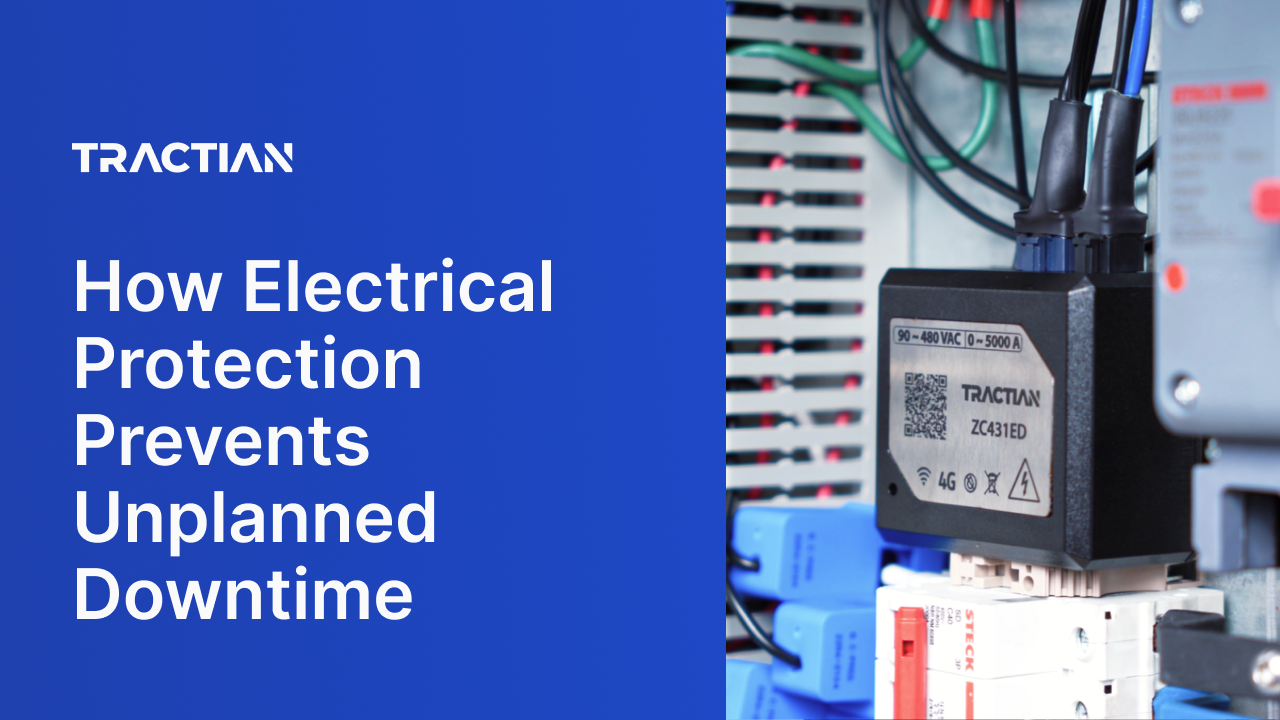
That is what Energy Trac was built to do. By bringing continuous electrical monitoring into your predictive maintenance strategy, you gain full visibility into asset health in one place. Energy Trac does more than trip a breaker when something goes wrong. Its Electrical Signature Analysis reads the raw current and voltage waveforms to tell you why an anomaly is developing and when to act on it, so your team spends its time preventing failures instead of reacting to them.
That is the shift that matters. Traditional electrical protection keeps a failure from turning into a disaster. Predictive electrical protection keeps the failure from happening on your production schedule in the first place.
You cannot eliminate the risk of electrical faults. But you can eliminate the surprise. Moving from reactive protection to proactive electrical monitoring turns unpredictable breakdowns into scheduled tasks, keeps your assets healthy, and keeps your production lines moving. It gives your team back the one thing every maintenance professional is chronically short on: control over their own week.
Ready to eliminate your electrical blind spots? See how Tractian's electrical monitoring solutions protect your critical assets and maximize your uptime. Let's talk about what that could look like for your plant. Schedule a Demo.