
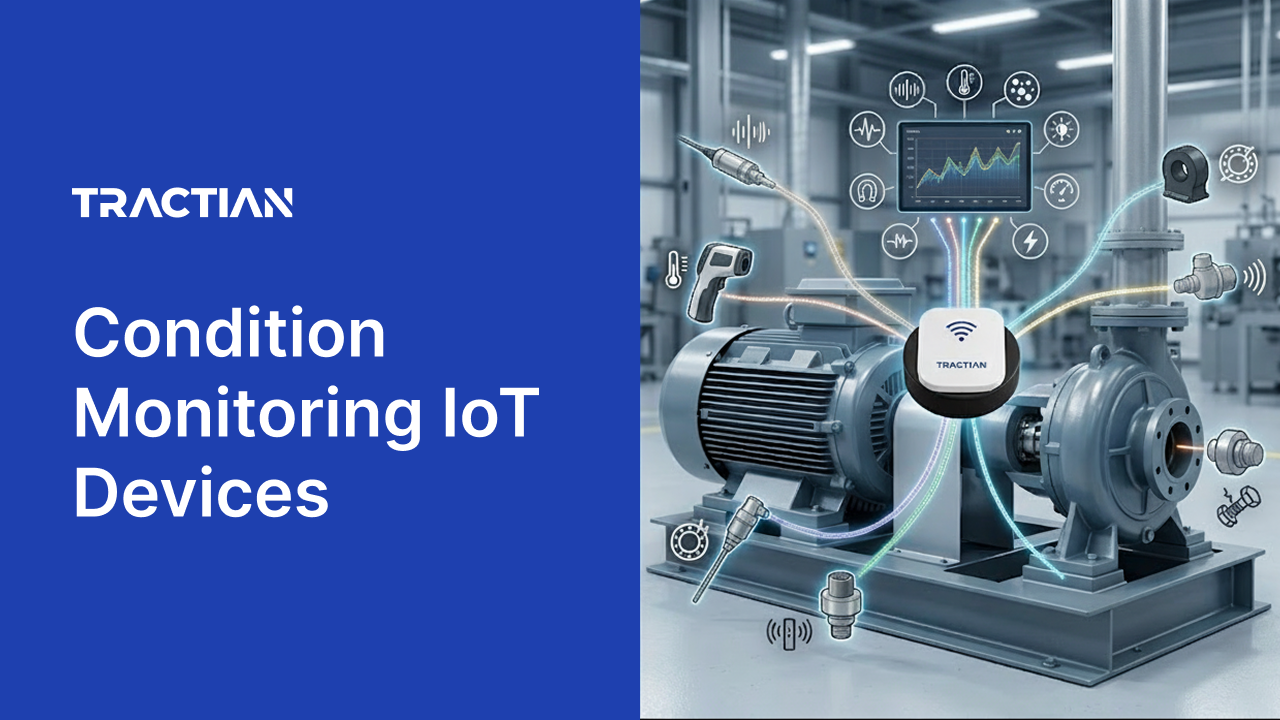
Key Points
- Condition monitoring IoT devices span multiple sensing disciplines, each designed to detect a class of failure the others physically cannot.
- Vibration and ultrasound form the core of most general industrial programs, covering mechanical degradation from earliest friction signals through confirmed fault progression.
- Electrical, thermal, and process sensors extend coverage to the failure modes that mechanical sensing alone misses.
- Programs built on a single sensing layer have blind spots that only become visible when something fails because of them.
The Sensing Layers of Condition Monitoring IoT
Most condition monitoring programs are built around one or two sensing technologies. That's often enough to catch a large portion of failures, but it's rarely enough to catch all of them. Mechanical equipment fails in multiple ways simultaneously, expressing degradation through vibration, heat, sound, electromagnetic state, and fluid condition. Each of those failure channels requires a different sensing instrument to detect reliably.
Condition monitoring IoT devices are organized around those channels because a program's reliability is limited by the failure modes it can actually see, not the ones it's assumed to cover.
Condition-based maintenance works because physical degradation leaves measurable traces before functional failure occurs. Those traces appear in different domains depending on the failure type, which is why effective IoT programs treat sensing as a layered discipline rather than a single-instrument deployment.
Vibration Sensors
The primary sensing layer for rotating equipment, vibration sensors provide the spectral data needed to identify specific fault types and track their progression toward failure.
How vibration sensors detect mechanical faults
Vibration monitoring uses triaxial accelerometers to capture the mechanical signature of rotating assets across a wide frequency spectrum. Raw time-domain signals are converted into frequency spectra using the Fast Fourier Transform (FFT), revealing characteristic patterns corresponding to specific fault types. Bearing wear (BPFI, BPFO), misalignment, imbalance, mechanical looseness, and gear degradation each produce identifiable spectral signatures that vibration analysis can pinpoint.
Watch how vibration sensors work in condition monitoring.
The reliability outcome is a defined intervention window. A well-monitored asset with continuous vibration coverage detects developing faults weeks to months before functional failure, giving maintenance teams time to schedule repairs during planned downtime rather than respond to unplanned breakdowns.
The Siemens True Cost of Downtime 2024 report found that the world's 500 largest companies lose approximately $1.4 trillion annually to unplanned downtime and attributes a significant portion of recent improvements to the adoption of predictive maintenance.
The importance of frequency range and resolution
Two technical parameters define whether a vibration sensor provides diagnostic value or just presence data: frequency range and resolution. A sensor capturing only low-frequency overall vibration levels will miss the high-frequency bearing fault signatures that appear earliest in the failure sequence. Full spectral resolution at frequencies up to 40,000 Hz, or beyond, makes early fault detection practical rather than theoretical.
Monitoring variable-speed equipment
For equipment driven by variable-frequency drives (VFDs), there's an additional constraint. Vibration fault frequencies shift with operating speed. Without real-time RPM tracking integrated into the analysis, those frequency shifts get misread as fault signatures or missed entirely.
Programs monitoring variable-speed assets without speed-aware processing have a structural gap that standard dashboard views don't surface.
Ultrasonic Sensors
Ultrasonic sensors detect high-frequency acoustic energy from friction, micro-impacts, and turbulence, placing them at the earliest detectable point in the failure timeline for lubrication-related and bearing faults.
Why ultrasound detection reveals faults earlier
Piezoelectric transducers in the ultrasonic range capture sound energy that's inaudible to the human ear and invisible to standard vibration analysis. The physics that makes ultrasound sensitive to early-stage friction is distinct from what accelerometers measure: friction and lubrication breakdown generate high-frequency acoustic emissions long before the mechanical damage is severe enough to produce a measurable vibration signature.
See how vibration and ultrasound combine in a single sensor.
That timing difference matters operationally. Ultrasound can surface developing lubrication and bearing friction issues three to twelve months before they register in vibration or temperature trends, significantly extending the usable intervention window. For bearing-heavy asset populations, that lead time is the difference between a planned greasing route and an unplanned bearing replacement.
Coverage for low-speed equipment
Ultrasonic sensing also addresses a coverage gap that vibration analysis can't fill. Low-speed equipment, typically assets operating below 100 RPM, generates vibration energy too faint for reliable spectral analysis. Ultrasound remains effective at those speeds because it responds to friction regardless of how slowly the component moves. Slow-speed conveyors, gearboxes operating at reduced speeds, and similar assets are often underserved by predictive maintenance programs that rely solely on vibration.
How ultrasound and vibration work together
The relationship between the two techniques is complementary rather than competitive. Ultrasound raises the earliest flag and asks whether something has changed. Vibration analysis answers what exactly is failing and how severe it is. Programs capturing both cover a wider span of the failure timeline than either technique alone.
A vibration-only program on a bearing-heavy asset population is missing the earliest detectable signal for the most common failure mode in rotating equipment, and that gap isn't visible in program data until the fault has already progressed past the stage where ultrasound would have caught it.
Thermal Sensors
Thermal sensing detects failure modes tied to heat and electrical resistance that neither vibration nor ultrasound reliably reveals, making it a distinct, rather than redundant, sensing layer.
What thermal sensing detects
Infrared cameras and surface temperature sensors map heat signatures across mechanical and electrical components. The failure modes in their detection range don't produce meaningful vibration or acoustic signatures until the late stage. Electrical resistance anomalies in switchgear, loose connections in control cabinets, insulation degradation in motors, and overloaded conductors all manifest primarily as heat.
For asset health monitoring programs that include significant electrical infrastructure, periodic thermal imaging inspections are a standard reliability practice precisely because those failure modes have no other early-detection channel.
Continuous temperature monitoring vs. thermal imaging
Surface temperature sensors integrated into multi-modal vibration devices provide continuous monitoring of bearing housing temperature, detecting overheating trends, and confirming whether corrective lubrication actions have taken effect.
Learn how temperature sensing supports condition-based monitoring.
Thermal imaging cameras provide broader spatial coverage across panels and cabinets where point measurements aren't practical. The two approaches serve distinct roles and aren't interchangeable.
Electrical and Magnetic Field Sensors
Electrical sensing monitors the electromagnetic state of motors and generators, catching insulation breakdown, rotor bar faults, and phase unbalance before they reach the mechanical failure threshold.
Fault modes that vibration misses
Motor Current Signature Analysis (MCSA) and Electrical Signature Analysis (ESA) monitor current and voltage waveforms to detect both electrical faults and their mechanical effects. Insulation breakdown in stator windings, broken or loose rotor bars, phase unbalance, and eccentricity all leave characteristic patterns in the current spectrum that don't produce measurable vibration signatures until late-stage damage has already occurred. Partial discharge sensors extend this coverage to high-voltage infrastructure, detecting minute arcing within transformer and switchgear insulation before catastrophic failure.
For induction motors, which represent the majority of the rotating asset population in most industrial facilities, electrical failure modes account for a meaningful share of total failures. A vibration program provides strong coverage of the mechanical failure pathway. It has limited visibility into the electrical pathway that can take the same motor offline with comparatively little warning.
Magnetic field sensing in general plant monitoring
Magnetometer-based sensing, integrated into advanced multi-modal condition monitoring sensors, captures magnetic field variations that reflect rotor bar condition, phase unbalance, and other electromagnetic anomalies. This provides practical electrical monitoring coverage for general industrial motor fleets without requiring dedicated MCSA instrumentation on every asset.
Full MCSA and partial discharge monitoring for high-voltage infrastructure are more specialized and require dedicated instrumentation beyond general plant sensors.
Process and Performance Sensors
Process sensors provide the operational context that makes condition monitoring data accurate and defensible, turning a vibration reading into a confident diagnosis rather than an ambiguous alert.
Why operating context determines alert accuracy
Pressure, flow, shaft speed, ambient temperature, and energy consumption sensors monitor the parameters that define an asset's operating environment. These devices don't measure asset health directly. They provide the context that determines whether a condition signal reflects a developing fault or a change in operating conditions.
The cost of missing operational context
Without that context, alerts become ambiguous. A vibration spike on a centrifugal pump could indicate mechanical looseness or a shift in flow conditions. Real-time RPM data is the most critical process input for rotating equipment: without it, vibration fault frequencies shift as speed changes, and analysis loses accuracy on any variable-speed asset.
See how RPM Encoder technology works.
Process sensors are what make a condition-based monitoring platform's output defensible to the teams acting on it. Programs that capture rich condition data but lack operational context produce alerts that require manual validation before action, adding exactly the kind of labor burden that IoT monitoring is supposed to eliminate.
Fluid and Oil Condition Sensors
Inline and sample-based fluid sensors monitor oil viscosity, oxidation levels, moisture ingress, and metallic wear debris in machines with internal lubrication circuits. Gearboxes, hydraulic systems, and heavily loaded rotating assets shed microscopic metallic particles as internal components degrade. Wear debris counting provides direct evidence of that degradation before it registers as a vibration or ultrasound signal.
This is a specialized layer extending coverage to internal degradation pathways that acoustic and mechanical sensing detect only after damage has progressed. For facilities with large populations of gearboxes or hydraulic equipment, continuous fluid monitoring replaces periodic lab sampling with real-time condition data.
Structural Monitoring and Visual Inspection
Structural IoT devices, including ultrasonic wall-thickness sensors and strain gauges, monitor the physical integrity of static assets: tanks, pressure vessels, and piping subject to corrosion, erosion, and fatigue cracking. These failure modes have no rotating component and no vibration signature.
Visual and optical IoT, using AI-enabled cameras and LiDAR, automates surface inspections for conveyor belts, structural cracks, and material spillage. Both categories address failure modes in non-rotating or visually inspectable assets and are most applicable in oil and gas, chemical, and process-intensive environments rather than general manufacturing facilities.
Coverage Gaps Are the Real Program Risk
The measure of a condition monitoring IoT program isn't the number of sensors installed. It's whether the sensing disciplines deployed map to the failure modes the asset population actually generates.
Equipment failure doesn't pick one channel to express itself through. A bearing degrading from lubrication starvation first appears in ultrasound, then in surface temperature, then in vibration spectral patterns, and eventually in current draw as the mechanical load on the motor driving it increases.
Each of those signals belongs to a different sensing category. A program covering three of the four has a gap that remains invisible until a failure arrives through the uncovered channel.
The more operationally dangerous situation is partial coverage that appears to be complete coverage. A well-populated asset tree with installed sensors doesn't guarantee full failure-mode visibility. Mean time between failure and mean time to repair metrics will reflect the failures a program can see. They won't reflect the ones it can't.
Evaluating sensing coverage against the failure modes an asset population is actually exposed to is the step that turns a populated dashboard into a defensible reliability strategy.
Tractian: Multi-Modal Condition Monitoring IoT in Practice
Tractian's multimodal Smart Trac sensor consolidates the core sensing layers into a single wireless device: triaxial vibration from 0 to 64,000 Hz, ultrasound to 200 kHz, magnetometer-based RPM encoding from 1 to 48,000 RPM, and continuous surface temperature monitoring.
One installation point simultaneously covers vibration, ultrasound, electrical, and magnetic field monitoring, and thermal trending, addressing the multimodal coverage problem without deploying separate instruments for each sensing discipline.
See how Tractian IoT sensors work in condition monitoring.
Tractian applies patented fault-finding algorithms trained on over 3.5 billion collected samples to automatically identify all major failure modes across all sensing channels. Every alert includes the confirmed fault type, severity classification, and prescriptive next steps drawn from a validated Procedures Library.
Tractian Auto Diagnosis software not only flags changes, but also tells the team what is wrong, how bad it is, and what to do next. Patented features, like Always Listening, address real-world deployment complexity by activating data capture at exactly the right moment for intermittent machines, while Ultrasync correlates signals from multiple sensors on the same asset for more comprehensive fault detection across measurement points.
Tractian's condition monitoring insights and diagnosis also integrate natively with its maintenance execution software, so when a fault is confirmed, it flows directly into a prioritized work order with the diagnosis and recommended procedure already attached.
Detection and action occur in the same system, which means the distance between identifying a developing fault and scheduling the fix collapses into a single, connected workflow. That closed-loop structure is what converts multimodal sensor coverage into actual reliability outcomes rather than a longer alert list.
Review full sensor specifications for complete technical details.
Learn more about Tractian’s condition monitoring to find out how high-quality, decision-grade IoT data transforms your program into AI-powered maintenance execution workflows.
FAQs about Industrial Condition Monitoring
- What types of IoT sensors are used in condition monitoring?
The primary categories are vibration, ultrasound, thermal, electrical and magnetic field, process and performance, fluid, structural, and visual sensors. Each detects a distinct class of failure that the others can't reliably cover.
- Can a single IoT sensor cover multiple failure modes?
Advanced multi-modal sensors combine vibration, ultrasound, temperature, and magnetic field sensing in a single device, covering the most common failure modes in rotating equipment from a single installation point. Specialized failure pathways, such as fluid degradation or structural corrosion, still require dedicated instruments.
- What failure modes does vibration monitoring miss?
Vibration has limited sensitivity to early-stage lubrication breakdown, electrical insulation faults, and internal fluid system degradation. Ultrasonic, electrical sensing, and oil analysis each cover failure modes that appear before vibration registers a measurable change.
- How does ultrasound extend the detection window in a condition monitoring program?
Ultrasonic sensing detects friction and lubrication issues three to twelve months before they show up in vibration or temperature trends. For bearing-heavy programs, lead time represents the difference between a planned condition-based intervention and a reactive replacement.
- What role do process sensors play in the accuracy of condition monitoring?
Process sensors provide the operational context, RPM, load, pressure, and flow, which makes condition data interpretable. Without it, alerts require manual validation to determine whether a signal indicates a fault or a change in operating conditions, which erodes both team confidence and program efficiency.