
Key Points
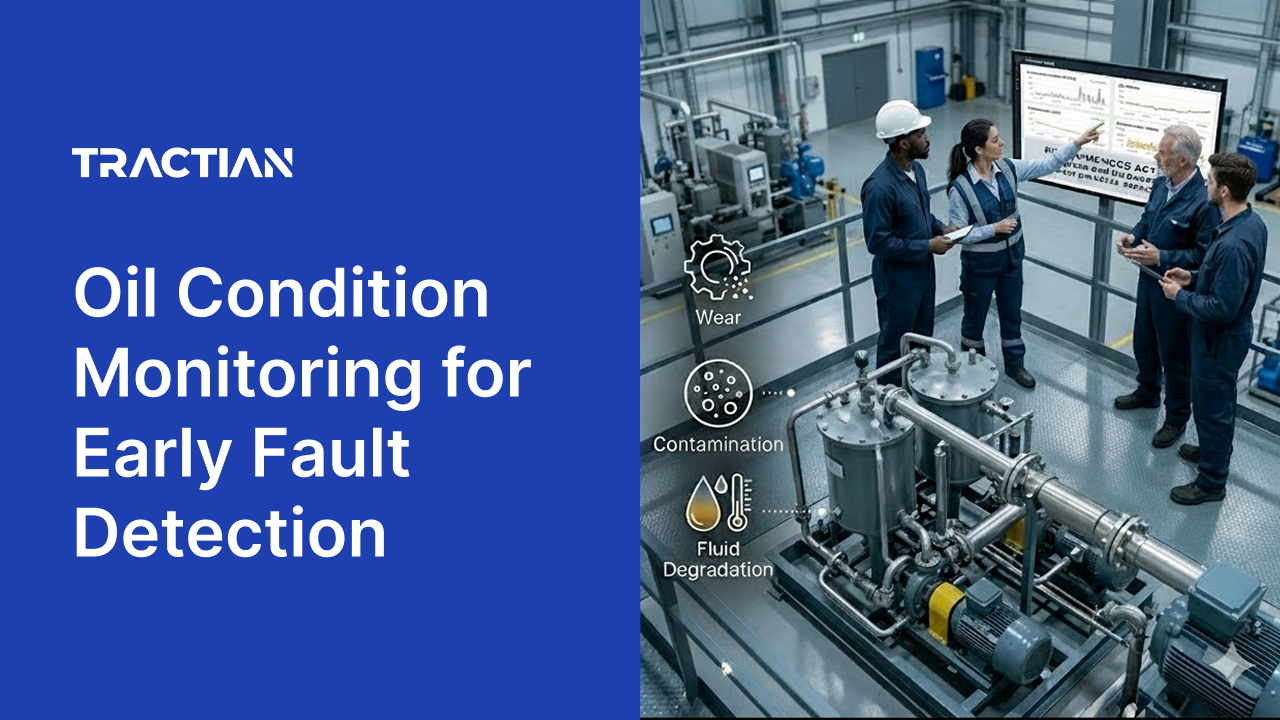
- Oil condition monitoring detects wear, contamination, and fluid degradation before vibration or temperature signals emerge, making it one of the earliest fault detection techniques available for rotating industrial equipment.
- The technique's value depends on sampling quality, trending discipline, and the effectiveness with which oil data is correlated with other condition-monitoring inputs at the asset level.
- Programs that treat oil analysis as a standalone practice produce reports. Programs that integrate it into a unified condition monitoring platform make decisions.
What Happens with Oil Condition Data
Oil condition monitoring reveals what's happening inside a machine before any external sensor registers a change. Particle contamination, chemical breakdown, moisture ingress, and additive depletion are signals from the lubricant itself. And, they often appear earlier on the P-F curve than mechanical vibration shifts or thermal anomalies.
For reliability teams, that detection window is valuable and represents the opportunity window between planning a controlled intervention and reacting to a failure that's already underway.
In most facilities, oil analysis reports land in a PDF or a spreadsheet, reviewed by whoever has the bandwidth, and disconnected from the vibration data, maintenance history, and operating context that would make those findings actionable.
A report that says "abnormal iron trending" doesn't tell the maintenance planner how urgent the issue is, what else is happening on that asset, or what the next step should be. The technique generates valuable data. Whether that data reaches the right person with enough context to drive a confident, prioritized decision is a different question entirely.
This article covers what oil condition monitoring detects, where it fits within a broader condition monitoring program, and what separates programs that generate oil data from programs that generate decisions from it.
What Oil Condition Monitoring Detects
Oil condition monitoring provides three categories of insight into asset health, each targeting a different stage of the degradation process.
Fluid health is the condition of the lubricant itself.
Viscosity shifts, oxidation levels, changes in total acid number, and additive depletion all indicate whether the oil is still performing its protective function. A lubricant that has degraded beyond its serviceable range accelerates component wear even when no mechanical fault exists yet. What’s required is identifying the conditions that lead to failure before failure begins. We need to know the root causes.
Contamination covers the foreign substances that compromise both the lubricant and the components it protects.
Water ingress degrades viscosity and promotes corrosion. Particle contamination acts as an abrasive between contact surfaces. Fuel dilution thins the oil film. A multi-industry study published by the National Research Council of Canada found that particle contamination was the root cause of 82% of wear-related failures in lubricated machinery.
That figure reframes oil cleanliness from a housekeeping task to a core reliability strategy, and monitoring contamination levels against ISO 4406 cleanliness codes gives teams a measurable, trackable indicator of asset protection.
Wear debris is the point at which oil analysis provides direct evidence of component degradation.
Elemental spectroscopy measures the concentration and type of metals present in the oil. For example:
- Elevated iron typically points to gear or shaft wear.
- Copper signals bearing or bushing degradation.
- Lead and tin indicate babbitt bearing deterioration.
The critical factor for interpretation isn't a single reading but the rate of change across trending samples. A gradual climb reflects normal wear. A sharp spike is a developing fault that warrants investigation.
In a mining gearbox application, for instance, rising iron and silicon concentrations in oil samples indicated both gear tooth wear and environmental contamination well before vibration amplitudes changed. The maintenance team planned a controlled shutdown around the processing schedule rather than reacting to a catastrophic failure mid-shift. The detection advantage of oil condition monitoring provides visibility into internal degradation while the intervention window is still wide open.
Similarly, each of these categories produces actionable signals. But a wear metal reading or a contamination spike, viewed without the asset's vibration trend, maintenance record, and operating context alongside it, doesn't answer the questions the maintenance team actually needs answered. That is, “how urgent is this, what else is developing on this machine, and what should we do first?”
Where Oil Condition Monitoring Fits in a Condition Monitoring Program
Every predictive maintenance technique has a defined detection window on the P-F curve, the interval between the earliest point at which a developing fault becomes detectable and the point of functional failure.
To see how this works, watch Vibration and Ultrasound in One Sensor Redefine Predictive Maintenance
- Oil analysis frequently provides the earliest indication of lubrication degradation, contamination, and slow-developing internal wear.
- Vibration analysis captures mechanical fault signatures such as misalignment, imbalance, and bearing defects because they produce changes in physical movement.
- Ultrasonic sensing detects friction and micro-impacts.
- Thermography identifies thermal anomalies from electrical faults, insulation breakdown, or heat buildup.
No single technique covers the full curve.
The most effective condition-based maintenance programs layer these techniques to ensure continuous fault detection across the full P-F interval.
Oil analysis catches what vibration can't see. This includes internal fluid degradation, contamination trends, and slow-developing wear that hasn't yet produced a mechanical signature.
Vibration monitoring catches what oil can't see: structural looseness, misalignment in non-lubricated assemblies, and mechanical faults that don't generate debris in the oil. The techniques are complementary, not competing, and the layering is what produces coverage without blind spots.
But layering only works when the data converges in a single place.
In a food and beverage plant, a hydraulic press showed clean vibration trends while oil analysis flagged rising particle counts and moisture ingress. The contamination was degrading seals and accelerating internal wear that vibration hadn't yet registered. Catching it at the oil stage avoided a mid-production failure on a line with tight delivery windows.
That outcome was possible because someone connected the oil data to the asset context. In too many facilities, that connection depends on a single person manually cross-referencing reports from disconnected systems, and that manual synthesis takes time and expertise that lean reliability teams don't have in surplus.
When oil analysis runs in parallel with vibration monitoring, but the results don't converge, the team is effectively running two separate programs.
The technician reviewing vibration sensor trends doesn't see the oil report. The lubrication engineer doesn't see the vibration history. Each has a partial view. Neither has the correlated context to make a confident call on timing, severity, or priority.
Advanced condition monitoring platforms address this by consolidating oil analysis findings alongside vibration, ultrasound, and temperature data into a single asset timeline, giving teams the unified view they need to act rather than interpret.
What Changes the Value of Oil Condition Monitoring?
The effectiveness of decision-making is limited by the quality of oil condition monitoring data.
Most programs hit a “quality” ceiling, but not because lab instrumentation is inaccurate. Rather, it’s because upstream factors undermine the data before it reaches the analyst.
Sampling consistency
The same asset can produce drastically different oil analysis results depending on where the sample is drawn, when it's taken relative to machine operation, and how it's handled between collection and lab. Samples collected from the bottom of a sump capture settled debris that doesn't represent the circulating oil. Samples taken immediately after a filter change may show artificially low particle counts.
Without standardized sampling procedures and consistent draw points, trending becomes unreliable. And unreliable trends produce hesitation, not action.
Trending Discipline
A single oil sample is a snapshot. It gains meaning only when compared to a baseline established for that specific asset under known-good conditions and trended across multiple intervals.
Research published by Bearing News indicates that improper lubrication accounts for approximately 80% of bearing failures. Identifying whether a lubrication issue is developing on a particular machine requires the trending history to see the trajectory, not just the current value.
Context Dependency
An elevated wear metal reading could indicate a developing fault, a recent maintenance event that released trapped debris, a break-in period on a new component, or a normal operating condition under the machine's current load profile.
Reliability Web notes that as little as 1,000 ppm of water in oil can reduce bearing life by 75%, but whether a given moisture reading warrants immediate action depends on the asset's operating history, vibration trend, and maintenance record. In context, the oil report alone doesn't carry.
This is where the technique's value quietly erodes in practice. Manual cross-referencing of oil results with vibration data, maintenance logs, and operating conditions is manageable for a handful of critical assets. It doesn't scale to a facility monitoring dozens or hundreds of machines with a lean reliability team. The interpretation work exceeds the team's bandwidth, and unprocessed oil reports become another source of data that nobody fully acts on.
How Tractian Integrates Oil Condition Monitoring into a Unified Platform
The gap between valuable but isolated oil analysis data, disconnected from the vibration trends and asset context needed to drive confident decisions, is a structural problem. It can't be solved by better sampling alone or by hiring more analysts. It requires a platform that consolidates condition data from multiple techniques into a single decision-support environment.
Tractian's Asset Performance Management module does exactly this. It consolidates events from oil analysis, vibration monitoring, thermography, ultrasonic sensing, calibration diagnostics, and electrical monitoring into a unified timeline for each asset. Oil analysis findings don't sit in a separate report waiting for someone to cross-reference them. They appear alongside vibration trends, temperature data, and the asset's full maintenance history in a single view, giving reliability teams the correlated context to assess severity, confirm developing faults, and prioritize action.
Between oil sampling intervals, Tractian's Smart Trac sensor provides continuous data on vibration, ultrasound, temperature, and RPM. When oil analysis flags early-stage wear and the vibration data corroborates a developing fault signature, the combined picture yields diagnostic confidence that neither technique alone provides.
The sensor's patented Auto Diagnosis identifies all major failure modes automatically, and AI-powered diagnostics provide prescriptive guidance. You’re provided with what is wrong, how severe it is, and what to do next.
That guidance flows directly into maintenance execution. Condition insights from any source, including oil analysis logged into the APM timeline, can trigger prioritized work orders in Tractian's maintenance execution platform with AI-generated procedures and connected inventory.
The loop from detection to corrective action closes within a single system, without data handoffs or platform switching. Every finding also feeds into FMEA and Root Cause Analysis workflows, building a traceable archive of failure modes and resolutions that sharpens diagnostic accuracy over time.
Tractian reports payback on condition monitoring in as little as three months, with published benchmarks including an 11% increase in availability and a 30% decrease in preventive maintenance costs. The platform is trusted by manufacturers including Kraft Heinz, Cargill, Hyundai, Carrier, and Caterpillar, and holds Forbes AI 50 recognition, SOC 2 Type II, and ISO 27001 certifications.
Learn more about Tractian’s condition monitoring solution to find out how high-quality, decision-grade IoT data transforms your program into AI-powered maintenance execution workflows.
FAQs about Oil Condition Monitoring
What does oil condition monitoring detect?
Oil condition monitoring detects lubricant degradation, contamination (water, particles, fuel dilution), and wear debris from internal components like bearings, gears, and shafts. These signals often appear before changes in vibration or temperature, making oil analysis one of the earliest fault-detection techniques available for rotating equipment.
How often should oil samples be taken?
Sampling frequency depends on asset criticality, operating environment, and equipment type. Critical assets in harsh or high-load conditions may require monthly sampling, while lower-criticality machines often follow quarterly intervals. Consistent timing matters more than frequency because trending requires comparable data points to produce reliable baselines.
Can oil analysis replace vibration monitoring?
No. Oil analysis and vibration monitoring detect different failure modes at different points on the P-F curve. Oil catches lubrication degradation and contamination that vibration can't see, while vibration detects mechanical faults like misalignment and structural looseness that don't generate debris in the oil. The most effective condition monitoring programs layer both techniques.
Why do oil analysis programs fail to deliver results?
Most failures aren't about lab accuracy. They stem from inconsistent sampling practices, a lack of trending discipline, and oil results sitting in isolation without correlation to vibration data, maintenance history, or asset context. When interpretation requires manual effort across disconnected systems, teams can't sustain it at the scale their asset population demands.
How does Tractian handle oil analysis data?
Tractian's APM module consolidates oil analysis findings alongside vibration, ultrasound, temperature, and other condition data into a single asset timeline per machine. This gives reliability teams the correlated view needed to assess severity and prioritize action, and condition insights can trigger work orders in the maintenance execution platform with procedures and priority attached.
What industries benefit most from oil condition monitoring?
Any industry operating oil-lubricated rotating equipment benefits, including mining, food and beverage, chemical processing, and oil and gas. Gearboxes, hydraulic systems, compressors, turbines, and large bearings are among the highest-value applications because their failure modes produce detectable oil signatures well before functional failure.