
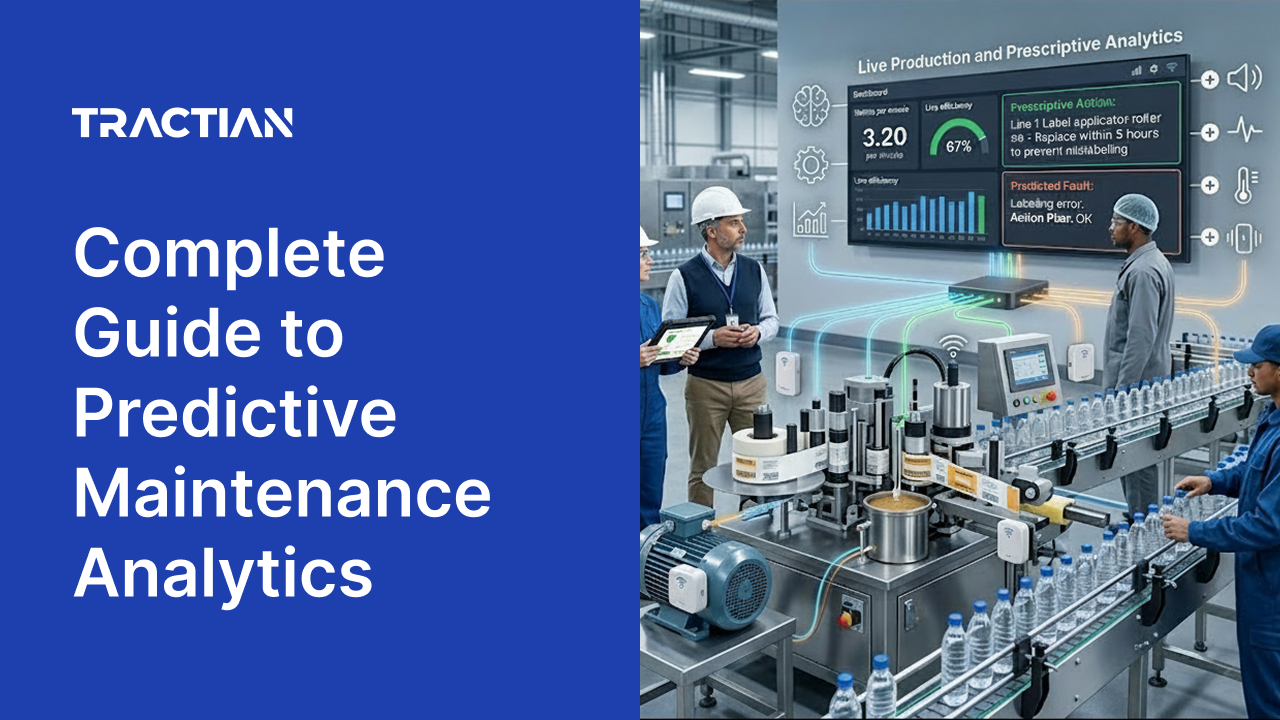
Key Points
- Predictive maintenance analytics is the intelligence layer that converts condition data into prioritized, prescriptive action, not just alerts.
- The analytics spectrum progresses from descriptive reporting through diagnostic pattern recognition to predictive forecasting and automated prescriptive workflow.
- Data quality and contextual synthesis define the ceiling on what an analytics system can produce and how confidently teams can act on it.
- Closing the loop between anomaly detection and automated maintenance execution is where measurable ROI is realized.
Most facilities running condition monitoring programs today don't have a sensing problem, but an analytics problem. The volume of condition data available to maintenance and reliability teams has grown considerably over the past several years. Yet, the ability to translate that data into confident, prioritized action has not kept pace.
This gap, between detection and interpretation, is where predictive maintenance ROI is won or lost. A bearing fault detected three weeks before failure is only valuable if the analytics layer can classify it accurately, assign it appropriate urgency, and route it to the right person with the right instructions.
Data sitting in a dashboard waiting for an analyst to interpret it isn't predictive maintenance. It's data collection with extra steps.
This guide covers the five layers of a capable predictive maintenance analytics environment. These layers are:
- Data synthesis
- Machine learning
- Prognostic forecasting
- Digital twin and ecosystem integration
- Automated workflow execution
Understanding these layers will help us highlight how analytics operate in predictive systems. We need to uncover how each layer builds on the others through the flow of information in the monitoring-to-execution lifecycle. But first, let’s look at how analytics operationally changes across the stages of maintenance programmatic output.
The Descriptive to Prescriptive Analytics Spectrum
Predictive maintenance analytics operates across a four-stage spectrum, and most programs stop well short of where the operational value is concentrated.
Not all analytics are equal, and the stage at which a program operates largely determines whether it produces decisions or just produces data. The four stages are descriptive, diagnostic, predictive, and prescriptive, with each requiring a meaningfully higher level of model sophistication than the one before it.
Descriptive analytics tells teams what has happened: dashboards displaying historical vibration trends, temperature readings, and work order completion rates.
Diagnostic analytics moves into pattern recognition, identifying why an anomaly occurred and which failure mode it matches. These first two stages form the baseline. They're valuable, but they still require an experienced analyst to close the gap between insight and action.
Predictive analytics is where the spectrum becomes operationally significant. By applying machine learning models to historical and real-time data, the system forecasts what will happen, including Remaining Useful Life (RUL) estimation. Rather than knowing a bearing is showing early wear, the team now knows approximately how much operational time remains before functional failure. This is what enables condition-based scheduling. Maintenance happens neither too early nor in an emergency.
Finally, prescriptive analytics completes the chain. The system recommends the specific intervention, when to schedule it, and what parts to source.Basically, this spectrum represents a shift for the maintenance team from "here is what the data shows" to "here is what you should do next.”
The Data Synthesis Engine
Analytics output is bounded by the completeness and context of the data feeding the model, a fact that most programs encounter too late.
A predictive maintenance analytics system is only as capable as the data it ingests. The inputs that a capable environment must integrate span several categories:
- Real-time IoT sensor streams covering vibration, temperature, ultrasound, magnetic field, and RPM
- Historical maintenance logs and work order records that supply the failure history the model learns from
- Structured failure mode frameworks built on Failure Mode and Effects Analysis (FMEA) that connect known fault signatures to live condition data.
This operational context, representing the asset's current load state, speed profile, and ambient conditions, is what makes everything else interpretable.
A vibration reading on an asset running at 40% load means something different than the same reading at full load. So, without that context embedded in the model, the analytics layer either generates false positives or misses real degradation developing under non-standard conditions. This distinction separates a data platform from a condition-based maintenance system.
The FMEA integration point is particularly significant. Analytics environments that link live condition data to pre-mapped failure mode libraries can identify not only that a signal is deviating, but also which specific failure mode it matches and how far along the P-F curve the asset is. That specificity converts raw monitoring into actionable reliability intelligence.
Fortunately, the business impact of getting this right is measurable. A pilot implementation of predictive analytics for one asset class at a large chemical manufacturer resulted in an 80% reduction in unplanned downtime and savings of approximately $300,000 per asset, according to Deloitte's Industry 4.0 research. The quality of the operating context feeding those models was precisely what made that performance possible.
Machine Learning and AI is The Diagnostic Core
The diagnostic quality of a predictive maintenance program is determined by the ML architecture doing the pattern recognition, and the gap between rule-based and AI-driven systems is wide.
Static threshold-based alerting operates on a rule. If vibration exceeds a set threshold, an alarm triggers. It's an easy, straightforward mechanism to implement. Unfortunately, it’s just as easy (and demonstrates an equally straightforward lack of grounding in the day-to-day workflow needs of technicians) to outgrow.
Machine learning models work differently. They establish what normal looks like for each individual asset under its specific operating conditions, including speed, load, duty cycle, and ambient environment, then alert on meaningful deviation from that personalized baseline. The result is a system that catches developing faults earlier and with far fewer false alarms.
Deep learning algorithms extend this further by detecting anomalies across multiple simultaneous data streams in patterns that single-parameter monitoring and experienced human analysts can't match at scale. Early-stage bearing wear, developing misalignment, and lubrication degradation each leave multi-variable signatures long before any individual parameter crosses a threshold. It’s impossible to identify those signatures manually (reliably) across hundreds of assets running continuously.
False positive reduction deserves particular attention here. Asset health monitoring that generates frequent false alarms creates extra work and doubt. When maintenance teams learn through experience that most alerts don't result in confirmed faults, they stop responding with urgency, and that behavioral shift is difficult to reverse. It functionally cancels the program's predictive advantage.
The answer is a human-in-the-loop learning architecture. Each verified maintenance outcome feeds back into the model to improve future diagnostic accuracy, and the system compounds in value the longer it runs. As McKinsey notes, advanced analytics identifies complex patterns across hundreds or thousands of variables in ways that traditional analysis cannot.
To see the detection-to-diagnosis pipeline in operation, Tractian's AI-assisted monitoring resource walks through how that flow works in practice.
Digital Twins and the Connected Maintenance Ecosystem
Asset twins represent the integration point between predictive analytics and the broader digital factory, enabling simulation-based maintenance planning that reactive and preventive programs can't replicate.
An asset twin is a real-time virtual representation of a physical asset, continuously updated by live sensor data, PLC feeds, and maintenance records. Where condition monitoring captures what is happening to an asset right now, the asset twin extends that visibility into simulation. A team can model how a partially degraded component would behave under increased load, test whether a planned repair resolves the underlying fault, or validate a maintenance decision before executing it on the physical machine. This shift from monitoring signals to actively managing asset condition is what defines mature asset performance management.
Connecting analytics to the broader digital factory ecosystem extends this value further. Asset condition data integrated with manufacturing execution systems (MES), ERP platforms, and energy management systems captures operational value that a standalone monitoring deployment cannot. As McKinsey's research on factory digital twins describes, asset twins, informed by PLCs, sensors, and IoT devices, enable predictive maintenance and yield, energy, and throughput optimization.
Closing the Gaps From Insight to Automated Action
Predictive analytics only delivers on its ROI promise when the gap between detecting a developing fault and executing a maintenance response is closed, and increasingly, that closure is automated.
If detection is the first step, then the final step is a technician resolving the fault at the right time, with the right parts, using the right procedure. Every manual handoff between those two points introduces delay and dependency on specialist availability. In environments where experienced analysts are already managing large asset populations, these delays compound quickly.
Establishing automated workflow execution closes the loop.
- When analytics detects and classifies a developing fault, the maintenance execution platform generates a work order automatically, pre-populated with the diagnosis, recommended procedure, severity rating, and part requirements.
- The technician receives specific guidance on what is wrong, how severe it is, and what to do next.
- Root cause analysis data from completed work orders feeds back into the analytics model, while mean time between failure, overall equipment effectiveness, and planned vs. reactive ratios update continuously, providing a live, evidence-based view of program performance.
- Even spare parts inventory benefits from the same integration, and RUL estimates fed into inventory systems allow parts to be ordered based on projected need rather than static safety-stock rules, reducing carrying costs while improving first-time fix rates.
These are concrete outcomes for programs that fully close this loop.
Tractian is the Standard for Industrial Predictive Maintenance Analytics
The gap between collecting condition data and producing trusted, prescriptive maintenance action is closed at the analytics layer. Tractian's AI-powered predictive maintenance platform exists precisely to solve this problem.
At the diagnostic core, Tractian's patented Auto Diagnosis algorithms are trained on 3.5 billion+ collected samples across hundreds of thousands of global assets. The system automatically detects all major failure modes, assigning each a severity rating, root cause classification, and specific repair prescription. No vibration analysis expertise is required on the team. The Auto Diagnosis feature walks teams through the detection-to-prescription pipeline when they want to see the process in detail.
Data quality is handled through Asset GPT, which autocompletes asset specifications from a library of over 6 million motors and 70,000 bearing models, ensuring each diagnosis has accurate parametric context. An adaptive temperature algorithm draws on five years of historical weather data to separate ambient fluctuations from machine-induced anomalies. And operational state auto-detection eliminates false alarms during load transitions.
Together, these capabilities produce the diagnostic specificity and resistance to false positives that sustain team confidence over time. Tractian's condition monitoring insights and diagnosis platform overview covers how this full detection-to-report flow is structured.
Beyond the core analytics layer, Tractian's asset performance management module extends those insights into reliability strategy through FMEA frameworks, root cause analysis tools, and machine benchmarking at the asset, intra-company, and industry levels.
For teams that want the complete loop from detection to execution, Tractian's maintenance execution platform automatically receives analytics insights and converts detections into pre-populated work orders, eliminating manual handoffs.
Watch Inside Tractian: AI for Condition Monitoring for a closer look at how the analytics and execution environments work together. One platform, one data environment, no gap between insight and action.
Learn more about Tractian’s predictive maintenance analytics to find out how high-quality, decision-grade IoT data transforms your program into AI-powered maintenance execution workflows.
FAQs about Industrial Condition Monitoring
What is the difference between condition monitoring and predictive maintenance analytics?
Condition monitoring captures real-time equipment health data through sensors and analysis techniques. Predictive maintenance analytics applies machine learning and statistical modeling to that data to forecast when failures will occur and prescribe optimal interventions. Monitoring provides the inputs; analytics determines what those inputs mean and what to do about them.
What data inputs does a predictive maintenance analytics system need?
Effective analytics requires real-time sensor data, historical maintenance records, FMEA-based failure-mode libraries, and operational context, such as load state and speed profile. Missing any of these layers limits diagnostic specificity and increases the likelihood of false positives that erode team confidence over time.
How does machine learning reduce false positives in predictive maintenance?
ML models establish individualized baselines for each asset under its specific operating conditions rather than applying static thresholds. By detecting meaningful deviation from a personalized normal, these models generate far fewer spurious alerts while maintaining the sensitivity needed to catch developing faults early.
What is Remaining Useful Life, and how is it used in maintenance scheduling?
Remaining Useful Life (RUL) is an estimate of how much operational time an asset has before functional failure. RUL converts anomaly detection into planning: instead of reacting to an alert, maintenance teams can schedule the intervention during a planned window at the optimal point on the P-F curve.
How does predictive maintenance analytics connect to automated work order generation?
When analytics identifies a developing fault, the maintenance execution platform automatically generates a prioritized work order, with diagnosis, procedure, and part requirements pre-populated. This eliminates the manual interpretation step between detection and response, where delay and expertise dependence most often constrain program performance.
What KPIs should a mature predictive maintenance analytics program track?
Core KPIs include mean time between failure, mean time to repair, planned vs. reactive maintenance ratio, percent planned maintenance, and overall equipment effectiveness. Together, these metrics surface whether the analytics environment is driving the program toward proactive execution and reducing the cost of reactive intervention over time.