
Detecting an anomaly is only half the job. What a maintenance team actually needs is the full picture: what is failing, which component, how severe, and what to do about it. Without that, every alert is just another item in the inspection queue.
Tractian Autodiagnosis™ delivers that complete picture. Powered by Tractian AI, it goes beyond anomaly detection to generate a full diagnostic report, failure type, affected component, severity level, and recommended corrective actions, automatically.
What Is Autodiagnosis™?
Autodiagnosis™ is Tractian's AI-powered fault automated diagnostics capability. It continuously monitors industrial rotating equipment through IoT sensors and uses machine learning algorithms to identify developing failure modes before they cause unplanned downtime.
The closest analogy is a doctor for your machines: monitoring vital signs around the clock, diagnosing what is wrong, and prescribing the right treatment before the patient collapses.
Tractian AI runs thousands of machine learning models to power Autodiagnosis™. Together, they identify all major failure modes across industrial rotating equipment.
How It Works
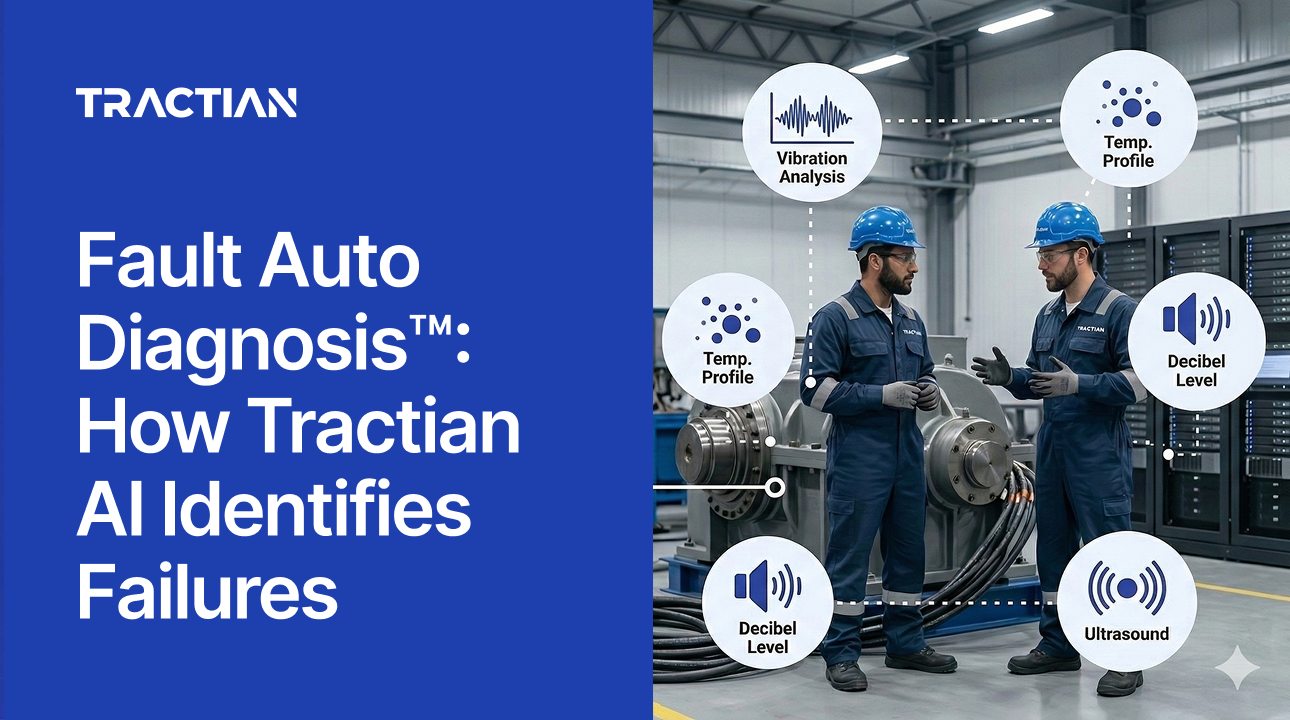
IoT sensors sample machine health data (vibration, ultrasound, temperature, and magnetic field) continuously, 24/7. That data is transmitted to the cloud, where Tractian AI's neural networks process it immediately.
The algorithms scan every new data point against the asset's full operating history, looking for patterns that match known failure signatures. When a developing fault is detected, an Insight is automatically generated and delivered to the maintenance team.
After each intervention, the team's feedback on the outcome feeds back into the system. This feedback loop continuously refines the algorithms, making every subsequent diagnosis more precise.
What a Diagnosis Contains
Every Insight generated by Autodiagnosis™ includes:
- Failure type: the specific failure mode detected (unbalance, misalignment, mechanical looseness, and more)
- Affected component: the exact part of the equipment that requires attention
- Severity level: urgency classification so teams prioritize correctly
- Recommended actions: a corrective action plan prescribed by Tractian AI, drawing from manufacturer manuals, technical standards, and industry best practices
The result is that technicians arrive at the equipment already knowing what they will find, with the right parts and tools in hand.
The Four Pillars Behind Autodiagnosis™
1. Quality Data
The system is trained on data sampled from thousands of assets across different industries and operating conditions. Data integrity, accuracy, and freshness are what make diagnoses reliable at scale.
2. AI-Defined Thresholds
Tractian AI does not apply generic limits from industry standards. It learns the specific behavior of each asset and sets operational thresholds based on that asset's actual history and operating context, not a one-size-fits-all benchmark.
3. Operating Mode Detection
The system identifies the different operating modes of each piece of equipment: load variations, process changes, environmental shifts, and production cycles. This ensures that every comparison the AI makes is relevant to the specific context of that machine at that moment.
4. Multi-Layer Comparative Analysis
Tractian AI runs three simultaneous layers of comparison:
- Internal history: compares current data against the full history of that specific asset
- Similar assets in the plant: benchmarks performance against comparable machines in the same facility, surfacing anomalies that only appear at this level
- Global database: compares performance against hundreds of thousands of similar assets across other industries, functioning as automatic reliability benchmarking
What Changes for Maintenance Teams
With Autodiagnosis™, maintenance shifts from reactive to condition-based. Every intervention is precise: the team knows what needs to be done before they reach the equipment.
The operational outcomes:
- Fewer unplanned stops: faults are caught before they turn into downtime
- Extended asset life: targeted interventions prevent secondary damage
- Better resource allocation: teams act where and when it matters, not on routine checks
- Improved safety: high-severity issues are automatically surfaced and prioritized
- Data-driven decisions: diagnosis replaces intuition as the basis for action
Frequently Asked Questions
Does Autodiagnosis™ work on all types of rotating equipment?
Yes. Tractian AI algorithms have been trained on data from a broad range of industrial rotating assets, including electric motors, pumps, compressors, fans, and gearboxes. The system adapts to the operating history and context of each specific asset.
How quickly does the system generate a diagnosis after detecting an anomaly?
Data is transmitted to the cloud every 10 minutes on standard settings. Processing and Insight generation follow immediately. The total time from detection to team notification is measured in minutes.
Does technician feedback actually change future diagnoses?
Yes. Every outcome logged by the technician after an intervention is fed back into the AI models. This feedback loop means the Autodiagnosis™ improves continuously, with each cycle producing more accurate diagnoses.
Does Autodiagnosis™ replace maintenance technicians?
No. It amplifies the technician's capability by delivering the right information at the right time. Judgment, execution, and feedback still belong to the person doing the work.
See Autodiagnosis™ in action
Discover how maintenance teams use Tractian AI to detect faults before failure and act with precision.