
Key Points
- PM compliance tracks whether scheduled tasks were completed on time, but it doesn't measure the risk consequence of tasks that get deferred.
- Without real-time condition data, teams can't distinguish between a deferral that's safe to push and one that's advancing a failure mode toward breakdown.
- Backlog size doesn't quantify risk exposure. It measures volume. Risk requires weighting deferrals by asset criticality and equipment condition.
- Condition monitoring is the evidence layer that turns deferred maintenance backlogs from unknown risks into decisions that teams can defend and act on.
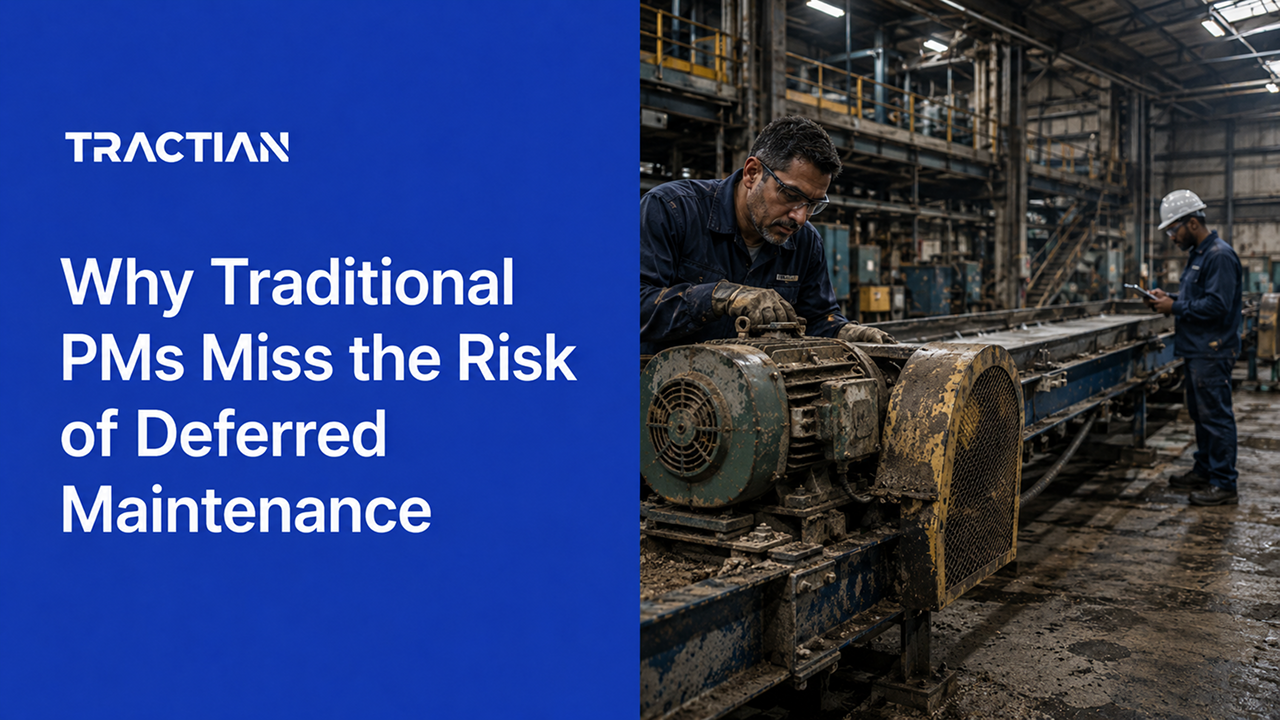
It started with one motor and it’s deferred PM
At one point, a motor's quarterly bearing inspection was pushed back because production wouldn't release the asset. Then it got pushed again because three emergency work orders came in the same week. By the time the backlog cleared enough to revisit that motor, six months had passed without anyone confirming whether the bearing was still in acceptable condition.
The PM program now showed two missed tasks, one of which was the motor. Unfortunately, it didn’t show that pushing the motor’s PM had turned a $200 inspection into a $15,000 failure, just in parts alone. When you take into account that the failure caused more downtime than the originally scheduled PM, the final breakdown costs highlight a lack of leadership, foresight, and operational clarity.
Deferrals are a structural problem
This is the structural problem with how most preventive maintenance programs handle deferrals. Even if a program tracks whether tasks were completed, that’s not the same as tracking whether the tasks that weren't completed are compounding into a reliability risk that nobody can see or quantify. PM compliance numbers can look acceptable even as the assets behind those numbers quietly move closer to failure, because the metric was designed to measure scheduling discipline, not asset health.
This article examines why traditional PM programs structurally miss the risk of deferred maintenance, how that risk compounds when teams lack visibility into equipment condition between completed intervals, and what it takes to close the gap between compliance reporting and actual asset reliability.
What PM Compliance Actually Measures
Preventive maintenance compliance tracks whether scheduled tasks were completed on time. It doesn't measure the risk of the ones that weren't.
Most PM programs define "on time" using the 10% rule, which means a task must be completed within 10% of its preventive maintenance schedule interval to count as compliant. A monthly PM has a window of roughly three days on either side. Hit that window on 90% of your scheduled tasks and, by SMRP Best Practice standards, you're operating at a world-class level. Fall below 80%, and the program is considered ineffective.
That benchmark is useful for what it measures, which is execution discipline. But that benchmark (though valuable) still leaves a glaring information gap, which is unmeasured..
A glaring information gap
When a PM is deferred, the compliance percentage drops by the same amount regardless of what that deferral means for the equipment. A skipped lubrication task on a critical compressor and a postponed visual inspection on a non-critical ventilation fan both register as one missed PM. The program treats them equally because compliance is a volume metric rather than a consequence metric.
There is a notable structural blind spot between volume and consequence. The schedule assumes each interval is independent. It doesn't account for what happens to the asset's failure mode trajectory between a skipped interval and the next completed one.
A deferred bearing inspection doesn't pause the bearing's degradation. The wear continues whether or not the task gets rescheduled. But the PM program has no way to reflect that progression. It can tell the maintenance manager that 12 PMs were missed last month. It can't tell them which of those 12 are now approaching a failure threshold.
Deloitte's research on predictive maintenance and the smart factory found that poor maintenance strategies can reduce a facility's productive capacity by 5 to 20%. That kind of capacity erosion doesn't always announce itself through a dramatic breakdown. Often, it accumulates quietly through deferred tasks, so that the compliance number is treated as equivalent.
How Deferred Maintenance Compounds Without Visibility
A single deferral amounts to no more than a scheduling decision. But repeated deferrals without condition data become an unquantified reliability exposure.
Consider a quarterly bearing inspection on a cooling tower fan motor, where the PM is deferred just once because production can't release the asset during a high-demand period. We can say that's probably a reasonable call. Now, let’s say it gets deferred the following quarter again because the technician maintenance backlog is already three weeks deep and higher-priority emergency work keeps pulling the team away. And finally, six months have passed without the inspection that was designed to catch early-stage wear before it progresses into a more expensive problem.
The backlog continues to grow, but the backlog amount doesn't differentiate this bearing from a dozen lower-risk items sitting behind it. It turns out that this facility is like most and tracks backlog in work order count or estimated labor hours.
The bearing, we know, is on the brink of failure. But neither metric in use tells the maintenance manager which deferred maintenance items are approaching failure and which are genuinely safe to push another cycle.
What happens between skipped intervals
What’s about to happen should be obvious. But without the right data and program structure, the blind spots don’t reveal what should be expected. The failure mode the PM was designed to interrupt continues advancing along the P-F curve, the progression from the point where a potential failure becomes detectable to the point where functional failure occurs. Each skipped interval had narrowed the remaining window for intervention, but the PM program had no mechanism to show the team how much of that window remained. The schedule only knew the task was overdue.
When deferrals become failures
When the deferred task eventually results in an equipment failure, the cost isn’t limited to the original component. And it rarely is. The bearing that should have been inspected at a few hundred dollars in labor can seize, overheat, and damage the shaft, motor, and coupling it's connected to. The U.S. Department of Energy documents that reactive maintenance costs 3 to 5 times more than planned preventive work when emergency labor, expedited parts, production losses, and cascading damage are all accounted for.
And this is exactly what happened in the facility. But, to frame the issue properly, the question for the facility wasn’t whether to defer. Sometimes deferral is the right operational decision. The question should have been whether the team had the information to know when deferral wasn’t the right decision. In most PM programs, that information doesn't exist because the program was built to manage schedules, not to continuously monitor equipment conditions.
What Closes the Gap Between Compliance and Risk
The missing layer is condition-based evidence. It converts deferrals from scheduling unknowns into decisions the team can defend.
When a PM is deferred, the question that should drive the next decision isn't whether to reschedule. The question should be “What is the current condition of the equipment that PM is supposed to protect?” Has anything changed since the last completed interval? Condition monitoring answers that question by providing continuous visibility into parameters indicating whether a failure mode is progressing.
With that visibility in place, a deferred lubrication task on a motor no longer remains an open-ended uncertainty. Vibration and ultrasound data can show whether bearing friction has increased since the last completed interval. If the readings are stable, the deferral is a supported decision. If the readings have shifted, the team knows to prioritize the intervention before the failure advances further along the asset's remaining useful life.
From flat backlog to risk register
The most effective programs take this further by weighing deferrals against the results of criticality analysis.
Not every deferred task carries the same consequence. A skipped PM on a redundant pump with a backup in service is fundamentally different from a deferred inspection on the only compressor feeding a production line. When condition-based maintenance data is combined with an asset's criticality classification, the backlog transforms from a flat work order list into a prioritized risk register where the team can see exactly which deferrals need immediate attention and which can safely wait.
The operational outcomes follow directly from this.
- Reactive maintenance drops because the deferrals that matter get caught before they escalate into unplanned downtime.
- Mean Time Between Failure (MTBF) improves because interventions happen at the right point in the failure progression rather than on a fixed calendar that can't account for actual equipment behavior.
- The team can demonstrate to leadership that deferral decisions are evidence-based, not assumption-based, which changes how maintenance risk is discussed at the operational level.
How Tractian Delivers the Condition Layer Traditional PMs Lack
Tractian's condition monitoring is built to close the gap between PM compliance and actual asset risk.
Tractian's Smart Trac wireless sensors continuously track vibration, ultrasound, temperature, and RPM on rotating equipment, providing real-time visibility into the failure modes that deferred PMs were designed to prevent. When a task gets pushed, the team doesn't lose sight of what's happening on the machine. The sensor is still sampling, and Tractian's AI-powered Auto Diagnosis identifies all major failure modes automatically, flagging when an asset's condition has deteriorated beyond safe operating parameters.
Each alert specifies the failure mode, its severity, and prescriptive next steps, so the team knows exactly what the deferral has cost in terms of asset health and what to do about it.
Criticality-based alerting adjusts the urgency of these notifications based on how critical the asset is to production. A deferred PM on a high-criticality compressor triggers earlier intervention thresholds than the same condition on a redundant backup unit. The system itself prioritizes deferrals with the highest consequences, which is precisely the capability that traditional PM schedules lack.
What makes Tractian's approach distinct is that condition intelligence doesn't stop at detection. It feeds directly into Tractian's maintenance execution platform, where a sensor insight about a degrading bearing on a deferred asset can generate a prioritized work order with diagnostic context, recommended procedures, and parts information already attached.
The gap between identifying a risk and acting on it gets closed within the same system. Instead of monitoring in one tool and executing in another, the entire loop from detection to resolution runs on a single, connected platform, so nothing falls through the handoff.
Learn more about Tractian's condition monitoring solution to see how high-quality, decision-grade IoT data transforms your maintenance program into AI-powered closed-loop workflows.
FAQs about Deferred Maintenance
What is deferred maintenance?
Deferred maintenance is the postponement of scheduled maintenance tasks, usually due to production pressure, resource constraints, or budget limitations. It becomes a reliability risk when deferrals accumulate without visibility into how the equipment condition has changed since the last completed task.
How does deferred maintenance affect PM compliance?
Each deferred PM lowers the compliance rate, but the metric doesn't weight deferrals by consequence. A facility can report acceptable compliance while carrying significant unquantified risk on deferred tasks that protect critical assets.
Can you defer a PM without increasing risk?
Yes, when the team has condition data confirming the asset is still operating within safe parameters. Without that evidence, every deferral is an assumption about asset health rather than an informed decision.
What's the difference between a maintenance backlog and deferred maintenance risk?
Backlog measures the volume of outstanding work. Deferred maintenance risk measures the consequence of that work not being done. A backlog weighted by asset criticality and condition data is a risk register. A backlog, as counted in work orders, is a list.
How does condition monitoring reduce deferred maintenance risk?
Continuous condition data provides real-time visibility into asset health between PM intervals. When a task is deferred, the team can see whether the failure mode has progressed or the asset remains in acceptable condition, enabling informed decisions.
What should I look for in a system that helps manage deferred maintenance?
Prioritize platforms that combine continuous multimodal sensing with AI-powered diagnostics and direct integration with maintenance execution workflows. The value comes from the system's ability to identify what's wrong, how severe it is, and what to do next, not just that something changed.