
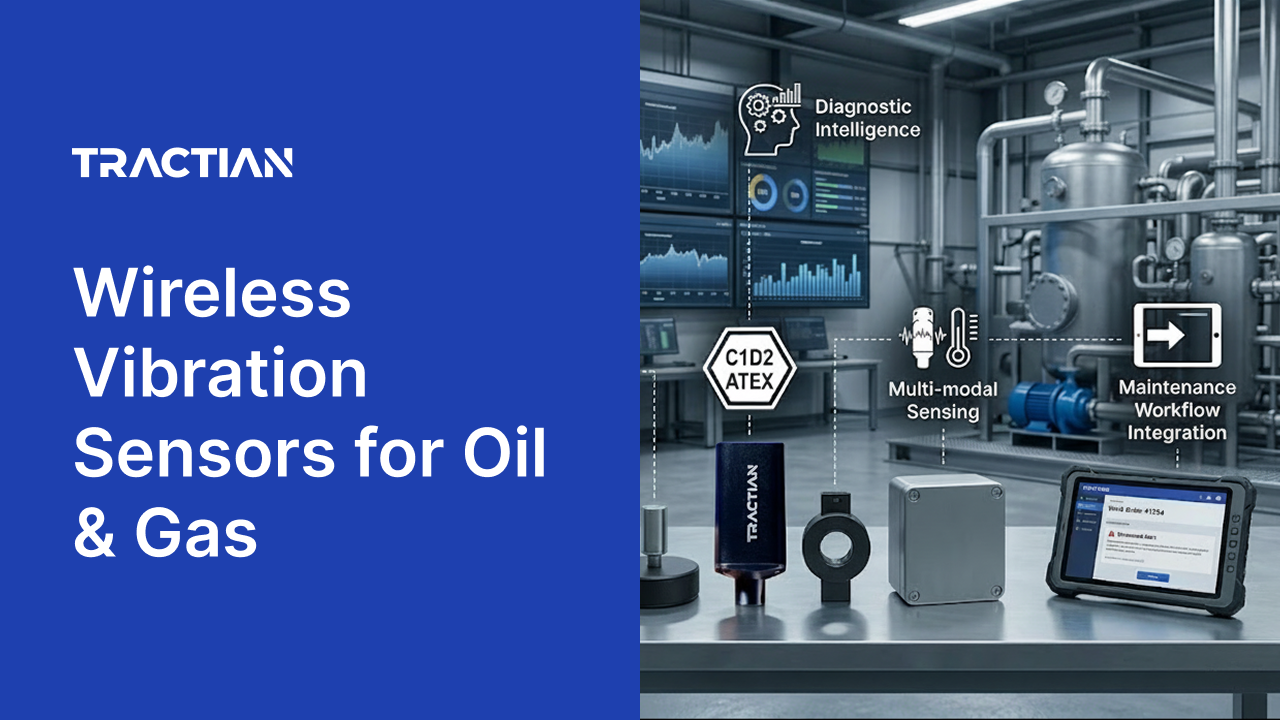
Wireless vibration sensors are the data acquisition layer of any condition monitoring program. They attach to rotating equipment, capture vibration signatures and other machine health parameters, and transmit that data wirelessly to a platform where it can be analyzed and acted on. In general industrial settings, the primary selection criteria tend to center on frequency range, sampling rate, battery life, and connectivity. Oil and gas operations add layers of complexity that reshape which criteria actually matter.
What's Different About Wireless Vibration Sensors in Oil & Gas?
Hazardous area classifications govern what equipment can be deployed and where. Assets and facilities operate in environments where a sensor without the right certification cannot legally be installed. Beyond certification, the assets themselves are diverse, and their failure carries high consequences. Their profiles may differ, but they all require accurate fault identification before conditions escalate into safety events or production losses.
An important distinction should also be made here. The performance output between a standalone sensor system and a more complete condition-based maintenance solution can be a primary competitive consideration. A sensor that captures vibration data and displays it on a dashboard provides visibility. A sensor embedded within an integrated condition monitoring platform, one that includes AI-powered diagnostics, prescriptive guidance, and a direct connection to maintenance execution, provides decision confidence.
In oil and gas, where the cost of a missed or misinterpreted alert compounds quickly across safety, environmental, and production dimensions, the difference between those two outcomes defines whether a monitoring program reduces risk or simply documents it.
What to Prioritize When Selecting Wireless Vibration Sensors for Oil & Gas
Choosing wireless vibration monitoring equipment for oil and gas has implications that extend beyond which hardware to procure. It's a reliability architecture decision that determines whether your condition monitoring program can scale across distributed operations, deliver trusted diagnostics without a proportional increase in headcount, and connect sensor insights to the maintenance actions they're supposed to trigger.
The following priorities separate systems built to perform in oil and gas operating environments from those that were designed for less demanding conditions and adapted after the fact.
- Hazardous area certification breadth: Oil and gas facilities require sensors certified for the specific classifications present across their operations. ATEX, IECEx, and NFPA 70 Class I Division I ratings are baseline requirements for many deployment locations. Sensors with narrower certifications limit where they can be installed, creating coverage gaps on the assets that carry the highest consequence of failure.
- Multi-modal sensing for broader fault coverage: Vibration alone doesn't catch everything. The more parameters a single sensor captures (such as ultrasound, vibration, magnetic field, and temperature), the fewer devices and integration points the program requires.
- Diagnostic autonomy independent of analyst availability: Oil and gas maintenance teams face compounding labor pressures. A sensor system that collects data but requires a certified vibration analyst to interpret every alert creates a bottleneck that worsens as programs scale. Prioritize platforms where the AI identifies the specific failure mode, rates its severity, and recommends an action, so teams can act without waiting for specialist interpretation.
- Native integration with maintenance execution: The value of a condition monitoring insight degrades with every manual handoff. The path from sensor alert to executed work order should be as direct as possible. Systems where condition data flows automatically into work order management, with diagnostic context and recommended procedures, eliminate the translation gap that delays response.
How Oil & Gas Condition Monitoring Programs Benefit From Wireless Vibration Sensors
When wireless vibration sensors deliver on the priorities above, they don't just add data to a maintenance team's workflow. They restructure how oil and gas facilities manage across their hazardous, distributed, and labor-constrained operations. The shift from periodic manual collection to continuous, AI-driven condition monitoring changes what teams can see, how fast they can respond, and how confidently they can act.
The following downstream benefits define what competitive wireless vibration sensor programs enable for oil and gas maintenance teams.
- Maintenance decisions driven by real-time asset conditions: When equipment health is visible continuously, teams stop maintaining on schedule and start maintaining on evidence. Preventive maintenance intervals that were set conservatively because no one had better information can be extended or tightened based on what the equipment is actually telling you. The result is fewer unnecessary interventions on healthy machines and faster action on the ones that need it.
- Extended asset lifecycles: Catching a lubrication issue, a developing misalignment, or early bearing wear weeks before it reaches a critical threshold means the corrective action is smaller, less costly, and less disruptive. Equipment that would have run to failure or been pulled offline for a major repair stays in service longer because the problems were addressed when they were still minor. Over time, this compounds into measurably longer intervals between overhauls and replacements.
- Technician time shifts from data collection to maintenance execution: Route-based vibration collection programs in oil and gas consume significant labor hours, especially when measurement points are spread across remote or hazardous locations that require travel, permitting, and safety escorts. Continuous wireless monitoring eliminates those collection routes, freeing technicians to spend their time executing repairs, verifying corrective actions, and supporting production rather than walking routes with handheld instruments.
- Fewer safety incidents tied to emergency repairs and unplanned failures: Unplanned failures in oil and gas create emergency maintenance scenarios that carry elevated risk: rushed work in hazardous areas, improvised procedures, and pressure to restore production as quickly as possible. When the monitoring program catches problems early enough to plan the response, maintenance happens on the team's terms, with proper isolation, permitting, and preparation, rather than under emergency conditions.
Oil & Gas Wireless Vibration Sensors at a Glance
| Feature | Tractian / Smart Trac | Emerson / AMS 9530 | Bently Nevada / Ranger Pro | SKF / IMx-1 |
|---|---|---|---|---|
| Score | 6/6 | 2/6 | 1/6 | 1/6 |
| Ultrasound Sensing | ✅ Built into sensor | ❌ | ❌ | ❌ |
| Magnetic Field Sensing | ✅ | ❌ | ❌ | ❌ |
| Hazardous Area Certification (Class I Div 1 / Zone 0-1) | ✅ | ✅ | ✅ | ✅ |
| AI Auto-Diagnosis of Specific Failure Modes | ✅ 75+ failure modes | ✅ Via embedded analytics | ❌ | ❌ Anomaly detection only |
| Prescriptive Alerts with Maintenance Procedures | ✅ | ❌ | ❌ | ❌ |
| Native CMMS | ✅ | ❌ | ❌ | ❌ |
Top Oil & Gas Wireless Vibration Sensors
The following are the top companies offering wireless vibration sensors for oil and gas, beginning with Tractian, which integrates vibration sensing into a multimodal, closed-loop condition-monitoring and maintenance-execution platform.
Tractian Smart Trac
Best for: Oil and gas facilities that need multi-modal sensing, AI-powered diagnostics, and native maintenance execution integration in a single platform, with hazardous area certifications covering the most restrictive classifications across upstream, midstream, and downstream operations.
Tractian's condition monitoring solution is built around the Smart Trac sensor, a wireless device that combines four sensing technologies in one unit: triaxial vibration (0 to 64,000 Hz), piezoelectric ultrasound (up to 200 kHz), magnetometer-based RPM tracking (1 to 15,000 RPM), and surface temperature (-40°F to 250°F).
Watch how it works: Vibration and Ultrasound in One Sensor Redefines Predictive Maintenance
The sensor is certified for ATEX, IECEx, and NFPA 70 Class 1, 2, and 3, all Division I, covering the most restrictive hazardous area classifications in oil and gas. IP69K-rated and resistant to hydrocarbons, fuels, acids, and seawater, it operates across the chemical and thermal extremes that define refinery, offshore, and processing environments.
Communication runs over sub-GHz frequencies to the Smart Receiver, which transmits data to the cloud via 4G/LTE with no dependency on plant Wi-Fi. Patented features include Always Listening for intermittent machines, RPM Encoder for variable-speed equipment, and Ultrasync for multi-sensor correlation across a single asset.
What sets Tractian apart from every other option on this list is what happens after the sensor captures data. The AI-powered platform auto-diagnoses all major failure modes using patented algorithms trained on 3.5 billion+ collected samples, delivering prescriptive alerts that tell the team exactly what's wrong, how severe it is, and what to do next.
Supervised Analysis provides expert-validated reports for complex cases, giving teams without in-house vibration specialists the confidence to act. And because Tractian's condition monitoring is natively integrated with its CMMS and Asset Performance Management module, sensor insights automatically generate prioritized work orders with diagnostic context and recommended procedures. There's no handoff to a separate system. Sensors, diagnostics, and maintenance execution operate as one platform, which is what makes Tractian's approach fundamentally different from systems that stop at data collection or require third-party tools to close the loop.
Notable features
- Multi-modal sensing in a single sensor: Vibration, ultrasound, magnetic field, and temperature captured in one IP69K-rated, Division I-certified device. This breadth of sensing in a single unit eliminates the need for separate sensor types to cover different fault categories across oil and gas asset populations.
- Auto-diagnosis across all major failure modes with prescriptive actions: Patented AI identifies specific faults, rates severity based on asset criticality, and attaches validated maintenance procedures from the Procedures Library. Teams receive clear direction without waiting for specialist interpretation.
- Native maintenance execution with automatic work order generation: Condition insights trigger prioritized work orders directly within the platform, complete with procedures, task assignments, and inventory links. The mobile app supports offline execution, QR code asset access, and built-in team communication for field teams in remote or connectivity-limited locations.
- Adaptive AI with human-in-the-loop learning: The system adapts to each machine's operating context, including load, speed, and ambient conditions. An adaptable temperature algorithm uses five years of local weather data to distinguish environmental temperature swings from machine-generated heat, which is particularly relevant for outdoor oil and gas assets exposed to wide seasonal variation.
- Cellular connectivity with no plant Wi-Fi dependency: Sub-GHz communication to the Smart Receiver, which transmits over 4G/LTE. Indoor range of 330 feet, with up to 100 sensors per receiver. 48-hour offline storage ensures no data loss during connectivity interruptions, a common reality in remote upstream and midstream installations.
Why real customers choose Tractian’s Wireless Vibration Sensors
- “We observed many recurring lubrication failure insights. We revised our maintenance plan, and today we no longer have this type of failure. We were able to train the sensor by providing feedback on the insights related to material changeovers.” says William C., Maintenance Coordinator
- “I'm really impressed by the reliability metrics that Tractian is able to calculate in real time, and the level of detail when it comes to the failure modes and the insight generation. Tractian has really improved our asset availability.” says Gautam Sane, Senior Reliability Engineer
- “For the first time, we can clearly see what’s happening on the floor before a failure hits. That kind of visibility is a game-changer.” says Trevor Baker, Sr. Manager, Manufacturing Strategic Initiatives
What Industries use Tractian Wireless Vibration Sensors?
Tractian's wireless vibration sensors are deployed across industrial sectors where the reliability of rotating equipment, production continuity, and worker safety directly affect output and operating costs. These teams manage diverse asset populations running under demanding conditions and need accurate, fault-specific vibration diagnostics without adding analytical complexity to daily operations.
- Oil and Gas refineries and upstream operations use Tractian's ATEX/IECEx-certified sensors to monitor critical rotating assets in hazardous and remote locations.
- Mining and Metals operations use Tractian to monitor vibration signatures on crushers, conveyors, mills, and pumps operating under heavy loads in remote or extreme environments.
- Chemical plants deploy Tractian on pumps, mixers, compressors, and agitators that run within tightly controlled process conditions in hazardous areas.
- Mills and Agriculture processors rely on Tractian's vibration monitoring to protect equipment running at peak capacity during seasonal harvests.
- Manufacturing facilities use Tractian to maintain uptime across motors, gearboxes, fans, and production line equipment, with vibration data feeding directly into the native CMMS.
- Heavy Equipment operators use Tractian to detect developing vibration faults on high-value mobile and stationary assets across job sites.
- Food and Beverage producers monitor equipment vibration tied to temperature control, hygienic processes, and product consistency.
- Automotive and Parts manufacturers deploy Tractian on high-precision machinery, robotics, and automated assembly systems where even minor vibration anomalies can affect product quality.
Tractian is trusted across industries by companies such as DHL, Ingredion, and CP Kelco, who use the platform to support equipment reliability, meet compliance requirements, and scale consistent maintenance practices across their operations.
See How CZM Uses AI to Cut Downtime Across 500+ Heavy Equipment
Emerson AMS 9530
Best for: Oil and gas facilities with existing WirelessHART infrastructure and dedicated vibration analysis staff who can interpret condition data within the company's process control ecosystem.
Emerson provides a wireless vibration monitor that captures triaxial vibration and temperature data over WirelessHART mesh networks. The sensor is certified for Class I Division 1, ATEX, and IECEx Zone 0, and measures vibration up to 20 kHz.
For oil and gas facilities already operating within the company's process automation ecosystem, the sensor connects to the existing wireless gateway infrastructure, reducing the networking effort associated with deployment.
The system captures vibration and temperature. It does not include ultrasound sensing, which limits early-stage fault detection on low-speed equipment common in upstream pump applications. There is no magnetometer for RPM tracking, so analysis of variable-speed equipment requires external speed references. The analysis software is desktop-oriented, and the platform, as of March 2026, does not include native maintenance management capabilities.
Notable features
- Envelope detection analytics: A patented algorithm processes vibration data to surface indicators for bearing severity, lubrication condition, and mechanical health.
- WirelessHART mesh networking: The sensor communicates over self-organizing wireless mesh networks compatible with the company's existing process control infrastructure.
- Hazardous area certification: Rated for Class I Division 1, ATEX, and IECEx Zone 0, covering the most restrictive classified areas in oil and gas facilities.
Potential downsides
As of March, 2026:
- No native maintenance workflow integration: Condition monitoring insights must be transferred to a separate CMMS or EAM system to generate work orders, introducing additional steps between detection and maintenance action.
- Vibration and temperature only: The sensor does not include ultrasound or magnetic field measurement. Fault coverage for low-speed and variable-speed equipment is narrower than that of platforms offering multi-modal sensing in a single device.
- Analyst-dependent interpretation: The analysis software is oriented toward vibration specialists, which means teams without dedicated analysts on staff rely on external expertise to interpret alerts as the number of monitored assets grows.
Bently Nevada Ranger Pro
Best for: Oil and gas operations with critical turbomachinery that already use the company's rack-based protection systems and need to extend wireless condition monitoring to secondary rotating equipment.
Bently Nevada, a Baker Hughes business, provides the Ranger Pro wireless sensor, which captures triaxial vibration, velocity, and temperature data with an envelope analysis capability for bearing fault detection.
The sensor is certified for Class I, Division 1, and carries ATEX/IECEx ratings, with an IP67 enclosure and a battery life of up to 5 years. It communicates over the ISA100 or WirelessHART protocols and integrates with the company's condition-monitoring and diagnostics software platform.
The software platform was built for turbomachinery specialists in control room environments. The sensor measures vibration and temperature and does not include ultrasound or a magnetometer for magnetic-field-based RPM tracking. It does not include ultrasonic sensing or a magnetometer for magnetic-field-based RPM tracking, as of March 2026. The platform does not include native CMMS functionality for work order management or technician execution, requiring the use of other vendors.
Notable features
- Envelope analysis for bearing detection: The sensor includes an envelope processing capability that isolates high-frequency bearing fault signatures from background machine vibration.
- Hazardous area certification with high-temperature option: Class I Division 1, ATEX/IECEx certified, with a tethered version that operates up to 257°F for thermally demanding oil and gas applications.
- Integration with rack-based protection systems: The wireless sensor complements the company's existing online protection hardware, allowing facilities to extend coverage from critical turbomachinery to secondary rotating assets within a single software environment.
Potential downsides
As of March 2026:
- Analyst-oriented platform: The diagnostic software is designed for vibration specialists in control rooms.
- Multi-vendor dependency for AI diagnostics: Prescriptive diagnostic intelligence is available through a partnership with a separate company, meaning sensor hardware and AI analysis come from different vendors.
- No native maintenance execution: The platform integrates with third-party CMMS and EAM systems but does not include work order management, task assignment, or technician-facing mobile execution tools within the condition monitoring platform itself.
SKF IMx-1
Best for: Facilities that already purchase bearings and rotating equipment components from the company and want to add wireless vibration monitoring to their existing relationship, with optional remote diagnostic services.
SKF provides a wireless vibration and temperature sensor that communicates over a mesh network, where sensors relay data to one another. The sensor measures vibration with a fixed maximum frequency of 10 kHz for acceleration, includes envelope-processing capability for early bearing and gear damage detection, and carries an IP69K rating. An ATEX/IECEx-certified variant is available for Zone 1 and Zone 2 hazardous areas, developed specifically for oil and gas and petrochemical environments.
The company's on-premises analysis software provides condition monitoring, visualization, and data management. Remote diagnostic services, staffed by the company's reliability engineers, offer analyst support for facilities without in-house vibration expertise.
Condition monitoring is one product line within a much larger business centered on bearings, seals, and lubrication systems. As of March 2026, the platform does not include native CMMS or maintenance execution capabilities. The sensor measures vibration and temperature only. There is no ultrasound or magnetometer, and the fixed 10 kHz frequency ceiling narrows the range of detectable fault signatures compared to sensors with broader frequency responses.
Notable features
- ATEX/IECEx-certified hazardous area variant: A sensor version rated for Zone 1 and Zone 2 classified areas, developed for deployment in oil and gas and petrochemical environments.
- Mesh network communication: Sensors relay data between each other using a patented wireless protocol, extending network coverage without requiring a direct line of sight to every gateway.
- Remote diagnostic services: The company's reliability engineers provide remote analysis and recommendations, offering external expertise for facilities that don't maintain in-house vibration specialists.
Potential downsides
As of March 2026:
- No native maintenance execution: The platform does not include CMMS, work order management, or technician-facing tools, and the company's own factories use a third-party CMMS product for maintenance execution.
- Limited sensing parameters: The sensor captures vibration and temperature. There is no ultrasound for early-stage fault detection on slow-speed equipment, no magnetic field measurement for RPM tracking on variable-speed machinery, and the fixed 10 kHz frequency ceiling limits high-frequency analysis capability compared to sensors with broader response ranges.
Tractian Wireless Vibration Sensors for Oil & Gas
Are you ready to see the difference a multimodal wireless ultrasound and vibration sensor makes when integrated into a closed-loop condition-monitoring and maintenance-execution platform?
Explore Tractian's condition-monitoring platform to discover what your team can achieve when sensor data, AI diagnostics, and maintenance execution work together as a connected system.
FAQs: Frequently Asked Questions About Wireless Vibration Sensors
What hazardous area certifications should wireless vibration sensors have for oil and gas?
At minimum, sensors deployed in classified areas should carry ATEX, IECEx, and NFPA 70 Class I Division I ratings. The specific classification required depends on the zone or division where the sensor will be installed, but Division I and Zone 1 certifications cover the most restrictive environments found in refineries, processing facilities, and production platforms.
Why does multimodal sensing matter for oil and gas condition monitoring?
Oil and gas operations include asset types that produce different fault signatures at different frequencies. Ultrasound detects early-stage bearing wear, friction, and cavitation that vibration alone may miss, especially on low-speed equipment. Magnetic field sensing provides accurate RPM tracking on variable-speed machinery without external tachometers. A single sensor that captures multiple parameters reduces the device count and provides the diagnostic context needed for more accurate fault identification.
Can wireless vibration sensors work in remote oil and gas locations with limited connectivity?
Yes, but it depends on the communication architecture. Sensors that transmit over cellular networks (4G/LTE) via a receiver can operate independently of plant Wi-Fi or existing process control networks. Offline data storage on the sensor itself ensures no data is lost during connectivity interruptions. Tractian's Smart Trac sensor stores up to 48 hours of data offline and communicates through its Smart Receiver over 4G/LTE.
Do oil and gas teams need vibration analysts on staff to use wireless condition monitoring sensors?
It depends on the platform. Systems with AI-driven auto-diagnosis that identify specific failure modes and provide prescriptive guidance reduce the need for specialist interpretation. Tractian's platform auto-diagnoses all major failure modes and attaches recommended procedures, while Supervised Analysis provides expert-validated reports for complex cases. Systems that provide anomaly alerts without fault-specific diagnosis still require analyst expertise to interpret each flagged condition.
How do wireless vibration sensors connect to maintenance workflows in oil and gas?
Some platforms offer native CMMS integration, in which sensor alerts automatically generate prioritized work orders with diagnostic context. Others require condition monitoring data to be exported or manually transferred to separate maintenance management systems. The difference determines whether the team can act on an insight immediately or whether there's a translation delay between detection and execution.
What types of oil and gas equipment benefit most from wireless vibration monitoring?
Compressors, pumps (centrifugal and reciprocating), turbomachinery, fans, blowers, gearboxes, and electric motors across upstream production, midstream transportation, and downstream refining and processing operations. Any rotating or reciprocating equipment where an unplanned failure carries safety, environmental, or production consequences is a candidate for continuous wireless monitoring.