
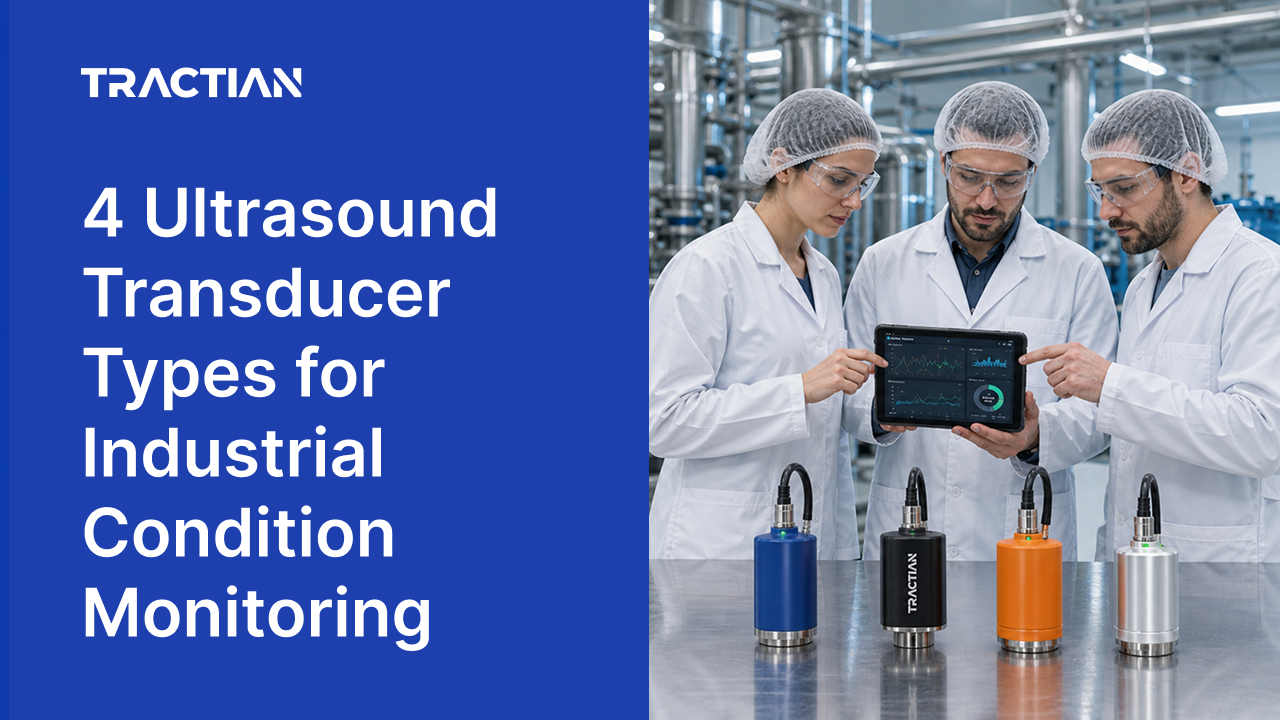
Key Points
- Ultrasound transducer types span more than a dozen designs across industries, but only four are relevant to industrial condition monitoring of rotating equipment.
- Each transducer type has a distinct detection profile. Resonant piezoelectric transducers remain the standard for diagnostic-quality fault detection in bearings and lubrication systems.
- Deployment mode, whether handheld, continuous single-technology, or multimodal continuous, determines whether a transducer's detection capability translates into actionable maintenance decisions.
Ultrasound transducers come in many forms
The term covers more than a dozen distinct designs across medical imaging, non-destructive testing, aerospace, and industrial maintenance. Most of those designs have nothing to do with monitoring rotating equipment on a plant floor. For maintenance and reliability teams evaluating ultrasonic condition-based maintenance, the relevant options narrow to four transducer types, each with a specific detection profile, equipment fit, and set of limitations.
This article covers those four types, explains how deployment mode shapes their practical value, and shows where each fits within a monitoring program designed to build diagnostic confidence.
Why Most Ultrasound Transducer Types Don't Apply to Your Plant
- Medical imaging transducers, such as linear array, convex, and phased array designs, operate at frequencies between 1 and 15 MHz and are engineered to produce detailed images of soft tissue.
- NDT transducers, including immersion, angle beam, and dual-element designs, operate at 0.5 to 25 MHz and are built for structural integrity testing of welds, pipes, and pressure vessels.
- Aerospace and defense applications add electromagnetic acoustic transducers (EMATs), laser ultrasonics, and magnetostrictive devices.
The total count across all industries easily exceeds a dozen distinct types.
The fundamental reason that none of the above applies to machine condition monitoring is that ultrasonic transducers operate passively. They don't emit ultrasonic pulses and analyze reflections the way NDT and medical transducers do. They listen for acoustic emissions produced by friction, micro-impacts, cavitation, and turbulence on rotating equipment, at frequencies between 20 kHz and 200 kHz.
That passive, receive-only operation within a significantly lower frequency range is a different engineering problem, and it narrows the relevant transducer landscape to four types that maintenance and reliability teams will actually encounter.
4 Ultrasound Transducer Types for Condition Monitoring
Each transducer type has a specific detection profile, and the differences between them determine which faults your program can catch and at what stage of progression.
Resonant piezoelectric (PZT) contact transducers
The most widely used transducer type in industrial condition monitoring is the resonant piezoelectric contact transducer. Its core element is a bulk ceramic material, most commonly lead zirconate titanate (PZT), shaped and mounted to achieve peak sensitivity at a specific resonant frequency. In condition monitoring applications, that resonant frequency typically falls between 25 kHz and 40 kHz, placing it in the range where lubrication breakdown, early bearing wear, and cavitation produce their strongest acoustic signatures.
What makes this transducer effective is the physics of resonance. At its designed frequency, the PZT element converts mechanical stress waves from the equipment surface into electrical signals with a high signal-to-noise ratio. Research confirms that bearing fault energy in the earliest stage of degradation appears at ultrasonic frequencies between approximately 20,000 and 60,000 Hz, which is exactly the window where resonant PZT transducers perform best.
The resonant design concentrates sensitivity where ultrasound provides unique diagnostic value rather than distributing it across a wider bandwidth at lower peak performance. In a standalone handheld instrument, this means excellent detection within the resonant window and less coverage outside of it. In a multimodal system where the ultrasonic element operates alongside a vibration sensor covering lower frequencies, the concentrated sensitivity becomes a deliberate engineering advantage. Each channel handles the frequency range it's best suited for. This is the transducer type used in both traditional handheld ultrasound instruments and advanced continuous monitoring devices such as Tractian's Smart Trac.
Broadband piezoelectric composite transducers
Rather than a solid ceramic element, broadband composite transducers are built from piezoelectric composite materials, typically ceramic rods or pillars embedded in a polymer matrix. This composite structure produces a flatter frequency response across a wider bandwidth than a resonant PZT design can achieve.
The practical advantage is consistency across a wider frequency range from a single measurement. A resonant transducer delivers excellent results when the fault's frequency signature aligns with the sensor's resonant peak, but detection quality drops when the signature falls outside that window. A broadband composite reduces that variability, which matters most in single-transducer deployments where no other sensing modality covers the gaps.
The trade-off runs in the other direction. Peak sensitivity at any single frequency is typically lower than what a resonant design optimized for that frequency can achieve. This makes broadband composites best suited to advanced handheld inspection instruments, where breadth of coverage from one element is the priority.
In multimodal devices that pair ultrasound with vibration, the broadband advantage isn’t relevant because the combined system already covers the full spectrum through complementary channels.
MEMS ultrasonic transducers
MEMS (micro-electro-mechanical systems) ultrasonic transducers are fabricated using semiconductor processes, making them significantly smaller and more power-efficient than bulk piezoelectric designs. For industrial condition monitoring, they represent an emerging technology with clear advantages in miniaturization and manufacturing cost at scale.
However, current MEMS transducers face meaningful limitations in this application. They typically provide a narrower frequency range, lower sensitivity, and reduced dynamic range compared to bulk PZT. For the earliest stages of bearing degradation, where fault energy concentrates at higher ultrasonic frequencies, MEMS-based sensors may not register a response that a piezoelectric transducer would catch.
Where MEMS transducers gain traction is in IoT-oriented deployments that prioritize widespread, low-cost coverage over maximum diagnostic sensitivity per measurement point. They don’t displace piezoelectric transducers as the primary technology for diagnostic-quality condition-based monitoring, but they are expanding the range of assets that can receive at least a basic level of ultrasonic coverage.
Airborne ultrasound transducers
Airborne transducers detect ultrasound traveling through air rather than through the equipment structure. The sensing element is typically an electret or capacitive microphone designed for high-frequency acoustic detection.
They serve a fundamentally different function than structure-borne types. The primary applications are compressed air leak detection, electrical inspection for corona, arcing, and tracking on switchgear and distribution systems, and steam trap and valve testing. Because ultrasonic wavelengths are short and highly directional, airborne transducers allow technicians to pinpoint leak locations even in loud plant environments where audible noise would mask the source.
The important distinction for teams evaluating their monitoring program is that airborne transducers don't detect bearing faults or lubrication breakdown. Research published by Bearing News confirms that approximately 80% of premature bearing failures trace back to improper lubrication, making structure-borne detection the priority for the health of rotating equipment.
Airborne transducers complement that capability by addressing energy waste and electrical reliability, which is why comprehensive predictive maintenance programs incorporate both.
How Deployment Mode Shapes What a Transducer Can Deliver
Selecting the right transducer type is only half the decision. How that transducer is deployed determines whether its detection capability translates into timely, actionable insight or retrospective data that arrives too late.
Handheld route-based deployment
Data is collected periodically during scheduled technician rounds. A resonant PZT transducer in a handheld instrument might deliver excellent detection sensitivity, but only when the technician is standing at the measurement point with the probe coupled to the surface. Between rounds, whether weekly or monthly, developing faults are invisible.
For slow-developing conditions like gradual lubrication degradation, a monthly route may catch the issue with enough lead time. For faster-progressing faults, the detection window narrows or closes entirely. And in plants facing the labor pressures that many US facilities are experiencing, route schedules are often the first casualty when headcount tightens.
Continuous single-technology deployment
Permanently mounting the transducer eliminates route dependency. The sensor collects ultrasound data at configurable intervals, whether every 10 minutes or every 30 minutes. The fault that would have been missed between handheld rounds is now visible as a trend.
But if the sensor captures only ultrasound, the team still needs separate vibration data from another instrument to characterize the fault. Detection improves. Interpretation remains fragmented because two data streams, collected on different timelines by different instruments, must be reconciled manually or through integration before a confident diagnosis is possible.
Multimodal continuous deployment
This is when the ultrasonic transducer is integrated with vibration, temperature, and RPM sensing in a single device. Data streams are correlated at the platform level, which means the ultrasound signal that flags early friction is immediately contextualized by the vibration spectrum, operating speed, and temperature trend from the same measurement point at the same moment.
In a multimodal environment where a single device integrates the sensing technologies, the team doesn't need to spend time reconciling instruments. The platform’s software should be able to analyze and form its own diagnosis.
What’s critical to understand here is that the deployment choice is a program-architecture decision. It’s not a procurement decision. The deployment model has team-wide and production-wide consequences. It’s basically a plant-level impact.
Tractian Multimodal Monitoring
Tractian's Smart Trac sensor uses a dedicated resonant piezoelectric transducer sampling ultrasound up to 200 kHz, paired with a triaxial accelerometer covering 0 to 64,000 Hz, a magnetometer tracking RPM from 1 to 48,000, and continuous surface temperature measurement.
Four sensing modalities from a single measurement point, capturing both the earliest friction indicators and the full mechanical fault spectrum without separate instruments or reconciliation workflows.
The resonant PZT design is a deliberate choice within this architecture. Because the accelerometer already covers 0 to 64,000 Hz, the ultrasonic transducer's job is specifically the high-frequency range where friction, early wear, and cavitation live. Concentrated sensitivity in that range delivers maximum detection quality exactly where vibration analysis can't reach.
Tractian AI processes these correlated data streams using auto-diagnosis to identify all major failure modes. When the ultrasonic transducer detects increased friction in a bearing, the system cross-references vibration signatures, operating speed, and temperature context to determine what's failing, how severe it is, and what to do next.
That ultrasonic capability also enables condition-based lubrication. Instead of greasing bearings on a fixed calendar, maintenance teams apply lubricant based on actual friction levels, with the sensor confirming in real time that the intervention worked. For intermittent machines, the sensor's Always Listening feature ensures data is captured at exactly the right moment. For variable-speed equipment, the proprietary RPM Encoder adjusts analysis dynamically for accurate diagnosis at any operating speed.
And because Tractian's condition monitoring platform shares a unified ecosystem with its maintenance execution software and asset performance management module, detection doesn't stop at a dashboard. Condition insights generate prioritized work orders with attached procedures, assigned technicians, and linked inventory. Completed work orders feed back into the AI to improve future accuracy. It's a closed-loop system where the transducer's detection capability connects directly to the maintenance action it was designed to trigger.
Learn more about Tractian's multimodal condition monitoring platform to see how high-quality, decision-grade IoT data transforms your program into AI-powered closed-loop maintenance workflows.
FAQs about Ultrasound Transducer Types
What is the most common ultrasound transducer type used in industrial condition monitoring?
Resonant piezoelectric (PZT) contact transducers are the most widely used. Their concentrated sensitivity at target ultrasonic frequencies makes them the standard for detecting bearing faults, lubrication breakdown, and cavitation in rotating equipment.
Can one ultrasound transducer type detect all industrial fault types?
No. Structure-borne transducers (resonant PZT, broadband composite, and MEMS) detect mechanical faults like bearing wear and lubrication degradation. Airborne transducers detect compressed-air leaks, electrical discharges, and valve bypasses. A comprehensive program typically requires both categories.
What's the difference between a resonant and broadband ultrasonic transducer?
A resonant transducer delivers peak sensitivity at a specific frequency, producing a strong signal-to-noise ratio for faults in that range. A broadband composite transducer offers more uniform detection across a wider frequency range, with some trade-off in peak sensitivity. The choice depends on whether the transducer operates alone or alongside complementary sensing modalities.
Are MEMS ultrasonic transducers ready for industrial condition monitoring?
MEMS transducers offer advantages in size and power consumption, but they currently provide lower sensitivity and a narrower frequency range than bulk piezoelectric transducers. For diagnostic-quality condition monitoring, piezoelectric transducers remain the standard.
Does continuous ultrasonic monitoring replace vibration analysis?
No. Ultrasound detects the earliest indicators of friction and wear in the failure timeline. Vibration analysis provides diagnostic depth and fault characterization. The two technologies are complementary, covering different portions of the failure progression.
What frequency range do condition monitoring ultrasonic transducers operate in?
Typically, 20 kHz to 200 kHz. This is significantly lower than medical ultrasound transducers (1 to 15 MHz) or NDT transducers (0.5 to 25 MHz), reflecting the different detection requirements of passive acoustic emission monitoring.