
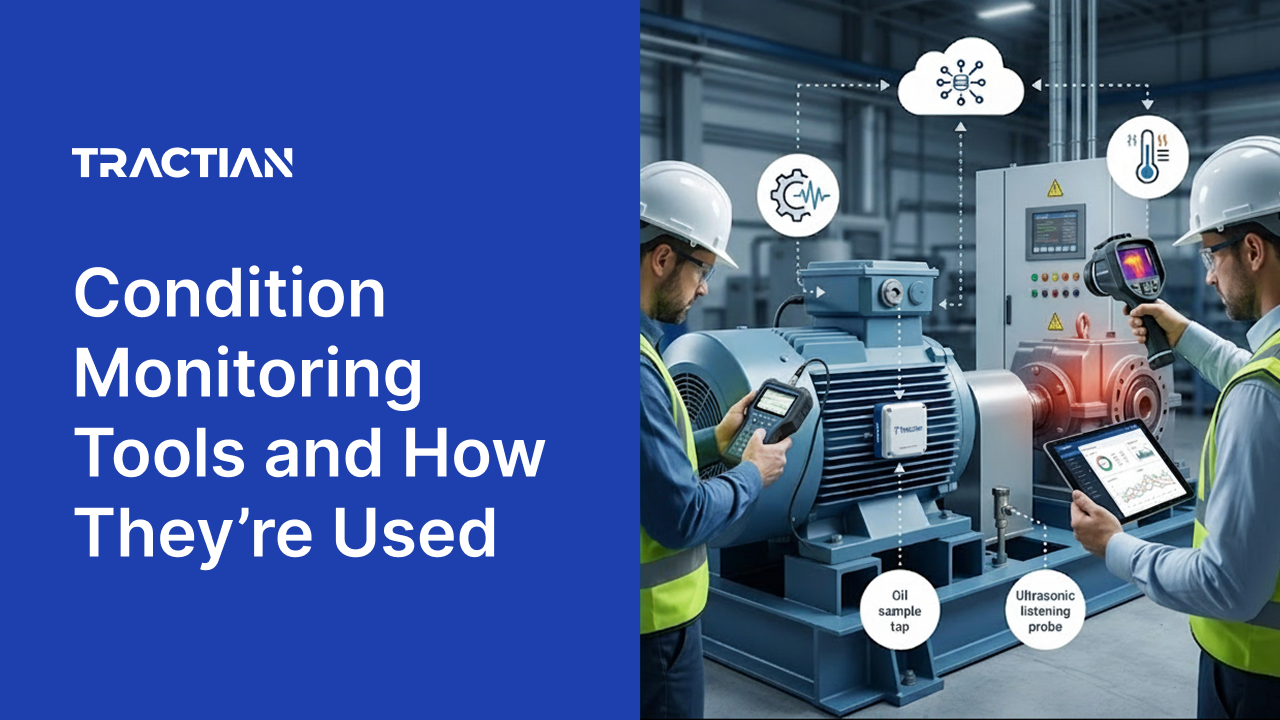
Key Points
- Each condition-monitoring tool detects a distinct class of failure signals, with different sensitivity ranges and optimal asset types.
- No single tool covers the full failure signature of a complex rotating asset. Decision confidence in a maintenance program comes from combining complementary techniques.
- The real measure of a condition monitoring tool is not what it detects. It is whether the detection leads to a clear, defensible maintenance action.
- Programs that consolidate signals from multiple tools into a unified asset view consistently outperform those that manage each technique in isolation.
Why the Tool You Choose Shapes the Decisions You Can Make
Selecting a condition-monitoring tool without matching it to the failure modes and operating conditions of your assets doesn't produce coverage. It produces blind spots you aren't aware of yet. Most reliability teams already know what the tools are.
The harder problem is understanding what each one actually enables at the decision level, because that's the dimension that determines whether a monitoring program drives action or generates data that waits to be interpreted.
Every technique has a defined position on the P-F curve, the interval between the earliest point at which a developing fault becomes detectable and the point of functional failure. Different tools detect different signal types at different points along that curve. Vibration analysis captures mechanical signatures as faults develop.
Ultrasonic monitoring detects friction and micro-impacts earlier, before mechanical movement changes. Oil analysis surfaces internal wear conditions that no external sensor can reach. Thermography reads thermal patterns across broad surface areas. Electrical monitoring catches motor circuit faults before they produce any mechanical symptoms.
Choosing among these without understanding where each fits means some portion of the failure timeline goes unmonitored, and faults that develop in that gap will not be caught until they've progressed into more expensive territory.
The Core Condition Monitoring Tools
Let’s explore five primary condition monitoring tools or techniques. And we’ll look beyond how each operates to what they enable downstream.
Vibration analysis
Vibration analysis is the foundational detection method for rotating equipment, and for most facilities, it's the starting point of any condition-based maintenance program.
Rotating assets generate characteristic vibration signatures during normal operation. When faults develop, those signatures change in specific, interpretable ways. Unbalance shifts the amplitude at running speed. Misalignment produces frequency patterns at one and two times the rotational frequency.
Bearing defects generate fault frequencies tied directly to bearing geometry, including ball-pass frequencies for the inner and outer races and the fundamental train frequency. Looseness appears as harmonic families. Each fault leaves a frequency fingerprint that spectral analysis can identify and track over time.
Vibration monitoring can take two forms: route-based collection using portable handheld instruments, or continuous data capture via wireless sensors. Both have a legitimate place in a well-structured program, but they serve different roles. A skilled analyst using a portable vibration analyzer can perform detailed spectral diagnostics that match continuous systems for analytical depth. For targeted investigations or post-repair verification, handheld instruments remain essential. The limitation is the collection frequency.
A fault that develops between route visits may not be detected until it has already passed the most cost-effective intervention point. Continuous wireless sensors eliminate that constraint, providing the data density needed for AI-powered diagnostics to identify fault mode and severity at any point in the operating cycle.
One boundary worth understanding: vibration analysis has a detection floor for certain failure modes. Lubrication-related deterioration, where the first sign is microscopic friction rather than mechanical movement, can begin well before vibration levels change. That gap is precisely what makes ultrasonic monitoring the natural complement.
Ultrasonic monitoring
Ultrasonic monitoring detects high-frequency signals generated by friction, micro-impacts, early-stage wear, leaks, and electrical arcing, and it does so earlier on the failure timeline than vibration analysis for lubrication-related and friction-based faults.
A bearing in the first stage of lubrication breakdown will emit ultrasonic noise from microscopic friction before any corresponding change appears in the vibration spectrum. By the time vibration confirms the fault, the window for low-cost intervention has already started to close. That earlier position on the P-F curve makes ultrasonic monitoring particularly valuable for managing bearing lubrication.
Teams can monitor conditions in real time, apply lubricant when the signal indicates a need rather than on a fixed schedule, and verify recovery afterward rather than assuming the issue has been resolved.
For slow-speed equipment, ultrasound is often the primary technique. At low RPM, conventional accelerometers generate low signal energy that limits their ability to detect early-stage faults. Ultrasound doesn't share that constraint. Beyond rotating machinery, the technique applies to leak detection in compressed air systems, steam trap verification, and the identification of electrical arcing or corona discharge.
Used together, the two techniques cover a substantially wider portion of the asset's failure timeline than either does independently. Ultrasound catches what vibration misses in early stages, and vibration tracks the mechanical progression that follows.
Oil analysis
Oil analysis treats the lubricant circulating through an asset as a direct source of information about internal machine condition, surfacing wear, and contamination data that no external sensor can access.
The fluid that passes through a gearbox, hydraulic system, or compressor carries traces of everything it contacts. Wear metal concentration, measured through spectrometric and ferrographic analysis, identifies which specific components are shedding particles and at what rate. Viscosity changes signal degradation, thermal stress, or incorrect lubricant grade. Additive depletion shows how much protective chemistry remains functional. Contamination markers, including water ingress and particulate debris, round out the picture of internal condition.
Oil analysis is primarily a periodic technique. Samples are collected at defined intervals, sent to a laboratory, and evaluated against established baselines. That cadence is a real constraint for fast-developing faults. Where it excels is in surfacing internal wear conditions that precede any detectable external signal and in confirming diagnoses that other tools have flagged.
When vibration data suggests a developing fault in a lubricated assembly, an oil analysis result showing elevated wear metals from the corresponding component removes ambiguity and provides a more defensible basis for the corrective action already under consideration.
Infrared thermography
Infrared thermography detects thermal anomalies by capturing the infrared radiation emitted from surfaces, serving as a broad-scope screening tool for failure conditions that manifest as heat before they produce other detectable symptoms.
Heat is a secondary effect of many fault types. Friction in degrading bearings generates a localized temperature increase. Loose electrical connections raise resistance and produce heat signatures. Overloaded circuits, degraded insulation, and failing transformer components all appear thermally before they become detectable through other means.
Thermography is particularly valuable for electrical infrastructure: switchgear panels, bus bars, motor control centers, and high-voltage equipment can be screened without contact and without shutdown, catching high-resistance connections and insulation faults before they escalate.
Within a condition monitoring program, thermography functions best as a screening and validation layer rather than a primary diagnostic method for rotating equipment. It identifies the location and general nature of an anomaly. A complementary technique then pinpoints the root cause and severity. That division of roles makes it an efficient use of inspection capacity without overstating what thermal data alone can determine.
Electrical monitoring
Electrical monitoring assesses motor and circuit health through electrical signals rather than mechanical ones, and for motor-heavy facilities, it catches fault classes that vibration analysis addresses only after they've already begun producing mechanical downstream effects.
Motor circuit analysis applies a low-voltage test signal to motor windings with the motor offline, measuring the electrical response to identify stator winding degradation, insulation breakdown, rotor bar defects, and connection anomalies. None of these conditions produces vibration signatures in their early stages.
By the time a developing stator fault shows up in the vibration spectrum, it has typically progressed significantly. The offline nature of motor circuit analysis makes it well-suited for planned outage windows, providing a verified health check before a motor returns to service.
Continuous current monitoring extends that visibility into active operation, tracking phase unbalance, overload conditions, and electrical anomalies in real time. The failure-mode sequence for electric motors generally moves from electrical deterioration to mechanical symptoms, not the reverse.
A facility monitoring only vibration is, by definition, waiting for a fault to cross into the mechanical domain before detection becomes possible. Electrical monitoring closes that upstream gap, extending the effective detection range of the overall program.
How These Tools Work Together
Decision confidence in a condition-monitoring program depends on correlation, not just on coverage.
Each technique described above occupies a defined detection range tied to specific signal types and failure modes. Assembling the full set of techniques doesn't automatically produce that confidence.
When each tool generates data in its own format, on its own platform, and in its own alert queue, the work of integrating what they collectively say about an asset falls to whoever is responsible for making the maintenance call. That synthesis demands time and expertise, both of which are chronically scarce in facilities managing aging equipment with lean reliability teams.
The gap between what a monitoring system detects and what a maintenance team confidently acts on is often not due to sensing issues. It is an integration problem. A vibration alert that requires a specialist to review before anyone knows what action is warranted isn't delivering its full value. Neither is a promising oil analysis result sitting in a separate system that no one connects to the vibration trend from the same asset.
When an ultrasonic friction signal, a vibration trend, a recent oil analysis result, and the asset's full maintenance history are visible together in a single interface, the cognitive load of correlation drops substantially. A technician doesn't need specialist expertise to understand what the combined picture indicates. The path from "something is changing" to "here is the work order with the procedure attached" becomes shorter and less dependent on analyst availability.
This operational shift is what separates programs that consistently drive action from those that consistently produce alerts requiring further deliberation before anything happens.
Tractian Delivers Condition Monitoring Across the Full Detection Spectrum
Tractian's condition-monitoring platform is what the integrated, multi-technology approach described in this article looks like when it's engineered as a single system.
The Smart Trac UG2 wireless sensor captures vibration and ultrasound in a single device, providing triaxial vibration analysis from 0 Hz to 64,000 Hz, along with continuous ultrasonic sensing up to 200 kHz. Both signals are collected wirelessly, without dependence on plant Wi-Fi and without manual collection routes, giving reliability teams the continuous, decision-grade data that route-based programs can't produce at scale.
See how vibration and ultrasound work together in one sensor.
The AI-powered diagnostics platform analyzes incoming data every 30 minutes, identifying all major failure modes automatically and generating prescriptive alerts that specify what is wrong, how severe it is, and exactly what to do next. No manual interpretation step sits between detection and action.
The insights and diagnosis layer validates those alerts against historical failures and expert-reviewed data, giving teams the confidence to act without second-guessing every result.
Asset Performance Management extends the platform beyond sensor data, consolidating events from vibration monitoring, oil analysis, thermography, electrical monitoring, and ultrasonic data into a unified failure history for each asset. Reliability teams get a single timeline where every condition signal and maintenance event is visible in context, supporting failure-mode and root-cause analysis without switching between systems.
Tractian's maintenance execution platform integrates natively with that condition data, converting insights directly into prioritized work orders with AI-generated procedures attached. The loop from detection to executed repair closes within a single system, with no data handoff or platform switching required.
Explore Tractian condition monitoring solutions to see how high-quality, decision-grade data transforms your monitoring program into AI-powered maintenance execution workflows.
FAQs About Ultrasonic Sensors in Condition Monitoring
- What is the difference between vibration monitoring and vibration analysis?
Vibration monitoring refers to the continuous or periodic collection of vibration data from rotating equipment. Vibration analysis is the process of interpreting that data, examining frequency spectra, amplitude trends, and fault signatures to diagnose specific failure modes. Advanced condition monitoring platforms automate much of the analysis step through AI-powered diagnostics, reducing reliance on dedicated vibration specialists for routine fault identification.
- Which condition monitoring tools work best for slow-speed equipment?
Ultrasonic monitoring is the preferred primary technique for slow-speed assets because it detects friction and micro-impacts at high frequencies where standard accelerometers have limited sensitivity. Combining continuous ultrasonic monitoring with vibration provides the most complete coverage for low-RPM and variable-speed equipment, catching faults that vibration analysis alone would miss until they had progressed significantly further along the failure timeline.
- How do you decide which condition monitoring tools to use for a specific asset?
Match the technique to the asset type and its most likely failure modes. Rotating equipment benefits most from vibration analysis and ultrasonic monitoring. Electrical infrastructure and panels warrant thermography. Lubricated assemblies, including gearboxes and hydraulic systems, benefit from oil analysis alongside vibration analysis. Motor-heavy areas justify electrical monitoring to catch stator, rotor, and insulation faults before they develop mechanical symptoms.
- Can a single sensor replace multiple condition monitoring tools?
A multi-modal sensor that continuously combines vibration and ultrasound without manual intervention is the most complementary technique. Thermography and oil analysis address different fault classes and physical domains, so they remain necessary for comprehensive programs. The more useful question is whether the platform behind the sensor integrates signals from all those sources into a single asset-level view, because that's what determines whether multi-technology monitoring produces confident decisions or just more data.
- What role does maintenance execution software play in condition monitoring?
A condition monitoring tool that generates alerts without a direct path to maintenance action creates a gap between detection and response. Maintenance execution software, connected natively to condition-monitoring data, closes that gap by converting alerts into work orders with prescriptive guidance attached. Programs with that closed loop consistently produce faster response times and more complete failure histories than those that require a manual handoff between monitoring and execution systems.