

Key Points
- Ultrasonic sensors use a piezoelectric transducer to detect high-frequency acoustic emissions from friction, wear, and turbulence, catching developing faults before they produce measurable vibration.
- Ultrasound detects lubrication breakdown and early bearing wear 3 to 12 months before vibration or temperature trends register a change.
- Combining ultrasound and vibration in a single monitoring system closes the detection gap that vibration-only programs leave in the earliest portion of the failure timeline.
Ultrasonic Sensors and Ultrasound Data
Ultrasonic sensors detect high-frequency acoustic emissions produced by friction, wear, and turbulence in rotating equipment, catching developing faults at the earliest detectable point on the failure timeline.
For reliability and maintenance teams evaluating the completeness of their condition-monitoring programs, it’s necessary to understand how these sensors work. Without this baseline, it’s difficult to grasp the significance of what they can and can’t detect. But once you do, the advantages will be very apparent.
A note on terminology
A terminology note worth establishing early. "Ultrasonic" is the adjective. It describes the frequency range above human hearing (above 20 kHz) and modifies the sensor or the technology: ultrasonic sensor, ultrasonic detection, ultrasonic frequency range. When the word ‘ultrasonic’ is used, it refers to ‘the technology.’ "Ultrasound" is the noun. It refers to the sound waves themselves, or, in condition monitoring, to the data and techniques: ultrasound data, ultrasound monitoring. When the word ‘ultrasound’ is used, it refers to ‘the science.’
This matters because both terms are frequently used interchangeably in the field, even among experienced practitioners. While this confusion often has no practical consequences, if left unclarified in a discussion like ours, it can obscure how the technology actually functions.
This article explains the sensing mechanism behind ultrasonic condition monitoring, what ultrasound data reveals about machine health, and where ultrasonic detection fits within a broader, multimodal monitoring strategy.
Most condition monitoring programs are built around vibration analysis, and for good reason. But vibration has a specific detection window on the failure timeline, and certain failure modes develop quietly outside of it. Understanding how ultrasonic sensors work clarifies what that window misses and what it takes to close the gap.
How Ultrasonic Sensors Detect Machine Faults
Ultrasonic sensors use a piezoelectric transducer to convert high-frequency acoustic emissions from rotating equipment into electrical signals, capturing the subtle sounds of friction, micro-impacts, and turbulence that precede measurable mechanical vibration.
The core of an ultrasonic condition-monitoring sensor is a piezoelectric element, typically a ceramic material such as lead zirconate titanate (PZT). The defining property of piezoelectric materials is that they generate an electrical charge when subjected to mechanical stress.
In condition monitoring, this response operates passively. The sensor does not emit ultrasonic waves. It listens. When mechanical events occur on rotating equipment, whether friction between degraded surfaces, micro-impacts from developing defects, or turbulence from cavitation, they produce acoustic emissions in the ultrasonic frequency range. The piezoelectric element converts these stress waves into electrical signals that the monitoring platform can process and analyze.
The frequency range is what gives ultrasonic sensing its practical advantage. Condition-monitoring sensors typically operate at frequencies above 20 kHz, with advanced piezoelectric transducers sampling up to 200 kHz. At these high frequencies, wavelengths are short. Short wavelengths are highly directional and easy to isolate from the lower-frequency mechanical noise that fills most plant environments. A vibration sensor operating in the 0 to 10 kHz range must contend with overlapping signals from adjacent equipment, structural resonance, and process noise. An ultrasonic sensor operating at 30 kHz or above cuts through that interference and focuses on the acoustic activity at the source.
What the sensor captures, at a practical level, are the acoustic signatures of conditions that have not yet produced enough mechanical displacement to register in vibration data. Consider a bearing experiencing early breakdown of the lubrication film. As the lubricant thins or degrades, metal surfaces begin interacting with increasing friction. That friction generates acoustic emissions in the ultrasonic range, and the piezoelectric transducer converts them into a signal the platform can trend.
The system registers a rising decibel level against the asset's established baseline. At this stage, vibration readings may still appear entirely normal because the fault has not yet progressed to a point where measurable mechanical impact is present. The ultrasonic sensor detects the precursor to a mechanical impact, not the consequences of it.
What Ultrasound Reveals in Condition Monitoring
Ultrasound is particularly effective at detecting failure modes that develop quietly, including lubrication breakdown, early-stage bearing wear, cavitation, and faults on slow-speed equipment where vibration analysis has inherent limitations.
Lubrication-related failures represent the single largest category of preventable bearing damage.
Industry research indicates that approximately 80% of premature bearing failures are attributable to improper lubrication, whether due to insufficient grease, the wrong lubricant, contamination, or degradation over time. Ultrasound detects an increase in friction from lubrication breakdown before it causes mechanical damage. And the ability to catch asset-specific lubrication issues before mechanical damage occurs lets maintenance programs implement a strategy that is more efficient and effective than calendar-based lubrication.
Condition-based lubrication is when grease is applied based on actual bearing conditions, enabled by monitoring the acoustic response in real time during application, and confirmed by observing the friction signal stabilize.
Early-stage bearing wear follows a similar detection pattern. As micro-cracks form on raceways or rolling elements begin to fatigue, the bearing produces faint clicking or popping at ultrasonic frequencies long before those defects generate enough mechanical displacement to appear in vibration data.
The acoustic signature becomes erratic while the bearing may still feel and sound entirely normal to an operator standing next to it. Ultrasound’s detection advantage is that the fault is already visible in the data, while every other indicator suggests the asset is healthy.
Slow-speed equipment presents a particular challenge for vibration-based programs. Below approximately 100 RPM, rotating components produce very little vibration energy, making reliable spectral analysis difficult. Ultrasound remains effective in these applications because it responds to friction and acoustic quality rather than mechanical displacement.
This makes it especially valuable for assets such as large gearboxes, slew bearings, and low-speed conveyors, where vibration alone struggles to cover.
Cavitation in pumps produces strong ultrasonic components as vapor bubbles form and collapse within the fluid. Ultrasound detects this turbulence before it progresses to visible impeller or housing damage, giving teams time to adjust operating conditions or schedule intervention.
Where Ultrasound Fits in a Condition Monitoring Program
Ultrasound occupies the earliest detection window on the failure timeline, identifying developing faults months before vibration analysis or thermography can confirm them, which makes it a complement to vibration rather than a replacement.
The relationship between ultrasound and vibration analysis is best understood through the P-F curve, the interval between the moment a developing fault first becomes detectable (Potential Failure) and the point at which the asset can no longer perform its function (Functional Failure).
Each condition-monitoring technique occupies a specific range within that interval. The length of the intervention window available to a maintenance team depends on where detection begins.
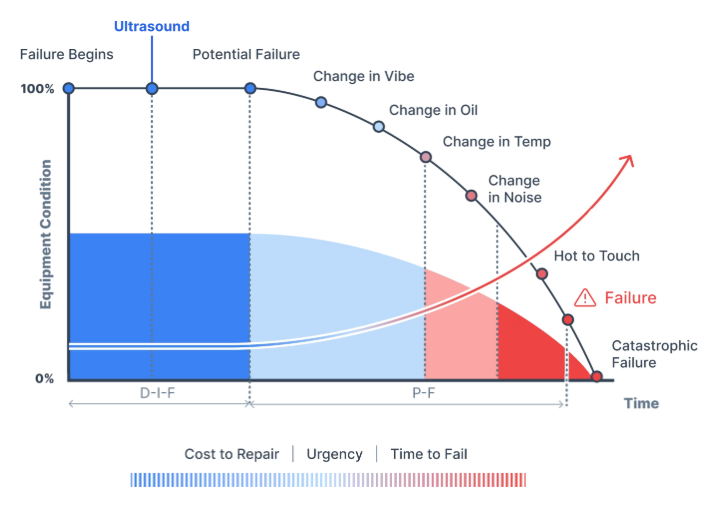
Ultrasound sits at the earliest point on the P-F curve for friction-related and lubrication-related faults. It can detect early friction and lubrication issues 3 to 12 months before they register in vibration or temperature trends. Vibration analysis picks up where ultrasound's detection fades. It quantifies mechanical severity through spectral analysis, identifies specific fault types based on characteristic defect frequencies, and tracks their progression over time.
The two technologies answer different questions at different stages. Ultrasound answers, "Has something changed?" Vibration answers "What exactly is failing and how severe is it?"
The relationship is complementary rather than competitive. The earliest ultrasound readings indicate that a condition is developing, but they don't always reveal what it means or how quickly it's progressing. That ambiguity resolves when vibration data confirms or dismisses what the ultrasound flagged.
A program that captures both signals across their respective windows turns early detection into diagnostic confidence. Peer-reviewed research directly supports this. Studies on sound and vibration data fusion report classification accuracies above approximately 93%, outperforming single-modality approaches. The improvement comes not from adding more data, but from adding data that covers a different portion of the failure timeline.
A condition-monitoring program built exclusively on vibration analysis has a structural blind spot in the earliest portion of the timeline, precisely where intervention is cheapest and least disruptive. Understanding how ultrasonic sensors work is the first step toward evaluating whether that gap exists in your program and what it would take to close it.
How Tractian Delivers Multimodal Condition Monitoring
Tractian's condition-monitoring platform combines always-on ultrasound and vibration sensing in a single device, eliminating the need for separate tools, separate routes, and separate interpretation workflows.
The Smart Trac sensor captures both signals with one device. A triaxial accelerometer covers 0 Hz to 64,000 Hz to detect common mechanical faults, while a dedicated piezoelectric transducer samples ultrasound up to 200 kHz for early-stage detection of friction, wear, cavitation, and micro-impact.
A magnetometer provides real-time RPM tracking, and surface temperature is measured continuously. One sensor delivers both the early warning that ultrasound provides and the diagnostic depth that vibration analysis enables, with no reconciliation required across separate tools or platforms.
The monitoring model is continuous and always on. The sensor communicates wirelessly on sub-GHz frequencies, independent of plant Wi-Fi, with a battery life of 3 to 5 years. Faults that develop between scheduled inspections don't go undetected because the sensor is always listening, which directly addresses the limitation that periodic, route-based programs face.
For condition-based lubrication, continuous ultrasound changes how lubrication decisions are made. The platform provides real-time visibility into bearing friction levels, signals when lubrication is needed, gives technicians live feedback during the application so they know when enough grease has been applied, and continuously verifies improvement after the intervention. Manual lubrication routes and spot checks become unnecessary.
On the diagnostic side, Tractian's AI-powered platform uses patented fault-finding algorithms, trained on over 3.5 billion collected samples, to automatically detect all major failure modes. Each alert includes the diagnosis, its severity, and a recommended course of action. Tractian’s sensor consolidates ultrasound, vibration, temperature, and other predictive data into a single asset timeline, so early friction signals and confirmed mechanical progression appear in the same view.
Tractian also integrates its condition monitoring natively with its maintenance execution software, generating tracked work orders with attached diagnoses and procedures. Detection and action occur within the same system, which means the distance between identifying a developing fault and scheduling the fix collapses into a single, connected workflow.
Explore Tractian condition monitoring solutions to see how decision-grade data quality transforms your vibration monitoring equipment into AI-powered maintenance execution workflows.
How Different Industries Benefit from Ultrasonic Sensors
Ultrasonic sensing delivers the greatest measurable impact in industries where lubrication-related failures are a leading cause of unplanned downtime and where the window for intervention between early detection and costly damage is narrow. Facilities operating slow-speed equipment, high-criticality rotating assets, or machinery in harsh and remote environments benefit most directly because these are the conditions where vibration-only programs leave the widest gaps.
The advantages compound across operations. Continuous ultrasound monitoring replaces manual lubrication routes with condition-based decisions, catches bearing degradation months before vibration data shifts, and gives teams diagnostic confidence earlier on the failure timeline.
For industries where labor is constrained and maintenance windows are tight, that earlier confidence translates directly into fewer emergency repairs, longer bearing life, and more predictable production schedules.
- Automotive and Parts: High-speed production lines depend on bearing health across motors, conveyors, and spindles, and ultrasonic monitoring catches lubrication breakdown and early wear before they escalate into line stoppages that cascade across dependent processes.
- Fleet: Shop equipment like lifts, compressors, and hydraulic systems often runs on fixed lubrication schedules that don't reflect actual condition, and continuous ultrasound monitoring shifts those decisions to real-time friction data so interventions happen between service jobs rather than during them.
- Manufacturing: Dense populations of motors, pumps, gearboxes, and fans create lubrication management challenges at scale, and ultrasonic sensing enables condition-based lubrication across the entire asset base without adding manual inspection routes or headcount.
- Oil and Gas: Remote and hazardous installations make physical bearing inspections costly and dangerous, and always-on ultrasound provides continuous friction visibility from the platform level so teams can identify developing faults and schedule interventions without dispatching personnel to confirm.
- Chemicals: Pumps operating in corrosive and high-temperature environments are prone to cavitation and lubrication degradation, and ultrasonic detection catches both conditions at their earliest acoustic signatures before they progress to measurable mechanical damage or process instability.
- Food and Beverage: Washdown environments accelerate lubricant contamination and degradation, and compressed maintenance windows leave no room for diagnostic guesswork, so ultrasonic monitoring delivers the earliest possible warning and real-time verification of lubrication within the production schedule.
- Mills and Agriculture: Seasonal processing windows make every hour of uptime critical, and many assets, such as large conveyors, dryers, and gearboxes, operate at low speeds where vibration analysis alone struggles, making ultrasonic detection essential for monitoring equipment that would otherwise go unmonitored.
- Mining and Metals: Heavy-duty crushers, mills, and conveyors operate under extreme loads and dust exposure, which accelerate bearing wear and lubricant contamination, and ultrasonic sensing detects the increase in friction from these conditions before they lead to catastrophic failures common in high-inertia equipment.
- Heavy Equipment: Variable loads and inconsistent duty cycles make lubrication needs unpredictable, and continuous ultrasound replaces fixed greasing schedules with condition-driven decisions that account for how the equipment is actually running rather than how a maintenance calendar assumes it runs.
- Facilities: Distributed HVAC systems, chillers, and pumps across multiple buildings often receive infrequent manual attention, and always-on ultrasonic monitoring provides centralized, continuous visibility into bearing and lubrication conditions without requiring dedicated inspection routes at each location.
FAQs About Ultrasonic Sensors in Condition Monitoring
What is the difference between "ultrasonic" and "ultrasound"? "Ultrasonic" is the adjective describing the frequency range above 20 kHz. It modifies the technology or the device: ultrasonic sensor, ultrasonic detection. "Ultrasound" is the noun referring to the sound waves, the data, or the technique itself: ultrasound data, ultrasound monitoring.
Can ultrasonic sensors replace vibration analysis? No. The two technologies are complementary. Ultrasound detects the earliest signs of friction, breakdown of lubrication, and wear. Vibration analysis diagnoses specific fault types, quantifies severity, and tracks progression. Programs that combine both cover a wider portion of the failure timeline than either one alone.
What types of equipment benefit most from ultrasonic monitoring? Bearings are the primary application, particularly where lubrication health is critical to reliability. Slow-speed equipment (below approximately 100 RPM) benefits significantly because vibration energy at low speeds is often too faint for reliable analysis. Pumps prone to cavitation, gearboxes, and any rotating asset where early friction detection extends the intervention window are also strong use cases.
How does ultrasound enable condition-based lubrication? Ultrasound monitors friction levels in real time. When friction rises above the asset's baseline, it signals the need for lubrication. During the application, the technician can observe the acoustic response and stop applying grease once friction stabilizes. This replaces calendar-based schedules with decisions grounded in actual bearing conditions.
How does Tractian incorporate ultrasound into its condition monitoring platform? Tractian's Smart Trac sensor combines vibration and ultrasound in a single device with always-on, continuous monitoring. The AI-powered platform automatically detects 75+ failure modes, supports condition-based lubrication with real-time feedback, and integrates natively with Tractian's maintenance execution software for closed-loop workflows from detection to action.
What should I look for when evaluating an ultrasonic condition monitoring system? Continuous monitoring rather than periodic spot checks. Multimodal sensing that combines ultrasound and vibration in a single device. Diagnostic intelligence that translates raw signals into actionable guidance. And integration with maintenance workflows so that detection leads directly to scheduled, tracked action rather than ending at a dashboard.