

Most facilities have invested in condition monitoring. They have sensors on critical assets, scheduled inspection routes, and teams trained to interpret the data. Despite all of it, unexpected failures keep breaking through. The question isn't whether early detection works in theory. It's why, in practice, so many programs still miss the earliest warning signs.
Bearings are an exemplar of this problem. They remain one of the most common failure points in rotating equipment, with approximately 80% of bearing failures tracing back to improper lubrication. What makes them difficult is timing.
The earliest signs of lubrication film breakdown produce faint signals that fall below the sensitivity threshold of most standard monitoring approaches. By the time a clear reading appears, the window to intervene without disruption has already narrowed.
This points to a structural reality that extends well beyond bearings. Every detection technology has an effective range on the failure timeline and blind spots outside it. When a program depends on a single method, those blind spots become the openings where problems quietly escalate.
Where Each Technology Adds Value in the PF Curve
The PF curve maps the distance between two points. The moment a developing fault first becomes detectable is the Potential Failure (P), and the point at which the asset stops functioning is the Functional Failure (F). That distance is the intervention window, and its length depends on the failure mode, operating conditions, and the sensitivity of whatever detection method is in use.
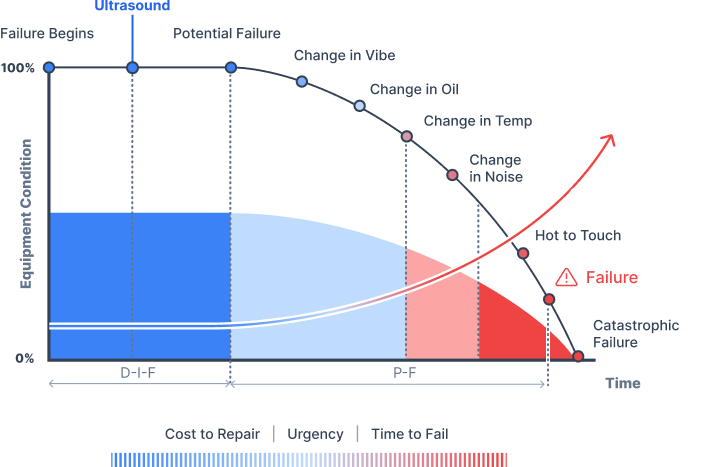
Ultrasound and vibration don't compete for the same portion of that window. They occupy different stretches of it. Ultrasound detects high-frequency acoustic energy, typically in the 20-100 kHz range, generated by friction, turbulence, and micro-impacts. It responds to changes in the lubrication film before they produce measurable mechanical displacement. Ultrasound can detect early friction and lubrication issues 3 to 12 months before they show up clearly in vibration or temperature trends.
Vibration picks up where ultrasound's clarity fades. It quantifies mechanical severity, identifies specific fault types based on characteristic defect frequencies, and tracks their progression over time. It confirms whether a condition is worsening or stable, and answers the question that ultrasound raises but can't resolve. That is, “how severe is it and what exactly is failing?”
Together, they create a productive tension. Catching a signal earlier doesn't automatically sharpen the picture. In many cases, it widens it. The earliest ultrasound readings indicate that something has changed, but they don't yet reveal what it means or how fast it's moving. That ambiguity only resolves when vibration data arrives to confirm or dismiss what the ultrasound flagged. A program that captures both across their respective windows turns that tension into a decision-making advantage.
Why Teams Still Miss Early Failures
The physics behind ultrasound and vibration detection are well established, and the hardware available today is more capable than ever. The instruments are working. But what's breaking down isn't the technology. It's the maintenance strategy wrapped around it.
Most programs still rely on route-based, periodic data sampling, also called time-based preventive maintenance. That approach was designed for a time when manual readings were the only option, and in that context, it made sense. Routes are basically snapshots, like a screenshot of a video. And just like a video, it keeps playing between the screenshots. You couldn’t possibly understand the dialogue from screenshots.
As labor constraints push inspections back, they become compressed, or scheduled checks are skipped entirely. An issue that develops the day after a route-based inspection may progress significantly before the next one occurs.
Then there's the data problem. Ultrasound and vibration typically live in separate tools, dashboards, and interpretation workflows. There's no unified view connecting an early friction signal to a confirmed mechanical impact. Findings lose context when they can't be correlated in one place.
The result is a gap that has nothing to do with instrument quality. The case is often that teams aren't lacking detection capability. They're undermining their capabilities through deployment practices that haven't kept pace with the technology they use.
Combining Ultrasound and Vibration Into One System
When ultrasound and vibration are fed into the same system, the value is contextual rather than additive. One technology registers the first sign of change. The other confirms whether that change is progressing and how far it's gone. Together, they build a chain from early detection through confirmed diagnosis to a clear basis for action.
Consider under-lubrication, one of the most common causes of bearing failure. Ultrasound registers the friction spike first. If left unaddressed, vibration levels increase later as the damage progresses. With both signals in view, the team sees the full arc rather than interpreting an isolated data point without context.
To demonstrate the point of this method, research on sound and vibration fusion under speed-varying conditions (generalized across operating conditions) reports classification accuracies above approximately 93%, outperforming single-modality approaches.
What makes that accuracy practical, though, is how the data reaches the team. When both signals originate from a single device and converge in one platform, the distance between insight and response collapses. There's no switching between tools, no reconciling separate dashboards, no translating one analyst's findings into another's format. For teams already stretched thin, that reduction in friction is often what determines whether a detection actually leads to action.
What an Effective Program Looks Like
The technology to support continuous, multi-signal condition monitoring isn't emerging, it’s already here. And the programs delivering the most consistent results share a recognizable set of attributes, defined by how sensing, data, and workflow connect.
Here's what those programs tend to have in common:
Sensing: Captures both vibration and ultrasound data from a single device. Vibration covers a wide frequency range and can be measured triaxially to detect common mechanical faults. Ultrasound sensing is responsive to friction, early-stage wear, cavitation, and micro-impacts, particularly on low-speed equipment.
Monitoring: Continuous, always-on data collection rather than periodic snapshots. Wireless communication that operates independently of the plant's WiFi. Battery life measured in years, not months.
Diagnostics: A unified platform where early signals and confirmed progression appear together. AI-powered diagnostics that surface issues automatically rather than requiring manual interpretation. Mobile access with offline capability.
Deployment: Quick, non-invasive installation without complex wiring. Industrial-grade construction for harsh environments. Direct integration with existing maintenance workflows through CMMS connectivity.
Condition-based lubrication
Condition-based lubrication clearly highlights the impact of early detection and action. The article opened by pointing out that most bearing failures stem from lubrication issues, and that most monitoring programs catch them too late.
However, continuous ultrasound rectifies this common problem by making lubrication decisions based on real-time machine condition rather than fixed schedules.
For example, here’s what the shift from periodic checks to continuous monitoring looks like.
A reliability engineer at the plant reviews the monitoring platform and notices an ultrasound trend showing a rising temperature in a conveyor bearing. Instead of waiting for the next scheduled lubrication round, the team sends a technician to that specific asset first. While lubricating, the technician can see the readings in real time and knows when enough grease has been applied and the friction signal has stabilized. After walking away, the data confirms that the bearing is back on track.
No guesswork, no over-lubrication, no return visit to check.
This is the change that continuous ultrasound, built into the same sensor that captures vibration data, makes happen. Handoffs and gaps are eliminated, and lubrication rounds move online. The maintenance team knows where to go first to get real-time feedback before, during, and after the task.
How Tractian Delivers on This
Delivered through an AI-powered condition monitoring platform, Tractian's new generation of condition-monitoring sensors captures both vibration and ultrasound in a single device, eliminating the need for separate tools, separate routes, and separate interpretation workflows.
Ultrasound sensing detects early-stage friction, wear, cavitation, and micro-impacts, while triaxial vibration measurement covers the full range of common mechanical faults, from unbalance and misalignment to looseness and bearing defects. One sensor, both signals.
The monitoring model is continuous and always on, not periodic. The sensor communicates wirelessly, independent of plant WiFi, reducing IT dependencies and simplifying deployment. Battery life is measured in years (3-5), not months, keeping the maintenance burden on the sensor itself to a minimum.
On the platform side, ultrasound and vibration data are combined, linking early friction signals to confirmed mechanical progression. This consolidates data from vibration, temperature, oil analysis, thermography, and ultrasound into a single asset timeline, giving teams a single, connected view across detection methods.
AI-powered diagnostics surface issues automatically with prescriptive guidance, and mobile access with offline capability means teams can view asset condition from anywhere on the floor. Sensor alerts flow directly into your existing CMMS (or Tractian CMMS), generating tracked work orders with attached diagnoses and procedures, so detection and action occur in the same system.
Installation is quick and non-invasive, with no complex wiring or infrastructure changes. The sensor hardware is industrial-grade, built for harsh environments, temperature extremes, and chemical exposure. And for teams with existing systems, open APIs and direct CMMS connectivity keep Tractian connected to their existing workflows.
From detection to action in one system.
Explore Tractian's condition monitoring solutions to learn how you can ensure your program has full coverage through continuous, multimodal monitoring.
Frequently Asked Questions About Ultrasound & Vibration Continuous Monitoring
What does ultrasound detect in condition monitoring? Ultrasound detects high-frequency acoustic energy from friction, turbulence, and micro-impacts, making it sensitive to early-stage lubrication breakdown before vibration or temperature data registers a change.
Why combine ultrasound and vibration monitoring? Ultrasound detects the earliest signals, while vibration confirms progression and severity. Together, they eliminate the ambiguity of relying on either alone.
Why does continuous monitoring matter for these programs? Faults develop on their own timeline, not on an inspection schedule, and route-based snapshots miss issues that progress between visits.
How does Tractian support a continuous monitoring approach? Tractian sensors provide continuous vibration, ultrasound, temperature, and RPM data, AI diagnostics identify failure modes with prescriptive guidance, and native CMMS integration turns alerts into tracked work orders within one platform.