
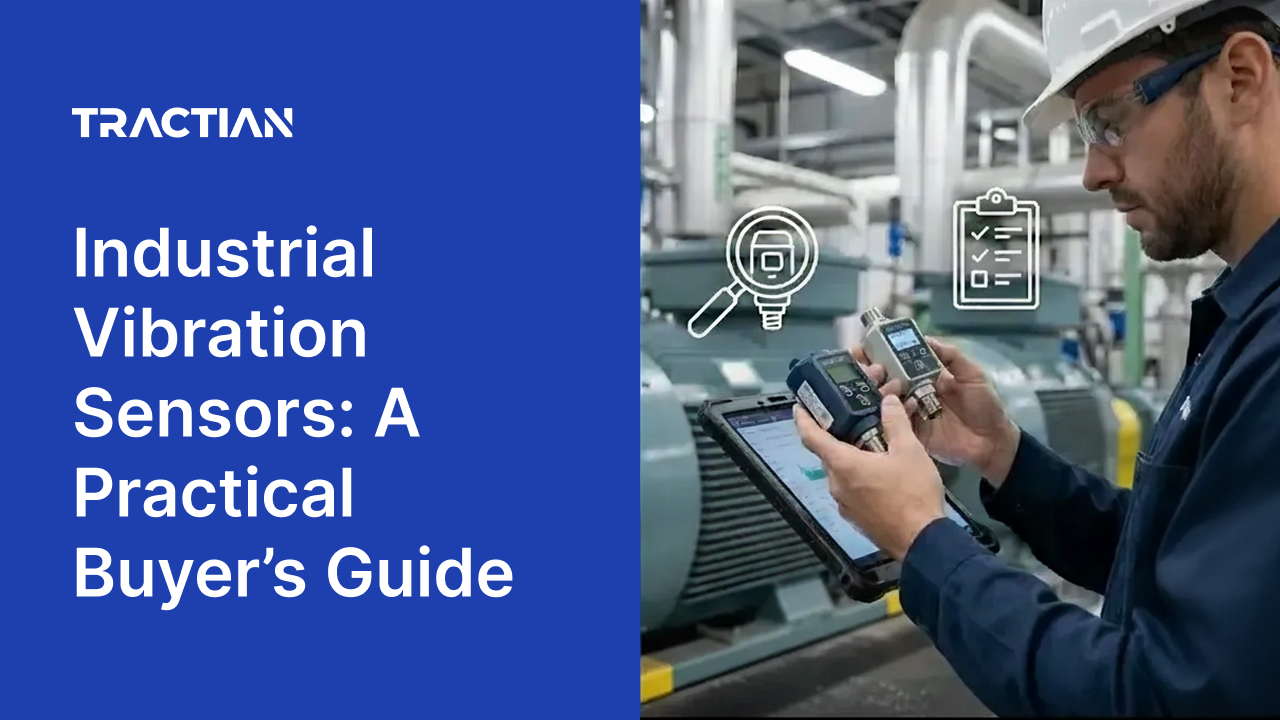
Industrial vibration sensors play a central role in modern predictive maintenance and condition monitoring programs. When implemented correctly, they give maintenance teams continuous visibility into the health of rotating equipment, allowing faults such as bearing wear, imbalance, misalignment, and looseness to be identified well before failure.
As plants scale automation and monitor more assets across larger footprints, the sensor itself becomes a critical point of success or failure. Inconsistent data, limited environmental durability, or unclear diagnostics can quickly erode trust and restrict condition monitoring adoption across the plant.
This buyer’s guide explains what separates industrial-grade vibration sensors from basic monitors and compares leading options based on data quality, ruggedness, diagnostics, and how effectively insights translate into maintenance action.
What Defines an Industrial-Grade Vibration Sensor
Industrial vibration sensors are designed for permanent installation on critical assets such as motors, pumps, fans, compressors, and gearboxes. Their job is not just to detect that vibration has changed, but to do so reliably and consistently under real operating conditions.
Best-in-class industrial sensors typically balance four core requirements.
High-fidelity vibration data
Sensors must capture vibration signals with enough resolution and frequency coverage to support meaningful diagnostics, not just overall vibration levels. Triaxial measurement is commonly used to provide a more complete view of machine behavior.
Environmental durability
Industrial environments introduce heat, dust, moisture, washdowns, and sometimes hazardous atmospheres. Sensors must be rated appropriately for the conditions where they will be installed, including ingress protection and hazardous-area certifications where required.
Stability over time
A predictive maintenance program depends on trend reliability. Sensors must deliver consistent measurements year after year without drifting, failing, or requiring frequent replacement.
Actionable integration
Vibration data only delivers value when it leads to action. Industrial programs benefit when sensor insights connect directly into diagnostics, inspections, and work execution workflows rather than remaining isolated in dashboards.
Why Sensor Quality Determines Predictive Maintenance ROI
A predictive maintenance strategy is only as effective as the data feeding it. When vibration sensors lack reliability or diagnostic depth, several problems emerge.
Missed faults occur when early failure signatures are not captured clearly enough to stand out from background noise. False alarms arise when systems cannot distinguish between meaningful changes and normal operating variation. Limited diagnostics force teams to rely on manual interpretation or external specialists, slowing response times.
High-quality industrial vibration sensors help teams move from reactive maintenance toward condition-based decision making. The result is fewer unplanned outages, longer asset life, safer inspections, and more efficient use of technician time.
Top Buying Criteria for Industrial Vibration Sensors
When evaluating solutions, buyers should focus on these three criteria, as they largely determine long-term program success.
Data integrity and diagnostic depth
Look beyond overall vibration metrics. Validate whether the system captures waveforms or spectra, supports fault classification, and explains why an alert was raised.
Industrial ruggedness and certifications
Confirm ingress protection ratings, operating temperature limits, and hazardous-location certifications if applicable. Sensors should be matched to the harshest environment they will face, not just average conditions.
Diagnostics and execution integration
Evaluate how insights move from detection to action. Systems that integrate diagnostics with inspections and work orders reduce delays and eliminate manual handoffs.
Comparison of Leading Industrial Vibration Sensors
| Industrial Feature | Tractian Smart Trac Ultra | AssetWatch | Waites Wireless | Augury Halo | Relay (Sensemore) |
|---|---|---|---|---|---|
| Sensing Capabilities | Triaxial vibration, temperature, RPM, runtime | Vibration and temperature | Vibration and temperature | Vibration, temperature, magnetic signals | Vibration and temperature |
| Wireless Architecture | Sub-GHz encrypted long-range industrial radio | Proprietary plant-wide wireless network | Node-to-gateway wireless design | BLE-based mesh network | Short to mid-range IIoT wireless |
| Indoor Range | Approx. 100 meters in industrial environments | Varies by plant size and gateway density | Moderate industrial coverage | Short to moderate depending on interference | Limited range for small installations |
| Line-of-Sight Range | Up to ~1 km | Designed for medium to large facilities | Several hundred meters depending on layout | Shorter BLE footprint | Short-range deployments |
| Battery Life | 3–5 years depending on sampling strategy | Multi-year battery design | Multi-year operation | Field-replaceable batteries up to 5 years | Multi-year battery life |
| Industrial Readiness | IP69K, hazardous-location certified | General industrial environments | Rugged stainless-steel housing | IP66/68/69 protection | Not hazardous certified |
| Diagnostics Model | High-fidelity waveforms with automated fault identification | Analyst-assisted alert interpretation | Rule-based alarms with optional analyst review | AI-driven anomaly detection with expert support | Basic anomaly alerts |
| Best For | Industrial teams needing rugged sensing, long-range wireless, and closed-loop maintenance execution | Plants preferring a managed monitoring service | Cost-conscious facilities expanding wireless monitoring | Organizations seeking AI-driven detection with service support | Small plants or pilot-scale CBM programs |
The Best Industrial Vibration Sensors by Use Case
Tractian Smart Trac Ultra
Best for: Industrial facilities operating in harsh environments that need vibration monitoring to remain reliable at scale while converting insights directly into maintenance action.
The Smart Trac Ultra vibration sensor is engineered for industrial plants where monitoring must perform consistently across complex, demanding conditions. It supports large deployments while maintaining signal reliability, durability, and clear operational outcomes for maintenance teams.
Industrial environments place continuous strain on monitoring systems due to dense equipment layouts, steel structures, frequent washdowns, hazardous zones, intermittent asset operation, and limited technician availability. Many vibration sensors perform well in controlled settings but degrade when exposed to these realities at scale.
Wireless Design Built for Industrial Layouts
In large plants, wireless reliability is often the limiting factor, not sensor accuracy. Smart Trac Ultra uses a sub-GHz industrial radio architecture designed to maintain stable communication through steel structures, rotating equipment, tanks, and high-interference production areas.
From an operational standpoint, this delivers:
- Consistent data flow across large footprints, reducing blind spots in multi-building or multi-line facilities
- Indoor coverage around 100 meters per receiver and line-of-sight distances up to approximately 1 km, minimizing gateway density in wide plant layouts
- Encrypted communication to meet industrial cybersecurity requirements without tying into corporate Wi-Fi networks
- Predictable multi-year battery performance under continuous monitoring, allowing maintenance teams to plan sensor upkeep instead of reacting to failures
The result is a wireless monitoring layer that behaves predictably in real plant conditions, not just in lab environments.
Engineered for Harsh and Regulated Environments
Industrial reliability programs often fail when sensors cannot be installed at the actual point of failure. Smart Trac Ultra is built to withstand failure-prone environments.
- IP69K protection supports high-pressure washdowns common in food, beverage, and chemical processing
- ATEX-certified hazardous-location readiness allows installation in flammable or explosive atmospheres without workaround solutions
- High-temperature and dust-tolerant design supports deployment in mining, metals, and heavy manufacturing
This allows teams to standardize on one sensor across diverse plant areas instead of managing multiple device classes.
Diagnostics That Reduce Noise in Industrial Operations
In industrial settings, alert fatigue is a major barrier to adoption. Smart Trac Ultra emphasizes diagnostic clarity over raw alert volume.
- Always Listening ensures vibration data is captured whenever intermittent or standby equipment actually runs, avoiding misleading trends from scheduled snapshots
- RPM Encoder derives rotational speed directly from vibration, enabling accurate diagnostics on variable-speed assets common in modern production lines
- Bearings Library and fault-frequency matching support earlier identification of bearing-related issues without manual calculations
- Temperature Seasonality filtering removes normal ambient temperature swings, preventing seasonal false alarms that often plague long-term deployments
Operational Benefits for Maintenance Teams
Beyond detection, Smart Trac Ultra is designed to support day-to-day maintenance execution in industrial environments.
- Plain-language insights via Asset GPT help technicians understand what changed and why it matters, even without vibration specialization
- Machine health scoring and benchmarking allow reliability teams to prioritize work across assets, lines, and sites
- Direct connection to inspections and work orders inside the integrated Tractian's platform eliminates manual handoffs between monitoring tools and execution systems
This reduces time spent interpreting data and increases time spent resolving real issues on the floor.
Why real customers choose Tractian Industrial Vibration Sensors
- “We observed many recurring lubrication failure insights. We revised our maintenance plan, and today we no longer have this type of failure. We were able to train the sensor by providing feedback on the insights related to material changeovers.” says William C., Maintenance Coordinator
- “I'm really impressed by the reliability metrics that Tractian is able to calculate in real time, and the level of detail when it comes to the failure modes and the insight generation. Tractian has really improved our asset availability.” says Gautam Sane, Senior Reliability Engineer
- “For the first time, we can clearly see what’s happening on the floor before a failure hits. That kind of visibility is a game-changer.” says Trevor Baker, Sr. Manager, Manufacturing Strategic Initiatives
What Industries are using Tractian’s Industrial Vibration Sensors?
Tractian Smart Trac Ultra is used across industrial sectors where unplanned downtime, safety exposure, and asset failure directly impact production, compliance, and operating cost. These environments typically share three characteristics: harsh operating conditions, a high concentration of rotating equipment, and limited tolerance for monitoring gaps or false alerts.
- Mining and Metals used on crushers, conveyors, and pumps in abrasive, high-vibration environments to detect mechanical degradation early and reduce unplanned stoppages in remote or safety-critical areas.
- Chemical plants deployed on pumps, mixers, and compressors operating under strict process and safety constraints, enabling early fault detection in hazardous and regulated zones.
- Mills and Agriculture applied to continuously running assets during seasonal peaks to catch bearing and alignment issues early and protect throughput during high-demand periods.
- Manufacturing Used across motors, gearboxes, conveyors, and automated systems to maintain line uptime, reduce unexpected stoppages, and support continuous improvement initiatives.
- Oil & Gas Installed across upstream, midstream, and downstream assets exposed to hazardous conditions, supporting safer operation and more predictable maintenance planning.
- Heavy Equipment Monitors equipment across active job sites to maintain availability and reduce costly breakdowns during time-sensitive operations.
- Food & Beverage Installed in washdown and hygienic environments to support uptime on critical assets while meeting cleanliness and regulatory requirements.
- Automotive and Parts Applied to high-precision and automated production equipment to prevent disruptions in just-in-time manufacturing workflows.
Tractian is trusted across industries by companies such as DHL, Ingredion, CP Kelco, and CZM, who use the platform to support equipment reliability, meet compliance requirements, and scale consistent maintenance practices across their operations.
AssetWatch
Best for: Industrial plants that want vibration data interpreted by external specialists rather than internal teams.
AssetWatch approaches industrial vibration monitoring as a managed service rather than a self-directed diagnostic system. Facilities install fixed wireless vibration and temperature sensors on rotating equipment, but the responsibility for interpretation largely sits with AssetWatch’s remote analysts. These analysts review vibration trends, validate abnormal behavior, and issue maintenance recommendations back to the plant.
This model is often attractive to organizations that are early in their predictive maintenance efforts or that lack in-house vibration expertise. It reduces the need for internal analysts and speeds initial adoption. In industrial settings with many assets or multiple sites, however, reliance on an external review layer can introduce latency and limit how deeply plant teams engage with the vibration data itself. Over time, some facilities find that knowledge accumulation remains outside the organization rather than on the plant floor.
Notable Capabilities
- Fixed wireless vibration and temperature sensors for continuous asset monitoring
- Analyst-led review of vibration trends and fault conditions
- Lower internal training burden during early program phases
Potential Downsides
- Scaling across sites can increase service coordination and cost complexity
- Recommendations may need manual translation into Tractian's platform work orders
- Turnaround time depends on analyst workflows rather than plant urgency
What real customers say about AssetWatch
- “Cannot access trend charts on mobile app. Basically can’t select any filter.” says joseph smith
- “This team is an absolute joy to work with. Could not be happier with them!” says Charmaine Berry
Waites
Best for: Industrial facilities seeking broad vibration coverage at a lower entry cost.
Waites Wireless focuses on providing fixed vibration and temperature sensors that support continuous monitoring across large numbers of assets. The system is often used as a replacement for manual vibration routes, particularly in plants where overall condition trending is sufficient for many machines.
From an industrial vibration perspective, Waites emphasizes accessibility and deployment speed over advanced fault discrimination. The platform provides configurable alarms and trend visualization, but meaningful results often depend on careful threshold setup and ongoing tuning. In larger plants, maintaining signal quality and alert relevance can require additional effort as sensor counts grow.
Notable Capabilities
- Wireless vibration and temperature sensors designed for permanent installation
- Centralized portal for trend visualization and alarm configuration
- Optional access to vibration expertise when needed
Potential Downsides
- Alarm sensitivity may need ongoing adjustment to reduce noise
- Integration into maintenance workflows may require manual steps
- Large deployments require planning to avoid alert overload
What real customers say about Waites
- “They monitor 24/7 and record to an online database. Its still early in the data collection to establish a base line.” says MySavageAncestors
- “Waites came and trained us at our site. Although they can be a pain in the ass, they also help letting us know when there is a potential for catastrophic failure on conveyor beds and motors.” says PalpitationFar6923
- “Holy crap it's such a pain in the ass. Those things alert for almost anything. Idk if you have been signed into the Waites Wireless website to check alerts. Simplest ones to do are obviously when repeaters are not repeating and when sensors become detached.” says AndyPlaysBadly
Augury
Best for: Industrial organizations that want AI-led anomaly detection with supplemental validation.
Augury’s industrial vibration monitoring strategy combines multi-signal sensing with machine-learning models trained to identify abnormal machine behavior. Sensors collect vibration, temperature, and magnetic data, which is processed by algorithms designed to detect deviations rather than explicit fault signatures. Augury specialists then review findings and provide recommendations.
In industrial environments, this approach can surface issues that traditional threshold-based systems may miss, particularly in complex or variable processes. However, because the system emphasizes anomaly detection over transparent fault mechanics, some reliability teams prefer additional visibility into how conclusions are reached, especially when decisions affect critical or regulated assets.
Notable Capabilities
- Multi-signal industrial sensors capturing vibration and related indicators
- AI-driven models focused on anomaly detection across operating states
- Dashboards designed for fleet and site-level oversight
Potential Downsides
- Anomaly-based insights may require interpretation for root-cause clarity
- Service and subscription costs can increase as monitoring expands
- IT and OT coordination may be required for stable deployments
What real customers say about Augury
- “Augury provides a range of industrial settings, from small factories to large manufacturing plants, and can be customized to meet the specific needs of each business.” says Prashant S., Small-Business
- “Consistency is a concern for me. Even though they provide me with the best possible service, but at times notification reaches to me a bit late. They can improve in that sector.” says Kartik A., Trainee Engineer
Relay (formerly Sensemore)
Best for: Smaller industrial sites or pilot programs monitoring limited numbers of assets.
Relay provides compact wireless vibration and temperature sensors aimed at basic condition awareness rather than deep industrial diagnostics. The platform is often used by facilities taking their first step into fixed vibration monitoring or by teams tracking lower-criticality equipment where early warning is sufficient.
In heavy industrial environments, limitations typically appear around range, ruggedness, and diagnostic depth. Relay’s approach works best in contained footprints with relatively clean operating conditions and modest expectations around fault classification.
Notable Capabilities
- Compact IIoT vibration and temperature sensors
- Fast installation and straightforward setup
- Simple dashboards for trend visibility and alerts
Potential Downsides
- Not designed for hazardous or highly regulated environments
- Limited support for advanced fault identification
- Scaling beyond pilot scope may require a different platform
How to Choose the Right Industrial Vibration Sensor for Your Plant
In industrial environments, the question is not whether a vibration sensor can collect data. Most can. The real question is whether the sensor can operate reliably under harsh conditions, capture meaningful data from how equipment actually runs, and convert those insights into maintenance action at scale.
Industrial plants place unique demands on vibration monitoring. Equipment may run continuously or intermittently, often at variable speeds. Assets are surrounded by steel structures, electrical noise, heat, dust, moisture, and in many cases hazardous atmospheres. Sensors that are not purpose-built for these realities often perform well in pilots, then struggle once deployed across critical assets.
For most facilities, the right industrial vibration sensor shares several defining characteristics.
It must be engineered for the environment, with construction and certifications that allow installation directly at the point of failure. Sensors that cannot survive washdown, high temperatures, dust, or hazardous areas limit coverage and force compromises in monitoring strategy.
It must deliver reliable data in real operating conditions, including on variable-speed and intermittent equipment. Sensors that rely on scheduled snapshots or idealized assumptions frequently miss early-stage faults or produce misleading trends.
It must reduce noise rather than create it. In industrial operations, alert fatigue is one of the fastest ways a monitoring program loses credibility. Effective systems clearly explain what changed, why it matters, and how severe the condition is, enabling teams to prioritize work with confidence.
Finally, it must connect condition insights directly to maintenance execution. Industrial maintenance teams do not have time to manually translate dashboards into action. Sensors deliver the most value when findings automatically flow into inspections, tasks, and work orders, and when results are reflected in reliability metrics.
Systems designed specifically for industrial use consistently outperform general-purpose monitoring tools because they address sensing, diagnostics, and execution as a single workflow rather than disconnected components.
See How Tractian Supports Industrial Reliability at Scale
Tractian industrial vibration sensors are built to meet these exact requirements, combining rugged hardware, reliable long-range connectivity, diagnostic clarity, and execution-ready workflows in one unified system.
Request a demo to see how equipment health insights, AI diagnostics, and maintenance execution work together to support real industrial operations.
Industrial Vibration Sensor FAQs
- What makes a vibration sensor “industrial”?
An industrial vibration sensor is designed for permanent installation on operating equipment in harsh environments. Beyond measuring vibration, it must withstand heat, dust, moisture, washdowns, electrical noise, and in some cases hazardous atmospheres. Industrial-grade sensors also deliver consistent, repeatable data over years of operation and support diagnostics that lead directly to maintenance action.
- Are wireless vibration sensors reliable in industrial environments?
Yes, when they are purpose-built for industrial use. Industrial wireless vibration sensors use communication architectures designed to operate through metal structures, machinery, and interference. Sub-GHz industrial radios typically provide more stable range and penetration than consumer-grade wireless technologies, especially in large plants or multi-building facilities.
- How important are certifications like IP ratings and ATEX?
Certifications are critical in industrial settings. IP ratings indicate resistance to dust and water, which is essential for washdown or outdoor environments. ATEX or similar hazardous-location certifications are required for sensors installed in explosive or flammable atmospheres. Without the proper certifications, sensors may not be legally or safely deployable where failures actually occur.
- What failure modes can industrial vibration sensors detect?
Industrial vibration sensors are commonly used to detect bearing wear, imbalance, misalignment, looseness, resonance, and lubrication-related issues. The ability to detect faults early depends on signal quality, frequency coverage, and whether the system supports fault classification rather than basic threshold alerts.
- Do industrial vibration sensors replace handheld vibration analysis?
In most industrial programs, fixed vibration sensors complement or reduce the need for manual routes rather than fully replacing them. Continuous monitoring provides early detection and trend visibility, while handheld analysis may still be used for confirmation, advanced diagnostics, or specific investigations. Over time, many plants reduce manual routes as confidence in fixed sensors increases.
- How do industrial vibration sensors deliver ROI?
ROI comes from avoiding unplanned downtime, extending asset life, improving maintenance planning, and reducing unnecessary inspections. Industrial vibration sensors deliver the most value when they provide early, actionable insights and connect directly to maintenance execution, allowing teams to intervene before failures escalate.