
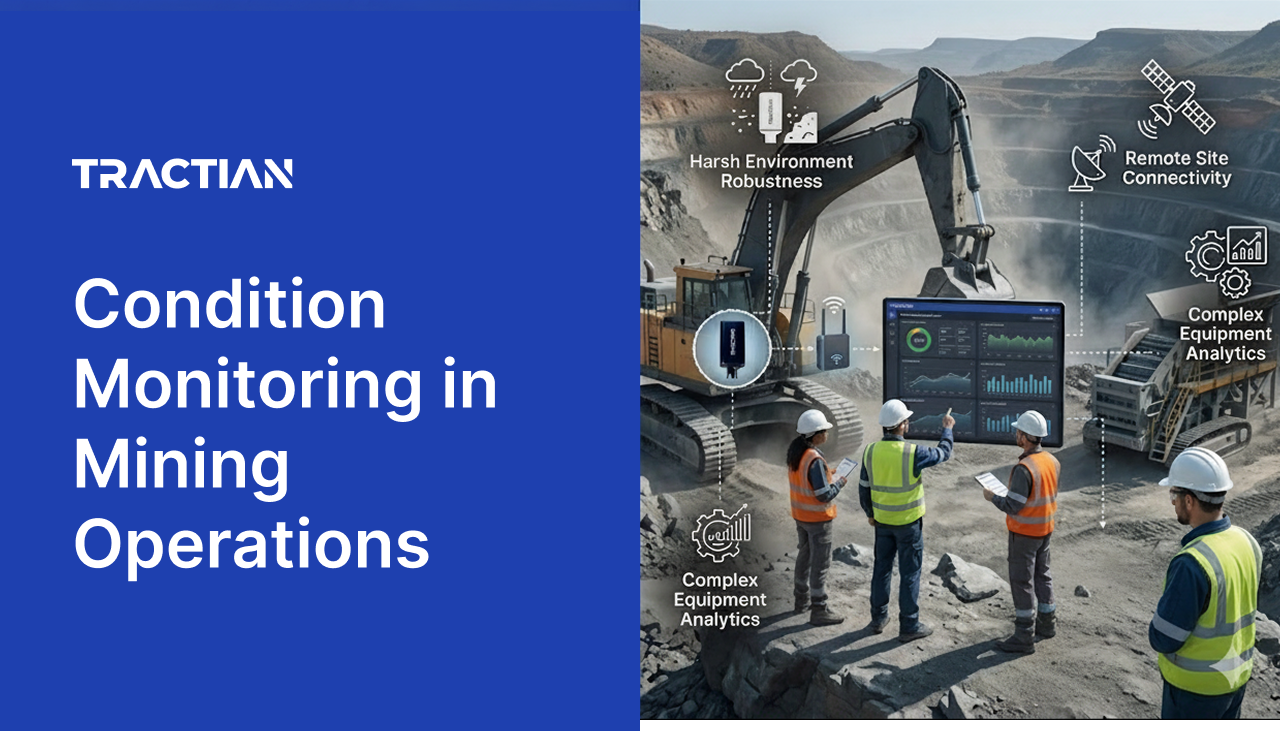
Key Points
- Mining's environmental extremes don't just degrade equipment. They degrade the sensors monitoring that equipment, and a sensor that fails silently in harsh conditions creates a coverage gap the team won't discover until something breaks.
- Variable-speed crushers, low-RPM mill bearings, and load-shifting conveyors produce vibration signatures that generic threshold alerting can't interpret accurately. Without operational context and multi-modal sensing, the system generates noise that erodes the trust it's supposed to build.
- The gap between detecting a fault and executing a repair is where most mining condition monitoring programs lose their value. Systems that connect diagnosis to work order generation within a single platform close that gap without adding manual steps to an already-stretched team.
Monitoring in high-stakes, high-stress environments
With more than half of the U.S. mining workforce projected to retire by 2029, condition monitoring programs that require a specialist to interpret every alert are built on a foundation that is actively shrinking. Mining operations spend more on maintenance than almost any other industrial sector, with maintenance costs reaching up to 30-50% of total operating costs.
In an industry where a single crusher or conveyor failure cascades through the entire processing chain, backing up haul trucks and pulling production targets out of reach, that shrinking workforce puts direct pressure on how mining operations detect, diagnose, and respond to developing equipment faults.
The unique set of pressures is exactly why many are repositioning their investments to account for the maintenance needs. The harder question is whether those investments are producing decisions or just producing data. While the asset lifecycle loop can be complex, understanding decision-grade data is not.
For example:
- A sensor that can't survive the dust, moisture, and temperature extremes of a mining environment creates a coverage gap that the team doesn't know about until something breaks.
- A monitoring platform that depends on plant Wi-Fi loses visibility the moment it goes underground.
- A diagnostic system that flags "high vibration" on a mill that just shifted from idle to full load produces an alert that a shrinking team has to manually investigate, interpret, and decide whether to trust.
These are actual scenarios, and they're the points where mining condition monitoring programs most commonly break down, not because the concept failed, but because the system wasn't built for what mining actually does to equipment, connectivity, and the people responsible for acting on the output.
This article examines what condition monitoring must deliver specifically in mining operations. We examine where the compounding pressures of environmental extremes, remote geography, equipment complexity, and workforce constraints reshape what "effective monitoring" means. The gap between having sensors and having trusted maintenance decisions is wider than in most industrial environments.
Why Mining Demands More from Condition Monitoring
Mining presents a set of compounding pressures that stress every layer of the monitoring system simultaneously, from the sensor housing to the diagnostic algorithm to the maintenance team interpreting the output.
Environmental exposure and sensor survivability
Mining subjects both equipment and the sensors monitoring that equipment to dust ingress, water exposure (dripping underground, washdown at surface plants), temperature swings from below freezing to extreme heat, constant shock loads, and potentially explosive atmospheres. The sensor has to survive the same conditions that are destroying the machine it's watching.
This is where the monitoring program's reliability starts. If a sensor degrades or fails silently in a harsh environment, the team believes they have coverage on an asset that is actually unmonitored. That blind spot only becomes visible when something breaks.
Hardware rated for clean manufacturing floors won't hold up bolted to a crusher housing or mounted in an underground drift where moisture, particulate, and vibration are constant. The practical threshold for mining includes IP69K protection (sealed against dust, high-pressure water, and steam), hazardous-location certification (ATEX, IECEx, or NFPA 70 for Class 1 environments), and an operating temperature range that accounts for the full envelope imposed by the site. Anything less introduces a hardware reliability question that sits underneath every diagnostic the system produces.
Remote sites and connectivity gaps
Mining operations span large geographic areas, and underground mines frequently have no Wi-Fi coverage. Even more, the surface operations may stretch across miles of conveyor systems and processing stages, with assets distributed across terrain that makes wired infrastructure impractical. Remote equipment monitoring in these environments requires connectivity independent of the plant's network infrastructure.
When data doesn't reach the platform due to a connectivity interruption, the team loses visibility into assets, leaving unmonitored hours that pose real financial and safety risks. The system defaults to silence, and the maintenance team defaults to time-based or reactive maintenance responses, which is exactly the mode condition monitoring is supposed to replace.
Cellular connectivity (4G/LTE) that operates independently of plant networks, combined with onboard data storage that preserves samples during connectivity gaps and automatically syncs when the connection returns, is a practical requirement for mining deployments.
These are just the baseline expectations for sites where Wi-Fi coverage can't be assumed.
Equipment complexity and variable operating conditions
Mining's critical rotating assets, including crushers, SAG mills, ball mills, conveyors, hoists, ventilation fans, and dewatering pumps, operate under highly variable conditions. Loads fluctuate with feed rates and material hardness. Speeds change with VFD control. Duty cycles shift between idle and maximum throughput, sometimes multiple times per shift.
Vibration analysis on equipment with variable speed and variable load requires systems that account for operational context. Fixed-threshold alerting on a crusher that regularly shifts between loaded and unloaded states will either generate false positives that erode team trust, or miss developing faults during non-standard conditions. Both outcomes undermine the program.
Low-speed equipment adds another dimension. Ball mill trunnion bearings, large gearbox output shafts, and slow-running conveyors operate at RPMs where traditional vibration sensing has inherent limitations. Fault signatures at these speeds don't produce the frequency content that accelerometers are optimized to detect.
Ultrasonic sensing becomes essential for these assets because it captures friction, early-stage wear, cavitation, and micro-impacts at frequencies where vibration alone lacks sensitivity. Programs without ultrasonic capability carry a detection gap on some of mining's most capital-intensive equipment without necessarily knowing it.
Labor constraints and safety exposure
Mining faces a structural workforce challenge that directly threatens condition monitoring capability. As mentioned earlier, the Society for Mining, Metallurgy & Exploration estimates that more than half of the current U.S. mining workforce will need to retire and be replaced by 2029. A McKinsey survey found that 71% of mining executives report talent shortages are impeding production targets and strategic objectives, with 86% saying it's harder to recruit and retain talent.
Route-based vibration monitoring programs depend on trained analysts who walk collection routes at scheduled intervals. When those analysts retire and aren't replaced, collection intervals stretch, data gaps widen, and the program's ability to catch developing faults deteriorates. Manual collection in mining environments also exposes technicians to high-risk situations, making it both a capability constraint and a safety liability.
Condition monitoring in mining can't scale linearly with headcount when headcount is the constraint. Systems that require a specialist to interpret every alert become bottlenecks. In mining's labor environment, this is an ever-present structural vulnerability.
What Effective Mining Condition Monitoring Requires
The challenges above must be overcome for a condition monitoring program to produce decision-grade data rather than just “detection” data. A different approach to data detection and a similar shift in expectations for what the layer of analytics sitting between data capture and human handoff can do with that data must emerge. The following demonstrates what that looks like.
Multi-modal sensing for full fault coverage.
Vibration sensors cover the core of rotating equipment diagnostics, but ultrasonic sensing captures early-stage friction, wear, cavitation, and lubrication degradation that vibration alone misses, particularly on low-speed assets where traditional accelerometers lack sensitivity. Temperature monitoring adds thermal context. Magnetic field data enables accurate RPM tracking on variable-speed machines without requiring an external tachometer.
The combination provides broader fault coverage from a single measurement point, which matters when mining sites have hundreds of assets spread across locations that are difficult and sometimes hazardous to reach.
Operational context and adaptive intelligence.
Raw vibration data from a crusher doesn't mean much without knowing whether the machine was loaded or idle, what speed it was running at, and what the ambient conditions were. Effective mining condition monitoring requires systems that auto-detect operational states, adapt diagnostic thresholds to real-time conditions, and distinguish between a genuine developing fault and a normal load-induced change in vibration.
Without this layer of contextual awareness, the system produces noise on complex mining equipment. That noise erodes trust. And when maintenance teams stop trusting alerts, they stop acting on them, which means the monitoring program is running without producing outcomes.
Diagnostic clarity over alert volume.
The gap between detection and decision is where most mining condition monitoring programs lose their value. An alert that says "high vibration on Mill #3" creates more work before action can be taken. For example, someone has to investigate, interpret, and decide whether to act on the alert.
However, a diagnosis that identifies outer bearing wear on Mill #3, assesses severity, and recommends a specific corrective procedure creates a direct-action response. Mining teams need the second version. Predictive maintenance (what this approach is called) is only as useful as the clarity of its predictions and prescriptions, and the need for that clarity intensifies as the pool of in-house analysts capable of interpreting raw spectra continues to shrink.
Integration with maintenance execution.
Condition insights that reside in a monitoring dashboard, separate from the maintenance workflow, introduce a manual translation step. Someone has to see the alert, open a different system, create a work order, attach the relevant diagnostic information, and assign the task.
In mining's fast-paced environment, that handoff is where critical insights get delayed, deprioritized, or lost entirely. Systems that connect detection to diagnosis to work order generation within a single condition-based monitoring platform close the loop between identifying a problem and executing the fix, reducing the risk that a validated alert sits unactioned while the fault progresses.
How Tractian Delivers Condition Monitoring Built for Mining
Tractian's condition monitoring platform addresses the specific operational realities of the mining sector through every layer of the monitoring system, from the sensor enclosure to the diagnostic output to the maintenance response.
The hardware foundation is the Smart Trac sensor, which combines vibration measurement (0 Hz to 64 kHz, up to 60 g), continuous ultrasound (up to 200 kHz), magnetometer-based RPM tracking, and surface temperature monitoring in a single device. This multi-modal approach means a single sensor covers the full diagnostic range that mining demands:
- High-frequency vibration analysis for fast rotating equipment.
- Continuous ultrasonic detection for the low-speed, heavy assets, where vibration alone falls short.
- An IP69K protection rating, ATEX/IECEx/NFPA 70 certification for hazardous locations (Class 1, 2, and 3, all Division I)
- An operating temperature range from -40°F to +250°F.
- A chemical-resistant Lexan enclosure with 100% resin-coated electronics.
This is hardware engineered for the conditions mining actually imposes, not adapted from a lighter industrial design.
Connectivity operates independently of plant infrastructure. The Smart Trac communicates via sub-GHz frequencies to a Smart Receiver, which transmits data to the cloud over 4G/LTE. No plant Wi-Fi required. Indoor range reaches 330 feet, with a line-of-sight range of approximately 0.6 miles. If connectivity drops, 48 hours of onboard sample storage ensures no data is lost, with automatic syncing when the connection returns. Mining sites don't need to build or maintain network infrastructure to deploy monitoring coverage.
Three patented capabilities directly address mining's equipment complexity.
- RPM Encoder tracks real-time rotation speed on variable-RPM machines from 1 to 48,000 RPM, providing the operational context that VFD-driven crushers and conveyors require for accurate diagnostics.
- Always Listening ensures data is captured at precisely the right moment on machines with intermittent operating cycles, so batch-process and discrete-operation equipment isn't missed between fixed sampling intervals.
- Ultrasync correlates signals from multiple sensors on the same asset, providing more comprehensive fault detection for large, multi-bearing equipment such as mills and crushers.
See how vibration and continuous ultrasound in a single sensor redefine predictive maintenance.
The AI-powered platform turns sensor data into the diagnostic clarity mining teams need as experienced analysts retire. Auto Diagnosis detects all major failure modes automatically, and every insight arrives with specific prescriptive guidance. This includes what's wrong, how severe it is, and what to do next, with validated procedures attached. The system is trained on 3.5 billion+ collected samples with human-in-the-loop feedback that continuously refines diagnostic accuracy.
Explore why reliability teams trust Tractian for condition monitoring.
What also sets Tractian apart is that condition insights flow directly into its maintenance execution platform, automatically generating prioritized work orders with diagnostic context and recommended procedures attached. And, the mobile app supports offline mode for technicians working underground or in remote areas with limited connectivity.
Condition Monitoring in Adjacent Heavy Industries
The operational pressures discussed throughout this article aren't exclusive to mining. Metals processing, quarrying, aggregate handling, and cement production share many of the same environmental, equipment, and labor challenges.
Facilities that run crushers, mills, conveyors, and heavy rotating equipment in dusty, remote, or high-temperature environments face the same questions about sensor survivability, connectivity independence, diagnostic intelligence, and labor scalability.
Teams in these adjacent industries evaluating their monitoring capabilities can use the same criteria:
- Does the system survive the actual operating environment?
- Does it deliver diagnostic clarity without specialist interpretation for every alert?
- Does it integrate condition insights with maintenance execution workflows without manual handoffs?
Tractian serves metals, heavy equipment, and related industrial verticals with the same platform and the same hardware ruggedness. The monitoring and diagnostic capabilities that address mining's demands translate directly to any operation where environmental exposure, equipment complexity, and workforce constraints intersect.
Learn more about Tractian’s condition monitoring solution to find out how high-quality, decision-grade IoT data transforms your program into AI-powered maintenance execution workflows.
FAQs about Oil Condition Monitoring
What types of mining equipment benefit most from condition monitoring?
Crushers, mills, conveyors, hoists, ventilation fans, and dewatering pumps benefit most because they are both high-consequence and prone to failure modes that condition monitoring reliably detects. Tractian's Smart Trac sensor is designed to monitor virtually any critical rotating asset in a mining operation.
Can condition monitoring sensors survive underground mining environments?
Sensors rated IP69K with ATEX/IECEx hazardous-location certification and operating ranges from -40°F to +250°F are built for underground conditions, including dust, moisture, and extreme temperatures. Onboard data storage ensures no data is lost during connectivity interruptions.
How does condition monitoring work on variable-speed mining equipment?
Advanced systems use RPM tracking algorithms that adjust diagnostics dynamically based on real-time rotation speed, ensuring accurate fault detection on VFD-driven crushers, conveyors, and mills. Tractian's patented RPM Encoder provides this capability from 1 to 48,000 RPM.
Does mining condition monitoring require a vibration analyst on staff?
Not with systems that provide AI-driven auto-diagnosis and prescriptive alerts. Platforms that identify the specific fault, assess severity, and recommend corrective procedures reduce dependence on specialist interpretation. Tractian's Supervised Analysis also provides expert-validated reports for complex cases.
How does condition monitoring reduce safety risk in mining?
Continuous remote monitoring reduces the need for manual data collection in confined spaces, dusty environments, and near moving equipment. Detecting faults before failure also eliminates emergency repair scenarios that expose technicians to higher risk under time pressure.
What should mining operations prioritize when evaluating condition monitoring systems?
Prioritize sensor ruggedness for your actual operating environment, connectivity that doesn't depend on plant Wi-Fi, multi-modal sensing that covers both high-speed and low-speed equipment, diagnostic intelligence that doesn't require specialist interpretation, and native integration with maintenance execution workflows.