
Key Points
- Predictive maintenance IoT is the connected architecture of sensors, data infrastructure, and integrated software that converts continuous asset signals into confident, prioritized maintenance decisions. It is defined by what it produces, not by what it contains.
- Poor maintenance strategies reduce a plant's overall productive capacity by 5 to 20 percent, and unplanned downtime costs industrial manufacturers an estimated $50 billion annually, according to Deloitte. PdM IoT exists to address both.
- The system works through four interdependent layers. A gap in any one of them limits what the others can deliver.
- Teams evaluating PdM IoT environments should assess integration depth across all four layers, not just sensing coverage.
A Connected System that Turns Signals Into Decisions
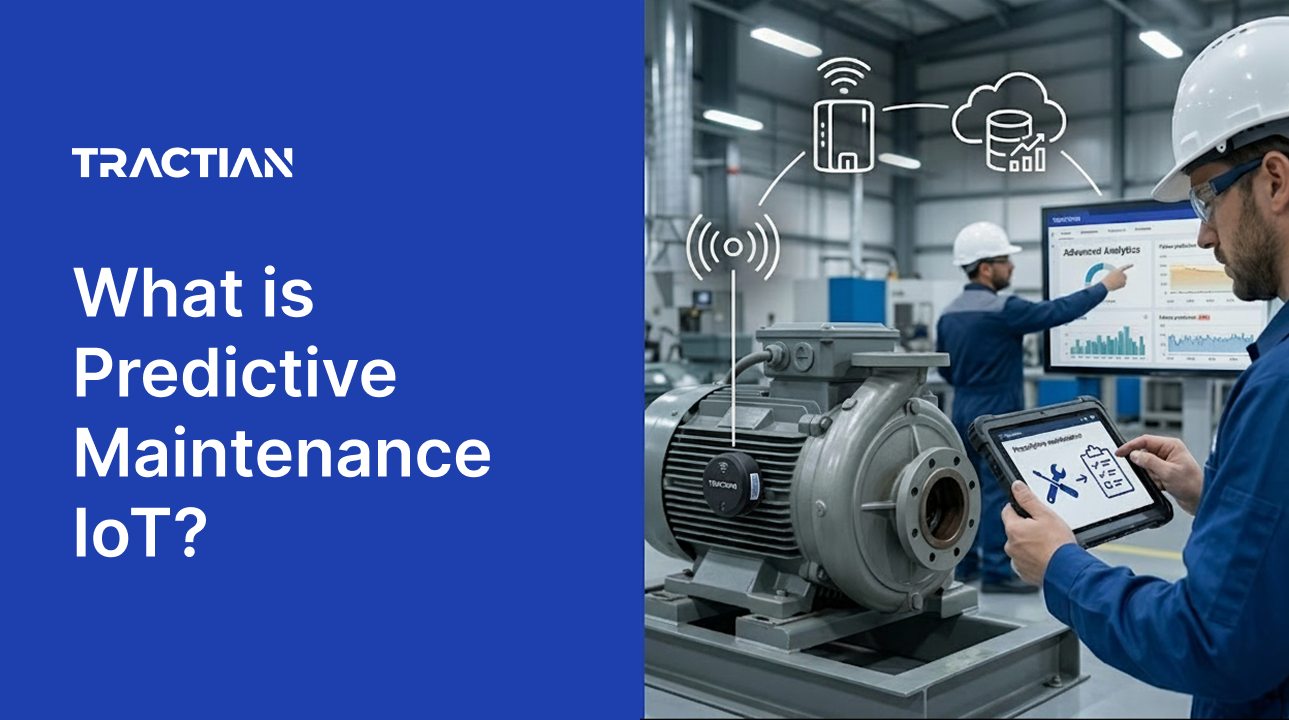
Predictive maintenance (PdM) IoT is the connected system of hardware, data infrastructure, and integrated software that enables a PdM program to function as intended: converting continuous asset signals into confident, prioritized maintenance decisions. It can be thought of as the technical architecture that makes good on PdM's core promise.
That architecture works through four interdependent layers.
- Sensing produces the input.
- Connectivity moves it.
- Data processing transforms it into something interpretable.
- Execution integration ensures that what the system knows becomes what the maintenance team does.
Each layer has a specific job, and each also has a specific failure point when it isn't designed to feed the next one. When all four work together, the result is a decision support system. When they're assembled independently, the result is a data collection environment that still requires human judgment to produce action.
Operationally, this difference is consequential. Facilities often have sensing in place and some form of monitoring software. But the gap between signal and action remains, and the cognitive burden on maintenance teams doesn't decrease. Rather, it shifts.
Understanding what a PdM IoT system actually requires at each layer is the starting point for evaluating whether a given environment is genuinely operating predictively, or generating information that people still have to sort through before anything gets done.
The Four Layers of a PdM IoT System
A PdM IoT system is best understood as a sequence of dependent layers, each of which must deliver on its functional role for the next to perform.
The architecture isn't a collection of tools that happen to be connected. It's a pipeline, and its value depends entirely on whether each stage reliably delivers usable output to the stage that follows.
Sensing and data acquisition
The sensing layer is where data collection begins. Industrial IoT sensors installed directly on rotating equipment continuously measure parameters including vibration, temperature, pressure, RPM, and ultrasound. Vibration monitoring and thermal sensing have been the traditional pillars of this layer, but the quality of the sensing layer's output depends significantly on coverage depth, not just on measurement accuracy.
A vibration sensor tracking a single axis at low frequency will miss failure modes that only become visible in high-frequency ultrasonic data or in the correlation between two measurement types. A bearing in the early stages of inner race wear may produce a detectable signature in ultrasonic frequency well before vibration amplitudes register any meaningful change.
Systems built around narrow sensing coverage narrow the detection window and push intervention later in the failure timeline, where consequences compound.
Connectivity and data transmission
Connectivity is the layer most often treated as infrastructure and given the least strategic attention, which is a practical mistake. Sub-GHz wireless protocols, 4G/LTE transmission, and local offline storage are the mechanisms that keep asset data flowing independent of plant Wi-Fi availability. The connectivity layer determines whether measurements arrive in time and in full. Gaps in transmission become gaps in asset visibility.
Those visibility gaps accumulate quietly, and decisions made without complete data carry risks that aren't always traceable back to the connectivity problem that caused them.
Data processing and contextualization
Data processing and contextualization are where the architecture earns its value or fails to. Raw vibration signals are converted into frequency spectra. AI algorithms identify fault signatures. And the system applies operating context, including load state, RPM, ambient temperature, and asset-specific baselines, to determine whether a given signal represents a genuine anomaly or normal variation.
Vibration analysis at this layer isn't threshold monitoring. It's pattern recognition applied against a backdrop of contextual variables that determine meaning. Without that context, a temperature reading on a heavily loaded motor is indistinguishable from the same reading during light-duty operation. Without multi-sensor correlation, a frequency component that indicates early bearing degradation looks like noise until it doesn't.
When the processing layer works correctly, it produces a diagnosis that includes what the fault is, how it's progressing, and what it means for the asset. When it doesn't, it produces alerts, and someone qualified enough to interpret them has to close the gap.
For teams managing complex, multi-asset environments with limited specialist availability, that gap isn't a minor inefficiency. It's a structural dependency that the program relies on, and that becomes harder to sustain as expertise ages out of the workforce.
See how AI-assisted monitoring handles this processing layer in practice.
Maintenance execution and integration
Execution integration is the final layer, and the one most responsible for whether a PdM IoT environment actually prevents failures or simply detects them. A diagnosis that doesn't flow into scheduled action doesn't prevent downtime.
Native integration between condition monitoring and a CMMS is the mechanism through which a detected fault should trigger a prioritized work order, carry a prescriptive corrective procedure, and update asset history when the repair is completed.
This feedback loop improves both diagnostic accuracy and maintenance scheduling over time. Without it, insights have to be manually translated into another system. The latency that it introduces, and the loss of outcome data that follows, gradually erode the program's precision at exactly the point where it should be improving.
What Determines Whether a PdM IoT System Is Decision-Grade
Having all four layers present doesn't automatically produce the diagnostic confidence that maintenance teams can act on.
The architecture is necessary, but it alone isn't sufficient. Two variables determine whether a PdM IoT environment crosses the threshold from data-producing to decision-supporting.
Contextual awareness in the processing layer
The first is contextual awareness in the processing layer. This refers to how consistently the system accounts for operating conditions when interpreting signals to determine whether alerts are trustworthy and which aren’t.
A flat threshold alarm on a vibration metric carries no information about whether the asset was running at full load, ramping up from a cold start, or operating in high ambient heat when the reading was taken. Systems that don't resolve this context generate false positives, and false positives are more damaging to a PdM program than most teams recognize.
Once a maintenance team learns that a significant share of alerts don't reflect real problems, they begin mentally filtering the queue. The actual faults that require attention arrive in the same stream as the noise, and the analytical burden of sorting between them falls back on people who are already stretched. Condition-based maintenance depends on the team trusting the system's recommendations.
Systems that haven't earned that trust don't get acted on.
Asset-level prioritization
The second is asset-level prioritization. This is a flat list of anomalies that scales poorly. Teams managing dozens or hundreds of assets can't devote equal attention to every flag, and a system that treats a minor lubrication indicator on a non-critical conveyor with the same urgency as an advancing bearing fault on a production-critical motor doesn't help its users make better decisions. Prioritization tied to asset health monitoring, criticality, and failure progression rate is what converts a monitoring environment into a planning tool. It tells teams not just that something needs attention, but what needs attention first and why.
Together, these two variables answer a practical question that any team should ask when evaluating their PdM IoT environment. “Does this system reduce cognitive load, or does it redistribute it?”
A well-integrated, context-aware system tells a maintenance team what to do next. A system that requires expert interpretation to produce that answer is placing a dependency on resources. Specifically, it’s placed on experienced analysts who can turn ambiguous alerts into confident recommendations, which most industrial teams can't reliably scale.
The remaining useful life of a critical asset shouldn't depend on whether the right person is available when the alert comes in.
How Tractian Approaches PdM IoT as an Integrated System
Tractian is built on the premise that all four layers of the architecture must be owned and integrated within a single platform.
Not connected through middleware, not assembled from separate vendors' tools, but designed as a closed loop where each layer is engineered to feed the next.
Multimodal sensing and connectivity
The sensing layer is handled by the Smart Trac sensor, which combines four measurement technologies in a single device: a triaxial accelerometer for vibration analysis, ultrasonic measurement up to 200 kHz, a magnetometer for high-precision RPM estimation, and a surface temperature sensor.
This multi-modal design addresses what single-parameter sensing misses, particularly in early-stage degradation where ultrasonic signatures precede visible vibration changes. The Always Listening feature ensures intermittent machines are captured at exactly the right point in their operating cycle, so no event goes unmonitored because the sensor sampled during downtime.
See this in practice here.
AI-powered diagnosis and contextual intelligence
The processing layer is powered by Auto Diagnosis, Tractian's patented fault-detection engine. It converts incoming multi-sensor data into actionable diagnoses across all major failure modes, applying
- The RPM Encoder algorithm for variable-speed equipment
- An adaptive temperature algorithm that draws on five years of location-specific weather data to separate ambient fluctuation from machine-induced thermal change
- Ultrasync for synchronized analysis across multiple sensors on the same asset.
The AI is trained on over 3.5 billion samples from industrial assets globally, and a human-in-the-loop feedback mechanism means diagnostic accuracy improves with every verified maintenance outcome.
Watch Auto Diagnosis explained.
Native execution integration and closed-loop feedback
Execution integration runs through Tractian's native CMMS. When the platform identifies a fault, it generates a prioritized work order with a prescriptive procedure drawn from a validated library.
Completed work orders feed back into the diagnostic model. The loop closes, and the system becomes more accurate over time rather than staying static.
For teams operating under labor constraints and with limited specialist depth, this architecture replaces the human bottleneck in the diagnostic process with guidance that any trained technician can act on directly.
Learn more about Tractian’s predictive maintenance solutions to find out how high-quality, decision-grade IoT data transforms your condition monitoring program into AI-powered maintenance execution workflows.
FAQs about Predictive Maintenance IoT
Condition-based monitoring refers to the continuous measurement of asset health parameters to detect changes from a baseline. Predictive maintenance IoT is the broader system architecture that takes those measurements, processes them through AI diagnostics, and integrates the output with maintenance execution tools to produce a prioritized maintenance action. Condition monitoring is the sensing function. PdM IoT is the full loop from sensing to resolution.
- What sensors are used in a predictive maintenance IoT system?
Industrial IoT sensors for PdM typically measure vibration, temperature, ultrasound, pressure, and RPM. Multi-modal sensors that combine several of these parameters in a single device provide broader failure-mode coverage than single-parameter devices, particularly for detecting early-stage faults in rotating equipment, where different measurement types reveal distinct failure signatures at different points in the degradation timeline.
- How does a PdM IoT system identify a specific failure mode rather than just flagging an anomaly?
The processing layer converts raw sensor signals into frequency spectra and applies machine learning models trained on large datasets of known fault signatures. When patterns consistent with a specific failure mode appear, such as those associated with outer bearing race wear or rotor imbalance, the system names the fault and characterizes its severity. Systems trained on broader, more diverse datasets produce more accurate and specific diagnoses across a wider range of asset types and operating conditions.
- Why does my PdM system generate alerts that my team doesn't act on?
Alert fatigue typically reflects a processing layer that lacks sufficient contextual awareness. When a system doesn't account for operating conditions, load states, or asset-specific baselines when interpreting signals, it produces false positives that teach teams to distrust the output. Reducing reactive maintenance requires alerts that arrive with a diagnosis and priority already assigned, rather than raw threshold crossings that require expert interpretation before anyone commits to a response.
- Does predictive maintenance IoT require a separate CMMS, or can they be integrated?
CMMS is required to close the loop from detection to action, but it doesn't need to be a separate platform. Native integration is significantly more effective than a middleware connection because it eliminates manual handoffs and enables completed work orders to feed diagnostic accuracy back into the system. Platforms that own both layers natively provide tighter integration and a feedback loop that improves over time.
- What should I evaluate when comparing PdM IoT systems for our facility?
Evaluate all four layers: sensing coverage and modality depth, connectivity independence from plant Wi-Fi, AI diagnostic accuracy and contextual awareness, and native integration with maintenance execution. Pay particular attention to how the system handles false positives and whether it delivers prescriptive guidance or raw anomaly data that requires interpretation. A system that sustainably improves mean time between failure does so because all four layers operate as a closed loop, not because sensing coverage has been expanded in isolation.