
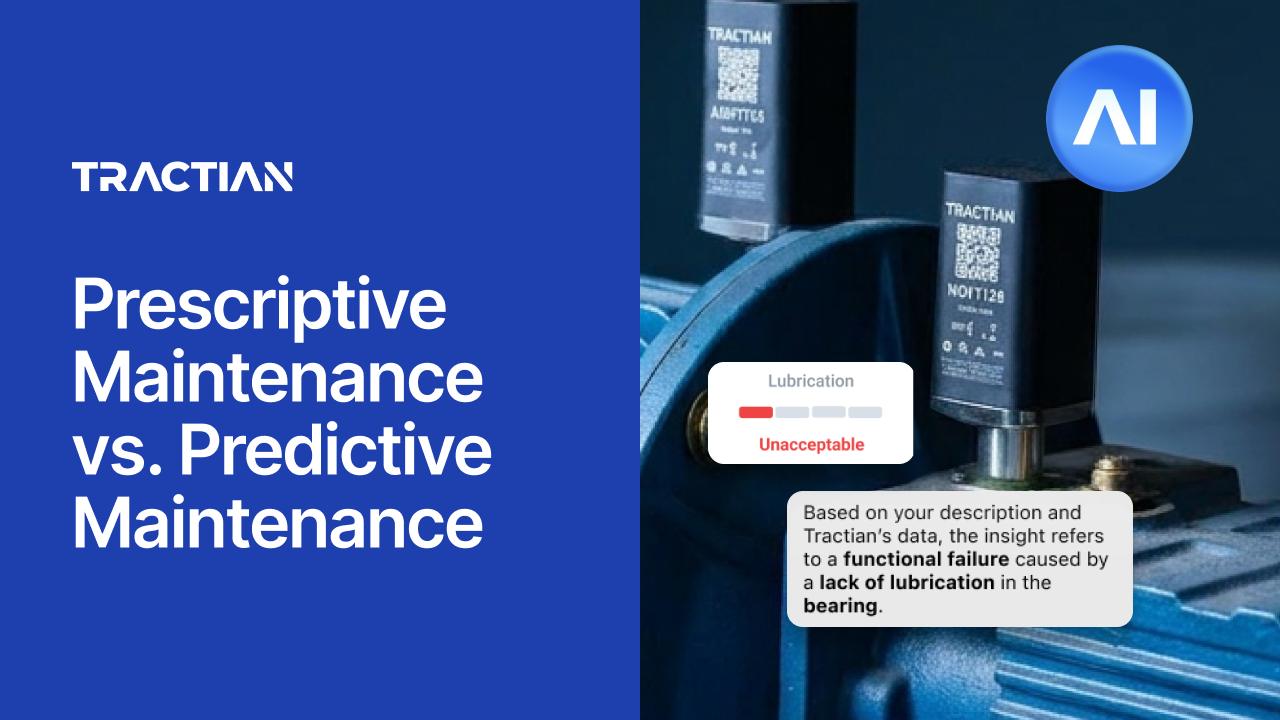
Key Points
- Predictive maintenance tells you when an asset is going to fail. Prescriptive maintenance tells you what to do about it, when to do it, and what trade-off you're making by choosing one action over another.
- The gap between the two isn't more sensors or better dashboards. It's whether your team is handed information that still requires interpretation, or a defensible decision they can act on directly.
- Prescriptive maintenance combines equipment condition data with operational and business context, so recommendations weigh production cost, parts availability, and asset criticality, not just mechanical wear.
- Without a closed loop from diagnosis to work order to verified repair, a "prescriptive" program is just a predictive program with extra slides.
In the modern industrial landscape, downtime is the enemy of profitability. For decades, maintenance teams operated on a "run to failure" mentality (reactive) or a "calendar-based" schedule (preventative). However, the rise of Industry 4.0 has introduced two heavyweight contenders to the ring: predictive maintenance and prescriptive maintenance.
The leap from predictive to prescriptive is as significant as the leap from a weather forecast to an automated climate control system. One tells you a storm is coming. The other adjusts the building around it.
What Is Prescriptive Maintenance?
Prescriptive maintenance is the strategy that turns condition data into specific, contextual recommendations, not just alerts.
Prescriptive maintenance (RxM) is a data-driven maintenance approach that uses AI and machine learning to predict equipment failures and recommend the specific action, timing, and resources needed to prevent them. It sits at the top of the maintenance analytics maturity model, above reactive, preventive, and predictive tiers.
Where most maintenance strategies stop at identifying a problem, prescriptive maintenance closes the loop between diagnosis and decision. It answers the harder question: what should we do about it, and what does each option cost us?
The output isn't a notification that something is wrong. It's an instruction grounded in operational context: reduce operating speed by 15% to extend motor life by 40 hours until the scheduled weekend repair window. Or: defer the bearing replacement to Saturday's planned outage, order the part now, reduce load by 8% in the interim.
To produce recommendations like these, a prescriptive system needs three structural layers working together:
- Continuous, multimodal condition monitoring across vibration, ultrasound, temperature, and magnetic field data, captured at sufficient resolution to detect failure signatures early across the full equipment fleet.
- Automated diagnostics that identify the specific failure mode, not just that something changed. Knowing a vibration level increased is information. Knowing the increase is consistent with a stage-two inner race bearing defect is the beginning of a decision.
- A prescription layer that takes the diagnosis, weighs it against operational variables (production schedule, parts inventory, asset criticality, labor availability, energy cost), and returns a specific recommended action with an expected outcome.
In many implementations, this prescription layer is supported by a digital twin that simulates intervention scenarios before the system commits to a recommendation. The result is a workflow where decisions are tied to outcomes, not to alerts.
What Is Predictive Maintenance?
Predictive maintenance is the strategy that uses real-time condition data to forecast failures before they happen, replacing schedule-based assumptions with evidence.
Predictive maintenance (PdM) uses real-time data from IoT sensors, typically measuring vibration, ultrasound, and temperature, to evaluate the condition of equipment as it operates. By analyzing patterns in that data, predictive maintenance identifies the signatures of developing failures and forecasts when an asset is likely to require intervention.
The question predictive maintenance answers is: when is this asset going to fail?
The output is an alert, a severity rating, and often a Remaining Useful Life (RUL) estimate. From there, a technician interprets the data and decides what to do about it.
Predictive maintenance was the major leap forward from preventive programs, which replace components on fixed schedules regardless of actual condition. Instead of changing a bearing every 6,000 operating hours whether it needs it or not, predictive maintenance lets the equipment itself signal when intervention is warranted. The U.S. Department of Energy estimates that a functional predictive maintenance program delivers 8% to 12% cost savings over a preventive program alone, driven by fewer unnecessary interventions and earlier detection of developing faults.
The limitation is what predictive maintenance hands to the team at the end of the pipeline. An alert tells you something needs attention. It doesn't tell you which action to take, when to take it, or what you're trading off by choosing one option over another. That interpretive work still falls to the technician, the reliability engineer, or the maintenance manager.
That gap, between identifying a problem and prescribing the right response, is what prescriptive maintenance closes.
|
PREDICTIVE VS. PRESCRIPTIVE MAINTENANCE
The Core Differences
|
||
|
DIMENSION
|
APPROACH
Predictive Maintenance
|
APPROACH
Prescriptive Maintenance
|
|---|---|---|
|
01
Primary Question
|
When will it fail? | What should we do about it, and when? |
|
02
Output
|
Alert, severity, RUL estimate | Specific action with expected outcome |
|
03
Data Scope
|
Equipment condition data | Equipment data + operational and business context |
|
04
Decision Burden
|
On the technician | On the system, validated by the technician |
|
05
Failure Mode
|
Alert fatigue, misdiagnosis | Trust gap if recommendations aren't transparent |
|
06
Operational Outcome
|
Reduced unplanned downtime | Optimized decisions across cost, uptime, and asset life |
| TRACTIAN | The evolution from predicting failures to prescribing actions | |
The transition between the two isn't about adding technology. It's about closing the interpretation gap that sits between a sensor reading and a work order.
The Maintenance Maturity Curve
The path from reactive to prescriptive maintenance is well-documented, but worth walking through with concrete examples rather than abstractions.
- Reactive. You replace the bearing when the motor seizes and the line stops. Highest total cost, lowest predictability.
- Preventive. You replace the bearing every 6,000 operating hours regardless of condition. Predictable, but you're either replacing healthy parts or missing degradation that started at hour 5,000.
- Predictive. Sensors detect the vibration signature of a developing inner race defect. The system flags it. A technician interprets the data and schedules the repair.
- Prescriptive. The system flags the defect, identifies the failure mode, simulates the trade-off between repairing now and deferring 72 hours, and recommends: defer to Saturday's planned window, order the bearing now, reduce load by 8% in the interim.
Each step up the curve compresses the gap between condition data and confident action. Prescriptive is the point where that gap closes.
What Prescriptive Maintenance Delivers When It's Working
The benefits aren't theoretical, but they're also not automatic. They show up when the system is properly architected and integrated with the rest of the maintenance operation.
- Decisions defensible to leadership. When a maintenance manager is asked why a specific action was taken on a specific day, the answer isn't "the schedule said so" or "the alert looked serious." It's a documented diagnosis, a simulated trade-off, and a measured outcome.
- Optimized total cost, not just optimized uptime. Predictive maintenance reduces unplanned downtime. Prescriptive maintenance reduces unplanned downtime while also accounting for parts cost, energy cost, labor availability, and production priority. The math gets harder. The decisions get better.
- Extended asset life through operational adjustment, not just timely repair. A prescriptive system can recommend changes to operating parameters (speed, load, lubricant flow, cooling) that slow degradation rather than only scheduling its repair. This is where the strategy moves from reactive to genuinely proactive.
Where Prescriptive Maintenance Programs Stall
Being honest about the failure modes matters more than listing benefits.
- Data quality. AI is only as good as the inputs. Poorly calibrated sensors, gaps in coverage, or inconsistent sampling rates produce prescriptions that are confidently wrong, which is worse than no prescription at all.
- The integration problem. A prescription that doesn't flow into a maintenance platform as a prioritized work order with the right SOP and parts list is a recommendation sitting in a dashboard. The closed loop from diagnosis to execution to verified repair is what separates working prescriptive programs from expensive ones.
- The trust gap. Technicians who have spent decades developing intuition for their assets don't automatically trust a system that tells them what to do. Adoption requires transparency. Recommendations need to show their work, and the system needs to be right often enough to earn the team's confidence.
- Cultural shift. Maintenance organizations that have spent years rewarding heroic firefighting don't reorient overnight toward systems that make firefighting unnecessary. The shift is operational and managerial, not just technical.
- Knowledge codification. Experienced reliability engineers carry decades of pattern recognition that gets lost when they retire. Prescriptive systems, especially those with human-in-the-loop feedback, codify that expertise into models that improve with every verified outcome.
When Predictive Is Enough, and When Prescriptive Becomes Necessary
Not every facility needs prescriptive maintenance. The honest framing is this:
- Predictive maintenance is enough when your team has the technical depth to interpret diagnostic data, the assets aren't so critical that an hour of downtime is catastrophic, and the operational variables (parts, labor, scheduling) are stable enough that recommendations don't need to weigh complex trade-offs.
- Prescriptive maintenance becomes necessary when asset criticality is high enough that the cost of a wrong decision exceeds the cost of the system, when the equipment is complex enough that root-cause diagnosis isn't reliable on human judgment alone, or when the operation is large enough that consistent decision quality across shifts and sites is more valuable than individual expertise.
In practice, most mature operations run both. Predictive monitoring on the broad asset base, prescriptive workflows on the high-criticality equipment where decision quality matters most.
The Real Question
The debate isn't predictive vs. prescriptive. It's whether your maintenance program is producing decisions your team can defend, or information your team still has to interpret.
Predictive maintenance was the leap from assumption-based to evidence-based maintenance. Prescriptive maintenance is the leap from evidence-based to decision-based. The first told you what was happening. The second tells you what to do about it, and what you're trading off when you choose.
The organizations that win the next decade of industrial operations won't be the ones with the most sensors. They'll be the ones whose maintenance decisions are tied to outcomes, validated against reality, and improving with every verified repair.
How Tractian Operationalizes Prescriptive Maintenance
The gap between a prescriptive recommendation and a verified repair is where most programs lose their ROI. Tractian closes that loop on a single platform.
Prescriptive maintenance only delivers on its promise when diagnosis, prescription, and execution operate as one continuous workflow. Tractian's platform is built around that closed loop.
The Smart Trac sensor captures vibration, continuous ultrasound, temperature, and magnetic field data in a single device, covering the full range of failure signatures across rotating equipment. That multimodal coverage is what makes downstream prescriptions reliable, since recommendations built on incomplete sensing produce incomplete decisions.
Tractian's patented Auto Diagnosis algorithms, trained on over 3.5 billion samples across hundreds of thousands of global assets, identify all major failure modes automatically. Every alert arrives with prescriptive guidance attached: what's wrong, how severe it is, and what to do next. Alerts are prioritized by asset criticality through the Asset Performance Management module, so teams focus on the equipment that actually matters rather than treating every notification with equal urgency.
The execution layer is where most prescriptive programs break down, and where Tractian's architecture diverges from monitoring-only platforms. When the system identifies a fault, it generates a prioritized work order directly within Tractian's maintenance execution platform, complete with the diagnosis, recommended SOP, and relevant parts. Completed work feeds back into the AI model through a human-in-the-loop mechanism. When a technician verifies a fix and the equipment signature returns to baseline, that outcome refines future diagnostics for that asset and similar equipment across the facility.
The result is a maintenance program that compounds in accuracy over time, rather than staying static after deployment. Predictive monitoring is the foundation. Prescriptive guidance is what makes it operational.
See how Tractian's AI-powered platform delivers prescriptive maintenance at scale and turns condition data into decisions your team can act on with confidence.
FAQs about Prescriptive Maintenance vs. Predictive Maintenance
What is the main difference between prescriptive and predictive maintenance?
Predictive maintenance forecasts when an asset is likely to fail, delivering an alert and a severity rating that a technician then interprets. Prescriptive maintenance goes a step further by recommending a specific action, the timing for that action, and the resources required to execute it, factoring in operational and business context alongside equipment condition data.
Is prescriptive maintenance the same as predictive maintenance with AI?
Not exactly. Predictive maintenance already uses machine learning to identify failure patterns in condition data. Prescriptive maintenance adds a decision layer on top that simulates intervention options, weighs operational trade-offs (cost, parts, scheduling, criticality), and recommends a specific course of action. The difference is between AI that detects and AI that decides.
Do I need predictive maintenance before I can implement prescriptive maintenance?
In practice, yes. Prescriptive maintenance depends on the same foundational layer as predictive: continuous condition monitoring, automated diagnostics, and accurate failure-mode identification. Without that foundation, there's nothing for the prescription layer to act on. Most organizations build predictive capability first and add prescriptive workflows on high-criticality assets where decision quality matters most.
What kind of equipment benefits most from prescriptive maintenance?
High-value, high-criticality rotating equipment where the cost of a wrong decision exceeds the cost of the system. Examples include critical motors, compressors, large pumps, and complex gearboxes in operations where unplanned downtime carries significant financial or safety consequences. Equipment whose root-cause diagnosis is difficult for human judgment alone also tends to deliver strong ROI on prescriptive workflows.
What are the biggest barriers to adopting prescriptive maintenance?
Four show up consistently: data quality issues from poorly calibrated or incomplete sensor coverage, integration gaps between the prescription layer and maintenance platform, a trust gap between technicians and AI-generated recommendations, and the cultural shift required to move from heroic firefighting to data-led execution. The technical barriers are usually easier to solve than the organizational ones.
How long does it take to see results from a prescriptive maintenance program?
Advanced platforms can begin producing actionable diagnostics within days of sensor installation, with prescriptive recommendations following as the AI model builds confidence in asset-specific behavior. Measurable improvements in unplanned downtime and decision quality typically appear within the first few months, and the program compounds in accuracy from there as verified repairs feed back into the diagnostic model.