
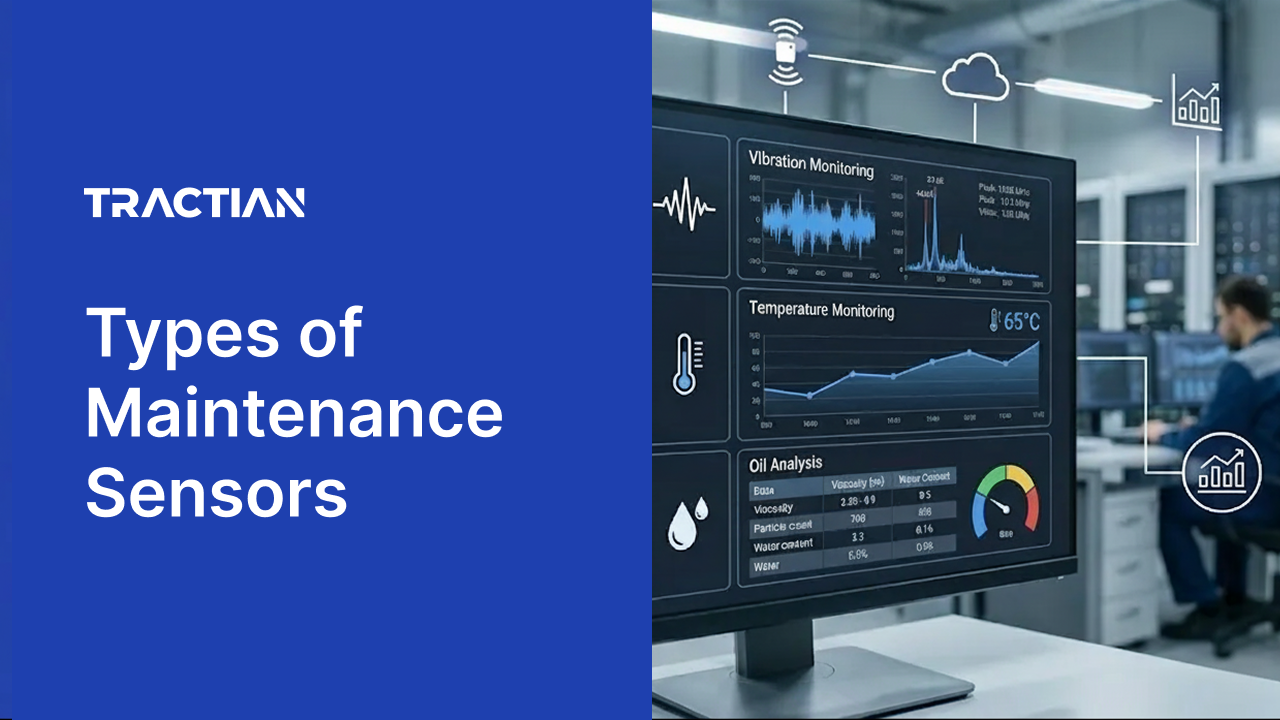
Maintenance sensors are devices used to continuously or periodically measure physical, electrical, or process-related conditions in industrial equipment. Their purpose is to detect early signs of degradation so maintenance teams can intervene before failures disrupt operations.
Different sensor types focus on different failure modes. Some identify mechanical wear, while others detect thermal, electrical, lubrication, or process-related issues. Together, they support condition-based and predictive maintenance strategies by replacing time-based assumptions with real equipment conditions.
In industrial environments, no single sensor type provides complete coverage. Effective maintenance programs layer multiple sensors to build a comprehensive view of asset health across rotating, electrical, and process-driven equipment. In practice, most programs begin with vibration sensing and expand selectively as monitoring maturity increases.
Key Takeaways
- Maintenance sensors detect early signs of equipment degradation before failures occur.
- Different sensor types target specific failure modes, including mechanical wear, overheating, electrical faults, and contamination.
- Vibration sensors are typically deployed first because they detect mechanical issues earliest and scale efficiently across large asset populations.
How Do Maintenance Sensors Work?
Maintenance sensors are installed directly on equipment or integrated into control systems to capture condition data such as vibration, temperature, electrical current, pressure, flow, speed, or acoustic signals.
Depending on the sensor type, data may be collected continuously or at defined intervals. That data is transmitted to monitoring platforms where trends, thresholds, and analytics identify abnormal behavior. Instead of relying on calendar-based inspections, teams monitor how assets actually operate and respond when conditions change.
As maintenance programs scale, sensor design becomes as important as sensor type. Systems that rely on manual data collection or fixed-speed assumptions often struggle with intermittent or variable-speed equipment. Sensors that automatically adapt to real operating conditions and wirelessly deliver data toadapt automatically to real operating conditions and deliver data wirelessly into centralized platforms reduce friction and improve long-term adoption.
Advanced platforms correlate data from multiple sensor types to determine whether an issue is mechanical, electrical, lubrication-related, or process-driven, reducing guesswork and false alarms.
6 Types of Maintenance Sensors and What They Detect
Vibration Sensors
Vibration sensors measure mechanical motion in rotating equipment and are the most widely adopted maintenance sensors in industrial plants. They are especially effective because most mechanical faults alter vibration behavior early in their lifecycle, often before temperature or performance changes appear.
Modern vibration sensors increasingly combine vibration data with temperature, runtime, and speed context to improve diagnostic accuracy and reduce false alarms. This is particularly important for variable-speed and intermittent machines, where snapshot-based monitoring can miss early-stage faults.
- Bearing wear and lubrication degradation
- Shaft misalignment
- Mechanical imbalance
- Looseness and gear defects
Example:
A motor operates normally, but vibration data shows increasing high-frequency energy. Maintenance identifies early bearing wear and schedules replacement before failure.
Temperature Sensors
Temperature sensors track heat generated by equipment components and are often used alongside vibration monitoring.
They typically detect:
- Overheating bearings or windings
- Friction caused by lubrication failure
- Electrical resistance or overload conditions
Temperature sensors often confirm severity rather than provide the earliest warning, making them complementary to vibration sensing.
Electrical Sensors
Electrical sensors monitor current, voltage, and power quality to assess motor and electrical system health.
They are used to detect:
- Phase imbalance
- Insulation degradation
- Rotor bar defects
- Power quality issues
Electrical monitoring helps distinguish whether a fault originates mechanically or electrically, reducing unnecessary mechanical interventions.
Oil and Lubrication Sensors
Oil and lubrication sensors analyze fluid conditions to identify internal wear and contamination.
They detect:
- Metal wear particles
- Moisture or contamination ingress
- Lubricant degradation
Oil analysis provides deep insight into internal component health but is often periodic rather than continuous, making it best used in combination with other sensors.
Ultrasound Sensors
Ultrasound sensors detect high-frequency acoustic signals that are not audible to humans.
They are commonly used for:
- Early bearing friction detection
- Compressed air and gas leak identification
- Steam trap failures
- Electrical arcing
Ultrasound tools are effective for targeted inspections but typically require manual data collection.
Process and Performance Sensors
Process sensors measure operating conditions such as pressure, flow, speed, load, or level.
They help identify:
- Cavitation in pumps
- Flow restrictions
- Overload conditions
- Efficiency losses
These sensors provide context that explains why mechanical stress is increasing, even when vibration or temperature changes appear secondary.
Why Sensor Combination Matters
Each sensor type has strengths and limitations. Vibration sensors excel at detecting mechanical faults early. Temperature sensors confirm overheating. Electrical sensors isolate motor-related issues. Oil analysis validates internal wear. Process data explains operating stress.
Increasingly, plants favor approaches that consolidate multiple condition indicators into fewer devices and workflows. Combining vibration with temperature, runtime, and speed context at the sensor level reduces integration complexity and improves signal quality.
Most predictive maintenance programs begin with vibration sensing and expand selectively based on asset criticality, operational complexity, and maintenance maturity.
How to Choose the Right Maintenance Sensors for Your Plant
| Asset Type | Common Failure Modes | Recommended Sensors | Why This Combination Works |
|---|---|---|---|
| Electric Motors | Bearing wear, misalignment, imbalance | Vibration | Detects early mechanical degradation and scales easily across large motor populations. |
| Pumps & Compressors | Bearing wear, cavitation, misalignment | Vibration + Temperature | Vibration identifies early faults, while temperature helps confirm severity and progression. |
| Gearboxes | Gear wear, lubrication breakdown | Vibration + Oil Analysis | Vibration tracks fault development, oil analysis confirms internal wear and contamination. |
| Variable-Speed Equipment | Load-related wear, speed variation | Vibration with RPM Context | Adapts to changing operating speeds and avoids false alarms from fixed assumptions. |
| Motors & Drives | Electrical imbalance, rotor faults | Electrical + Vibration | Separates mechanical issues from electrical root causes, improving diagnostic accuracy. |
| Continuous Process Assets | Overload, process instability | Process Sensors + Vibration | Provides operating context to explain why mechanical stress is increasing. |
| Low-Criticality Assets | Minor wear, infrequent use | None or Periodic Checks | Avoids unnecessary data collection and reduces alert fatigue. |
Selecting the right maintenance sensors depends less on the number of available technologies and more on how your assets operate, fail, and are maintained today. The most effective programs start simple, focus on critical equipment, and expand as reliability maturity increases.
Start With Asset Criticality
Not every asset requires the same level of monitoring. Begin by identifying machines whose failure would cause significant downtime, safety risk, or production loss. These are typically motors, pumps, compressors, fans, and gear-driven systems that operate continuously or under high load.
Critical rotating equipment is usually the best starting point because mechanical degradation is common and failures escalate quickly.
Match Sensors to Likely Failure Modes
Different sensors are better suited to different types of failures. Mechanical wear, misalignment, imbalance, and bearing degradation are best detected through vibration. Thermal sensors are effective for identifying overheating or confirming severity, while electrical sensors help isolate motor-specific issues.
Rather than deploying every sensor type at once, align sensor selection with the failure modes that historically cause the most disruption in your plant.
Account for Operating Conditions
Operating context matters. Assets that run intermittently, operate at variable speeds, or experience changing loads require sensors that adapt automatically to real conditions. Fixed-interval or manual data collection often struggles in these environments and can miss early-stage faults.
Wireless sensors that capture vibration alongside temperature, runtime, and speed context reduce blind spots and simplify deployment across large or complex facilities.
Consider Maintenance Maturity
Plants early in their reliability journey benefit from starting with continuous vibration monitoring on critical assets. This provides fast insight and clear ROI without adding complexity.
As programs mature, additional sensing such as electrical monitoring, oil analysis, or process data can be layered in for deeper diagnostics on high-value or failure-prone equipment.
In most cases, successful programs follow a progression:
- Start with vibration sensors on critical rotating assets
- Add temperature or electrical sensing to confirm and contextualize issues
- Expand into oil or process sensors where failures are costly, slow-developing, or difficult to diagnose
This approach builds capability gradually while keeping monitoring actionable and manageable.
Common Mistakes When Deploying Maintenance Sensors
Even well-intentioned monitoring programs can struggle if sensors are deployed without a clear strategy. Avoiding a few common pitfalls can significantly improve adoption and results.
Relying Only on Temperature for Early Detection
Temperature changes often occur after mechanical damage has progressed. Using temperature alone can delay detection and limit planning time. Temperature works best as a confirmation signal, not as the primary indicator of mechanical health.
Using Manual Ultrasound Routes at Scale
Ultrasound tools are effective for targeted inspections, but manual routes do not scale well across large asset populations. They rely heavily on operator availability and consistency, making them less suitable for continuous monitoring strategies.
Monitoring Too Many Low-Criticality Assets
Trying to monitor every asset equally can dilute focus and overwhelm teams with data. Prioritizing high-impact machines ensures sensor data leads to meaningful action rather than alert fatigue.
Collecting Data Without Clear Workflows
Condition data only creates value when it leads to action. Programs that collect sensor data without clear thresholds, diagnostics, or links to maintenance planning often struggle to justify ongoing use.
Effective monitoring connects detection to diagnosis and execution, ensuring insights result in inspections, planned work, and measurable reliability improvements.
How Maintenance Sensors Improve Plant Reliability
Maintenance sensors shift teams away from reactive repairs and time-based inspections. Instead of guessing when equipment needs attention, teams act based on measured conditions.
This results in:
- Fewer unplanned failures
- More predictable maintenance schedules
- Better use of limited labor
- Longer asset life
Reliability improves not because teams work more, but because decisions are driven by actual equipment behavior. Systems that prioritize actionable issues and suppress non-critical patterns further improve results by ensuring alerts lead to timely action rather than alarm fatigue.
How Tractian Supports Maintenance Sensors
Tractian supports maintenance sensing by combining industrial-grade wireless vibration sensors with continuous monitoring, automated diagnostics, and maintenance workflows. Vibration, temperature, runtime, and RPM data are collected in real time and translated into clear health indicators.
Rather than relying on raw data or static thresholds, the platform focuses on identifying meaningful condition changes and connecting them directly to maintenance planning. This approach helps teams detect issues earlier, diagnose root causes faster, and act consistently while tracking reliability impact over time.
See how maintenance sensors support continuous condition monitoring in real industrial environments by exploring Tractian’s condition monitoring solution.
Industries That Benefit Most from Vibration Sensors?
Maintenance sensors deliver the greatest value in industries where equipment uptime, safety, and production continuity are critical.
- Automotive & Parts: Prevents line stoppages in highly synchronized production environments.
- Manufacturing: Supports condition-based maintenance across motors, pumps, fans, and gear-driven systems.
- Oil & Gas: Detects early faults on compressors and pumps in remote or hazardous locations.
- Chemicals: Protects continuous processes with limited tolerance for unplanned downtime.
- Food & Beverage: Prevents mid-run failures that cause waste or quality issues.
- Mills & Agriculture: Protects seasonal, high-load equipment during time-sensitive processing periods.
- Mining & Metals: Monitors high-load assets to avoid extended downtime and secondary damage.
- Fleet & Heavy Equipment Maintenance: Improves maintenance planning and asset life in high-utilization operations.
Frequently Asked Questions About Maintenance Sensors
What are maintenance sensors used for?
They monitor equipment condition to detect early signs of failure and support condition-based maintenance.
Do all assets need the same sensors?
No. Sensor selection depends on asset type, failure modes, and criticality.
Are vibration sensors enough on their own?
They are often the best starting point, but combining sensor types improves accuracy and coverage.
How quickly do maintenance sensors deliver ROI?
Many teams see returns within months by preventing a single major failure.