
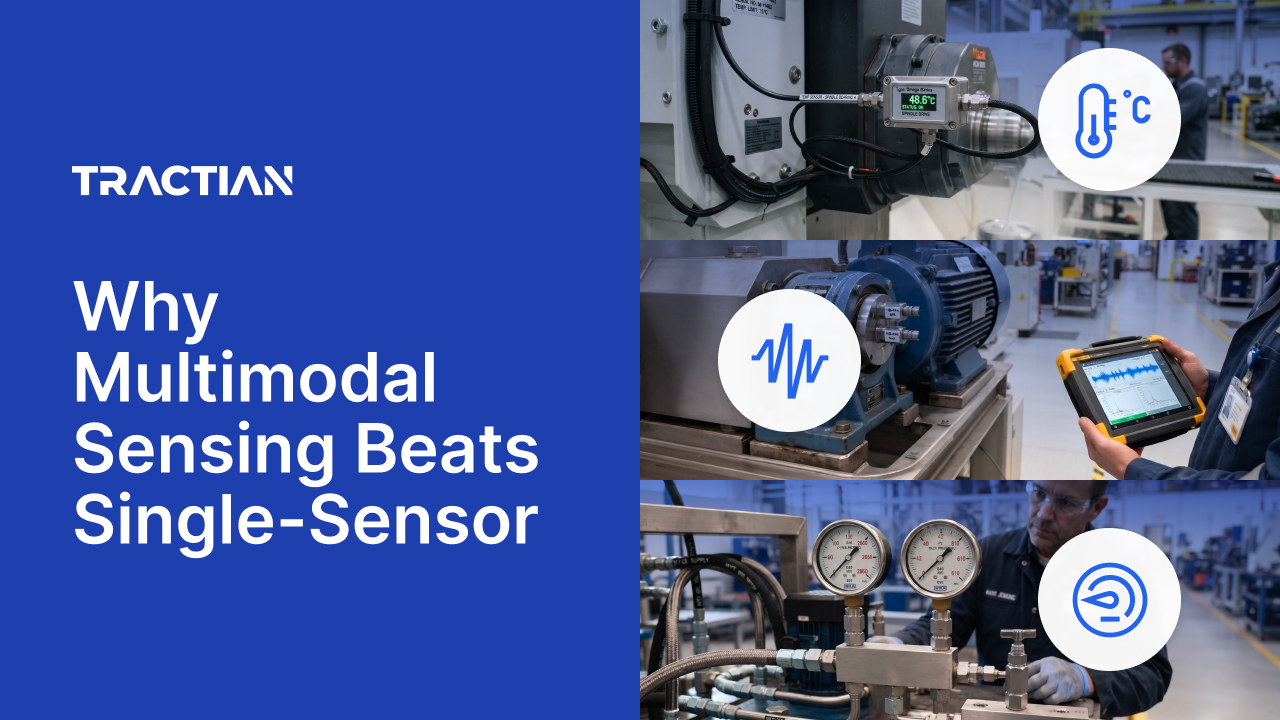
A good maintenance tech has never diagnosed a machine with one sense. They listen for the bearing. They feel for the heat. They look for the leak. The answer almost never lives in a single signal. It lives in the overlap, and the best techs have always known it.
So here's a question worth sitting with: if the people who actually fix machines use every sense at once, why do we still ask the technology watching those machines to get by on one?
That, in a sentence, is the case for multimodal sensing. A single sensor listens for one thing. Multimodal sensing measures several at once: vibration, temperature, and acoustic signature together. Then it reads the relationship between them. It's the difference between hearing a machine and understanding what it's trying to tell you. It's also what real predictive maintenance runs on, because you can't predict a failure you can only half-see.
What Multimodal Sensing Actually Measures
When it comes to multimodal sensing, vibration is the workhorse. It's the clearest read on imbalance, misalignment, looseness, and a defect already taking shape inside a bearing or a gear. If something is physically moving wrong, vibration usually shows it.
Temperature tells a different story. Heat is the fingerprint of friction and electrical trouble: a motor winding starting to break down, a coupling running hot, lubrication thinning out. A rising temperature is often the asset telling you it's working harder than it should to do the same job.
Acoustic and ultrasonic sensing catch what the other two can't hear yet. The very first sign of a lubrication problem, a pressurized leak, an early electrical discharge. These live in a frequency range a person can't pick up and a vibration sensor isn't built to flag.
No single one of these is wrong. Each is just partial. Multimodal sensing puts all three in the same conversation, so the strengths of one cover the blind spots of another.
A Failing Machine Speaks More Than One Language
Here's the part that makes single-sensor monitoring quietly risky: a machine in trouble doesn't announce it one way. It announces it in several, in sequence.
Take a failing bearing. First the lubrication film breaks down, and the earliest evidence shows up in the acoustic and ultrasonic range, long before anything looks dramatic. Then friction climbs, and temperature starts to rise. Then the defect grows, and the vibration pattern finally shifts enough to notice. By the time it's loud enough that someone walking past can hear it, you're at the most expensive moment to find out anything.
A single-sensor program listens for exactly one of those signals. Vibration-only is the classic example, and it's genuinely strong technology, right up until the failure shows up somewhere vibration can't see it, or until the damage is far enough along that vibration finally catches up. Every sensor has a window. The problem is that failures don't agree to show up inside one window.
That's the whole flaw. You're not getting a wrong answer from a single sensor. You're getting a partial one, and a partial answer on a critical asset is how a planned Tuesday repair becomes an emergency weekend call-out.
The Real Cost of a Single Signal
Most plants today are data rich and information poor. Sensors everywhere, answers nowhere, because each tool only sees its own slice.
Picture a critical conveyor starting to go.
The plant runs vibration monitoring, so that's the one signal anyone is watching. The vibration sensor catches a small blip, but it's under threshold, so nothing trips and no one gets dispatched. Meanwhile, two louder warnings are completely invisible to that setup: motor temperature has crept up fifteen percent, and the acoustic signature has gone high-frequency. Nothing is measuring those, or they sit in a separate tool no one cross-references until next Thursday.
In a single-sensor world, these signals never meet. No one piece of data looks catastrophic on its own. Forty-eight hours later the machine fails, and now you're looking at lost production and a crew called in on a Saturday for a repair that should have been routine.
A technician's brain would solve this in seconds: heat, plus abnormal noise, plus a vibration shift, equals a bearing about to fail. But you can't ask a person to stand at three dashboards every hour and cross-reference them by hand, and you shouldn't have to. That gap, between three partial signals and one clear answer, is exactly what multimodal sensing closes.
What Multimodal Sensing Catches That a Single Sensor Misses
Run the same conveyor again, this time with one device measuring vibration, temperature, and acoustic signature together.
None of the three signals alone trips an alarm. But the system sees all three moving in concert: vibration drifting, temperature climbing, acoustic energy shifting into the high-frequency band. That pattern is unambiguous. It writes a high-priority work order before the failure lands:
ALERT: High probability of Conveyor 3 motor bearing failure. Evidence: temperature up fifteen percent, abnormal high-frequency noise, early-stage vibration signature. Diagnosis: seal degradation leading to loss of lubrication and bearing friction. Recommended action: replace the drive-side seal and inspect the bearing. Parts: SKF Bearing 6205, Viton lip seal (in stock, Bin A4).
Caught early. Planned. Done on a Tuesday, with the crew home by dinner.
This isn't a future luxury for billion-dollar plants. It's the current frontier of predictive maintenance, and it moves a plant from a reactive scramble to an orchestrated operation. Not by adding more dashboards, but by reading the ones you'd otherwise be checking by hand.
Single-Sensor vs. Multimodal Sensing, Head to Head
The contrast is sharpest side by side.
Coverage. A single sensor sees one class of failure well and is blind to the rest. Imbalance shows in vibration, insulation breakdown shows in temperature, early lubrication failure shows in ultrasound. Measure one, and the others arrive unannounced. Multimodal sensing covers far more of the failure map at once.
Timing. A single signal usually catches a problem at one point in its life. Layering acoustic and temperature onto vibration buys you the earliest warnings, sometimes weeks of warning a vibration-only setup never gets.
False positives. One sensor spikes and the alarm fires, context or not, so teams get buried in noise and start tuning it out. Multimodal sensing confirms the issue across independent signals before it bothers anyone, so the alert that reaches your team is real and worth acting on.
Footprint. Single-sensor coverage means stitching together a vibration program, a thermal program, and an acoustic program. Three tools, three budgets, three things to interpret. Multimodal sensing puts those signals in one device and one feed.
More Signals, Fewer False Alarms
It's fair to wonder whether more sensors just means more noise. In a single-sensor world, that worry is earned. Every spike is treated as an event, because there's no second opinion to check it against.
Multimodal sensing flips that. When the system can ask whether a vibration spike is backed up by a temperature change or an acoustic shift, it stops treating every blip as an emergency. A lone reading that used to fire an alarm now gets weighed against the others before anyone's phone buzzes. The result is fewer interruptions, not more, and the alerts that do come through have already cleared a higher bar.
That matters more than it sounds. Alarm fatigue is one of the quietest ways a good maintenance team gets worn down. When half the alerts are noise, people stop trusting all of them, including the one that was real. Cross-confirmed sensing protects attention, which is the most limited resource on any floor.
What to Look for in a Multimodal Sensing Setup
If you're weighing the move, a few things separate a real multimodal sensing platform from a pile of sensors sold together.
One device, not a bundle. The point is to measure vibration, temperature, and acoustic signature from the same place, on the same asset, at the same time. Three separate sensors feeding three separate tools is the problem you're trying to leave behind, not the solution.
Fusion, not just collection. Gathering more data is easy. The value is in software that actually reads across the signals and tells you what the combination means, not a fourth dashboard for you to correlate by hand.
Context from your history. The strongest systems pull live readings together with your work order history and asset records, so a diagnosis arrives with what failed last time and what fixed it.
Built for the whole team. Good sensing shouldn't require a specialist to interpret. The right setup hands a clear, plain-language call to the newest tech on the floor, not just the one analyst who knows how to read a spectrum.
Why Multimodal Sensing Matters Now
You might be thinking this sounds great for a giant automotive plant, but you're just trying to get preventive maintenance done on time. The honest answer is that three forces make this urgent for you specifically.
Experience is walking out the door. A generation of intuitive, multi-sense troubleshooting is retiring, and single-sensor tools have always leaned on an expert to interpret them. Multimodal sensing plus AI lowers that bar. It hands a newer technician the reading the data would otherwise demand years of experience to do in their head.
Downtime keeps getting more expensive. Production runs leaner than ever, and run-to-failure is no longer a strategy you can afford. Predictive maintenance is the alternative, and it only works when something is actually reading every warning sign, not just the one or two that happen to land on a single sensor.
The technology is finally within reach. Five years ago, fusing these streams meant a team of data scientists and a budget in the millions. Today it's built into platforms you can buy and use now. You don't have to build it. You only have to choose a partner who already has.
Where Tractian Fits
This is the exact problem Tractian was built to solve. Our sensors capture vibration, temperature, and ultrasound, the high-frequency end of that acoustic range where the earliest faults surface, all from one point on the asset in real time. It's multimodal sensing in a single device, not multiple programs duct-taped together. From there, our AI reads across every signal and weighs it against each asset's history to tell you what's failing, why, and what to do about it: predictive maintenance you can act on before the breakdown lands on someone's weekend.
You don't have to assemble a multimodal system from scratch or hire a team to run it. That work is already done. Tractian hands your team the full picture a great technician carries in their head and puts it in everyone's hands, from the twenty-year veteran to the tech who just started last week.
The plants that win the next decade won't be the ones with the most sensors. They'll be the ones that can finally read every signal at once. That's what multimodal sensing delivers, and it's what Tractian was built to do.
Let's talk about what that looks like on your floor. Schedule a demo.