
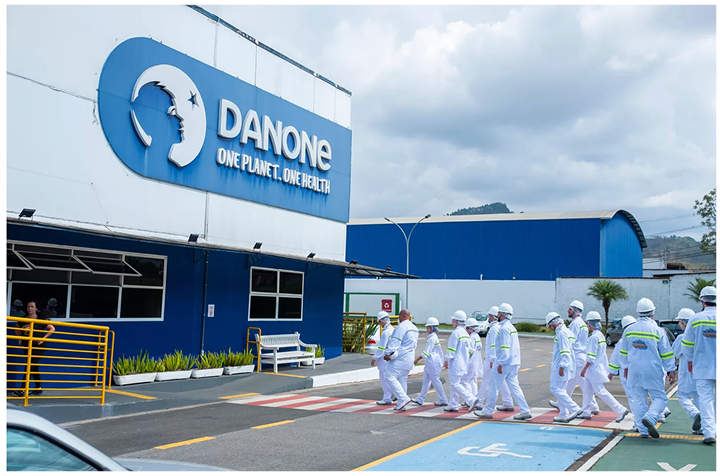
Danone, one of the largest global companies in the food and beverage sector, is a benchmark in dairy production and specialized nutrition. In industrial operations of this scale, where quality, food safety, and consistency are non-negotiable, equipment reliability is as critical as the production processes themselves.
Seeking to increase maintenance predictability and strengthen equipment reliability, Danone began investing in Tractian condition monitoring sensors.
At a glance
Challenge: no early warning on assets that can't stop
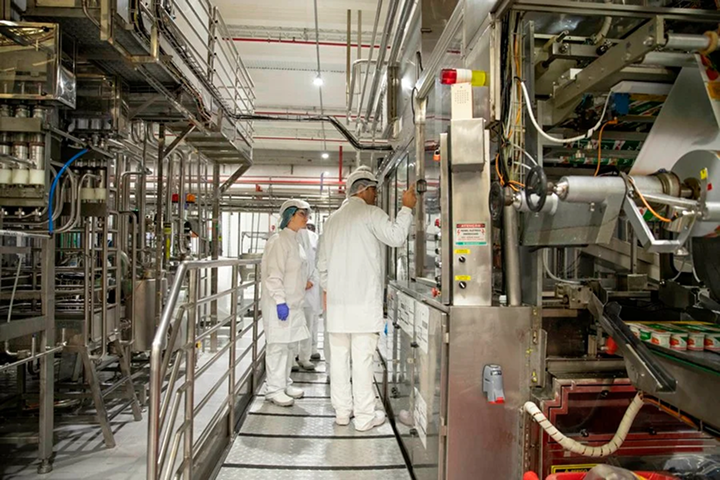
Before implementing condition monitoring, the maintenance team struggled to anticipate failures in critical production equipment, reinforcing the need for a more predictive, data-driven approach. Equipment such as homogenizers, pumps, and compressors operate continuously and play an essential role in the production process, making any unexpected downtime a significant operational risk.
Given this scenario, the team sought a solution capable of providing real-time visibility into equipment condition and enabling planned interventions before failures escalated into greater damage.
Solution: continuous data on the assets that carry the plant
To address these challenges, Danone implemented Tractian Condition Monitoring on critical plant assets. With smart sensors and AI-based analysis, the team began continuously tracking parameters such as vibration and the mechanical performance of equipment.
The solution made it possible to identify failure patterns at an early stage and generate alerts that guide the team in decision-making. With greater visibility into asset health, maintenance was able to schedule interventions in advance, reducing the risk of structural damage and increasing equipment operational availability.
With greater visibility into asset health, maintenance was able to schedule interventions in advance, reducing the risk of structural damage and increasing equipment operational availability. And a repair planned three weeks out is a different event than the same repair executed at 2 a.m. Different parts availability, different labor cost, different production impact.
Use Cases: what the sensors caught before the plant felt it
Lubrication anomaly identified before it could compromise the cheese-processing vessel’s gearbox
The sensor identified characteristic signs of lubrication failure in the cheese-processing vessel’s gearbox. The analysis indicated that the viscosity of the oil being used was not ideal for the equipment. With the early alert, the team corrected the issue, preventing damage to the gearbox. Without the alert, the risk of asset breakdown would have implied a cost of $7,600 for the new gearbox, in addition to the financial impact of the production stoppage.
AI anticipates wear in the production line’s homogenizer
The platform's artificial intelligence identified an increase in the vibration profile associated with a pulley on a homogenizer, indicating possible misalignment. During the field inspection, the team confirmed wear on the connecting rods and the asset's block. By tracking the progression of the failure, the team was able to schedule a planned intervention to correct the problem.
Early detection made it possible to carry out the repair and avoid a breakdown that could have generated up to $40,000 in maintenance costs, in addition to production stoppages of 3 to 30 days and commercial impacts estimated between $120,000 and $600,000.
Results and Business Impact: failures found in degradation, not at breakdown
Two catches. One alert on one pulley accounted for as much as $600,000 in avoided commercial impact.
With continuous asset monitoring, Danone began anticipating failures and carrying out planned interventions before equipment suffered structural damage. The combination of smart sensors and predictive analysis brought greater visibility into equipment health, making it possible to reduce the risk of breakdowns, avoid high repair costs, and preserve production continuity.
The structural change matters as much as the savings:
- Failures surface during degradation, not at breakdown, while there's still a decision to make about them.
- Interventions are planned, with parts and line time arranged in advance rather than improvised under pressure.
- Root causes get corrected, not just symptoms.
- Maintenance capacity shifts from emergency response to planned work.
By transforming monitoring data into more assertive operational decisions, the company strengthened its industrial reliability strategy, reducing costs associated with unexpected failures and increasing the safety and predictability of its operation.