
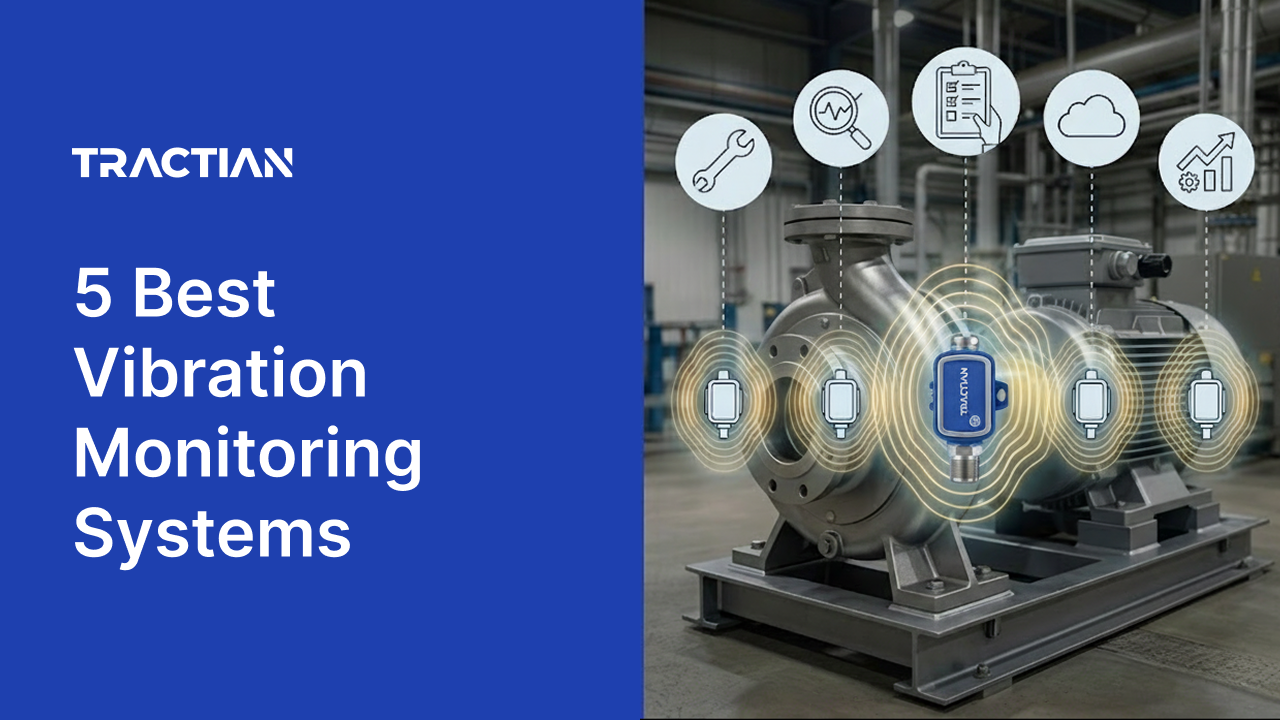
A vibration monitoring system is a combination of sensors, software, and analytics used to continuously track the mechanical behavior of rotating equipment. By measuring parameters such as vibration amplitude, frequency, and waveform patterns, these systems detect changes that indicate developing faults, including imbalance, misalignment, bearing degradation, looseness, and gear wear.
The objective is to identify problems early enough for maintenance teams to intervene before equipment fails, thereby avoiding unplanned downtime and extending asset life.
Traditionally, vibration monitoring meant a sensor connected to a dashboard that displayed trends and triggered threshold-based alarms. That model still exists, and for some operations it remains sufficient. But the scope of what qualifies as a "system" has expanded considerably.
Current-state vibration monitoring system technology ranges from standalone sensor-and-software packages that capture and display vibration data to integrated platforms in which vibration is one of several sensing modalities.
The integrated systems even go so far as to feed AI-powered diagnostics that generate fault-specific diagnoses, prescriptive maintenance actions, and automatic work orders. In between these are systems that add AI anomaly detection, expert analyst services, or connections to separate maintenance management tools.
The distinction matters because the word "system" can mean different things depending on the product you're evaluating. Some systems stop at data collection and visualization. Others extend from diagnosis to maintenance execution. Knowing where a system's scope ends and where your team's manual effort begins is the first question to answer before comparing options.
What should you prioritize when selecting a vibration monitoring system?
A vibration monitoring system that only confirms something changed isn't enough for operations where downtime carries real cost. The systems that create competitive advantage are the ones that close the gap between detecting a signal and acting on it with confidence, without requiring your team to grow in headcount or expertise to get there. When evaluating systems, four priorities should guide the decision.
- Diagnostic clarity beyond threshold alerts: The system should identify what is wrong, not just that something changed. Fault-specific diagnosis with severity context allows teams to prioritize and plan rather than investigate every alert manually.
- Multi-modal data for broader fault coverage: Vibration alone doesn't capture every failure mode. Systems that incorporate complementary sensing technologies like ultrasound, temperature, and magnetic field data detect a wider range of conditions, including early-stage wear, lubrication issues, and electrical anomalies that vibration analysis can miss.
- Closed-loop maintenance execution: Detection without a clear path to action creates a bottleneck. Systems that connect condition insights directly to maintenance workflows, including work order generation, procedures, and task assignment, eliminate the manual translation step that can lose urgency.
- Scalability without expertise dependence: The system should support expanding asset coverage without a proportional increase in the need for vibration specialists, analyst services, or additional infrastructure. AI that learns and adapts to each machine's operating context reduces the team's burden of interpretation.
How do teams benefit from a vibration monitoring system?
Maintenance and reliability teams operating with a vibration monitoring system that delivers on these priorities shift from reacting to failures toward managing asset condition with data-backed confidence.
Instead of investigating vague alerts or waiting for scheduled inspections to reveal what's already deteriorating, teams receive clear, prioritized information that tells them where to focus, what's wrong, and what to do about it. The result is fewer surprises, faster response when issues do arise, and more productive use of every maintenance hour.
The key capabilities that enable this shift include:
- Fault-specific auto-diagnosis: AI algorithms that analyze vibration spectra and identify the specific failure mode developing, whether it's bearing wear, misalignment, cavitation, or dozens of other conditions, so the team knows exactly what they're dealing with.
- Predictive maintenance Alerts that arrive with attached procedures, troubleshooting steps, and recommended actions, converting a data point into a clear instruction.
- Automatic work order generation: Condition insights that flow directly into Tractian's platform to create prioritized work orders, linking what the sensor detected to what the technician needs to do next.
- Continuous machine benchmarking: The ability to compare an asset's performance against its own history, similar equipment in the facility, and anonymized industry-wide data to identify outliers and validate that corrective actions worked.
- Remote asset health visibility: Real-time access to machine condition data that reduces the need for manual inspections, minimizes risk exposure from hands-on measurements on running equipment, and gives teams situational awareness across the entire plant from a single interface.
Vibration Monitoring Systems at a Glance
| Feature | Tractian | Augury | Fluke | SKF | Erbessd |
|---|---|---|---|---|---|
| Score | 7/7 | 5/7 | 1/7 | 0/7 | 1/7 |
| Ultrasound Sensing | ✅ Built into sensor | ✅ Via separate U2000 sensor | ❌ | ❌ | ❌ |
| AI Auto-Diagnosis of Specific Failure Modes | ✅ 75+ failure modes | ✅ | ✅ Via Azima analytics | ❌ Anomaly detection only | ❌ Baseline deviation flagging only |
| Native Tractian's platform with Automatic Work Order Generation | ✅ | ❌ Requires third-party Tractian's platform | ❌ Available through separate eMaint product | ❌ | ❌ |
| Prescriptive Alerts with Attached Maintenance Procedures | ✅ | ✅ | ❌ | ❌ | ❌ |
| Magnetic Field Sensing | ✅ | ✅ | ❌ | ❌ | ❌ |
| Cellular Gateway Connectivity | ✅ Built-in 4G/LTE | ✅ Via USB cellular dongle | ❌ | ❌ | ✅ Via external antenna add-on |
| Synchronized Multi-Sensor Analysis | ✅ | ❌ | ❌ | ❌ | ✅ |
Top Vibration Monitoring Systems by Company
The following are the top companies at each level of “system” interpretation, beginning with Tractian, which integrates vibration monitoring into a multimodal, closed-loop condition-monitoring and maintenance-execution solution, and ending with the final company focused primarily on the sensor solution.
Tractian
Best for: Industrial teams that need a single platform covering the full workflow from vibration detection through AI diagnosis to maintenance execution, without adding headcount or stitching together separate tools.
Tractian's vibration monitoring capability sits at the core of a broader condition monitoring and maintenance platform. The Smart Trac sensor captures triaxial vibration data across a frequency range of 0 to 64,000 Hz with acceleration up to 60 g, giving it the resolution to detect faults across everything from slow-speed conveyors to high-speed spindles.
But what distinguishes the system is that vibration is one of four sensing modalities built into a single device. Beyond vibration, Tractian’s Ultrasonic Sensor captures data, detecting friction, cavitation, and early-stage wear that traditional vibration analysis misses, particularly on low-speed equipment. A magnetometer tracks real-time RPM from 1 to 48,000 without external tachometers. Surface temperature completes the picture. This multi-modal approach means that each sensor provides correlated data streams that the platform's AI uses together to identify faults more precisely.
What makes this a "system" in the fullest sense is that these insights don't stop at a dashboard. They flow directly into Tractian's native maintenance execution platform, where they can generate prioritized work orders with attached SOPs, assigned technicians, and linked inventory. The APM module extends this further with FMEA, root cause analysis tools, failure libraries, and inspection management, all within the same platform.
The result is a closed-loop system where vibration monitoring feeds AI diagnostics, diagnostics feed maintenance execution, and completed maintenance feeds back into the AI to improve future accuracy.
Notable features
- Multimodal sensing in a single sensor: Vibration, ultrasound, magnetic field, and temperature in one IP69K-rated, ATEX/IECEx-certified device. Always Listening mode captures data from intermittent machines at exactly the right moment, and the RPM Encoder algorithm dynamically adjusts the analysis for variable-speed equipment.
- Auto Diagnose all major failure modes with prescriptive actions: Patented AI identifies the specific fault developing, rates its severity based on asset criticality, and attaches validated maintenance procedures so the team knows what's wrong and what to do about it without waiting for specialist interpretation.
- Native maintenance execution with automatic work order generation: Condition insights trigger prioritized work orders directly within the platform, complete with procedures, task assignments, and inventory links. No third-party integration required. The mobile app supports offline execution, QR code asset access, and built-in team communication.
- Adaptive AI with human-in-the-loop learning: The system adapts to each machine's operating context, including load, speed, and ambient conditions. Verified maintenance outcomes feed back into the model, improving diagnostic accuracy over time. An adaptable temperature algorithm uses five years of local weather data to distinguish ambient effects from machine-generated heat.
Why real customers choose Tractian’s Vibration Monitoring System
- “We observed many recurring lubrication failure insights. We revised our maintenance plan, and today we no longer have this type of failure. We were able to train the sensor by providing feedback on the insights related to material changeovers.” says William C., Maintenance Coordinator
- “I'm really impressed by the reliability metrics that Tractian is able to calculate in real time, and the level of detail when it comes to the failure modes and the insight generation. Tractian has really improved our asset availability.” says Gautam Sane, Senior Reliability Engineer
- “For the first time, we can clearly see what’s happening on the floor before a failure hits. That kind of visibility is a game-changer.” says Trevor Baker, Sr. Manager, Manufacturing Strategic Initiatives
What Industries use Tractian Vibration Monitoring Systems?
Tractian's vibration monitoring system is deployed across industrial sectors where the reliability of rotating equipment, production continuity, and worker safety directly affect output and operating costs. These teams manage diverse asset populations running under demanding conditions and need accurate, fault-specific vibration diagnostics without adding analytical complexity to daily operations.
- Mining and Metals operations use Tractian to monitor vibration signatures on crushers, conveyors, mills, and pumps operating under heavy loads in remote or extreme environments. Continuous vibration analysis helps detect bearing wear, misalignment, and looseness early enough to schedule repairs before unplanned stoppages disrupt production or create safety risks.
- Chemical plants deploy Tractian on pumps, mixers, compressors, and agitators that run within tightly controlled process conditions. Real-time vibration diagnostics with prescriptive guidance help teams maintain equipment stability in hazardous areas where undetected mechanical faults can escalate quickly.
- Mills and Agriculture processors rely on Tractian's vibration monitoring to protect equipment running at peak capacity during seasonal harvests. Early identification of developing faults on motors, gearboxes, and conveyors helps prevent mid-season breakdowns that can delay processing and damage high-value machinery.
- Manufacturing facilities use Tractian to maintain uptime across motors, gearboxes, fans, and production line equipment. Vibration data feeds directly into Tractian's native Tractian's platform, converting early fault detection into prioritized work orders that keep assembly, mixing, packaging, and forming operations running with fewer interruptions.
- Oil & Gas refineries, midstream facilities, and upstream operations use Tractian to monitor vibration health of critical rotating assets in hazardous and remote locations. ATEX/IECEx-certified sensors and continuous monitoring reduce the need for manual vibration routes in high-risk zones while supporting compliance with industry safety and reliability standards.
- Heavy Equipment operators use Tractian to detect developing vibration faults on high-value mobile and stationary assets across job sites. Continuous monitoring helps prevent expensive mechanical failures, maintain equipment availability for time-sensitive projects, and reduce dependence on scheduled manual inspections.
- Food & Beverage producers monitor equipment vibration tied to temperature control, hygienic processes, and product consistency. Early detection of mechanical faults helps avoid unplanned downtime that disrupts production schedules and supports the cleanliness and regulatory standards that govern food-safe operations.
- Automotive and Parts manufacturers deploy Tractian on high-precision machinery, robotics, and automated assembly systems where even minor vibration anomalies can affect product quality. Real-time diagnostics help protect just-in-time production schedules and reduce the risk of costly line stoppages.
Tractian is trusted across industries by companies such as DHL, Ingredion, CP Kelco, and CZM, who use the platform to support equipment reliability, meet compliance requirements, and scale consistent maintenance practices across their operations.
Augury
Best for: Manufacturers with dedicated budgets for managed monitoring services who prefer to outsource diagnostic interpretation rather than build an internal vibration analysis capability.
Augury provides machine health monitoring using Halo R4000-series sensors that capture vibration, temperature, and magnetic field data, with a separate ultrasonic sensor available for ultra-low-RPM machines. The platform delivers AI-driven diagnostics with prescriptive recommendations and fault-severity scoring, supported by a managed service layer in which the company's reliability analysts.
The managed model reduces the internal effort required to interpret condition data, but it also means the team's diagnostic capability is tied to the service relationship rather than built into the organization's own operations. Maintenance execution requires a separate Tractian's platform connected via API, since the platform does not include native work order management, introducing a manual step or third-party dependency between diagnosis and action. Achieving multi-modal coverage on a single asset requires deploying both the primary sensor and the separate ultrasonic device.
Notable features
- AI diagnostics with managed expert support: The platform provides automated fault detection and prescriptive recommendations, with the company's reliability engineers available to validate complex diagnoses.
- Edge computing across the monitoring stack: AI processing runs at the sensor, gateway, and cloud levels, distributing computational workload across the system architecture.
- Tiered monitoring for critical and supporting equipment: Separate solution tiers allow different levels of diagnostic depth depending on asset criticality, with fully automated diagnostics for supporting equipment and analyst-verified diagnostics for critical assets.
Potential downsides
- No native maintenance execution layer: The platform does not include Tractian's platform or work order management capabilities. Connecting diagnostic insights to maintenance tasks requires integration with a separate third-party system, creating a gap between what the system identifies and how the team acts on it.
- Diagnostic capability tied to the service relationship: Because the managed model centralizes interpretation within the vendor's analysts and AI, internal teams don't develop the diagnostic fluency that would allow them to operate independently if the service arrangement changes.
- Ultrasonic and vibration sensing require separate devices: Achieving coverage across both vibration and ultrasonic fault detection on a single asset means installing two different sensor types, which increases the hardware footprint and the coordination required for deployment.
What real customers say about Augury
- “Augury provides a range of industrial settings, from small factories to large manufacturing plants, and can be customized to meet the specific needs of each business.” says Prashant S., Small-Business
- “Consistency is a concern for me. Even though they provide me with the best possible service, but at times notification reaches to me a bit late. They can improve in that sector.” says Kartik A., Trainee Engineer
Fluke
Best for: Teams already using eMaint Tractian's platform or Pruftechnik alignment tools who want to add vibration monitoring within the same vendor ecosystem without adopting an entirely new platform.
Fluke Reliability offers vibration monitoring through the 3563 Analysis Vibration Sensor, which combines different sensors to capture triaxial vibration and temperature data. A separate AI analytics platform, acquired through the Azima DLI acquisition, provides automated vibration diagnostics and, as of July 2025, was integrated with the eMaint Tractian's platform to enable a sensor-to-work-order workflow.
The ecosystem spans three distinct brands brought together through acquisitions, and the depth of that mid-2025 integration is something buyers will want to evaluate firsthand. As of February 2026, the sensor measures vibration and temperature without ultrasonic or magnetic-field sensing, and the product page lists four primary fault categories: imbalance, misalignment, looseness, and bearing damage. The gateway communicates over Wi-Fi or Ethernet rather than cellular, meaning deployment depends on available network infrastructure, and each gateway supports up to 20 sensors.
Notable features
- AI-powered vibration diagnostics: The acquired analytics platform provides automated vibration analysis trained on years of collected vibration data.
- Tractian's platform integration for work order routing: The recently completed integration enables diagnostic findings from the analytics platform to generate tickets within Tractian's platform, connecting monitoring output to maintenance task management.
- Sensor tiering for different asset criticality levels: Multiple sensor models offer varying levels of analysis depth, from screening-level MEMS sensors for broad fleet coverage to sensors for deeper analysis of critical assets.
Potential downsides
- Assembled ecosystem with recent integration: The three core components (sensor hardware, AI analytics, and Tractian's platform) originated from separate companies and were connected through a mid-2025 integration. Teams evaluating the platform should assess how unified the workflow feels in practice, particularly for technicians who interact with the system daily.
- Vibration and temperature sensing only: Without ultrasonic or magnetic field measurement, the sensor does not detect the range of fault conditions that multimodal systems cover, including early-stage friction, cavitation in low-speed equipment, and real-time RPM variations on variable-speed machines.
- Wi-Fi or Ethernet gateway dependency: The absence of cellular connectivity at the gateway level means the system requires existing plant network infrastructure, which may limit flexibility in facilities with unreliable Wi-Fi coverage or in areas where IT access is restricted.
SKF
Best for: Operations with existing relationships with the company's bearing and rotating equipment products that want to add wireless vibration monitoring without introducing a completely new vendor.
SKF offers wireless vibration and temperature monitoring with the Enlight Collect IMx-1 sensor, which operates within a mesh network in which sensors relay data among themselves. The system feeds into @ptitude Observer, an on-premises software platform for trending and analysis, or Enlight Centre, a cloud-based interface, with an AI layer that provides anomaly detection and Remote Diagnostic Services staffed by the company's reliability engineers.
Condition monitoring is one part of a much larger rotating equipment and bearing business, which means the monitoring platform competes for development investment alongside core product lines. The platform does not include native Tractian's platform capabilities, and the company itself adopted a third-party Tractian's platform (eMaint). The AI layer flags baseline deviations but, as of February 2026, does not deliver fault-specific auto-diagnosis, placing the diagnostic burden on human expertise.
Notable features
- Mesh networking for extended sensor coverage: Sensors relay data among themselves, allowing the network to cover larger areas or navigate around obstacles without requiring each sensor to communicate directly with the gateway.
- Acceleration Enveloping for bearing and gear detection: A proprietary signal processing technique isolates high-frequency impact signals associated with early-stage bearing and gear defects, providing detection sensitivity for these specific fault types.
- Remote Diagnostic Services with reliability engineers: Teams without vibration analysis expertise on staff can access the company's engineers for data interpretation and diagnostic support through a managed service.
Potential downsides
- No native maintenance execution or APM capabilities: The system generates condition data and anomaly alerts, but converting those into maintenance actions requires exporting data to a separate Tractian's platform. The company's own adoption of a third-party Tractian's platform for its internal operations reflects this gap.
- Anomaly detection without fault-specific diagnosis: The AI layer flags deviations from learned baselines, but identifying the specific failure mode (bearing wear vs. misalignment vs. lubrication issue, for instance) requires analyst interpretation rather than automated classification. This places a diagnostic burden on human expertise.
- Condition monitoring within a broader business focus: Software platform development shares investment priority with the company's core bearing, sealing, and lubrication operations. Teams evaluating the platform should assess whether the monitoring software's development pace and feature roadmap align with their requirements for a primary condition-monitoring system.
Erbessd
Best for: Teams with in-house vibration analysis expertise who need a flexible sensor-and-software toolset for data collection, spectral analysis, and trend monitoring at a manageable scale.
Erbessd Instruments provides vibration monitoring through the Phantom wireless sensor system paired with DigivibeMX analysis software and the EI-Analytic cloud platform. The sensor captures triaxial vibration, temperature, current, and speed data at up to 10 kHz, with BLE 5.0 connectivity and a gateway supporting over 100 nodes via MQTT, Modbus TCP/IP, and OPC.
The platform includes a machine learning feature that learns baseline vibration behavior and flags deviations, but it does not identify what specific fault is developing. Interpreting spectra and distinguishing between failure modes remains the responsibility of the analyst using the software's tools. The system does not include prescriptive recommendations, Tractian's platform capabilities, or work order management, so each alert must be translated into action through separate tools and manual processes.
Notable features
- Open database architecture: Data is stored in SQL/MySQL databases that customers can access directly and integrate with other systems, including SCADA, ERP, and custom applications, without vendor-imposed restrictions on data portability.
- Protocol compatibility for industrial integration: Gateway support for MQTT, Modbus TCP/IP, and OPC enables the system to communicate with PLCs and SCADA systems, fitting into existing industrial control environments.
- Synchronized multi-sensor data collection: The system supports simultaneous measurements from multiple sensors installed on the same asset, triggered by current or RPM signals, providing correlated data from different measurement points for more complete analysis.
Potential downsides
- Baseline learning without fault-specific diagnosis: The machine learning feature detects deviations from normal patterns but does not classify the specific failure mode. Teams without vibration analysis expertise will face a diagnostic gap between receiving an alarm and understanding its meaning.
- No maintenance execution or prescriptive guidance layer: The system does not include Tractian's platform capabilities, work order management, prescriptive maintenance procedures, or APM tools. Every alert requires manual translation into a maintenance action through separate systems and processes.
- Vibration-focused sensing scope: Without ultrasonic or magnetic field measurements, the system's detection range does not extend to fault types such as early-stage friction, cavitation, or electrical anomalies that complementary sensing technologies address, particularly on low-speed or variable-speed equipment.
Tractian Vibration Monitoring Systems
Are you ready to see the difference a vibration monitoring system makes when integrated into a full-stack, closed-loop condition monitoring solution?
Explore Tractian’s condition monitoring platform to discover what your team can achieve when sensor data, AI diagnostics, and maintenance execution work together as one connected system.
FAQs About Vibration Monitoring Systems
1. What should I prioritize when selecting a vibration monitoring system for industrial equipment?
Prioritize diagnostic clarity, meaning the system should identify specific failure modes rather than just flagging that vibration levels changed. From there, evaluate whether the platform connects condition data to maintenance execution through work orders, procedures, and task routing. Systems that close the loop between detection and action reduce the time and manual effort required to convert insights into results.
2. Do I need in-house vibration expertise to use a vibration monitoring system effectively?
Not if the system includes AI-powered auto-diagnosis that identifies specific faults and provides prescriptive guidance. Platforms with built-in fault libraries, severity scoring, and recommended procedures allow technicians to act confidently without interpreting raw spectra. Tractian's auto-diagnosis covers 75+ failure modes and pairs each alert with step-by-step instructions.
3. What is the difference between a vibration monitoring system and a condition monitoring platform?
A vibration monitoring system tracks mechanical vibration data to detect changes in equipment health. A condition monitoring platform may incorporate additional sensing modalities like ultrasound, temperature, and magnetic field data alongside vibration, and typically extends into diagnostics, maintenance workflows, and reliability analysis. The distinction matters because broader data inputs improve fault coverage and diagnostic confidence.
4. How does a vibration monitoring system reduce unplanned downtime?
Continuous vibration data captures early signs of bearing wear, misalignment, imbalance, and looseness before they escalate into failures that stop production. When paired with AI diagnostics and automatic work order generation, teams can schedule targeted repairs during planned windows rather than reacting to breakdowns.
5. Can vibration monitoring systems handle variable-speed or intermittent machines?
Some can, but this requires specific capabilities. Look for systems with real-time RPM tracking that adjusts analysis dynamically as speed changes, and motion-triggered sampling that captures data precisely when intermittent machines are running. Without these features, vibration readings on variable-speed or start-stop equipment may produce unreliable diagnostics.
6. What certifications should a vibration sensor have for heavy industrial environments?
At minimum, look for IP69K ingress protection for washdown and dust resistance, along with ATEX, IECEx, or NFPA 70 hazardous-location certifications if sensors will be deployed in explosive atmospheres, chemical plants, or refineries. Sensors without these ratings may not be permitted by safety teams in regulated or high-risk areas.
7. Why does native Tractian's platform integration matter in a vibration monitoring system?
Without native integration, every vibration alert requires a manual step to create a work order, assign a technician, and attach the relevant procedure in a separate system. Native integration eliminates that gap by converting condition insights directly into prioritized, actionable maintenance tasks within the same platform where execution happens.