
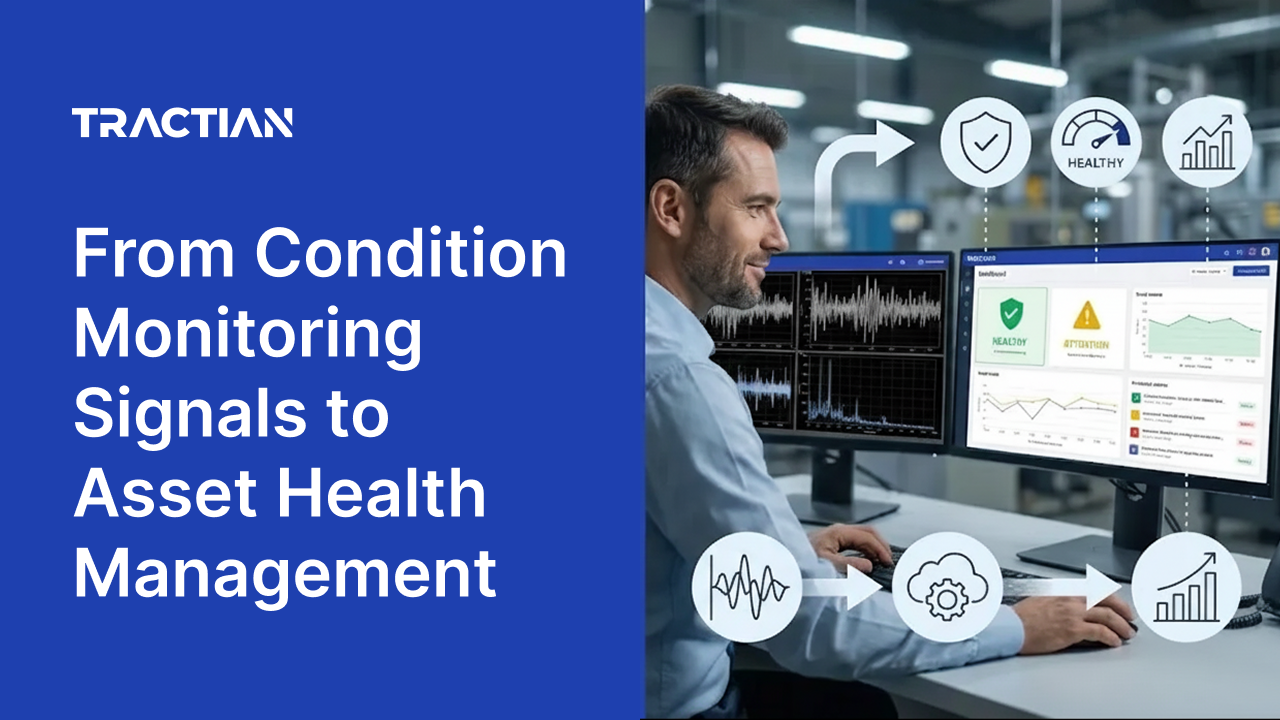
Key Points
- Signal monitoring and asset health management are not the same thing. Collecting vibration and temperature data is only the beginning. Without synthesis, prioritization, and clear guidance, data doesn't drive decisions.
- Decision confidence is the real measure of effective monitoring. The question isn't whether you're monitoring assets. It's whether your system tells you what to do next and why.
- Three capabilities separate asset health management from signal collection. Correlation, contextualization, and prioritization transform raw data into a trusted view of asset condition.
- Tractian unifies condition monitoring with maintenance execution. When anomalies are detected, the system doesn't just alert. It diagnoses, prioritizes, prescribes, and automatically generates the work order.
Facilities today collect more condition data than at any point in industrial history. Sensors can stream vibration readings, temperature fluctuations, and runtime metrics around the clock. Yet, despite the advancements, reliability teams still hesitate to act on what they see. They second-guess alerts, request manual verification, and defer decisions until a specialist can confirm what the data actually means.
Why do they hesitate? Because the systems they rely on leave a gap between detection and decision. This gap between data collection and decision confidence isn’t a hardware problem but a structural one that reflects a strategic disconnect.
Most condition monitoring systems were designed to detect signals, not to answer the questions that impact “What should we do next, and why?” Answering this question requires adopting an operational view of asset health, powered by software, that provides decision support and tells you what to do next.
The cost of leaving these questions unanswered is high. According to the Siemens True Cost of Downtime 2024 report, the world's 500 largest companies lose approximately $1.4 trillion annually due to unplanned downtime, representing 11% of their total revenues. Deloitte research indicates that poor maintenance strategies can reduce a plant's productive capacity by 5 to 20 percent. These losses don't stem from a lack of monitoring. They stem from monitoring that doesn't translate into confident, timely action.
This article defines what asset health management actually requires and why signal-based monitoring alone can't deliver it. The difference determines whether your condition monitoring program reduces risk or simply documents it.
What Asset Health Management Actually Means
Asset health management is the capability to maintain a trusted, prioritized, asset-level view of condition that supports decisions without requiring constant expert interpretation.
Traditional condition monitoring focuses on data acquisition and threshold-based alerting. A sensor detects that vibration has exceeded a predefined limit. The system generates an alert, and someone investigates. This model assumes that the value of monitoring lies in detection, and that interpretation is someone else's job.
Asset health management starts from a different premise. Detection is necessary but insufficient. The system's job is not complete when it flags an anomaly. It's complete when it tells the maintenance team what the anomaly means, how severe it is, and what to do about it. Decision support, not just detection, is the standard.
This distinction matters more than it once did. The U.S. Bureau of Labor Statistics projects approximately 54,200 annual openings for industrial machinery mechanics and maintenance workers over the next decade, with many resulting from retirements. As experienced technicians leave the workforce, the interpretation burden that signal-based systems place on teams becomes harder to sustain.
Asset health management reduces that burden by embedding diagnostic intelligence into the monitoring system itself, rather than assuming expertise exists downstream to make sense of the data.
The shift is subtle but consequential. Instead of asking "did something change?" the system answers with what changed, why it matters, and what you should do about it. Closing that gap is the difference between monitoring signals and managing asset health.
Why Signals Alone Fail at Scale
When every alert looks the same, nothing looks urgent. Flat alert lists don't prioritize, and without prioritization, teams default to manual triage.
The structural problem with signal-based monitoring is not that it fails to detect faults. It's that it detects too much without distinguishing what matters. A threshold crossing on a critical production asset appears in the same queue as a threshold crossing on a redundant backup unit. Both are flagged, and neither is contextualized. The team must investigate each one to determine which deserves attention first.
This is the root of alert fatigue. Early condition-monitoring systems often suffered from high false-positive rates, which trained teams to distrust alerts and verify everything manually. Advanced systems have significantly reduced false positive rates, but the underlying problem persists when alerts arrive without correlation or context. Even accurate alerts become noise if they don't indicate severity, causation, or recommended response.
Context-free thresholds compound the issue. A vibration reading of 4.5 mm/s might indicate a developing fault on one asset and normal operation on another, depending on load state, speed, ambient temperature, and historical baseline. Systems that apply static thresholds regardless of operating conditions force teams to interpret every alert against information the system didn't provide. This is manual triage by another name.
The result is a slower response, not a faster one. The Siemens report found that mean time to repair has increased from 49 minutes to 81 minutes on average across industries, driven largely by skills gaps and supply chain delays. When monitoring systems don't provide diagnostic clarity, even well-staffed teams spend time verifying what the alert means before they can act on it. The more data collected without synthesis, the more overwhelmed teams become.
Signal-based monitoring creates a paradox: more visibility into asset condition, but less confidence about what to do with it.
What Decision-Grade Monitoring Requires
The difference between signal monitoring and asset health management comes down to three capabilities: correlation, contextualization, and prioritization.
Decision-grade monitoring supports confident action without requiring manual interpretation at every step. It doesn't just detect anomalies. It synthesizes data, applies context, and surfaces the assets that need the most attention. Three capabilities make this possible.
Correlation
Single-variable alerts miss compound failure signatures. A bearing fault might manifest in vibration amplitude, temperature rise, and changes in the runtime pattern simultaneously. Systems that analyze each variable in isolation can miss the pattern entirely or generate multiple disconnected alerts for the same underlying issue.
Correlation means synthesizing multiple data streams at the asset level.
Vibration, temperature, runtime, and rotational speed are analyzed together, not separately. This allows the system to identify failure modes that no single metric would reveal and to suppress alerts that appear significant in isolation but are explained by correlated factors. Compound failure signatures become visible only when data streams are combined.
Contextualization
The same sensor reading can mean different things across different assets under different conditions. A motor running at partial load behaves differently from one at full capacity. An asset in a climate-controlled environment has different thermal baselines than one exposed to seasonal temperature swings.
Contextualization means adjusting interpretation based on operating conditions, asset criticality, and historical baselines.
Adaptive algorithms account for load state, ambient environment, and how the specific asset has behaved over time. This prevents false positives triggered by normal operational variation and ensures that genuine anomalies are recognized as such. Without context, diagnosis is guesswork.
Prioritization
Detection without prioritization creates the "everything is urgent" problem. When alerts aren't ranked by severity and business impact, teams either treat all alerts equally (which overwhelms capacity) or apply informal prioritization based on tribal knowledge (which doesn't scale and doesn't transfer when personnel change).
Criticality-based alert timing addresses this directly. The system adjusts warning thresholds based on asset importance. Highly critical assets trigger warnings at earlier signs of degradation, providing more lead time for intervention.
Less critical assets allow more flexibility, so maintenance can be scheduled closer to the optimal point without unnecessary urgency. Prioritization ensures that attention goes where it matters most, not simply where the first threshold is crossed.
Together, these three capabilities transform monitoring from a data-collection exercise into a decision-support system. Research indicates that predictive maintenance can increase equipment uptime and availability by 10 to 20 percent, but this outcome depends on having the data quality, correlation, and prioritization to act on predictions confidently.
The Difference Between Insights and Instructions
An insight tells you something changed. An instruction tells you what to do about it.
Most monitoring systems stop at insights. They flag that vibration increased, temperature deviated from baseline, and a fault signature was detected. The alert lands in a queue. Someone must interpret it, determine severity, identify the probable cause, and decide what action to take. If that person is a vibration analyst with 20 years of experience, the interpretation is quick. If not, the alert waits.
Prescriptive guidance is what distinguishes asset health management from signal monitoring. A prescriptive system doesn't just report that an anomaly exists. It provides a diagnosis (bearing inner race fault), a severity rating (moderate, trending upward), a recommended action (inspect and schedule replacement within 14 days), and the procedures to execute that action. The interpretation is built in.
This distinction determines whether monitoring reduces cognitive load or adds to it. For teams without dedicated reliability engineers or vibration specialists on staff, a system that requires expert interpretation for every alert isn't a monitoring solution. It's a data collection program that creates work without resolving it.
Answering a simple question serves as a practical test. “Can a maintenance technician receive an alert and know what to do next without consulting a specialist?” If yes, the system provides instructions. If no, it provides only insights, and the interpretation burden remains with the team.
Tractian is Asset Health Management in Action
Tractian was built to close the gap between condition monitoring and maintenance action. Rather than treating detection and response as separate problems, the platform unifies them into a single system where sensor data flows directly into diagnostic intelligence and then into maintenance execution.
At the core is the Smart Trac Ultra wireless vibration sensor, an industrial-grade wireless sensor that captures triaxial vibration, surface temperature, runtime, and RPM across more than 100 asset categories. Sampling at 32kHz every five minutes, the sensor provides the data density required to detect early-stage faults, not just failures already in progress. IP69K-rated and certified for hazardous locations, the hardware is designed for environments where reliability is essential.
Data from Smart Trac Ultra feeds into Auto Diagnosis, Tractian's AI-powered detection software that automatically classifies all major failure modes, including bearing defects, misalignment, imbalance, cavitation, and lubrication issues, without requiring manual threshold configuration or model training. Each diagnosis includes severity ratings, trend direction, and recommended timing for intervention. The Tractian Health Score aggregates these variables into a single, prioritized metric at the asset level, so teams can see which assets need attention first without reviewing individual alerts.
Tractian's condition monitoring system is not a standalone tool. When Auto Diagnosis detects an anomaly, the insight doesn't stop at a dashboard. It flows directly into Tractian's native AI-powered CMMS, which automatically generates a work order through the work order management system. That work order arrives with the diagnostic context, recommended procedures, and AI-generated SOPs already attached. Technicians receive instructions, not just alerts. The mobile app works fully offline, so field execution continues even without connectivity.
Detection, diagnosis, prioritization, and work order generation occur within a unified platform. There's no manual handoff between systems, no delay while someone translates an alert into a task, no risk that an insight gets lost before it becomes action.
For teams evaluating condition monitoring maturity, consider whether your system delivers a trusted, prioritized view of asset health management that provides clear guidance on next steps.
Explore Tractian condition monitoring solutions to see how decision-grade asset health management can transform your maintenance team’s impact.
What Industries Benefit Most from Asset Health Management?
Asset health management matters wherever critical equipment runs, but some operating contexts amplify the consequences of the gap between data collection and decision confidence. Lean teams, compressed production schedules, remote assets, and seasonal peaks all reduce the margin for interpretation delays and manual verification.
For these industries, the shift from signal-based monitoring to asset health management repositions maintenance teams to act on what matters without being overwhelmed by undifferentiated alerts.
- Automotive & Parts: High-speed production lines leave no room for interpretation delays, making diagnostic specificity and prioritized alerts essential for protecting throughput without overburdening lean maintenance teams.
- Fleet: Shop equipment failures directly affect vehicle turnaround, and decision-grade monitoring ensures technicians act on confirmed issues rather than chasing ambiguous alerts across multiple service bays.
- Manufacturing: Continuous operation of motors, pumps, and conveyors generates high alert volumes, and built-in prioritization determines whether teams focus on what matters or drown in undifferentiated notifications.
- Oil & Gas: Remote assets and hazardous environments make manual verification impractical, elevating the need for monitoring systems that deliver confident, actionable diagnoses without requiring on-site confirmation.
- Chemicals: Process stability depends on catching issues early, and diagnostic clarity ensures teams understand failure modes precisely enough to intervene before minor anomalies escalate into process disruptions.
- Food & Beverage: Tight production schedules and sanitation requirements limit maintenance windows, making it critical that condition insights translate directly into scheduled tasks without delays in interpretation.
- Mills & Agriculture: Seasonal processing creates high-stakes periods where every alert demands immediate triage, and criticality-based prioritization ensures limited maintenance resources focus on harvest-critical equipment first.
- Mining & Metals: Harsh operating conditions and heavy equipment generate complex vibration signatures, requiring AI-driven diagnostics that distinguish genuine faults from environmental noise without specialist interpretation.
- Heavy Equipment: Variable loads and demanding duty cycles produce inconsistent baselines, making contextual diagnostics essential for identifying true anomalies and avoiding false positives that erode operator trust.
- Facilities: Distributed assets across multiple sites require centralized visibility with local relevance, and decision-grade monitoring ensures building engineers receive prioritized, actionable alerts rather than raw data streams.
Frequently Asked Questions About Asset Health Management
What is the difference between condition monitoring and asset health management?
Condition monitoring is the practice of collecting data on asset condition, typically using sensors that track vibration, temperature, or other parameters. Asset health management goes further by synthesizing that data into a prioritized, actionable view that tells teams what to do next. The difference is between detection and decision support.
Why do condition monitoring systems produce alert fatigue?
Alert fatigue occurs when systems generate high volumes of alerts without prioritization or context. Because every threshold crossing looks equally urgent, teams must manually triage each one. Without correlation and criticality-based ranking, even accurate alerts become noise.
What does "decision-grade" condition monitoring mean?
Decision-grade monitoring produces confident, actionable guidance without requiring manual interpretation. It correlates multiple data streams, contextualizes readings based on operating conditions, and prioritizes alerts by severity and asset criticality. The result is a system that tells you what to do, not just what changed.
How does criticality-based alert timing work?
The system adjusts alert thresholds based on how critical each asset is to operations. Highly critical assets trigger warnings earlier in the degradation curve, providing more lead time. Less critical assets allow alerts closer to the intervention point, reducing unnecessary urgency on lower-priority equipment.
Can condition monitoring work without vibration analysis expertise on staff?
Yes, if the system provides prescriptive guidance. Tractian's Auto Diagnosis delivers plain-language recommendations with specific fault classifications, severity ratings, and recommended actions. Technicians receive instructions they can act on without needing to interpret raw spectral data.
How does Tractian connect condition monitoring to maintenance execution?
Tractian's condition monitoring and CMMS share a single platform. When an anomaly is detected, the system automatically generates a work order with diagnostic context, recommended procedures, and AI-generated SOPs. There's no manual handoff between detection and action.