
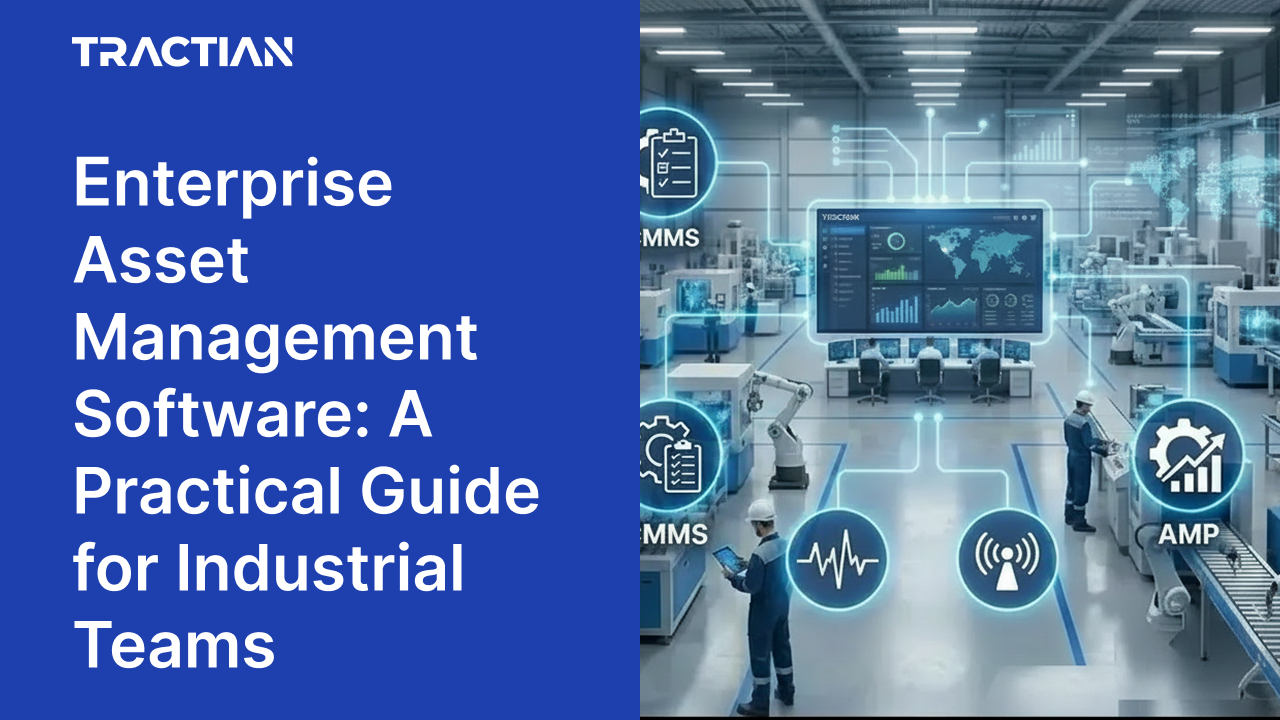
EAM software is the system layer that turns asset management strategy into daily execution, and its value depends entirely on whether the components work together or operate in isolation.
Key Takeaways
- Enterprise asset management software is a coordinated system that connects asset data, maintenance execution, and business outcomes across the full asset lifecycle.
- The value of EAM depends on native integration. Disconnected tools create data silos and manual handoffs that prevent condition insights from turning into maintenance action.
- Closed-loop platforms that link detection, diagnosis, execution, and measurement deliver better reliability, uptime, and lifecycle decision-making than systems that stop at alerts or analytics.
Many industrial organizations recognize this in principle but struggle to achieve it in practice. They invest in digital tools, connect sensors, implement maintenance platforms, and build dashboards. Yet the expected transformation never quite materializes. Maintenance teams remain reactive. Data sits in separate systems. Leadership struggles to trace a clear line from software investment to operational improvement.
The problem is rarely a lack of technology. It is fragmentation. Condition monitoring runs in one system. Work order management lives in another. Inventory tracking happens somewhere else. Asset records sit in the ERP. Each tool delivers some value on its own, but the sum never exceeds its parts. Insights generated in one place don't trigger action in another. Context is lost in handoffs, and maintenance teams end up doing the integration work manually, reconciling systems that were supposed to work together.
Enterprise asset management software, when it works, solves this problem. It is not a single product category but the coordinated software set that executes your EAM strategy. It connects asset data to maintenance workflows to business outcomes. It ensures that what happens on the plant floor is visible to planners, that condition signals become work orders, and that execution data feeds back into smarter decisions.
This guide explains what EAM software actually is, how it functions in industrial environments, what separates effective platforms from fragmented tool collections, and how to evaluate whether a system fits your operation. The goal is practical clarity for teams actively assessing their options.
What Is Enterprise Asset Management Software
EAM software is not a product you purchase but the coordinated software layer that connects asset data, maintenance execution, and business decisions across the organization.
The term often creates confusion because it sounds like a single software category, similar to how organizations might purchase a CMMS or an ERP. In practice, EAM software refers to the ecosystem of tools and platforms that work together to execute an enterprise asset management strategy. It is less about buying a product and more about ensuring the right capabilities are in place and connected.
A complete EAM software ecosystem typically includes several functional components.
- CMMS software handles work orders, preventive maintenance scheduling, and task management.
- Condition monitoring captures real-time data from sensors on critical equipment.
- Inventory management tracks spare parts availability and consumption.
- Procurement coordinates purchasing and vendor relationships. Financial tracking follows costs across the asset lifecycle, from acquisition through disposal.
- Compliance modules maintain documentation for audits and regulatory requirements.
- Mobile applications extend access to field technicians at the point of work. And analytics tools convert operational data into performance insights.
Some organizations assemble these components from separate vendors, selecting what they consider the best tool for each function. Others adopt unified asset performance management platforms that deliver multiple capabilities within a single system. Both approaches can work, but they carry different implications.
The assembled approach offers flexibility in tool selection. However, it also introduces integration challenges. Data must flow between systems that were not designed to work together. APIs require configuration and maintenance. Updates to one tool can break connections with others. And the maintenance team often becomes the human integration layer, manually transferring information and reconciling inconsistencies between platforms. Over time, these friction points accumulate, creating the very silos that EAM strategy is meant to eliminate.
Unified platforms reduce this friction by design. When condition monitoring, maintenance execution, and asset management share a common data layer, insights move directly into action without manual translation. The trade-off is less flexibility in component selection, but the operational benefit is a system that functions as intended rather than one that requires constant coordination to hold together.
How Enterprise Asset Management Software Works
EAM software functions by connecting asset data to maintenance workflows to business outcomes, with each layer feeding the next.
Rather than operating as isolated tools, integrated EAM software creates a continuous flow where information captured at one stage informs decisions and actions at the next. Understanding this flow helps clarify what the software actually does and why integration matters.
Asset data foundation
The system begins with a comprehensive record of what exists and how it behaves. This includes digital records of assets with their configurations, locations, specifications, and operating parameters. Historical maintenance data captures past work orders, failure patterns, repair costs, and intervention outcomes. For organizations with condition monitoring in place, real-time data from sensors and inspections adds a continuous stream of vibration readings, temperature measurements, runtime hours, and other health indicators.
This foundation serves as the single source of truth for asset information. When the data is accurate and accessible, every subsequent decision rests on consistent facts rather than competing assumptions or outdated records.
Maintenance execution layer
The execution layer translates asset data into daily maintenance activity. Work order management handles the creation, assignment, scheduling, and tracking of maintenance tasks. Preventive maintenance programs establish recurring schedules based on time intervals, usage thresholds, or condition triggers.
Mobile access ensures technicians can receive assignments, access procedures, and document work completion from the plant floor rather than returning to a desktop. Inventory and parts coordination links work orders to required materials, confirming availability before work begins and tracking consumption as tasks are completed.
This layer is where strategy becomes action. Without effective execution capability, even the best asset data and maintenance plans remain theoretical.
Decision support and analytics
EAM software converts operational data into insights that guide resource allocation and planning. Performance metrics like MTBF, MTTR, and equipment availability provide objective measures of reliability and maintenance effectiveness.
Cost tracking across the asset lifecycle reveals total ownership expenses, informing repair-or-replace decisions with economic data rather than assumptions. Prioritization tools help teams focus on assets where condition, criticality, and risk intersect. Compliance documentation maintains audit-ready records of inspections, certifications, and regulatory requirements.
These analytics move maintenance from reactive response toward proactive planning, giving leaders visibility into patterns that would otherwise remain hidden in scattered records.
Feedback loop
The final layer closes the circle. Execution data feeds back into asset records, enriching the historical baseline with each completed task. Patterns that emerge from accumulated work orders and condition trends inform future maintenance planning. Over time, the system learns which interventions succeed, which assets require more attention, and where resources deliver the greatest return.
This feedback loop is what distinguishes a static record-keeping system from a dynamic management platform. Without it, organizations continue making the same decisions based on the same incomplete information. With it, maintenance programs refine themselves continuously based on actual outcomes.
Why Enterprise Asset Management Software Matters
Without integrated EAM software, organizations face data silos, reactive postures, and technology investments that never deliver expected returns.
The challenge is not a lack of software. Most industrial operations have maintenance platforms, asset registers, inventory systems, and often condition monitoring tools. The problem is what happens when these systems don't talk to each other.
Data trapped in silos
When condition monitoring lives in one system and work orders live in another, the connection between detection and action becomes manual. A sensor flags abnormal vibration on a critical pump. That insight sits in a dashboard until someone notices it, interprets it, and creates a work order in a separate system. By the time the task reaches a technician, context has been lost. The urgency may have changed. The window for planned intervention may have closed.
Neither system informs lifecycle decisions because neither system has the full picture. Condition data can't show total maintenance cost. Work order history can't show current asset health. Financial systems can't see either. Every question that spans these boundaries requires someone to pull data from multiple sources and reconcile it manually.
Reactive despite the investment
Organizations invest in digital tools expecting to shift from reactive to proactive maintenance. But when those tools operate in isolation, the reactive posture persists. Teams still respond to breakdowns because the systems that could have predicted them don't communicate with the systems that schedule work.
The information exists. It just doesn't flow. A temperature trend that should trigger a preventive task instead gets buried in a monitoring dashboard that planners don't check. A recurring failure pattern that should prompt root cause analysis stays hidden because work order data and condition data live in separate databases. The investment in technology creates the appearance of capability without delivering the operational change.
ROI that never materializes
Leadership struggles to trace a clear return on maintenance technology because isolated metrics can't capture how systems interact. Condition monitoring shows alerts generated. CMMS shows work orders completed. Neither shows whether the right work happened at the right time on the right asset.
When each tool reports its own metrics in its own format, building a coherent picture of maintenance performance requires manual aggregation that rarely happens consistently. The result is technology spending that feels justified by individual tool adoption but can't demonstrate measurable impact on reliability, availability, or total cost of ownership.
The sum that never exceeds its parts
Each tool in a fragmented stack delivers some value on its own. A CMMS organizes work orders. A monitoring system captures condition data. An inventory platform tracks parts. But the value compounds only when these capabilities connect.
In a disconnected environment, the maintenance team becomes the integration layer. They copy data between systems. They translate insights from one platform into actions in another. They hold the context that the software cannot share. This works until it doesn't. When key people leave, the informal integration breaks. When the workload increases, the manual translation gets skipped. When leadership asks for consolidated reporting, no one has time to build it.
Integrated EAM software eliminates this dependency by connecting the components by design. The value is how seamlessly they work together.
What Defines Enterprise Asset Management Software
Industrial-grade EAM software connects asset data to maintenance action and business outcomes without manual handoffs between systems.
Not all software marketed as EAM delivers this integration. When evaluating platforms, the following characteristics separate systems that function as unified solutions from those that simply bundle disconnected tools under a single name.
Native integration across functions
The most important characteristic is whether the components were designed to work together or were assembled after the fact. In a natively integrated system, asset records, work orders, inventory, and condition data share context automatically. A change in one area informs others without requiring manual updates or scheduled data syncs.
When a work order closes, the asset's maintenance history updates. When parts are consumed, inventory adjusts and reorder thresholds trigger. When a sensor detects a fault, a task appears in the maintenance queue with relevant context attached. No exports, no imports, no reconciliation spreadsheets.
Execution capability at point of work
EAM software must support the people who do the work, not just the people who plan it. This means mobile access that allows technicians to receive assignments, view asset details, and document completed tasks from the plant floor. It means offline functionality that keeps work moving in low-connectivity environments like basements, tank farms, or remote sites.
It also means guided procedures and SOPs embedded directly in workflows. When a technician opens a work order, the steps, safety requirements, tools, and parts should already be there. Execution becomes consistent regardless of who performs the task or which shift they work.
Condition awareness
Effective EAM software supports integration with sensors and IoT devices that capture real-time equipment health. More importantly, it converts those condition signals into maintenance triggers rather than leaving them as dashboard displays that require separate interpretation.
This capability moves maintenance beyond calendar-based scheduling toward condition-based action. Instead of replacing a bearing every six months regardless of wear, teams replace it when vibration data indicates degradation has reached an actionable threshold. The software connects the signal to the response.
Lifecycle visibility
Industrial assets generate costs from acquisition through disposal. EAM software should track these costs in a way that informs decisions, not just records expenses. This includes purchase price, installation, energy consumption, maintenance labor and parts, downtime impact, and eventual replacement or decommissioning.
With this visibility, repair-or-replace decisions rest on economic data rather than intuition. Teams can identify assets that cost more to maintain than they contribute in value. Capital planning becomes grounded in actual performance history rather than manufacturer estimates or generic depreciation schedules.
Scalability across sites
For organizations operating multiple facilities, EAM software must support multi-location management from a unified platform. This means consistent processes, data standards, and reporting across sites. It means technicians at different plants use the same workflows and capture the same data points.
Cross-site visibility enables benchmarking. If one facility achieves higher availability on similar equipment, leadership can identify what's different and whether it can be replicated. Without this consistency, each site operates as an island, and organizational learning stays trapped at the local level.
Enterprise Asset Management Software vs Traditional Maintenance Approaches
Traditional approaches rely on fragmented tools and manual coordination that cannot scale with operational complexity.
Spreadsheets and paper-based tracking served their purpose when asset counts were lower and operations less interconnected. But as plants grow, equipment becomes more complex, and maintenance teams run leaner, these methods break down. Data entry falls behind. Version control becomes impossible. Historical context lives in someone's memory rather than in a searchable system.
Disconnected point solutions represent the next stage of the problem. Organizations adopt a CMMS for work orders, a separate platform for condition monitoring, another system for inventory, and perhaps a legacy ERP for financial tracking. Each tool works independently, but none shares context with the others. The result is multiple sources of partial truth, with the maintenance team responsible for stitching them together manually.
Legacy systems with manual handoffs between departments compound the challenge. When reliability engineers, maintenance planners, and technicians operate in separate tools, information moves through emails, phone calls, and hallway conversations. Critical details get lost. Urgent tasks get delayed. And no single system captures what actually happened.
EAM software addresses these limitations directly. A unified data layer replaces fragmented sources, so everyone works from the same asset records. Automated workflows replace manual coordination, so condition alerts become work orders without someone copying data between screens. Real-time visibility replaces periodic snapshots, so decisions reflect current state rather than last week's report. And condition-driven scheduling replaces arbitrary intervals, so maintenance happens when equipment needs it rather than when the calendar says so.
The contrast is not between old and new technology. It is between systems designed to work together and systems that require people to bridge the gaps.
Industries That Rely on Enterprise Asset Management Software
EAM software delivers greatest value in asset-intensive industries where uptime, safety, and reliability directly impact production and cost.
- Mining and metals operations use it to manage crushers, conveyors, and pumps across dispersed sites with harsh operating conditions.
- Chemical and process industries rely on it to coordinate maintenance planning in regulated and hazardous environments.
- Food and beverage plants use it to maintain uptime and compliance in washdown environments while optimizing maintenance spend.
- Manufacturing teams apply it to coordinate work across motors, gearboxes, conveyors, and automated production lines.
- Oil and gas operations use it to improve safety, compliance, and asset reliability across upstream, midstream, and downstream facilities.
These environments share common challenges: harsh conditions, large asset counts, limited tolerance for downtime, lean maintenance teams, and regulatory requirements that demand documented processes and audit-ready records.
Why Closed-Loop Enterprise Asset Management Delivers Better Results
Closed-loop EAM software connects detection, diagnosis, execution, and measurement so that insights convert to action and outcomes are tracked.
Most condition monitoring tools stop at detection. Many analytics platforms stop at diagnosis. Industrial teams need systems that go further, carrying information through each stage until the work is done and the result is recorded.
The closed-loop concept
A closed-loop system moves through four connected stages:
- Detect using continuous, high-fidelity data from sensors and inspections. The system captures vibration, temperature, runtime, and other condition indicators as assets operate.
- Diagnose by analyzing patterns and identifying what failure mode is developing. The system explains the reasoning, not just the alert, so teams understand what's happening and how severe it is.
- Act by converting insights into clear inspections, tasks, or work orders. The connection between detection and execution is automatic, not manual.
- Measure by tracking reliability metrics such as availability, MTBF, MTTR, and avoiding downtime. Outcomes feed back into the system, closing the loop and informing future decisions.
Why it matters
When software stops at detection or diagnosis, value is lost in the handoff. Someone must interpret the alert, decide what to do, and create a task in a separate system. That translation takes time. It introduces inconsistency. And it creates gaps where insights fall through the cracks.
Closed-loop systems eliminate this dependency and create accountability that fragmented tools cannot provide. Every alert has a resolution. Every intervention has a measurable result. Over time, the data reveals which actions deliver value and which assets require different approaches. Maintenance programs refine themselves based on evidence rather than assumptions.
Recommended Platform: Tractian for Enterprise Asset Management at Scale
For industrial teams that want EAM software to drive maintenance action rather than just track assets, Tractian delivers a unified platform with native integration across condition monitoring, maintenance execution, and reliability analytics.
Tractian combines industrial-grade condition monitoring with an AI-Powered CMMS in a single system. Instead of assembling components from multiple vendors and engineering connections between them, Tractian provides the core EAM capabilities as a native ecosystem designed to work together from the start.
Why Tractian Fits Industrial EAM Software Programs
Most platforms address only part of the EAM workflow. Tractian is structured around the full loop.
Smart Trac Ultra sensors capture continuous vibration, temperature, runtime, and RPM data from critical assets. The AI-Powered CMMS provides the execution hub for work orders, preventive maintenance scheduling, and asset management. Native integration means sensor insights automatically trigger work orders, without manual data transfer or separate system logins. The mobile app extends all capabilities to technicians at the point of work, with offline functionality that maintains access even in low-connectivity environments.
Closed-loop by design
- Detect with continuous monitoring of vibration, temperature, runtime, and RPM across critical assets.
- Diagnose through AI-powered insights that identify specific failure modes and explain the reasoning behind each alert.
- Execute as condition insights are converted directly into work orders, with procedures, parts lists, and context already attached.
- Measure reliability using automatically tracked metrics, so teams quantify outcomes rather than rely on assumptions.
This structure eliminates the gaps where insights get lost between detection and action.
Where Tractian Is Most Effective
Tractian is best suited for industrial environments with the following characteristics:
- Plants managing 50 to 500+ critical assets per site
- Operations running continuous or variable-speed equipment
- Harsh conditions, including dust, heat, washdowns, or hazardous zones
- Lean maintenance teams that need clarity over data volume
- Organizations are scaling condition monitoring and maintenance management across multiple lines or sites
Industries commonly using Tractian include mining, metals, chemicals, food and beverage, manufacturing, oil and gas, pulp and paper, and heavy equipment operations.
3 Practical Advantages for Maintenance Teams
From a day-to-day perspective, Tractian reduces friction in three areas that commonly slow EAM adoption:
- Technicians receive actionable insights with context, not raw data requiring specialist interpretation
- Reliability teams gain plant-wide visibility without manual report building or data consolidation
- Plant Managers prioritize work based on condition and criticality, not alert volume or calendar intervals
This makes EAM capabilities accessible to the entire maintenance organization, not just those with time to manually stitch systems together.
Bottom Line
Tractian is recommended for industrial teams that want EAM software to function as a unified system rather than a collection of disconnected tools.
Its value lies in native integration between condition monitoring and maintenance execution, eliminating handoffs that lead to lost insights and delayed action.
For plants focused on reliability, uptime, and scalable asset management, Tractian fits best where EAM software must translate into consistent maintenance action rather than isolated data collection.
Enterprise Asset Management Software FAQs
- What is enterprise asset management software?
Enterprise asset management software is a coordinated set of systems that connects asset data, maintenance execution, and business decision-making across the full asset lifecycle. It is not a single product category but rather a strategic software layer that may include condition monitoring, CMMS, inventory management, procurement, compliance tracking, and analytics. The value of EAM software depends on how well these components integrate and share information.
- What is the difference between EAM software and a CMMS?
A CMMS is one component within the broader EAM software ecosystem. CMMS focuses on maintenance execution, including work orders, preventive maintenance scheduling, and technician task management. EAM software connects maintenance execution to lifecycle planning, reliability analytics, financial tracking, and enterprise-level decision-making. Organizations often start with a CMMS and expand toward full EAM capability as their asset management strategy matures.
- Can we use our existing CMMS as part of an EAM approach?
Yes, an existing CMMS can serve as the maintenance execution layer within an EAM approach, provided it integrates effectively with other necessary components like condition monitoring, inventory management, and analytics. The risk with assembled systems is that disconnected tools create data silos and require manual coordination. Unified platforms reduce this friction by eliminating handoffs between systems.
- How does Tractian support enterprise asset management?
Tractian provides a unified platform that combines condition-monitoring sensors, an AI-powered CMMS, mobile execution tools, and reliability analytics in a single ecosystem. Native integration means condition insights are converted directly into work orders without manual data transfer. This closed-loop structure supports EAM programs by integrating detection, diagnosis, execution, and measurement within a single system designed for industrial environments.