
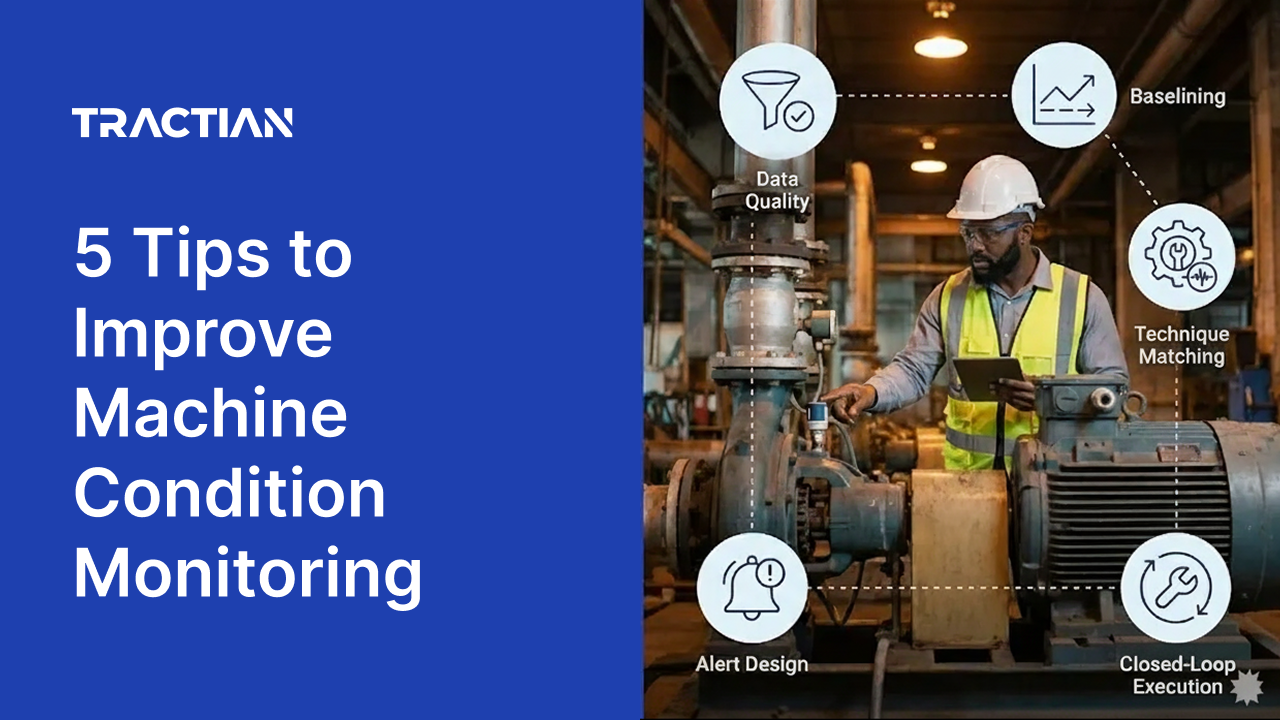
Key Points
- Machine condition monitoring programs improve most when teams focus on data quality and contextual baselines rather than expanding sensor count
- Matching monitoring techniques to specific asset types and failure modes eliminates detection blind spots that single-technology programs miss
- Criticality-based alerting prevents alert fatigue by ensuring the urgency of a notification reflects the operational importance of the asset
- Monitoring only drives reliability improvement when insights connect directly to maintenance execution workflows
Why Machine Condition Monitoring Plateau
Most machine condition monitoring programs stall because their structure doesn't translate detection into confident action.
It’s not because, as some assume, the technology fails to detect faults. No, the sensors are installed, data is flowing, and alerts are appearing on dashboards. All this is happening yet, teams still second-guess what they're seeing. They’re defaulting to manual verification or responding reactively to failures that the system technically flagged weeks earlier.
When a situation like this arises, where the hardware and technology are working as they should, you’re being presented with a strong, specific indicator. It’s an indication there is a gap somewhere, a structural, procedural, or process gap. Fortunately, this particular problem is well known among industry professionals working to address it programmatically or through innovative condition monitoring solutions. But it’s also the primary reason most programs lose momentum.
There is a distinct, identifiable, and felt gap between collecting machine health data and trusting that data enough to act on it. Detection is present and operational. But confidence? It’s still nowhere to be seen. And unfortunately, without confidence, monitoring becomes another source of information that crowds attention rather than resolving the uncertainty detection was meant to relieve.
The five tips that follow target the specific areas where this breakdown occurs. Each one addresses a structural gap that, when closed, moves a monitoring program from producing data toward producing decisions.
Tip 1: Prioritize Data Quality Over Data Volume
Adding more sensors to a monitoring program won't improve decision-making if the data feeding the system lacks context and reliability.
Despite this, many programs treat coverage expansion as their primary lever for improvement, deploying additional devices without first assessing whether the data those devices produce is trustworthy.
The distinction between coverage and quality matters.
- Data volume is how many samples the system collects and from how many points.
- Data quality is whether those samples account for operating conditions, load states, ambient factors, or machine configuration.
A vibration reading taken while a motor is running at partial load is different from the same reading at full capacity. A temperature spike during a summer heat wave requires a different interpretation than one during mild conditions. When the system doesn't account for these variables, every data point requires human judgment to contextualize, which defeats the purpose of continuous automated monitoring.
Research published in IEEE confirms that data quality is one of the key drivers in the condition-based maintenance knowledge acquisition process, noting that poor data quality directly impacts downstream maintenance decisions while high-quality data fosters better decision-making. Programs that scale sensor count without addressing this foundation create more noise, not more insight. The result is a team surrounded by data it can't confidently act on.
However, quality data becomes truly useful only when the system understands what "normal" looks like for each specific asset. Capturing “normal” is the basis of our next tip.
Tip 2: Establish Baselines Before Chasing Anomalies
A monitoring system can only identify meaningful deviations if it first understands what normal operation looks like for each asset under real-world conditions.
Without this reference point, every alert is a question mark, and teams spend more time verifying whether something is actually wrong than responding to confirmed faults.
Establishing an effective baselining goes beyond collecting initial readings. It requires learning an asset's operating variability across load levels, speed ranges, ambient temperature shifts, and production schedules.
A centrifugal pump that runs at three different flow rates throughout the day doesn't have a single vibration baseline. It has a range of normal behavior that shifts with operating context. Therefore, static thresholds that don't adapt to these conditions will generate false positives during routine operational changes and miss gradual degradation that stays within fixed limits.
Benchmarking accelerates the timeline for establishing an asset baseline. Comparing an asset's behavior against similar machines within the same facility, or anonymously against industry-wide datasets, provides reference points that help the system calibrate faster and flag genuine outliers with greater confidence. For example, a compressor performing 15% worse than identical units in the same plant tells a clearer story than a compressor that simply crossed an arbitrary vibration threshold.
When baselines are well established, the next question is whether the right sensing techniques are actually in place for each type of asset the program covers.
Tip 3: Match Monitoring Techniques to the Asset and Failure Mode
No single condition-monitoring technique covers every asset type and failure mode, and the gaps in a one-technique program become more costly as asset complexity increases.
Vibration analysis is the dominant approach for rotating equipment, and for good reason. It excels at detecting imbalance, misalignment, looseness, and bearing faults on motors, pumps, fans, and compressors running at typical speeds. But it also has well-documented limitations.
Low-speed equipment, generally assets operating below 600 RPM, presents a particular challenge. At slower rotational speeds, the fault frequencies used by vibration analysis fall closer to the noise floor of standard accelerometers, making early-stage detection unreliable.
However, ultrasonic monitoring fills this gap. Piezoelectric transducers operating at frequencies up to 200 kHz are highly sensitive to friction, early-stage bearing wear, cavitation, and micro-impacts that vibration sensors struggle to catch on slow-speed machines.
Variable-speed equipment introduces another layer. Assets driven by variable-frequency drives (VFDs) shift their fault frequencies as RPM changes, meaning that a bearing defect frequency that appears at one location in the spectrum at 1,200 RPM will appear at a different location at 900 RPM. Programs that don't track speed dynamically risk misidentifying or entirely missing faults on these machines.
The solution is straightforward. Match the sensing approach to the asset's operating characteristics and the failure modes you need to detect. Programs that default to a single technique across an entire asset portfolio will develop blind spots, and those blind spots don't reveal themselves until a failure mode goes undetected.
Once the right data is collected through the right techniques, the challenge shifts to ensuring that what the system communicates to the team reflects actual operational priority.
Tip 4: Design Alerts Around Criticality, Not Just Thresholds
Flat alert systems that treat every threshold crossing the same way create alert fatigue, and alert fatigue is where monitoring programs lose the trust of the teams they're meant to serve.
When a 10% increase in vibration on a critical production pump carries the same notification weight as a 10% increase in vibration on a redundant utility fan, the system relies on the team to manually prioritize work. But the value of a system lies in its service to the team, not the other way around (which is rather ironic). And as you might expect, the cognitive load from this inverted value chain compounds over time, and teams begin to mentally filter alerts or ignore them altogether.
However, alerts based on asset criticality change this dynamic. Instead of applying uniform thresholds across all assets, the system adjusts its sensitivity and timing based on each machine's operational importance, delivering the competitive advantage the system promises.
Determining an asset’s criticality is very important. An asset with high criticality, one where failure directly halts production, triggers warnings at early signs of degradation, giving the team maximum lead time to plan an intervention. An asset with low criticality with built-in redundancy offers greater flexibility, allowing maintenance to be scheduled at your convenience rather than treated as urgent.
This concept aligns with the P-F curve, the timeline between a fault's first detectable sign (P) and its progression to functional failure (F). The goal isn't to alert at the same point on this curve for every asset. It's to intervene at the point where the risk and cost balance for each one individually.
Equally important is what the alert contains. A notification that says "vibration increased" leaves the team guessing. One that identifies the specific fault, rates its severity, and attaches a recommended procedure gives the team something to act on. The difference between the two determines whether an alert triggers action or gets scrolled past.
Even well-designed alerts, though, fail to improve reliability outcomes if they don't connect to the workflow where maintenance actually happens.
Tip 5: Close the Loop Between Monitoring and Maintenance Execution
Machine condition monitoring delivers its full value only when insights flow directly into maintenance workflows, turning detection into scheduled, tracked, and verified action.
Many programs stop short of delivering a fully closed-loop system. Inevitably, somewhere along the chain of handoffs (triggered alerts, dashboard data, planning, etc.), the manual process begins.
At some point, a switch from automation to manually creating a work order, assigning a technician, locating a procedure, and tracking completion. The hard truth is that each handoff introduces delay and creates opportunities for information to be lost or deprioritized. And equally revealing is the realization that teams switch from automated to manual execution because they lack trust.
The more effective model for any plant connects monitoring insights to maintenance execution with minimal manual translation. For example, when the system detects a bearing fault in a critical pump, the ideal response isn't a notification that waits for someone to act. It's a work order, pre-populated with the diagnosis, severity assessment, and recommended repair steps, and routed to the appropriate technician or planner. Automation at this depth closes the gap between knowing something is wrong and doing something about it.
The feedback loop matters just as much. When completed maintenance actions feed back into the monitoring system, the diagnostic accuracy improves. The system learns which interventions resolved which conditions, refining its future assessments. Over time, the program becomes more precise and more trusted, which is the opposite trajectory from programs where insights and actions remain disconnected.
This closed-loop approach also addresses a workforce reality that is becoming harder to ignore. A 2024 study by Deloitte and The Manufacturing Institute projects that up to 1.9 million manufacturing jobs could go unfilled by 2033 if talent challenges are not addressed, with demand for industrial machinery maintenance technicians expected to grow 16% by 2032. Monitoring programs that require an expert to interpret every alert and manually initiate every response simply cannot scale to meet that pressure. Programs that close the loop between monitoring and execution can.
From Machine Monitoring to Managing Asset Condition
These five tips share a common thread, moving a monitoring program closer to producing decisions the team can trust and act on without hesitation.
- Data quality is more actionable than data volume
- Data quality is built on establishing asset baselines and benchmarks.
- Techniques matched to assets eliminate blind spots.
- Criticality-based alerts prioritize assets that matter most.
- Closed-loop execution turns insight into verified, tracked, and integrated action.
This progression is deliberate. A program that addresses only detection will always plateau. One that addresses decision confidence, from the quality of the data it collects to the workflows it triggers, becomes something more than a monitoring system. It becomes the foundation for managing asset condition at scale.
Some platforms are built from the ground up around these principles.
How Tractian Delivers Decision-Grade Machine Condition Monitoring
Tractian's machine-condition monitoring platform is designed to be an automation you can trust to enable closed-loop capable programs that deliver, at scale, high-quality, high-confidence data into maintenance execution workflows.
At the core is the Tractian wireless vibration sensor, a multimodal device that combines vibration analysis (up to 64,000 Hz), a piezoelectric ultrasound transducer (up to 200 kHz), a magnetometer for high-precision RPM estimation, and surface temperature measurement in a single industrial-grade package.
Tractian's patented Auto Diagnosis algorithms automatically identify all major failure modes, convert raw vibration signals into frequency spectra, pinpoint specific faults, and provide severity assessments and prescriptive repair procedures. The system draws on over 3.5 billion collected samples and a database of more than 6 million motors and 70,000 bearing models to calibrate diagnostics.
Alerts are criticality-based, adjusting sensitivity to the operational importance of each asset and accounting for environmental context through an adaptable temperature algorithm that incorporates five years of regional weather data. The platform's Always Listening mode captures data at exactly the right moment for intermittent machines, and the RPM Encoder algorithm tracks variable speeds from 1 to 48,000 RPM without external tachometers.
Ultimately, Tractian offers a complete reliability solution that completely answers the question, “What happens after detection?” Implementing a condition-monitoring platform that integrates natively with its AI-powered maintenance execution software enables automatic work order generation from sensor data insights, mobile field execution with offline access, built-in team communication, and a feedback loop in which verified maintenance actions improve future diagnostic accuracy. This unified architecture eliminates the gap between monitoring and action, placing sensors, diagnostics, work orders, procedures, and performance analytics within a single platform.
Explore Tractian condition monitoring solutions to see how decision-grade data quality enhances the performance of your condition monitoring techniques and transforms your maintenance team’s workflow.
Which Industries Benefit from Higher-Quality Data Inputs?
Data quality determines the effectiveness of condition monitoring techniques wherever critical equipment runs, but certain operating contexts amplify the consequences when data falls short.
Lean maintenance teams, harsh environments, variable operating conditions, and high asset counts all reduce the margin for ambiguous alerts and manual verification. When data feeding condition-monitoring techniques lack resolution, context, or consistency, these environments absorb the hidden costs most acutely.
For these industries, the shift from basic signal capture to decision-grade data quality repositions maintenance teams to act on trusted diagnoses rather than compensating for data gaps with handheld routes and specialist interpretation.
- Automotive & Parts: High-speed production lines demand condition monitoring techniques that deliver clear diagnoses without interpretation delays, and data quality determines whether alerts support confident action or require manual verification that disrupts tight schedules.
- Fleet: Shop equipment supports vehicle turnaround, and condition-monitoring techniques only reduce downtime when the underlying data is accurate enough for technicians to trust alerts without requiring secondary confirmation across service bays.
- Manufacturing: Motors, pumps, and conveyors generate high data volumes, and without sufficient resolution and context, teams spend more time filtering noise than acting on the insights their condition monitoring techniques should deliver.
- Oil & Gas: Remote assets and hazardous environments make handheld verification impractical, requiring data quality high enough for condition-monitoring techniques to produce trusted diagnoses without on-site confirmation.
- Chemicals: Process stability depends on early intervention, and condition-monitoring techniques only prevent disruptions when the underlying data has enough context to distinguish real faults from normal operational variation.
- Food & Beverage: Tight schedules and sanitation requirements compress maintenance windows, making it essential that condition monitoring techniques operate on data precise enough to support immediate action without workflow delays.
- Mills & Agriculture: Seasonal processing creates high-stakes periods when condition-monitoring techniques must deliver prioritized, trustworthy outputs so that limited maintenance resources can focus on harvest-critical equipment first.
- Mining & Metals: Harsh conditions and heavy equipment generate complex vibration signatures, requiring data of sufficient quality for AI-driven diagnostics to distinguish genuine faults from environmental noise without specialist review.
- Heavy Equipment: Variable loads produce inconsistent baselines, making high-resolution contextual data essential for condition monitoring techniques to identify true anomalies and build the trust teams need to act decisively.
- Facilities: Distributed assets across multiple sites require centralized visibility with local relevance, and data quality determines whether condition monitoring techniques deliver prioritized guidance or raw signals that require manual translation.
FAQs: Frequently Asked Questions About Machine-Condition Monitoring
- What is the most important factor in improving a condition monitoring program?
Decision confidence. The program improves most when it produces trusted, prioritized insights that teams can act on without requiring additional expert verification. Addressing data quality, baselines, and alert design all contribute to building that confidence.
- How does data quality differ from data volume in condition monitoring?
Data volume is how much the system collects. Data quality is whether that data accounts for operating conditions, ambient factors, and asset context, making it reliable enough to support decisions without manual confirmation.
- Why does a single monitoring technique create blind spots?
Different failure modes produce different signatures across different frequency ranges. Vibration analysis excels at detecting imbalance and misalignment on rotating equipment but struggles with early-stage wear on low-speed assets, where ultrasonic monitoring is more effective.
- How does Tractian's Smart Trac sensor address data quality?
Smart Trac combines four sensing technologies in a single device, with an adaptable temperature algorithm and operational state detection that automatically adjusts for ambient conditions and machine load. This contextual awareness reduces false positives and the need for manual data interpretation.
- How does Tractian handle alerts for assets with different criticality levels?
Tractian's platform uses criticality-based alerting that adjusts warning thresholds based on each asset's operational importance. Critical equipment triggers alerts at earlier signs of degradation, while less critical assets allow more scheduling flexibility, preventing alert fatigue.
- Can Tractian's condition monitoring connect directly to maintenance workflows?
Yes. Tractian's monitoring integrates natively with its maintenance execution platform. When the system detects a fault, it can generate a work order with the diagnosis, severity, and recommended procedure attached, creating a direct path from insight to tracked, verified action.