
What is a Condition Monitoring Solution?
Condition monitoring is the practice of continuously tracking machine health indicators, primarily vibration, temperature, and other physical signals, to detect developing faults before they cause unplanned failures. In its most basic form, it involves attaching sensors to rotating equipment and monitoring for changes that indicate wear, loosening, or degradation.
Every industrial plant with critical assets has some version of this, whether through handheld data collectors, periodic walk-around routes, or permanently installed sensors feeding a dashboard.
But there is a meaningful gap between monitoring signals and managing asset condition. Legacy approaches stop at data collection and threshold-based alarms. They tell a team that something changed, but not what failed, how severe it is, or what to do about it.
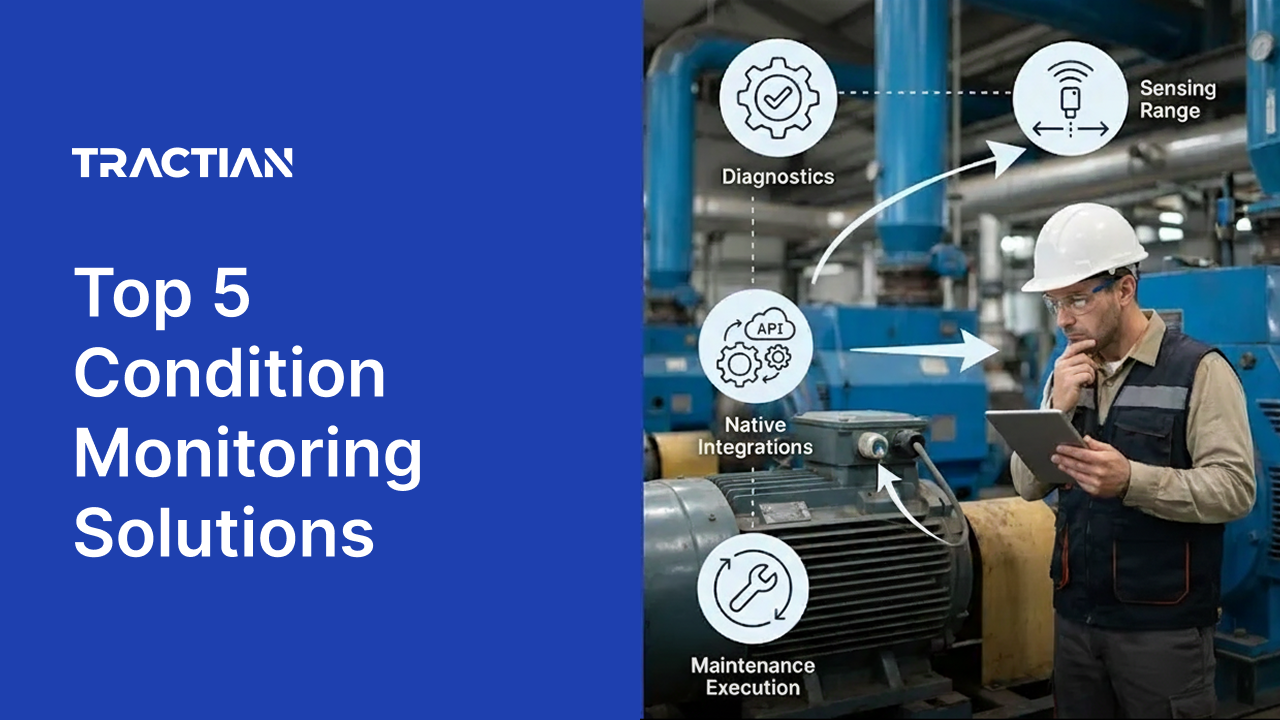
The result is a monitoring environment that produces information but not confidence, one that still depends on scarce vibration experts to interpret every alert and manually bridge the gap between detection and action. However, competitive condition monitoring closes it, preventing the decision failures of other solutions. They combine sensing hardware with diagnostic intelligence, prescriptive guidance, and native integration into maintenance execution workflows, so the path from "something changed" to "here's the work order with the procedure attached" happens inside a single system.
What Should You Prioritize When Selecting a Condition Monitoring Solution?
The condition monitoring market has matured to the point where sensor hardware alone no longer differentiates one program from another. What separates competitive solutions from basic monitoring tools is their ability to produce decisions teams can trust and act on without adding headcount or specialist dependency.
When evaluating condition monitoring solutions, prioritize these four areas to ensure your program delivers measurable reliability improvements rather than more data to manage:
- Diagnostic clarity and failure-mode identification: The solution should identify what is wrong with the machine, not just that something changed. Auto-diagnosis of specific failure modes (bearing wear, misalignment, looseness, lubrication issues) with severity scoring eliminates guesswork and allows technicians to act on the first visit rather than returning for confirmation.
- Sensor capability and environmental durability: The hardware must capture high-resolution data across the frequency ranges required to detect both early-stage and advanced faults across a wide range of asset types. Hazardous-area certifications, high ingress protection ratings, and independence from plant Wi-Fi are non-negotiable for heavy industrial environments.
- Native integration with maintenance execution: Condition monitoring only creates value when insights convert into action. Solutions that natively integrate with maintenance execution for automatic work order generation, prescriptive procedures, and closed-loop feedback shorten the time between detection and resolution and eliminate system switching that can stall insights.
- Scalability without proportional complexity: As monitoring programs expand from pilot to plant-wide to multi-site, the solution should not require a corresponding increase in analysts, gateways, or manual configuration. Architecture decisions like wireless range, gateway capacity, and AI that adapts to each machine's behavior determine whether a program scales smoothly or stalls under its own weight.
How Do Teams Benefit From Condition Monitoring Solutions?
Maintenance and reliability teams adopt condition monitoring solutions to move beyond reactive firefighting and gain control over equipment health across shifts, lines, and sites. A solution that combines continuous sensing with diagnostic intelligence and maintenance workflow integration enables teams to prevent failures rather than respond to them, allocate labor based on actual machine condition instead of calendar schedules, and demonstrate measurable improvements to operations leadership.
The following capabilities define what a competitive condition monitoring solution delivers:
- Automated fault detection and diagnosis: AI algorithms identify specific failure modes across bearing wear, misalignment, imbalance, looseness, lubrication degradation, and dozens of additional conditions, then communicate what is wrong in terms that technicians and planners can act on without specialist interpretation.
- Predictive Maintenance: Each detected fault is paired with recommended corrective actions, severity context, and step-by-step procedures. Teams know what to do, how urgent it is, and what happens if they delay, all without waiting for an external analyst or vibration expert.
- Closed-loop workflow from sensor to work order: Condition data flows directly into maintenance management systems, generating prioritized work orders with the diagnosis, procedure, and parts list already attached. Completed repairs feed back into the system, improving future accuracy and creating a traceable record of reliability.
- Multi-modal sensing for comprehensive coverage: Combining vibration analysis with ultrasound, temperature, and magnetic field sensing expands the range of detectable faults and asset types, including low-speed equipment, variable-speed drives, and intermittent machines that are challenging for single-technique systems.
- Scalable architecture that reduces dependency: Sub-GHz wireless communication, high gateway capacity, and AI that self-calibrates to each machine's operating profile allow programs to grow from a handful of pilot assets to plant-wide coverage without adding headcount or specialized infrastructure.
Condition Monitoring Solutions at a Glance
| Feature | Tractian | Augury | Fluke | SKF | AssetWatch |
|---|---|---|---|---|---|
| Score | 7/7 | 4/7 | 1/7 | 1/7 | 1/7 |
| Integrated Ultrasound Sensing | ✅ | ❌ Separate sensor for ultra-low RPM only | ❌ | ❌ | ❌ |
| AI-Powered Auto-Diagnosis | ✅ All major failure modes | ✅ | ✅ ~93% automated analysis | ❌ Anomaly detection only | ❌ Analyst interprets AI-flagged anomalies |
| Native maintenance execution with Automatic Work Order Generation | ✅ | ❌ Requires third-party maintenance execution | ❌ Requires separate eMaint subscription | ❌ | ❌ Requires third-party maintenance execution |
| Prescriptive Alerts with Attached Maintenance Procedures | ✅ | ✅ | ❌ | ❌ | ❌ |
| Hazardous Area Certification (ATEX/IECEx) | ✅ | ✅ | ❌ | ❌ | ✅ Available on request, not standard |
| Magnetic Field Sensing for Electrical Fault Detection | ✅ | ✅ | ❌ | ❌ | ❌ |
| Sub-GHz Wireless with Cellular Backhaul | ✅ | ❌ | ❌ | ❌ | ❌ |
Top Condition Monitoring Solutions by Company
Tractian
Best for: Industrial maintenance and reliability teams that need a complete, closed-loop condition-monitoring solution with built-in diagnostics, prescriptive guidance, and native maintenance-execution integration, all in one platform designed for technician-first execution.
Tractian delivers condition monitoring as part of a unified one device, one system platform where sensors, AI diagnostics, and maintenance execution share the same system. The Tractian Smart Trac wireless vibration sensor continuously monitors vibration, temperature, ultrasound, and magnetic field data across more than 100 asset categories, including variable-speed and intermittent machines that challenge single-technique approaches.
Patented fault-finding algorithms auto-diagnose all major failure modes and deliver prescriptive alerts that tell technicians what is wrong, how severe it is, and what to do next, with procedures attached.
What makes Tractian distinct as a condition-monitoring solution, not just a sensor, is its native closed-loop capability. When the AI identifies a fault, the platform can automatically generate a prioritized work order in Tractian's maintenance execution with the diagnosis, recommended SOP, and relevant parts already populated.
Completed work feeds back into the model, improving diagnostic accuracy over time. The sensor's sub-GHz wireless protocol connects to Smart Receivers over 4G/LTE with no dependency on plant Wi-Fi, supporting up to 100 sensors per receiver at ranges of 330 feet indoors and approximately 0.6 miles line of sight. With IP69K protection, ATEX/IECEx/NFPA 70 Class 1/2/3 Division I certifications, and resistance to a broad range of industrial chemicals, Tractian sensors operate in environments where many competing devices cannot be installed.
Notable Features
- Auto Diagnosis across all major failure modes: Patented AI algorithms convert vibration signals into frequency spectra and pinpoint faults, including bearing wear, misalignment, looseness, cavitation, lubrication degradation, gear wear, and electrical issues, each with severity scoring and prescriptive next steps.
- Multi-modal sensing in a single device: The sensor combines triaxial vibration (0-64,000 Hz), piezoelectric ultrasound (up to 200 kHz), magnetometer-based RPM encoding (1-48,000 RPM), and surface temperature measurement, capturing the full range of mechanical and early-stage faults that single-technique systems miss.
- Native maintenance execution and APM integration: Condition-monitoring insights flow directly into Tractian's maintenance execution for automatic work order creation and into the APM module for FMEA, root cause analysis, failure libraries, and inspection management, creating a single command center from detection through resolution.
- Always Listening and RPM Encoder: Proprietary algorithms capture vibration data precisely when intermittent machines operate, and infer rotational speed directly from vibration signals on variable-speed equipment, eliminating the need for external tachometers or complex scheduling.
- Adaptive AI with 3.5 billion+ samples: The diagnostic engine is trained on hundreds of thousands of assets globally, adapts to each machine's normal operating modes, incorporates a human-in-the-loop feedback mechanism, and uses a temperature seasonality algorithm (drawing on 5 years of local weather data) to distinguish environmental shifts from equipment-driven anomalies.
Why real customers choose Tractian’s Condition Monitoring Solutions
- “We observed many recurring lubrication failure insights. We revised our maintenance plan, and today we no longer have this type of failure. We were able to train the sensor by providing feedback on the insights related to material changeovers.” says William C., Maintenance Coordinator
- “I'm really impressed by the reliability metrics that Tractian is able to calculate in real time, and the level of detail when it comes to the failure modes and the insight generation. Tractian has really improved our asset availability.” says Gautam Sane, Senior Reliability Engineer
- “For the first time, we can clearly see what’s happening on the floor before a failure hits. That kind of visibility is a game-changer.” says Trevor Baker, Sr. Manager, Manufacturing Strategic Initiatives
What Industries are using Tractian’s Work Order Management Software?
Tractian's condition monitoring solutions are deployed across industries where equipment reliability, safety, and uptime directly determine production output and operating costs. These solutions are chosen by teams managing large populations of critical rotating assets who need diagnostic confidence and maintenance execution in one system, without adding complexity to daily operations.
- Mining and Metals operators use Tractian to monitor crushers, conveyors, and mobile assets running in extreme environments. Continuous condition monitoring helps prevent unplanned stoppages, protect workers, and keep high-value equipment running across remote or rugged locations.
- Chemical plants rely on Tractian to keep pumps, mixers, and compressors stable within tightly controlled process conditions. The platform supports strict safety requirements and provides early warnings that help avoid failures in hazardous production areas.
- Mills and Agriculture processors use Tractian's condition monitoring to ensure machines stay operational during peak seasons. Early detection of bearing wear or misalignment helps prevent disruptions during high-demand harvest windows and safeguards expensive processing equipment.
- Manufacturing and industrial production teams depend on Tractian to maintain line uptime, reduce unexpected stoppages, and support continuous improvement programs. Real-time diagnostics help teams protect motors, gearboxes, and robotics used across mixing, forming, packaging, and assembly operations.
- Oil & Gas refineries, midstream facilities, and upstream operations use Tractian to monitor equipment in remote and hazardous environments. The system helps keep rotating assets running safely while supporting compliance with industry safety and reliability standards.
- Heavy Equipment operators rely on Tractian to track maintenance across job sites, prevent costly failures in high-value mobile assets, and maintain equipment availability for time-sensitive projects.
- Food & Beverage producers leverage Tractian to reduce contamination risks and prevent unplanned equipment downtime that affects temperature control, hygienic processes, and product quality. Continuous condition monitoring supports regulatory compliance and plant cleanliness standards.
- Automotive and Parts plants rely on Tractian to keep high-precision machinery, robotics, and assembly lines running smoothly. Real-time condition monitoring insights help support just-in-time production schedules and reduce the risk of costly delays.
Augury
Best for: Companies that want a vendor-managed machine health monitoring service backed by AI diagnostics and support.
Augury provides a machine health monitoring platform that captures vibration, temperature, and magnetic field data through its Halo sensors and applies AI algorithms to detect anomalies and prescribe corrective actions. However, the diagnostic logic is largely embedded in proprietary models, which can limit how much transparency in-house reliability teams have into the reasoning behind specific calls.
The platform offers portfolio-level dashboards for multi-site visibility and tiered coverage for critical, supporting, and ultra-low RPM assets, but it does not include native maintenance management capabilities. Teams must integrate with a separate maintenance execution to bridge the gap between a detected fault and a tracked work order, which introduces additional system coordination that doesn't exist in natively integrated platforms.
For facilities that prefer to own their reliability program and develop in-house diagnostic confidence over time, the managed-service model may not align with long-term operational goals.
Notable Features
- Multi-signal sensing: Halo sensors capture vibration, temperature, and magnetic field data, enabling detection of both mechanical and electrical anomalies in rotating equipment.
- Tiered asset coverage: The platform offers monitoring tiers for critical equipment, supporting assets, and ultra-low RPM machines (down to 1 RPM via ultrasonic sensing), providing a framework for prioritizing monitoring investments.
- Portfolio-level dashboards: Multi-site visibility dashboards aggregate machine health status across facilities, supporting reliability leaders who manage programs across distributed operations.
Potential Downsides
- No native maintenance execution or APM capabilities: The platform monitors machine health but does not manage work orders, preventive maintenance schedules, inventory, or failure analysis natively. Teams must maintain separate systems and manage data synchronization between monitoring and execution.
- Diagnostic transparency is limited: Much of the intelligence lives inside proprietary AI models. In-house vibration analysts and reliability engineers may find it difficult to access the underlying frequency data, fault reasoning, or spectral evidence needed to validate or learn from the system's conclusions.
- Vendor dependency increases with scale: The managed-service model means that as monitoring programs expand, reliance on the vendor's analyst capacity, integration support, and renewal terms grows proportionally, which can constrain flexibility for teams that want to internalize reliability practices over time.
What real customers say about Augury
- “Augury provides a range of industrial settings, from small factories to large manufacturing plants, and can be customized to meet the specific needs of each business.” says Prashant S., Small-Business
- “Consistency is a concern for me. Even though they provide me with the best possible service, but at times notification reaches to me a bit late. They can improve in that sector.” says Kartik A., Trainee Engineer
Fluke
Best for: Organizations already using eMaint maintenance execution who want to add condition-monitoring sensors to their existing maintenance workflows.
Fluke provides a condition-monitoring solution assembled through the acquisitions of three brands: Azima DLI for AI-powered vibration analytics, eMaint for maintenance execution, and Pruftechnik for alignment tools and monitoring hardware. While the combined portfolio spans the sensor-to-work-order pathway, the integration between these components was announced only in July 2025, and teams evaluating the solution should consider how recently these products began operating as a connected system rather than as three products sharing data.
Notable Features
- Vibration analytics with diagnostic data: Azima's engine processes vibration patterns against a dataset built over three decades of industrial machine analysis to detect and classify faults.
- Maintenance execution connectivity through eMaint: The July 2025 integration enables Watchman Services to send fault information and recommended actions directly into eMaint as tickets, connecting condition data to maintenance scheduling.
- Sensor with spectral analysis: The 3563 sensor captures high-resolution vibration data with customizable frequency bands and auto-generated thresholds based on machine type, enabling both broadband and narrowband alarm configurations.
Potential Downsides
- Assembled through acquisitions, not designed as one platform: The sensor hardware, diagnostic engine, and maintenance execution were developed by three separate companies over different timelines. The unified experience for a technician on the floor, moving from alert to diagnosis to work order, may not feel as cohesive as purpose-built systems.
- Narrower sensing capability: The 3563 measures vibration and temperature across 2-10,000 Hz without dedicated ultrasound or magnetic field sensing. This can limit detection of early-stage faults, electrical anomalies, or issues in low-speed equipment that benefit from broader multi-modal coverage.
- Gateway capacity and connectivity constraints: Each gateway supports up to 20 sensors and communicates over Wi-Fi or Ethernet, which may require IT involvement and more infrastructure for plants with large asset populations or areas without reliable Wi-Fi coverage.
SKF
Best for: Facilities with existing SKF bearing programs or in-house vibration analysts who want to extend their monitoring coverage with wireless sensors from their bearing supplier.
SKF offers condition monitoring through its Enlight ecosystem and access to SKF's global network of remote diagnostic services experts. The sensors form a mesh network that relays data between devices, helping extend the range around obstacles in complex plant layouts. However, condition monitoring is one part of SKF's much larger bearing and rotating equipment business, and the slower pace of software platform development and upgrades reflects that broader organizational focus. The analytical tools, particularly @ptitude Observer and Enlight Centre, are oriented more toward trained analysts than toward frontline technicians looking for clear, prescriptive guidance they can act on without vibration expertise.
SKF's ecosystem does not include a native maintenance execution. For teams that need condition monitoring insights to flow directly into work orders, procedures, and inventory management, this means maintaining and integrating a separate system.
Notable Features
- Mesh networking plant coverage: IMx-1 sensors relay data to one another, routing signals around pipework and obstructions. This mesh architecture can extend the effective range in complex plant geometries where line-of-sight connectivity is limited.
- Bearing expertise: SKF's proprietary acceleration-enveloping and fault-frequency libraries draw on over a century of bearing engineering knowledge, providing detection capabilities for early-stage bearing and gear defects.
- Remote diagnostic services: SKF's network of reliability experts provides analyst-led interpretation of condition monitoring data, available as part of performance-based contracts for facilities that want expert support without building a full in-house vibration analysis team.
Potential Downsides
- No native maintenance execution or maintenance execution layer: The Enlight ecosystem monitors and analyzes machine health but does not generate or manage work orders, PM schedules, or maintenance procedures. Teams need a separate maintenance management platform to act on condition monitoring findings.
- Platform oriented toward analysts, not technicians: The software tools (@ptitude Observer, Enlight Centre) are built for trained vibration analysts rather than frontline maintenance workers. Teams without dedicated reliability specialists may find the interface and outputs less immediately actionable than platforms designed for technician-first adoption.
- Condition monitoring competes for investment within a larger business: As a division of a global bearing manufacturer, the Enlight platform's development roadmap is influenced by priorities beyond condition-monitoring software. Teams evaluating the solution should assess whether the platform's pace of innovation and feature development meets their evolving reliability program needs.
AssetWatch
Best for: Organizations in industries that need work order documentation and compliance tracking alongside standard maintenance execution compliance requirements.
AssetWatch provides work order management, preventive maintenance scheduling, and asset tracking with configurable fields, workflows, and interface layouts. The platform connects to 3rd party condition-monitoring sensors and testing equipment to trigger automated work orders. However, implementation and configuration demand significant time and technical expertise, with users reporting longer-than-expected deployment timelines and steep learning curves during adoption.
The platform includes regulatory reporting and audit trails that support compliance documentation across multiple sites and countries. While configurability enables adaptation to complex requirements, it can create a user interface that is difficult to navigate, especially for less technical users or during initial onboarding. Reporting setup requires substantial effort, and teams frequently cite the need for ongoing vendor support to maintain custom configurations or troubleshoot workflow issues.
Teams without dedicated maintenance execution administrators or IT resources may find that configuration overhead and support dependencies outweigh the platform's advantages in flexibility.
Notable Features
- 3rd-party Sensor Integration: Connectivity with other condition monitoring sensors, vibration analyzers, and testing equipment for automated work order triggering.
- Configurable Capabilities: Configurability of fields, workflows, dashboards, and reports allows adaptation to complex operational requirements and compliance standards.
- Multi-Site Management: Centralized administration across global locations with site-specific languages, currencies, and workflow configurations from a master account.
Potential Downsides
- Complex Setup Requirements: Implementation and configuration demand significant time and technical expertise, with users reporting longer-than-expected deployment timelines and steep learning curves during adoption.
- Interface Navigation Challenges: The platform's customization options create a complex user interface that can be difficult to navigate, especially for less technical users or during initial onboarding.
- Cost Escalation: While entry pricing appears competitive, costs can increase substantially as organizations add service requesters, expand integrations, or require advanced features, making the total cost of ownership difficult to predict for growing operations.
What real customers say about AssetWatch
- Numerous training libraries and the reps available to assist you in whatever initiative you have. The asset selection process is overwhelming for operators.” Verified User in Manufacturing
- Very easy to use. PM setup is straightforward and allows for custom tailoring for us. Reporting can be difficult to come up with what you want to see. Since you have to use "hard dates" like WO Date, or Close Date you have to export data to excel to actually view what you want.” Jason B., Plant Project Engineer
- “There are a few items that we are not overjoyed about. Searching for assets can be a bit of a hassle when it comes to getting the results you are looking for. Our Parts area of AssetWatch took almost a year to get fixed after issues occurred during implementation.” Verified User in Facilities Services
Tractian Condition Monitoring Solution in Head-to-Head Comparisons
Most condition monitoring platforms can capture vibration and temperature data from rotating equipment. The core differences emerge in how that data is converted into confident decisions:
- Whether diagnostics identify specific failure modes or just flag deviations
- Whether insights flow natively into maintenance execution or require separate systems
- Whether the sensing hardware covers the full range of industrial fault signatures or leaves gaps that require additional tools or expertise.
Selecting a condition monitoring solution, then, comes down to three capabilities:
- Diagnostic intelligence that tells teams exactly what is wrong and what to do
- Native integration from sensor to work order without system switching
- Multimodal sensing that detects faults across the frequency and speed ranges in which industrial assets actually operate.
Here's how Tractian compares head-to-head with its competitors.
Tractian vs. Augury: Augury provides AI-driven machine health monitoring with vibration, temperature, and magnetic field sensing delivered as a managed service. However, the platform lacks native maintenance management capabilities, requiring teams to integrate with a separate maintenance execution for work order creation and tracking. Diagnostic transparency is limited by proprietary models that give in-house teams less visibility into how conclusions are reached.
Tractian eliminates that friction with native maintenance execution integration that automatically generates prioritized work orders from sensor alerts, prescriptive procedures attached to every diagnosis, and Supervised Analysis that provides expert-validated reports when complex cases need deeper interpretation, keeping both autonomous AI and human expertise accessible within a single platform.
Tractian vs. Fluke Reliability: Fluke Reliability offers condition monitoring through a vibration sensor that connects to a recently integrated maintenance execution and AI analytics platform assembled through separate acquisitions. However, the sensor captures vibration and temperature across a 2-10,000 Hz range without ultrasound or magnetic field sensing, and the gateway supports up to 20 sensors over Wi-Fi, which can require IT involvement and additional infrastructure for larger deployments.
Tractian provides multimodal sensing up to 64,000 Hz, with integrated ultrasound at 200 kHz and magnetometer-based RPM encoding in every sensor, communicating via sub-GHz wireless to receivers over 4G/LTE with no plant Wi-Fi dependency, supporting up to 100 sensors per receiver.
Tractian vs. SKF: SKF offers wireless vibration and temperature sensors with mesh networking, cloud-based monitoring software, and access to remote diagnostic services staffed by the company's reliability engineers. However, the platform lacks a native maintenance execution layer, and fault-specific diagnosis relies primarily on analyst interpretation rather than automated prescriptive guidance, which can create bottlenecks for teams without dedicated vibration specialists.
Tractian delivers auto-diagnosis across all major failure modes, plain-language, prescriptive alerts, native maintenance-execution integration for automatic work order generation, and a mobile-first interface with offline capability, designed for technicians on the floor rather than analysts at a workstation.
Tractian vs. AssetWatch: AssetWatch provides a turnkey condition-monitoring service that bundles wireless vibration and temperature sensors with a dedicated analyst who interprets the data and delivers recommendations. However, the sensor's frequency range is limited to around 8-10 kHz without ultrasound or magnetic field sensing, and the service depends on the assigned analyst's capacity rather than on building the organization's diagnostic capability over time.
Tractian combines broader multi-modal sensing with AI that auto-diagnoses faults and attaches corrective procedures, enabling teams to act independently while still offering Supervised Analysis when specialist interpretation adds value, building internal reliability maturity rather than creating long-term vendor dependency.
Across all four comparisons, a consistent pattern emerges. Competing platforms either separate monitoring from maintenance execution, narrow the sensing range, or shift diagnostic ownership to the vendor. Tractian unifies detection, diagnosis, and corrective action in a single platform where the team, not the vendor, controls the reliability program.
Ready to see the difference a unified condition monitoring solution makes?
Explore Tractian condition monitoring platform to discover what your team can achieve when sensor data, AI diagnostics, and maintenance execution work together as one connected system.
FAQs About the Best Condition Monitoring Solutions
- What is the difference between a condition monitoring sensor and a condition monitoring solution?
A condition-monitoring sensor is hardware that captures data from equipment, typically vibration and temperature. A condition monitoring solution is the full system: sensors, diagnostic intelligence, prescriptive guidance, and integration with maintenance workflows. Sensors tell you something has changed. Solutions tell you what failed, how severe it is, and what to do about it, then connect that insight to a tracked work order so nothing falls through the cracks.
- How does AI-powered auto-diagnosis differ from anomaly detection?
Anomaly detection flags that a measurement has deviated from a baseline or crossed a threshold. Auto-diagnosis goes further by identifying the specific failure mode causing the anomaly, such as inner bearing wear, misalignment, or lubrication degradation, and assigning a severity level. The practical difference is significant: anomaly detection tells a technician to go investigate, while auto-diagnosis tells them what is wrong and what corrective action to take. Platforms that rely solely on anomaly detection typically require a trained vibration analyst or external service to interpret the alert before maintenance can act.
- Why does native maintenance execution integration matter for condition monitoring?
When condition monitoring and maintenance management operate in separate systems, every detected fault requires manual steps to create a work order, attach the diagnosis, assign the task, and track completion. This gap between detection and action is where insights stall, especially on lean teams managing hundreds of assets. Native integration eliminates that gap by automatically generating prioritized work orders with the fault description, recommended procedure, and relevant parts already attached. It also creates a closed feedback loop where completed repairs improve future diagnostic accuracy.
- Can condition monitoring solutions work in hazardous environments?
Some can, but certifications vary. Plants operating in areas classified as explosive or hazardous under ATEX, IECEx, or NFPA 70 standards require sensors with the appropriate Division and Zone ratings. Not all condition-monitoring sensors are certified for these environments, and some vendors offer hazardous-area variants only as separate products or on-demand options rather than as standard. Teams should verify the specific certification class and whether it covers their facility's hazard classification before committing to a platform.
- What role does ultrasound play in a condition monitoring solution?
Ultrasonic sensing detects high-frequency signals from friction, early-stage wear, cavitation, leaks, and micro-impacts that standard vibration analysis may miss, particularly on low-speed equipment. Machines operating below 300 RPM often generate fault signatures that fall outside the effective range of conventional accelerometers. A condition-monitoring solution with integrated ultrasound sensing can detect these faults earlier in the degradation curve, giving teams more lead time to plan corrective actions. Without ultrasound, teams monitoring slow-speed equipment may not receive alerts until faults have progressed significantly.
- How does Tractian's condition monitoring solution connect detection to maintenance execution?
Tractian's Smart Trac sensor continuously monitors vibration, ultrasound, temperature, and magnetic field data across critical assets. When the AI detects a fault, it auto-diagnoses the specific failure mode, assigns a severity score, and delivers a prescriptive alert with recommended corrective actions. That alert can automatically generate a work order in Tractian's native maintenance execution with the diagnosis, SOP, and parts information already attached. Once the technician completes the repair, the outcome feeds back into the diagnostic model, improving accuracy over time. This closed loop from sensor to diagnosis to work order to feedback operates within a single platform, without requiring integration with external systems.
{ "@context": "https://schema.org", "@type": "FAQPage", "mainEntity": [ { "@type": "Question", "name": "What does ultrasound detect in condition monitoring?", "acceptedAnswer": { "@type": "Answer", "text": "Ultrasound detects high-frequency acoustic energy from friction, turbulence, and micro-impacts, making it sensitive to early-stage lubrication breakdown before vibration or temperature data registers a change." } }, { "@type": "Question", "name": "Why combine ultrasound and vibration monitoring?", "acceptedAnswer": { "@type": "Answer", "text": "Ultrasound detects the earliest signals, while vibration confirms progression and severity. Together, they eliminate the ambiguity of relying on either alone." } }, { "@type": "Question", "name": "Why does continuous monitoring matter for these programs?", "acceptedAnswer": { "@type": "Answer", "text": "Faults develop on their own timeline, not on an inspection schedule, and route-based snapshots miss issues that progress between visits." } }, { "@type": "Question", "name": "How does Tractian support a continuous monitoring approach?", "acceptedAnswer": { "@type": "Answer", "text": "Tractian sensors provide continuous vibration, ultrasound, temperature, and RPM data, AI diagnostics identify failure modes with prescriptive guidance, and native Tractian's platform integration turns alerts into tracked work orders within one platform." } }, { "@type": "Question", "name": "Can condition monitoring and predictive maintenance be used together?", "acceptedAnswer": { "@type": "Answer", "text": "Yes. Many organizations layer predictive analytics on top of condition monitoring data. You get real-time alerts for immediate issues and forward-looking predictions for planning, all from the same sensor infrastructure." } }, { "@type": "Question", "name": "What are the three main types of predictive maintenance?", "acceptedAnswer": { "@type": "Answer", "text": "Vibration analysis, thermal imaging, and oil analysis are the three primary types. Each targets different failure modes and asset types, and many programs use all three in combination." } }, { "@type": "Question", "name": "How much does a predictive maintenance program cost compared to condition-based maintenance?", "acceptedAnswer": { "@type": "Answer", "text": "Predictive maintenance typically requires a higher upfront investment for AI software and sensors. However, the long-term savings from preventing unplanned downtime often exceed the additional cost, particularly for critical assets." } }, { "@type": "Question", "name": "What skills does a maintenance team need to implement predictive maintenance successfully?", "acceptedAnswer": { "@type": "Answer", "text": "Traditional programs required specialized vibration analysts. Modern AI-powered platforms reduce this barrier by automating diagnostics and delivering actionable insights directly to technicians without requiring deep analytical expertise." } }, { "@type": "Question", "name": "Why are asset performance metrics important?", "acceptedAnswer": { "@type": "Answer", "text": "They provide the data needed to identify reliability problems, measure maintenance effectiveness, and connect daily activities to business outcomes. Without metrics, teams are forced to rely on assumptions and reactive responses." } }, { "@type": "Question", "name": "What does an asset performance metrics program include?", "acceptedAnswer": { "@type": "Answer", "text": "A complete program includes defined metrics aligned with goals, reliable data-collection methods, software for calculation and visualization, regular review processes, and workflows that connect insights to maintenance actions." } }, { "@type": "Question", "name": "What are the most common asset performance metrics?", "acceptedAnswer": { "@type": "Answer", "text": "Common indicators include Mean Time Between Failures (MTBF), Mean Time to Repair (MTTR), availability, schedule compliance, preventive maintenance (PM) compliance, work order backlog, and planned maintenance percentage (PMP)." } }, { "@type": "Question", "name": "How do I choose which metrics to track?", "acceptedAnswer": { "@type": "Answer", "text": "Start with your maintenance objectives. If reducing downtime is the priority, focus on MTBF and availability. If improving response efficiency is your top priority, track MTTR and work order completion rates." } }, { "@type": "Question", "name": "Can asset performance metrics be tracked without software?", "acceptedAnswer": { "@type": "Answer", "text": "Technically, yes, but manual tracking introduces errors, delays, and a significant administrative burden. Tractian's Platform automates data collection, applies formulas consistently, and presents results in real time." } }, { "@type": "Question", "name": "How often should asset performance metrics be reviewed?", "acceptedAnswer": { "@type": "Answer", "text": "Daily or weekly reviews help teams respond quickly to emerging issues. Monthly or quarterly reviews support strategic planning, trend analysis, and goal-setting. The best programs combine both cadences." } } ] }