
Key Points
- Condition monitoring analysis identifies patterns and anomalies, but decisions require context, priority, and a clear path to execution.
- Trust erodes when alerts lack validation or produce frequent false positives, causing teams to second-guess insights rather than act on them.
- Without prioritization logic, flat alert lists create decision paralysis, forcing reliance on tribal knowledge that doesn't scale as experienced technicians leave the workforce.
- Analysis that lives in a separate system from maintenance execution introduces manual handoffs that delay response or prevent action entirely.
The Gaps Between Analysis and Action
Analyzing the signals and generating insights from condition monitoring has matured significantly. Teams now have access to continuous vibration data, temperature trending, AI-driven anomaly detection, and dashboards that visualize asset health in real time. The technology works. And yet, a persistent challenge remains.
Analysis doesn't reliably convert into confident, timely action.
There’s a gap between analysis and action. It's identified by asking, “What happens after the analysis is produced?” According to research from IoT Analytics, the accuracy of many predictive maintenance solutions remains below 50%, which "creates headaches for maintenance organizations that often run to an asset to find it operating normally, eroding trust in the entire solution.”
When half of the alerts lead nowhere, teams stop treating alerts as instructions and treat them as suggestions that need verification.
This isn't a failure of the underlying hardware technology. Rather, it’s a structural problem in the workflow and resource allocation. Analysis produces information and insights. But these alone don't create action.
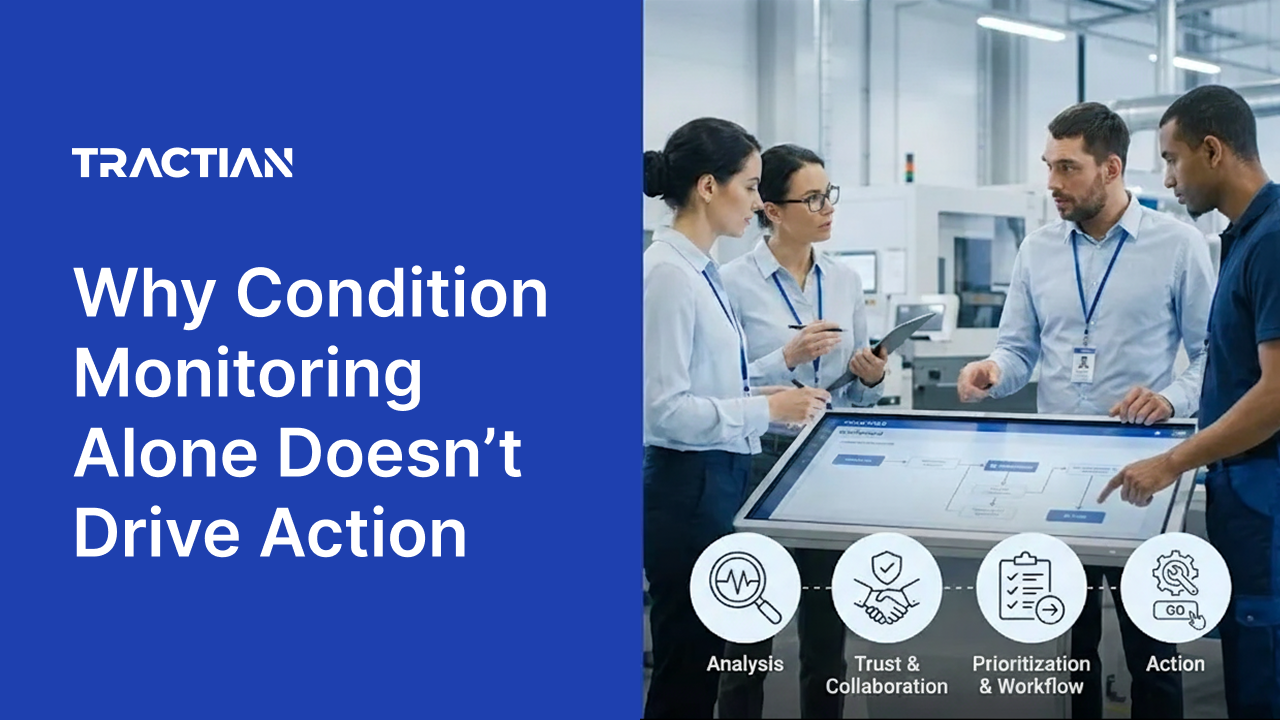
Three gaps consistently prevent condition monitoring analysis from driving the outcomes it promises:
- Lack of trust
- No prioritization
- A disconnected workflow
Understanding each is the first step toward closing them.
Gap 1: The Trust Problem
Teams often have analysis they don't fully trust, and low trust leads to hesitation, manual verification, or inaction. Confidence in the analysis determines whether teams act on it. When confidence is low, alerts become prompts for investigation rather than prompts for response.
Several factors erode trust. A history of false positives conditions teams to doubt alerts before validating them. If technicians have repeatedly walked to an asset only to find it running normally, they learn to treat alerts with skepticism. Context-free notifications compound the problem.
An alert that says "vibration exceeded threshold" without explaining what that means for the specific asset or failure mode forces the team to interpret raw data. Unclear data provenance invites further second-guessing: Is this reading accurate? Is the sensor functioning correctly? Was the machine in a normal operating state when the sample was taken?
The consequence is predictable. When trust is low, the analysis gets verified before anyone takes action. Verification requires time, expertise, and attention. In understaffed environments, verification bottlenecks quickly.
A 2024 study by Deloitte and The Manufacturing Institute found that 65% of manufacturers cite attracting and retaining talent as their primary business challenge, with up to 1.9 million manufacturing positions potentially unfilled by 2033, including industrial maintenance technicians. When expert judgment is scarce, systems that require expert verification to act become systems that don't drive action.
Trust is achieved when the team believes the insight is enough to act without a second opinion. Some systems address this by benchmarking assets against millions of similar machines and validating findings before surfacing them, reducing the need for manual confirmation. But many monitoring environments still surface raw alerts and leave validation to the team. In those environments, analysis accumulates while action waits.
Gap 2: The Prioritization Void
Even an accurate analysis creates decision paralysis when everything appears equally urgent. A dashboard showing 15 assets with anomalies doesn't tell the team which one matters most right now. It presents a list, and that list demands a choice.
Without built-in prioritization logic, teams face a few options, none of which are ideal.
- They can chase the most recent alert, which biases toward recency rather than importance.
- They can chase the loudest alarm, which biases toward severity without accounting for asset criticality or production impact.
- Or they can fall back on experience and tribal knowledge, relying on veteran technicians who know which assets "usually" cause problems and which anomalies can wait.
Tribal knowledge works until it doesn't. The workforce dynamics that make it unreliable are already in motion. As experienced technicians retire and positions go unfilled, institutional memory leaves with them.
The Deloitte study specifically identifies industrial maintenance technicians among the roles most urgently needed and most difficult to fill. Teams that depend on human judgment to prioritize alerts will struggle to maintain responsiveness as that judgment becomes harder to retain and replace.
Effective prioritization requires a criticality ranking that reflects how important each asset is to production. It requires a risk-based assessment that accounts for how quickly a fault could progress. And it requires timing logic that considers where the asset sits on its degradation curve.
When analysis doesn't incorporate these factors, it shifts the cognitive load to the team. In high-volume monitoring environments with dozens or hundreds of assets, the load overwhelms. Alerts pile up, responses lag, and the monitoring program produces data. But the data doesn't produce outcomes.
Gap 3: The Workflow Disconnect
Analysis that lives in a separate system from maintenance execution creates a manual handoff that delays or prevents action.
The monitoring platform detects a fault, but now what? Someone must interpret the insight, decide on the appropriate response, open the maintenance management system, and create a task or work order. Each step in that sequence introduces delay, potential error, and the possibility that the alert falls through entirely.
For slow-developing faults, that delay might be acceptable. Bearing wear that progresses over weeks can tolerate a multi-day response window. But not all faults develop slowly. Lubrication failures, thermal events, and certain mechanical looseness conditions can progress rapidly. In those cases, the handoff window can mean the difference between a planned maintenance repair during a maintenance window and an unplanned breakdown during production.
The structural issue is straightforward: analysis that doesn't flow into execution infrastructure often doesn't flow into execution at all. The handoff becomes a bottleneck, and bottlenecks become leaks.
Alerts that require three people and two systems to become work orders will lose some portion to delay, miscommunication, or simple oversight. Integrated platforms that connect monitoring insights directly to work order systems eliminate the handoff, turning detection into scheduled action without manual translation. But where that integration doesn't exist, the gap between analysis and action remains open.
What Bridges the Gap
The path from analysis to action requires trust mechanisms, prioritization logic, and workflow integration, not just better algorithms. To be operational, condition monitoring analysis must be embedded in the decision infrastructure rather than bolted on beside it.
Trust mechanisms
These give teams confidence to act without manual verification. This includes validation against large operational datasets, contextual intelligence that adjusts for operating conditions and asset history, and expert oversight options when findings need a second look. When the system handles validation, teams can respond to insights rather than investigate them.
Prioritization logic
This reduces cognitive load by ranking issues according to asset criticality and fault severity. Alerts surface in order of importance, not order of occurrence. Teams address what matters most first, and lower-priority items queue appropriately rather than competing for attention.
Workflow integration
This connects insights to action without requiring manual translation. When a monitoring system can generate a work order directly, with the diagnosis attached, the procedure included, and the technician assigned, the gap between detection and response closes.
The outcome is a monitoring program that drives action at scale. Teams spend less time interpreting data and more time executing repairs. Response accelerates because the path from insight to task is direct. Trust builds because the system proves reliable over repeated cycles.
Analysis is necessary for condition-based maintenance. But analysis isn't sufficient. The real measure of a condition monitoring program is whether it drives confident, timely action, not whether it produces accurate data. Programs that close the trust, prioritization, and workflow gaps convert analysis into outcomes. Programs that don't will continue to generate insights that accumulate without effect.
How Tractian Bridges Analysis and Action
Tractian's condition monitoring platform addresses the trust, prioritization, and workflow gaps that prevent analysis from driving action. Rather than producing alerts that require interpretation, Tractian delivers insights that teams can act on directly.
Building trust through validated intelligence.
Tractian's AI is trained on over 3.5 billion samples collected from hundreds of thousands of assets across industries. This operational dataset allows the system to recognize failure patterns with precision and validate findings before surfacing them.
Each monitored asset is benchmarked against similar equipment using the Tractian Health Score, which provides a defensible condition assessment within five days of sensor installation. Teams receive a baseline comparison even before the full learning period completes, so early action is possible when warranted.
The result is that analysis teams can trust the results without requiring manual verification for every alert.
Prioritization is built into every insight.
Tractian's criticality-based alerting adjusts when and how alerts trigger based on asset importance.
- More critical machines receive earlier warnings at lower severity thresholds, ensuring quick intervention before issues escalate.
- Less critical assets allow greater flexibility, enabling teams to schedule maintenance at optimal times rather than reacting to every anomaly.
- The Health Score combines fault severity with criticality variables, ranking what matters most rather than presenting a flat list of alerts as equivalent. Teams see priority, not just status.
From insight to work order without the handoff.
Each Tractian insight includes prescriptive guidance, which includes validated procedures that tell technicians what to do next, not just what the system observed.
Tractian's native maintenance platform, with a work order management system, automatically converts these insights into work orders. Detection becomes a scheduled task without manual translation. For organizations using existing enterprise systems, native integrations can sync alerts directly into those platforms, generating prioritized, technician-ready work orders in the system teams already use.
The unified platform advantage.
Because Tractian combines condition monitoring, AI-powered diagnostics, and maintenance management in a single environment, there is no gap between detecting an issue and scheduling the fix.
Analysis flows into action through an integrated system. The handoff that creates delay and leakage is eliminated. Instead, the loop is closed, with real-time data flowing into automated actions.
For teams ready to turn condition monitoring analysis into operational outcomes, Tractian offers a path worth evaluating.
Explore Tractian condition monitoring solutions to see how decision-grade condition monitoring analysis can transform your maintenance team’s workflow.
Which Industries does Condition Monitoring Analysis Benefit?
Condition monitoring analysis delivers value wherever critical equipment runs, but certain operating contexts amplify the consequences of the gap between analysis and action.
Lean maintenance teams, compressed production schedules, remote assets, and seasonal peaks all reduce the margin for interpretation delays and manual handoffs. When analysis doesn't flow into confident, prioritized action, these environments feel the cost most acutely.
For these industries, the shift from raw analysis to decision-grade condition monitoring repositions maintenance teams to act on trusted insights without being overwhelmed by alerts that require manual verification and interpretation.
- Automotive & Parts: Condition monitoring analysis delivers value wherever critical equipment runs, but certain operating contexts amplify the consequences of the gap between analysis and action. When analysis doesn't flow into confident, prioritized action, these environments feel the cost most acutely.
- Fleet: Shop equipment supports vehicle turnaround, and condition monitoring analysis only drives results when insights flow directly into work orders rather than waiting for technicians to manually verify alerts across service bays.
- Manufacturing: Motors, pumps, and conveyors produce high alert volumes, and without criticality-based prioritization, teams spend more time sorting through analysis than acting on it.
- Oil & Gas: Remote assets and hazardous environments make manual verification impractical, requiring condition monitoring analysis that delivers trusted, actionable diagnoses without on-site confirmation.
- Chemicals: Process stability depends on early intervention, and analysis only prevents disruptions when it includes diagnostic clarity specific enough to guide action without additional interpretation.
- Food & Beverage: Tight schedules and sanitation requirements compress maintenance windows, making it critical that condition monitoring analysis converts directly into scheduled tasks without workflow delays.
- Mills & Agriculture: Seasonal processing creates high-stakes periods where analysis must translate into immediate prioritization, ensuring limited maintenance resources focus on harvest-critical equipment first.
- Mining & Metals: Harsh conditions and heavy equipment generate complex signatures, requiring AI-driven analysis to distinguish genuine faults from environmental noise and deliver trusted recommendations without specialist review.
- Heavy Equipment: Variable loads produce inconsistent baselines, making contextual analysis essential to identify true anomalies and build the trust teams need to act without second-guessing every alert.
- Facilities: Distributed assets across multiple sites require centralized analysis with local relevance, and workflow integration ensures that building engineers receive prioritized work orders rather than raw data that requires manual translation.
FAQs: Frequently Asked Questions About Condition Monitoring Analysis
What is condition monitoring analysis?
Condition monitoring analysis is the process of collecting and interpreting sensor data from equipment to detect signs of wear, malfunction, or impending failure. It typically includes vibration, temperature, and other parameters that indicate asset health and degradation trends.
Why doesn't analysis alone drive maintenance action?
Analysis identifies patterns and anomalies but doesn't determine urgency, assign responsibility, or create tasks. Without prioritization logic and workflow integration, insights require manual interpretation and handoffs that delay or prevent timely response.
What causes teams to distrust condition monitoring alerts?
False positives, context-free notifications, and unclear data provenance erode confidence over time. When teams repeatedly investigate alerts that turn out to be non-issues, they begin second-guessing every alert and manually verifying it before acting.
How does prioritization improve condition monitoring outcomes?
Prioritization ranks alerts by asset criticality and fault severity, ensuring teams address the most important issues first. This reduces cognitive load and focuses limited resources on areas that have the greatest impact on uptime and reliability.
What does workflow integration mean for condition monitoring?
Workflow integration connects monitoring insights directly to maintenance management systems, automatically generating work orders that include diagnoses and procedures. This eliminates manual handoffs that introduce delays, errors, and drop-offs between detection and response.
How does Tractian turn condition monitoring analysis into action?
Tractian combines AI-validated diagnostics, criticality-based prioritization, and prescriptive alerts with an integrated maintenance platform. Insights flow directly into work orders, including procedures, so teams can act on trusted recommendations without having to manually translate between systems.