
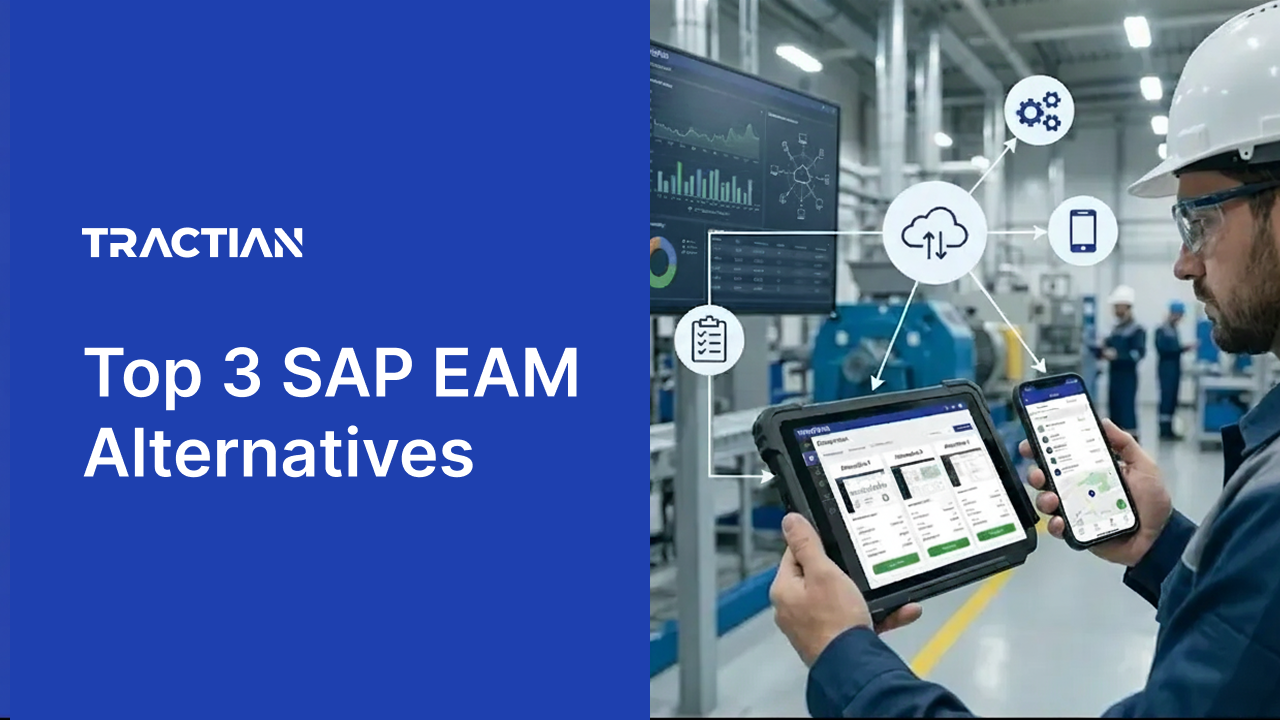
SAP S/4HANA Asset Management is the enterprise asset management module within SAP's ERP suite. It developed from SAP Plant Maintenance (PM) and includes work order management, preventive maintenance scheduling, equipment tracking, and maintenance cost analysis. The module operates in the S/4HANA environment and uses its apps for the user interface.
SAP EAM serves industries including manufacturing, heavy equipment, oil and gas, and fleet. Organizations using SAP for financials, procurement, or supply chain sometimes adopt Asset Management to operate maintenance within the same ERP system. The module supports cloud and on-premise deployments, though implementation typically requires significant configuration, integration effort, and specialized SAP consulting resources.
Why Teams Are Exploring SAP Alternatives
- Manual, Multi-Screen Workflows: Navigating multiple screens and transaction codes to complete a single maintenance task can feel excessive. One user notes that processing a work order, booking time, or updating equipment status often involves multiple steps across different applications, reducing technician productivity and increasing data-entry errors. "Simple stuff like checking if a PO had been received or if a payment went through took too many clicks. We made our own cheat sheets just to get people through day-to-day tasks."
- Steep Learning Curve and User Adoption Issues: The system's complexity creates adoption barriers, particularly for hourly maintenance workers. About the training requirements, one user shared, "Some features feel overwhelming, and the learning curve can be steep. I had to spend extra time training myself and the team before it really clicked."
- High Total Cost of Ownership: Beyond licensing, migrating from legacy SAP versions to S/4HANA Asset Management introduces additional costs and project risk. As one reviewer explained, "It's very expensive to set up, whether you're paying for the cloud infrastructure itself or for a consultant to help you get started. There are also significant ongoing costs associated with things like upgrades and keeping your system secure."
Potential Problems Teams Face with Limited Solutions
When evaluating or using SAP ERP-based asset management, teams may encounter limitations that require workarounds or third-party tools.
- Limited Mobile Usability for Technicians: Browser-based maintenance apps that lack offline capabilities create challenges for field technicians working in areas with poor connectivity. Some software requires resorting to third-party mobile solutions to bridge this gap, adding integration complexity and cost. Standard ERP mobile tools are often better suited to supervisors and planners than to technicians performing maintenance on the floor.
Key Capabilities to Prioritize When Replacing SAP
Organizations evaluating SAP EAM alternatives for enterprise asset management, or maintenance and reliability teams, should focus on capabilities that address the friction points inherent in ERP-based maintenance management.
- Mobile-First, Offline-Capable Execution: Look for platforms that allow technicians to access work orders, record data, and complete tasks on mobile devices without continuous network connectivity. The system should sync automatically when the connection resumes, ensuring field work continues uninterrupted.
- Asset Performance Management: Prioritize solutions that combine CMMS functionality with real-time asset health data in a single platform. This eliminates the need for separate monitoring systems and manual data transfers, connecting equipment condition directly to maintenance workflows.
- AI-Powered Condition Monitoring: Seek platforms that use machine learning to detect failure patterns and automatically generate work orders with embedded troubleshooting guidance. This reduces reliance on manual inspections and ensures technicians have clear direction before arriving at an asset.
- Rapid Deployment Without ERP Dependencies: Evaluate solutions that can be implemented in weeks rather than months, without requiring deep ERP integration projects. The platform should support data import from existing systems while providing standalone value from day one.
- Intuitive Interface with Minimal Training Requirements: Choose platforms designed for maintenance technicians, not adapted from broader enterprise tools. Look for clean interfaces, role-based views, and workflows that match how maintenance teams actually operate.
SAP Alternatives at a Glance
| Feature | SAP | Tractian | IFS | Maximo |
|---|---|---|---|---|
| Mobile Offline Capability | Fiori apps are browser-based and require additional platform configuration for offline functionality | Mobile app built offline-first with automatic sync when connectivity returns | Mobile app functionality limited compared to desktop version | Mobile experience requires significant technical effort for reliable offline data management |
| Deployment Timeline | Implementations require months of configuration, integration work, and SAP-certified consultants | Full deployment in 30-60 days with onboarding support included | Initial setup noted as time-consuming with dependencies that can extend timelines | Complex setup requires IBM consultants or certified partners for infrastructure configuration |
| AI-Powered Diagnostics | Processes work orders and schedules but does not diagnose faults or generate repair guidance | AI autonomously detects all major failure modes with plain-language prescriptions and repair steps | AI scheduling, but diagnostic intelligence requires additional configuration | AI capabilities available but require separate module licensing |
| Integrated Condition Monitoring | Requires additional SAP modules, third-party tools, and integration projects for sensor data | Smart Trac Ultra sensors connect directly to CMMS with automatic work order generation | Operates within IFS Cloud suite, but condition monitoring requires separate configuration | Modular architecture requires separate licensing for health monitoring and predictive applications |
| Technician Interface and Adoption | Multi-screen workflows and transaction codes create steep learning curve for frontline workers | Intuitive mobile interface designed for technicians with minimal training required | System requires learning curve due to feature density and module navigation complexity | Interface can be overwhelming for frontline workers, often requiring overlay tools to simplify tasks |
| Implementation Independence | Configuration changes and workflow adjustments typically require SAP-certified consultants | Teams configure workflows and scale to new sites without external consultant dependency | Adding modules introduces dependencies and may require IFS implementation expertise | Ongoing configuration and workflow modifications often require specialized technical resources |
Best 3 SAP Alternatives
Tractian
Best for: Asset-intensive teams seeking an EAM-like experience that unifies AI-driven condition monitoring, mobile-first work management, and asset reliability analytics across the asset lifecycle, without long implementation timelines.
Tractian delivers an integrated approach to enterprise asset management that unifies condition monitoring insights, maintenance execution, and reliability engineering into a single platform. The system connects Smart Trac Ultra wireless vibration sensors directly to its CMMS software, creating a closed loop from fault detection to work order completion.
When sensors detect anomalies in vibration, temperature, or runtime patterns, the platform automatically generates prioritized work orders with diagnostic context and prescriptive guidance. This eliminates handoffs between monitoring tools and maintenance systems, which can create delays in traditional environments.
The platform extends beyond basic maintenance management to provide predictive maintenance capabilities like failure modes, root cause analysis tools, and asset health scoring based on criticality. Teams can manage inspections, track failure events, and compare reliability metrics across assets from a single interface.
Tractian's approach positions maintenance programs as strategic revenue protection, whereas traditional programs are treated as cost centers. With real-time maintenance KPIs including MTBF, MTTR, and backlog visibility calculated automatically from operational data, the game truly changes. Customer deployments report ROI within 12 months, with implementation timelines of 30-60 days rather than the extended rollouts typical of legacy EAM platforms.
Key Features
- Real-Time Vibration Analysis: Smart Trac Ultra wireless sensors detect equipment anomalies and feed data directly into the CMMS, where AI algorithms identify specific failure modes and automatically generate work orders with diagnostic context and repair procedures. No separate monitoring software or manual alert-to-task handoffs required.
- AI-Powered Fault Diagnostics: Patented machine learning algorithms analyze vibration and temperature patterns to identify all major failure modes, from bearing wear and misalignment to cavitation and lubrication issues. Each alert includes severity ratings, root cause analysis, and prescriptive recommendations.
- SAP Integration with Standalone Value: The platform connects to SAP and other ERP systems to exchange financial data while providing complete maintenance management functionality in a standalone environment. Teams gain predictive capabilities without disrupting existing ERP workflows or waiting for complex integration projects.
Why real customers choose Tractian over SAP
- I like that Tractian “generates warnings in which the machine is not yet in a critical state, but notifies you to be able to perform a more detailed inspection with your vibration team to validate data and the physical condition of the machine.” Gerardo T., Predictive Maintenance and Lubrication Supervisor
- Tractian helps us “ensure that the plant is always available for production and that the equipment is not the cause of unplanned stoppages or interruptions. The centralization of information allows you to visualize all monitored assets in one place and obtain valuable insights in real time.” And, “It is easy to install and does not require major transformations within the plant.” Guadalupe O., Enterprise Maintenance Analyst
- Another review writes, “The infrastructure they provide is very beneficial. It allows for the establishment of a wireless communication network between multiple devices, facilitating continuous inspection 24 hours a day, 7 days a week. This frees people from the task of manually checking a large number of pieces of equipment.” Domingo O., Mid-Market Engineer
Why companies choose Tractian over SAP
- “There were some issues that I would say, if not for having Tractian, we would have never noticed… For example, a lubrication problem, we could go out and lubricate it and recheck it on Tractian platform and see that it fixed the problem… It was pretty impressive for that, the results we got early on.” Jacob Hoffine, Reliability Engineer at Ingredion
- “For the first time, we can clearly see what’s happening on the floor before a failure hits. That kind of visibility is a game-changer.” Trevor Baker, Sr. Manager, Manufacturing Strategic Initiatives
- “Tractian has allowed us to move from firefighting mode to proactive maintenance. We can plan ahead and keep things running smoothly, which makes a huge difference for the team and for the animals we care for.” Plant Engineer at Georgia Aquarium
Pro and Cons at a Glance
How much does Tractian cost?
Tractian uses transparent per-sensor and per-user pricing, without platform fees or hidden integration charges. All plans include AI-powered diagnostics, offline mobile execution, multi-site visibility, and condition monitoring capabilities.
IFS EAM
Best for: Organizations already operating ERP or field service management on IFS Cloud that need to add asset management capabilities within their existing platform environment.
IFS Cloud EAM is an asset management module within the IFS Cloud suite. The system includes maintenance planning, work order management, and scheduling tools, though users have noted that initial setup and configuration are time-consuming, particularly for organizations without prior IFS experience. The platform shares a data model with other IFS modules, including ERP, field service management, and supply chain, though adding these modules introduces dependencies that may extend deployment timelines for teams focused primarily on maintenance outcomes.
IFS Cloud EAM serves energy, utilities, manufacturing, and aerospace industries. The platform includes AI-assisted scheduling and asset performance features, but users have reported that the built-in reporting requires additional customization to meet specific needs, and the mobile app's functionality is more limited than desktop access. For organizations evaluating IFS, questions around the long-term cost of ownership warrant attention, as licensing, implementation, and ongoing support fees can accumulate, particularly for mid-sized operations considering standalone EAM rather than the full suite.
Key Features
- Asset Tracking: Records asset data from acquisition through operation, maintenance, and decommissioning, including associated costs and performance metrics.
- Maintenance Scheduling: Uses algorithms to generate maintenance schedules and resource assignments based on defined criticality levels and operational parameters.
- Shared Data Model: Operates within the IFS Cloud suite, supporting data exchange with ERP, field service, or supply chain modules when licensed.
Real Customer Gaps with IFS EAM
As of December 2025, teams implementing IFS Cloud EAM have identified several operational considerations to evaluate before deployment.
- Search and system performance: Users have reported slower search response times than in previous IFS versions, which is affecting daily task execution.
- Module navigation: Moving between modules has been described as confusing, and some reviewers mention the system requires time to learn due to its feature density.
- Localization and workflow customization: Organizations with specific regional requirements have encountered gaps, and limitations exist in customizing certain automated approval processes.
Pro and Cons at a Glance
How much does IFS EAM cost?
IFS Cloud EAM pricing is based on a subscription model, with costs varying by deployment scope, user count, and selected modules. Entry points for larger enterprises with extensive requirements can be significantly more than expected. Additional fees for implementation, training, and customization are typically in addition to base licensing.
IBM Maximo
Best for: Organizations with multi-site operations using configurable EAM workflows across SaaS, cloud, or on-premise deployments.
IBM Maximo provides enterprise asset management through a modular platform that includes work order management, preventive maintenance, inventory control, and procurement capabilities. The platform includes architectural layers that organizations should evaluate carefully. Implementation requires technical expertise, including initial setup of the WebSphere environment and infrastructure configuration, which often necessitates IBM consultants or certified partners.
Maximo uses an AppPoints licensing model with deployment options including SaaS, dedicated cloud, and on-premise installations. The platform includes capabilities through an IBM WatsonX integration, providing conversational interfaces and predictive analytics for organizations that license those modules. However, users have reported that the system can feel intimidating and that it creates a steep learning curve. Support responsiveness has been noted as a concern in user reviews, and license costs remain at the higher end of EAM solutions, which may impact the total cost of ownership for organizations comparing alternatives.
Key Features
- Application Suite: Includes separate applications for asset management, health monitoring, predictive maintenance, and visual inspection, licensed individually through AppPoints.
- Conversational Interface: Provides a conversational interface for querying asset data, generating reports, and summarizing maintenance information using natural language inputs.
- Deployment Options: Supports SaaS, dedicated single-tenant cloud, and on-premise installations.
Real customer gaps with Maximo
As of December 2025, teams implementing IBM Maximo have identified several operational considerations to evaluate before deployment.
- Interface complexity for frontline workers: The system can be overwhelming for maintenance technicians, often requiring overlay tools or customized work centers to simplify daily tasks.
- Version fragmentation and upgrade complexity: Many organizations continue to run legacy versions due to the effort required to upgrade, creating inconsistencies across sites.
- Support responsiveness and technical requirements: IBM technical support has been noted as occasionally closing tickets prematurely, and the database structure requires technical proficiency to fully leverage reporting capabilities.
Pro and Cons at a Glance
How much does Maximo cost?
IBM Maximo uses an AppPoints licensing model, a credit-based system where organizations purchase points that can be allocated across users and applications based on access level. Exact costs depend on the deployment model and scope. Small to mid-sized organizations may see annual costs with additional investment required for implementation services.
Why Tractian is the Smarter Choice Compared to SAP
SAP S/4HANA Asset Management was built as an ERP module. Tractian was built for maintenance teams. The differences show up in how quickly you can deploy, how easily technicians adopt the system, and how much your team can accomplish without outside help:
- Deployment in weeks, not months: Full implementation in 30-60 days without SAP consultants or complex ERP integration projects
- Mobile-first with true offline capability: Technicians execute work orders from anywhere, with or without connectivity, instead of navigating browser-based Fiori apps
- AI diagnostics built in: Automated fault detection and prescriptive guidance replace manual inspections and tribal knowledge
- Sensor-to-work-order in one platform: Condition monitoring and CMMS operate as a single system with no middleware or additional modules required
- Intuitive interface for frontline workers: Technicians adopt the system in days, not months, without extensive ERP training
For Plant Managers: SAP implementations tie up capital and resources for extended periods, with costs extending well beyond licensing into consultants, customization, and upgrades. Tractian customers report ROI in under 12 months, with documented outcomes including $2.6 million in savings and 1,500+ hours of prevented downtime. The platform delivers real-time visibility into asset health and maintenance performance across sites without requiring SAP-certified administrators or ongoing consultant engagements. Compliance documentation and audit trails are generated automatically as work is executed, reducing regulatory risk without adding overhead.
For Maintenance Managers: Managing maintenance within SAP often means managing SAP itself. Tractian removes that burden. Work orders flow directly from AI-detected anomalies to technician task lists. Scheduling uses drag-and-drop tools with automatic workload balancing. KPIs such as MTTR, MTBF, and backlogs are updated in real time without manual data entry or report generation. The result is more time spent on maintenance strategy and less time spent on ERP administration.
For Technicians: SAP's multi-screen workflows and browser-based mobile apps create friction on the floor. Tractian was designed for technicians first. The mobile app works offline in low-connectivity areas, provides instant access to assets via QR code scanning, and delivers AI-generated checklists and procedures directly within the workflow. Technicians know what to fix, how to fix it, and can document completion without returning to a desktop or navigating multiple SAP transactions. Adoption happens naturally because the tool helps get work done rather than adding steps.
See why maintenance teams are making the switch.
Explore Tractian's ROI calculator to estimate your potential savings, or book a demo and see what your team can achieve with Tractian on your side.
FAQs about SAP
- Can SAP S/4HANA Asset Management be deployed in under 60 days?
SAP implementations typically require months of configuration, consulting engagement, and ERP integration. Tractian deploys in 30-60 days with onboarding support included and no external consultants required.
- Does SAP EAM provide AI-generated diagnostics and repair guidance?
SAP's Asset Management module processes work orders and schedules but does not diagnose equipment faults or generate repair procedures. Tractian's Auto Diagnosis automatically detects failure modes and attaches specific repair steps to each alert.
- Can technicians use SAP EAM effectively in low-connectivity environments?
SAP apps are browser-based and require additional platform configuration to enable offline capabilities. Tractian's mobile app was built offline-first, allowing technicians to access work orders, scan assets, and complete tasks regardless of network conditions.
- Does SAP EAM include integrated condition monitoring sensors?
SAP does not provide condition monitoring hardware and requires additional modules, third-party tools, and integration projects to connect sensor data to maintenance workflows. Tractian combines Smart Trac Ultra sensors with its CMMS on a single platform, providing a direct path from equipment alerts to work orders.