
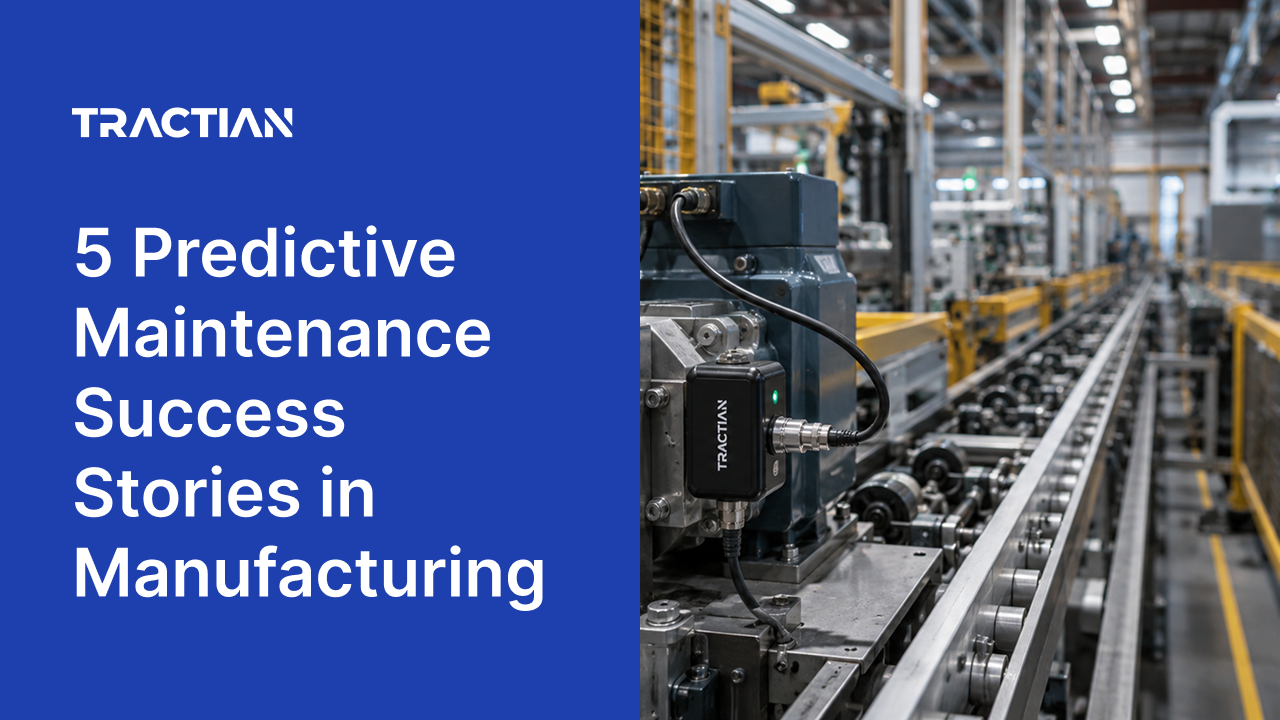
Key Points
- Predictive maintenance in manufacturing replaces "wait for it to break" with "fix it before it breaks." Instead of reacting to failures, teams use IoT sensors and AI to catch problems weeks early.
- Whirlpool saved over $1 million and reached 95% monitoring coverage on vibration points it used to track by hand.
- Ingredion avoided 168 hours of downtime and unlocked $1.0M in production savings at a single plant after AI flagged a defect on a backup-free pump.
- Sherwin-Williams prevented 564 hours of unplanned downtime and cut corrective work by 20% on its powder coating lines.
- Bosch cut recurring failures by 29% by layering its own AI on top of Tractian's real-time sensor data.
- Pirelli reached a 98% alert engagement rate and logged zero breakdowns on monitored exhaust systems after turning sensors into a reliability program that stuck.
- These predictive maintenance case studies span appliances, food, coatings, auto parts, and tires. Proof the same approach works across wildly different plants.
- The pattern is the same across every plant: the machines were already telling the team what was wrong. They just needed a way to listen.
The era of "run it until it breaks" is ending. For decades, maintenance meant firefighting. Waiting for a motor to seize, scrambling for a spare part that wasn't in stock, and eating the cost of a line that stopped without warning. It was expensive, stressful, and impossible to plan around.
Today, the best manufacturers operate differently. They pair IoT vibration and temperature sensors with AI-powered condition monitoring, and they catch failures while they're still small. That's the whole idea behind predictive maintenance in manufacturing: stop guessing, start knowing.
But strategy slides don't keep a line running. Results do. So we pulled the numbers from real Tractian customers. These customers are appliance makers, food producers, coatings plants, and global parts manufacturers, to show what predictive maintenance actually delivers on the floor.
How Predictive Maintenance in Manufacturing Works
The mechanics are simple. IoT sensors stream vibration, temperature, and other signals off your machines around the clock. AI compares those signals against known failure patterns and flags trouble early, often weeks before a breakdown. The team gets a prioritized alert, plans the repair, and avoids the failure entirely. That's predictive maintenance in manufacturing in a single sentence: catch it early, fix it on your terms.
The five predictive maintenance case studies below put that idea to work in wildly different settings. The pattern, you'll notice, never changes.
1. Whirlpool: $1M+ Saved by Breaking the Reactive Cycle
Whirlpool is one of the largest appliance manufacturers in the world. It also had a very common problem: a maintenance culture built around reacting to failures instead of preventing them.
With hundreds of vibration points to check manually, the team was always a step behind. Data was scattered. Work orders got prioritized on gut feel. And when a machine failed without warning, it didn't just stop production. It often caused expensive secondary damage that turned a small fix into a major repair.
What changed: Whirlpool installed Tractian condition monitoring sensors on its critical machines and pulled all that vibration and temperature data into one platform. For the first time, the team could see real machine health in real time, and rank work by actual failure risk instead of guesswork.
The results:
- $1M+ in avoided costs from preventing downtime and production losses
- 95% monitoring coverage on vibration points that were previously tracked by hand, if at all
- 85% insight validation rate, meaning the AI's alerts proved accurate the overwhelming majority of the time
The bigger win wasn't a single number. It was the mindset shift from chasing breakdowns to planning around them. That shift is what predictive maintenance in manufacturing is really about.
2. Ingredion: Catching a Failure on a Pump With No Backup
Ingredion's North Kansas City plant runs around the clock, with hundreds of machines. Many of them are hard to reach. Their traditional preventive maintenance routes had a blind spot: subtle, early-stage problems like slight misalignment or a bearing just starting to wear. By the time a technician noticed, the damage was often done.
They'd already lived the worst-case version of this. A critical pump failed with no spare on hand, and the plant lost three full days of production waiting for parts.
What changed: Ingredion rolled out Tractian's real-time condition monitoring with AI diagnostics. The defining moment came when the system flagged a looseness defect on a DSM pump. A machine with no backup and a history of causing multi-day outages. Because the alert came early, the team issued a work order and fixed it on their own schedule. No emergency. No shutdown.
The results at one plant:
- 168 hours of downtime avoided through early warnings
- $1.0M in production savings
- $223K in direct maintenance savings
As one of Ingredion's reliability engineers put it, there were issues they would never have noticed without the platform. A lubrication problem they could fix and then confirm was actually solved, right there in the data.
3. Sherwin-Williams: Trading Uncertainty for a Plannable Schedule
For Sherwin-Williams, the problem on its powder coating lines wasn't dramatic failures, It was unpredictability. Motors went down without warning. Maintenance was reactive. And without real-time data, it was nearly impossible to build a production schedule the team could trust.
What changed: Tractian sensors went on the key motors across the coating lines, giving the team continuous visibility into vibration spikes and temperature shifts. Suddenly there was hard evidence behind every decision. Decisions like which machine needed attention, and when. Maintenance got organized, strategic, and a lot less reactive.
The results:
- 564 hours of unplanned downtime prevented
- 20% reduction in corrective maintenance tasks
- $150,000+ in avoided production losses
Their engineer summed it up best: their equipment now talks to them. They can see a failure coming and act before it lands.
4. Bosch: 29% Fewer Recurring Failures With AI
A major Bosch facility had a data problem hiding inside a maintenance problem. With over 2,000 assets and more than 35,000 work orders a year, the team had mountains of maintenance history. But every bit of it was analyzed by hand. Work order descriptions were inconsistent and unstructured, so repeat failures were nearly impossible to spot. Prioritization came down to a generic "high, medium, or low," with no link to how critical an asset actually was. The result was a lot of reactive firefighting and very little visibility into what would break next.
What changed: Bosch built an internal AI tool, called mAIntenance, on top of Tractian's condition monitoring. Using natural language processing and the Levenshtein algorithm, it reads every work order description, finds recurring patterns, and flags failures that keep coming back. When the same failure shows up three times in 15 days, the system automatically generates a high-priority preventive work order. And with Tractian sensors feeding in real-time vibration and temperature data, the team could anticipate failures using both history and live machine health.
But the software was only half of it. Bosch also rebuilt its routines: weekly alignment meetings between engineering and maintenance to review AI-generated alerts, plus a dedicated group to validate each one and act fast. That's what turned a clever tool into a genuinely proactive operation.
The results:
- 29% reduction in recurring failures
- 17% increase in planned maintenance
- 100% of high-impact failures prioritized automatically by AI
As Bosch's senior maintenance planner put it, manual processes couldn't keep up with the workload. Now AI detects the failure patterns, sets the priorities, and helps the team make faster, more accurate decisions, with higher asset availability to show for it.
5. Pirelli: Turning Sensors Into a Reliability Program That Sticks
Pirelli runs a high-output tire plant with 2,800 people and a maintenance operation that has to keep pace with nonstop production. They'd already deployed Tractian condition monitoring sensors across their critical assets, so the technical foundation was in place. But here's a truth most vendors skip over: installing sensors and running a reliability program are two very different things.
The hard part is organizational. Getting a large maintenance team to trust new data, check alerts every day, and act on them takes deliberate effort. Asset records have to be complete enough for precise diagnostics. Sensors have to be positioned for an uninterrupted signal. And leadership needs visibility solid enough to base real decisions on.
What changed: Tractian didn't walk away at deployment. Weekly alignment meetings worked through the gaps methodically, and when remote diagnosis wasn't enough, the team came on-site. The hardware helped here too. Tractian's sensors run on 4G/LTE straight to dedicated receivers, with no Wi-Fi or IT infrastructure required, so a plant Pirelli's size got full coverage without the coordination headaches that usually stall a rollout.
Then came the human side. Tractian helped Pirelli define who owned what, trained the key platform users and gave them clear accountability, and built a factory-floor dashboard for always-on visibility. The team even showed up at Pirelli's internal maintenance events to present the program and drive adoption from the shop floor up.
The results:
- 98% alert check-in rate - technicians consistently acting on what the sensors flag
- 77 failures identified across the asset base
- Zero recorded breakdowns on monitored exhaust systems since deployment
The catches were real. A gearbox flagged a possible gear-wear signal; the team investigated, found an undetected oil leak, corrected it, and pulled preventive maintenance forward by a day, so everything was intact at inspection. As Pirelli's maintenance manager put it, without connectivity there's no reliability: assets only deliver consistent results when they're properly integrated and connected.
What this looks like at enterprise scale
Pirelli isn’t alone. Global manufacturers like Stellantis and Cummins run on Tractian too. And at that scale, disconnected spreadsheets and isolated plant data simply don't cut it. The challenge becomes standardizing reliability across dozens of sites and thousands of assets.
Scaling predictive maintenance in manufacturing across dozens of sites is exactly what Tractian's sensors are built for. Because they run on independent cellular connectivity, they don't need complex IT projects or plant Wi-Fi to get going, so a large facility can have visibility on day one. The platform benchmarks every machine against millions of historical machine-hours to deliver accurate, explainable diagnoses across the entire footprint.
Across our customer base, the platform delivers up to 7x ROI in the first year and reduces unplanned downtime by up to 43%. These are numbers we measure across the platform as a whole, not at any single plant. The individual predictive maintenance case studies above are how those platform-wide results get built, one early catch at a time.
The Bottom Line on Predictive Maintenance in Manufacturing
Predictive maintenance in manufacturing isn't a buzzword anymore. It's a measurable, repeatable advantage, and these five stories prove it across wildly different operations. Whether you're stamping out appliances, processing tomatoes, coating metal, or building precision parts, the story is the same.
Your equipment is already telling you what's wrong. Bearings hum differently before they fail. Motors run hot before they seize. Pumps shake before they quit. The signals are there. The only question is whether anyone, or anything, is listening.
The plants in these predictive maintenance case studies decided to listen. The numbers show what they got back.
Curious how these results would translate to your facility? Plug in your hourly downtime cost and asset count to see the potential impact of shifting to a predictive strategy, then talk to a Tractian specialist about what a rollout would look like on your floor.