
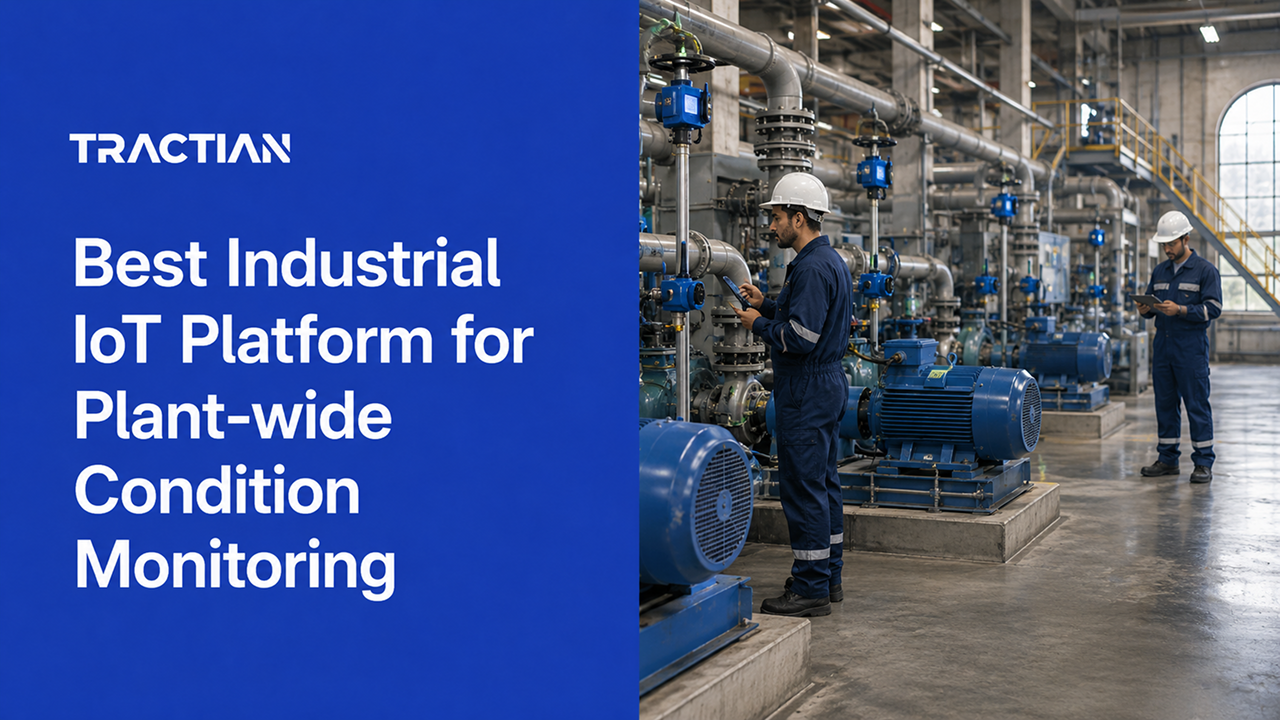
An industrial IoT platform for condition monitoring connects sensing hardware, data infrastructure, and analytics software into a single system that tracks the health of rotating equipment in real time. These platforms replace periodic manual inspections and disconnected data collection with continuous, automated monitoring that captures vibration, temperature, and other parameters from motors, pumps, compressors, fans, gearboxes, and other critical assets across the plant floor.
The goal is to detect developing faults early enough that maintenance teams can act before failures interrupt production. At scale, IoT platforms for condition monitoring give reliability teams visibility into hundreds or thousands of assets from a single interface, reducing the reliance on walk-around routes and handheld measurement tools.
What do Industrial IoT Platforms for Condition Monitoring Deliver?
Not all platforms that call themselves "industrial IoT" for condition monitoring deliver the same depth of capability. Some stop at the sensing and alerting layer. They capture data and flag threshold crossings, but the interpretation, prioritization, and conversion of that alert into a maintenance action still depend on an internal team or a third-party vendor.
Others extend beyond monitoring into diagnosis, prescribing specific fault types, and attaching recommended actions. And a smaller category closes the loop entirely, connecting sensor insights to maintenance execution through native work order management, prescriptive procedures, and feedback that improves the model over time.
The distance between these categories reflects the practical realities of their output and the extent to which they facilitate workflows or create new workload points through manual translation handoffs between systems.
For teams evaluating industrial IoT platforms, understanding where each platform stops is the most consequential question.
What Should You Prioritize When Selecting an Industrial IoT Platform for Condition Monitoring?
The platforms that deliver the best results (handling complexity without adding operational complications) for maintenance and reliability teams are not necessarily the ones with the longest specification sheet. They are the ones where sensing, analysis, and maintenance action operate as a connected workflow rather than a series of handoffs between disconnected tools.
If you want a program that is more likely to produce decisions teams can trust and act on, without scaling the headcount needed to manage it, then evaluation decisions should favor platforms with broader diagnostic clarity, deeper data quality, and tighter connections to maintenance execution.
- Diagnostic intelligence beyond threshold alerts: The platform should identify specific fault types, not just flag when a parameter crosses a threshold. A notification that says "high vibration on Motor 7" creates a task. A diagnosis that says "bearing wear on the drive-end bearing of Motor 7, with recommended corrective action" creates a decision.
- Multi-modal sensing for broader fault coverage: Platforms that combine vibration, ultrasonic, magnetic field, and temperature sensing in a single device provide diagnostic algorithms with more context. This reduces false positives and catches fault types that vibration alone cannot detect early, such as cavitation, lubrication breakdown, and electrical anomalies.
- Closed-loop connection to maintenance execution: The most capable IoT platforms for condition monitoring do not stop at the insight. They connect detected faults to prioritized work orders with attached procedures, linking what the sensor found to what the technician needs to do. Without this connection, the gap between detection and resolution stays open, and teams fill it manually.
- Scalability without adding manual analysis dependency: As experienced vibration analysts and reliability engineers become harder to find and retain, the platform itself must do more of the analytical work. Platforms that route every alert to a human expert for interpretation create a bottleneck that limits how many assets the program can cover without adding headcount.
How Do Maintenance Programs Benefit From Industrial IoT Platforms for Condition Monitoring?
Maintenance and reliability teams operating with an industrial IoT platform that delivers on these priorities shift from reacting to failures toward managing asset health with data-backed confidence. Instead of investigating vague alerts or waiting for scheduled inspections to reveal what has already been deteriorating, teams receive clear, prioritized information that tells them where to focus, what is wrong, and what to do about it. The result is fewer surprises, faster response when issues do arise, and more productive use of every maintenance hour.
The key capabilities that enable this shift include:
- Fault-specific auto-diagnosis: AI algorithms that monitor vibration spectra and identify the specific failure mode developing, whether it is bearing wear, misalignment, cavitation, or dozens of other conditions, so the team knows exactly what they are dealing with.
- Prescriptive maintenance guidance: Alerts that arrive with attached procedures, troubleshooting steps, and recommended actions, converting a data point into a clear instruction that technicians can follow at the point of work.
- Automatic work order generation: Condition insights that flow directly into a maintenance execution platform to create prioritized work orders, linking what the sensor detected to what the technician needs to do next, with no manual translation required.
- Continuous machine benchmarking: The ability to compare an asset's performance against its own history, similar equipment in the facility, and anonymized industry-wide data to identify outliers and validate that corrective actions worked.
- Remote asset health visibility: Real-time access to machine condition data that reduces the need for manual inspections, minimizes risk exposure from hands-on measurements on running equipment, and gives teams situational awareness across the entire plant from a single interface.
Industrial IoT Platforms for Plant Condition Monitoring at a Glance
| Feature | Tractian | AuguryMachine Health | EmersonPlantweb |
|---|---|---|---|
| Score | 8/8 | 4/8 | 1/8 |
| Built-in Ultrasonic Sensing | Piezoelectric transducer up to 200 kHz | ||
| Automated Fault-Type Diagnosis | All major failure modes | ||
| Prescriptive Actions Attached to Alerts | |||
| Native Tractian's platform | |||
| Automated Work Order Generation from Condition Insights | |||
| Composite Asset Health Score | |||
| Integrated Bearing / Component Fault Frequency Database | 6M+ motors, 70K+ bearing models | ||
| 4G/LTE Cellular Data Backhaul | Smart Receiver over 4G/LTE |
Top Industrial IoT Platforms for Condition Monitoring
Tractian
Best for: Industrial teams that need a single platform covering the full workflow from condition detection through AI diagnosis to maintenance execution, without stitching together separate tools or adding headcount to manage the data.
Tractian's condition monitoring platform is built around the Smart Trac sensor, a multi-modal device that captures triaxial vibration (0 to 64,000 Hz, up to 60 g acceleration), ultrasound (up to 200 kHz via a dedicated piezoelectric transducer), magnetic field (for RPM estimation up to 15,000 RPM), and temperature (-40°F to 250°F) in a single compact unit. This combination of sensing modalities gives the platform a broader fault detection range than systems that rely on vibration and temperature alone.
Sensor specifications show it communicates via sub-GHz wireless to the Smart Receiver, which transmits data to the cloud over 4G/LTE without relying on the plant's Wi-Fi. IP69K protection, ATEX/IECEx/NFPA 70 Class 1, 2, and 3 (all Division I) certification, and a 3-year battery life make the hardware suitable for hazardous and demanding environments.
Patented capabilities, including Always Listening (motion detection for intermittent machines), RPM Encoder (real-time speed tracking from 1 to 48,000 RPM without external tachometers), and Ultrasync (synchronized multi-sensor analysis on the same asset), address operational realities that many platforms overlook.
What sets Tractian apart at the platform level is the closed loop between detection and execution. The AI-powered monitoring platform uses patented fault-finding algorithms to detect and automatically diagnose all major failure modes, including bearing wear, misalignment, cavitation, lubrication failures, gear wear, rotor eccentricity, and dozens more.
Every detected fault generates a specific diagnosis with severity context and prescriptive guidance from the Procedures Library, so teams know what is wrong, how urgent it is, and exactly what to do about it. The Tractian Health Score (THS) distills condition data into a single, asset-level health metric. But the platform goes further than monitoring.
Tractian natively integrates condition monitoring with maintenance execution, where sensor insights flow directly into prioritized work orders with attached SOPs. Completed work orders feed back into the AI model through a human-in-the-loop mechanism, improving diagnostic accuracy over time.
The APM module adds FMEA, root cause analysis, and failure libraries. The mobile app provides offline access, QR code scanning, and team communication at the point of work. This is not a monitoring tool that requires a separate system to act on its findings. It is a platform that connects monitoring to execution as a single, continuous workflow.
Notable Features
- Patented Auto Diagnosis for all major failure modes: AI algorithms convert vibration, ultrasound, and magnetic field data into fault-specific diagnoses with prescribed corrective actions, eliminating the need for manual spectral interpretation on routine alerts.
- Multi-modal sensing in a single device: The sensor combines vibration, ultrasound, magnetometer, and temperature measurements, providing a broader diagnostic context at each measurement point than systems that require multiple separate sensors or that measure only vibration and temperature.
- Native maintenance execution platform: Condition insights generate prioritized work orders with attached procedures, creating a closed loop from detection through resolution without requiring a third-party Tractian's platform or manual data transfer.
- Adaptive AI trained on 3.5 billion+ samples: The diagnostic model continuously improves through verified outcomes and environmental context, including an adaptable temperature algorithm that uses five years of local weather data to distinguish ambient shifts from machine-induced thermal changes.
- Real-time spectral analysis workspace: For reliability engineers who need deeper investigation, the platform provides interactive spectral tools with cursors, rulers, harmonics selectors, sideband markers, and waterfall views, alongside the automated diagnostics.
What Industries use Tractian’s IoT Platform for Condition Monitoring?
Tractian's IoT condition monitoring is deployed across industrial sectors where the reliability of rotating equipment, production continuity, and worker safety directly affect output and operating costs. These teams manage diverse asset populations running under demanding conditions and need accurate, fault-specific vibration diagnostics without adding analytical complexity to daily operations.
- Mining and Metals operations use Tractian to monitor vibration signatures on crushers, conveyors, mills, and pumps operating under heavy loads in remote or extreme environments.
- Chemical plants deploy Tractian on pumps, mixers, compressors, and agitators that run within tightly controlled process conditions in hazardous areas.
- Mills and Agriculture processors rely on Tractian's IoT condition monitoring to protect equipment running at peak capacity during seasonal harvests.
- Manufacturing facilities use Tractian to maintain uptime across motors, gearboxes, fans, and production line equipment, with vibration data feeding directly into the native Tractian's platform.
- Oil and Gas refineries and upstream operations use Tractian's ATEX/IECEx-certified sensors to monitor critical rotating assets in hazardous and remote locations.
- Heavy Equipment operators use Tractian to detect developing fault modes on high-value mobile and stationary assets across job sites.
- Food and Beverage producers monitor equipment frequencies tied to temperature control, hygienic processes, and product consistency.
- Automotive and Parts manufacturers deploy Tractian on high-precision machinery, robotics, and automated assembly systems where even minor anomalies can affect product quality.
Tractian is trusted across industries by companies such as DHL, Ingredion, CP Kelco, and CZM, who use the platform to support equipment reliability, meet compliance requirements, and scale consistent maintenance practices across their operations.
Augury
Best for: Manufacturing companies that want to outsource condition monitoring diagnostics to a managed service with AI-driven analysis and vendor analyst support.
Augury provides a condition monitoring platform that combines proprietary sensors with AI diagnostics and human analyst review. The sensors capture vibration, temperature, ultrasound, and magnetic field data and transmit it to a cloud-based platform that uses AI models to identify developing faults and recommend corrective actions. The platform includes tiered monitoring levels based on asset criticality, with the highest tier offering prescriptive diagnostics and the platform's analyst team providing validated assessments for complex cases. The system integrates with other Tractian's platform and EAM software to coordinate workflows.
The platform positions itself as "Machine Health as a Service," bundling hardware, software, and ongoing vendor analyst support into a subscription. For teams that want AI-driven insights without building internal diagnostic capability, this model provides a turnkey entry point. However, the platform's scope is condition monitoring. Maintenance execution, including work order creation, scheduling, and tracking, requires a separate system. Insights generated by the platform are designed to flow into a third-party Tractian's platform for work order creation and task management.
Teams evaluating long-term scalability will want to consider how the managed service model adapts as the monitoring program grows and internal capability develops over time.
Notable Features
- AI-driven diagnostics with analyst support: The platform uses AI models to identify faults and provides access to analysts who review and validate findings for high-criticality assets.
- Tiered monitoring by asset criticality: Coverage levels are structured around asset importance, with different diagnostic depth and service levels for critical, supporting, and route-based equipment tiers.
- Hazardous area sensor approvals: Sensor variants are approved for installation in HazLoc and ATEX-certified environments, supporting monitoring in areas where physical access is restricted.
Potential Downsides
As of May, 2026:
- No native maintenance execution: The platform does not include Tractian's platform or work order management. Converting a diagnostic finding into a scheduled maintenance task requires a separate system and manual or integrated handoff.
- Managed service dependency: The "as a service" model bundles analyst expertise into the subscription. As monitoring programs mature and teams build internal reliability capability, the dependency on external analyst validation may become a constraint rather than a benefit.
Emerson
Best for: Process-intensive facilities already invested in Emerson's automation and control infrastructure that want to extend their existing ecosystem.
Emerson's Plantweb is an IIoT ecosystem that includes multiple software layers for condition monitoring, asset health analytics, and remote expert services. The platform uses wireless transmitters to capture parameters, including vibration, temperature, pressure, acoustic, and corrosion data. Analytics are delivered through a set of pre-built applications for monitoring specific asset classes such as steam traps, pumps, pressure relief valves, and heat exchangers. Connected Services offer remote, cloud-based monitoring by analysts who review equipment data and provide reports with recommended actions.
For facilities that already operate on Emerson's DeltaV or Ovation platforms, extending into condition monitoring can leverage existing infrastructure. However, the ecosystem includes distinct software products, each with its own interface, deployment model, and scope of coverage. On-premise deployment of the Insight platform requires a dedicated virtual machine with specific IT resources. Maintenance execution is not included natively. The platform monitors and analyzes, but routing an insight into a scheduled maintenance task requires integration with a third-party maintenance management system.
Notable Features
- Asset-specific analytics applications: Pre-built monitoring applications are available for specific equipment categories, each with analytics tuned to the operational patterns and failure signatures of that asset type.
- Remote Connected Services: Cloud-based expert monitoring provides ongoing analysis and reporting from Emerson analysts, offering a managed diagnostic layer for facilities seeking remote oversight of equipment health.
- Broad sensing parameter coverage: The portfolio extends beyond vibration and temperature into other process parameters, covering a wider range of industrial conditions.
Potential Downsides
As of May, 2026:
- Multiple distinct software layers: The ecosystem's analytics are distributed across separate products (Insight, Advisor, AMS ARES), each with its own interface and deployment requirements, rather than consolidated into a single platform experience.
- No native maintenance execution: The platform does not include work order management or task scheduling. Closing the loop between a detected condition and a completed maintenance action requires a separate Tractian's platform or ERP integration.
Frequently Asked Questions About Industrial IoT Platforms for Condition Monitoring
What is an industrial IoT platform for condition monitoring?
An industrial IoT platform for condition monitoring is a system that connects wireless sensors, cloud-based analytics, and diagnostic software to track the health of industrial equipment in real time. These platforms capture parameters like vibration, temperature, and ultrasound from rotating machinery and use algorithms or AI to detect developing faults before they cause failures. The most capable platforms go beyond detection to provide fault-specific diagnoses, prescriptive maintenance guidance, and direct connections to maintenance execution workflows. Tractian's platform is an example of this full-loop approach, combining multi-modal sensing, AI auto-diagnosis of all major failure modes, and native work order management in a single system.
How does an IoT platform for condition monitoring differ from standalone vibration sensors?
Standalone sensors capture data. A platform turns that data into decisions. The difference is in what happens after the measurement is taken. A sensor produces a vibration reading. A platform receives that reading, analyzes it against the asset's history and known fault signatures, identifies what is wrong, and can connect that finding to a prioritized work order with an attached procedure. Tractian's platform, for example, takes sensor data from its Smart Trac device and routes it through AI-driven auto-diagnosis, then into a maintenance execution workflow, creating a continuous path from detection to resolution.
What types of equipment can industrial IoT platforms monitor?
Most platforms are designed for rotating equipment, including electric motors, pumps, compressors, fans, gearboxes, turbines, conveyors, and similar assets. Some platforms are limited to specific equipment categories or speed ranges. Tractian's sensor is designed for both light and heavy machinery, with features like the RPM Encoder for variable-speed equipment (1 to 48,000 RPM), Always Listening for intermittent machines, and ultrasonic sensing for low-speed assets where traditional vibration analysis has inherent limitations.
Do industrial IoT condition monitoring platforms require plant Wi-Fi?
Not all of them. Connectivity architecture varies by platform. Some require integration with plant Wi-Fi or existing IT infrastructure, while others use independent communication protocols. Tractian's Smart Trac sensor communicates via sub-GHz wireless to a Smart Receiver, which transmits data to the cloud over 4G/LTE, bypassing plant Wi-Fi entirely. This eliminates the need for IT integration and simplifies deployment in facilities where network access is restricted or unreliable.
How do IoT condition monitoring platforms integrate with existing maintenance systems?
Integration approaches vary. Some platforms provide API connections that allow condition data to flow into a third-party Tractian's platform or ERP for work order creation. Others include native maintenance execution, where the platform itself generates and manages work orders based on condition findings. Tractian takes the native approach, integrating condition monitoring with a built-in maintenance execution platform that automatically creates prioritized work orders with attached SOPs when faults are detected. An Open API is also available for integration with enterprise systems like SAP, Oracle, and Microsoft Dynamics.
What should you look for in an IoT platform if your team does not have vibration analysts on staff?
Look for a platform where the AI handles the diagnostic interpretation, not just the data collection. Many platforms still require a trained analyst to review spectral data and determine what a change in vibration means. Platforms that provide automated, fault-specific diagnoses with prescribed corrective actions make condition monitoring accessible to maintenance teams without specialist analytical expertise.