
Key Points
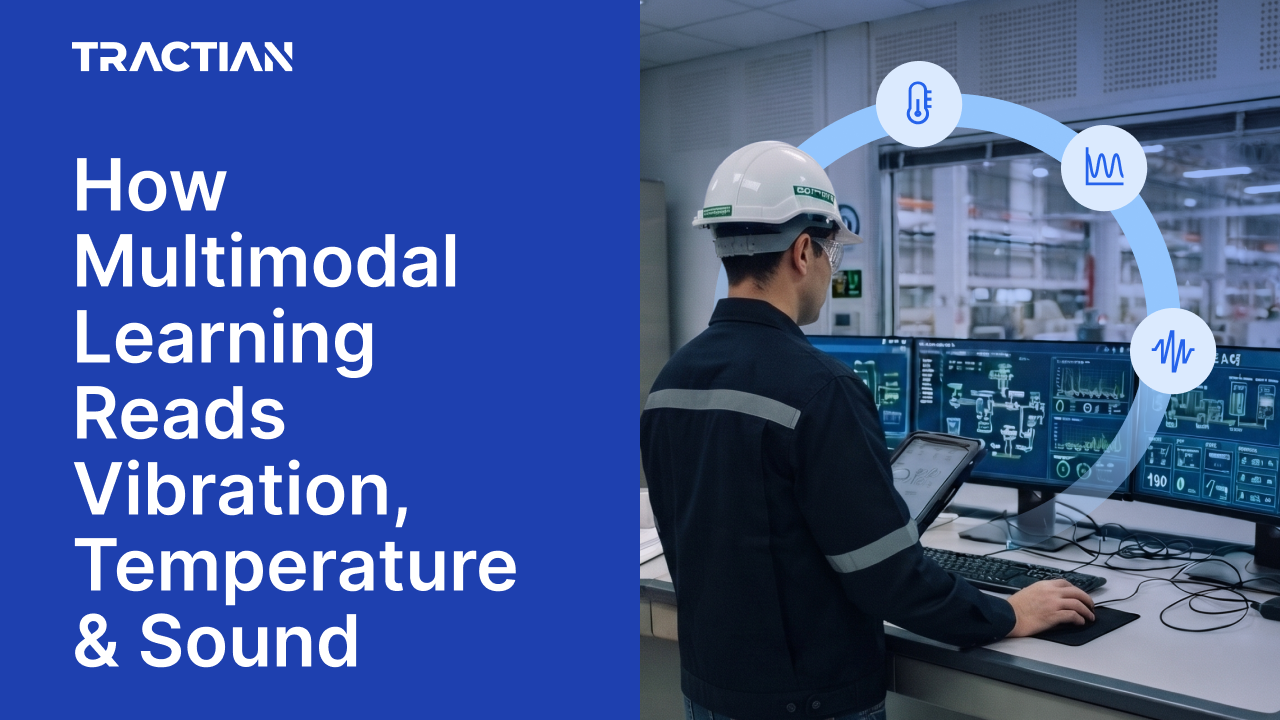
- Multimodal learning combines several data streams at once so a model can understand a situation that no single sensor could explain on its own.
- On the plant floor, the three signals that carry the most meaning are vibration, temperature, and sound. Each one tells a different part of the story.
- Vibration is the earliest and most precise indicator of mechanical health. Temperature confirms energy loss but arrives late. Sound adds context about the surrounding environment without a direct line of sight.
- Alone, every one of these signals has a blind spot. Sensor fusion combines them and turns a vague "something is off" into a specific diagnosis with a failure timeline.
- This is the foundation of modern predictive maintenance, and it is exactly how Tractian reads the health of your equipment.
What Multimodal Learning Actually Is
Multimodal learning is a branch of machine learning built to process and connect information from more than one type of data, or modality. The point is not just to collect more data. The point is to let one signal explain another.
It got here in stages. Early AI was unimodal. A language model only read text. A vision model only saw images. They lived in separate silos. Later, models learned to pair audio with video, which gave us automated captioning and content moderation. Then models learned to bridge text and images, so you could show a system a photo and ask it a question in plain language.
All of that is powerful, and all of it is disembodied. Those models read representations of the world, not the world itself. The moment you bolt a sensor onto a motor, a pump, or a gearbox, you need something different. You need a model that reads physics. That is where multimodal learning leaves the screen and walks onto the shop floor.
The Plant Floor Does Not Speak in Text
When most people picture artificial intelligence, they picture words and pictures. Large language models reading the internet. Vision models spotting a stop sign or a defect on a line. That makes sense. We are visual, verbal creatures, so we built our first machines in our own image.
But a failing bearing does not type a warning. A motor heading toward seizure does not post about it. The physical world communicates in forces: the hum of a shaft, the heat of friction, the acoustic signature of a fan moving air. To understand a machine, a model has to sense those forces directly, the same way a 20 year veteran reliability engineer reads a pump by touching the casing, listening to the housing, and watching the trend.
That is the job of multimodal learning. By combining vibration, temperature, and sound, you give an AI system a complete physical fingerprint of the asset. Combine those signals through sensor fusion and you have the engine behind modern predictive maintenance. This is what each of those three signals tells a multimodal learning model, and why their combination is the difference between catching a failure weeks out and walking up to a machine that has already stopped.
Sound: the Acoustic Signature
Sound is the most familiar of the three, but outside of speech recognition it is still a largely untapped resource. In the physical world, sound is airborne energy. It tells a model what is happening around an asset without needing to see it.
Microphones capture sound as a raw waveform, a continuous time series of air pressure changes. Models rarely read that waveform straight. They convert it into a spectrogram, which turns sound into a picture that shows how its frequencies shift over time. That trick matters, because it lets engineers point proven vision architectures, like convolutional neural networks, at audio and have them look for patterns.
Here is what sound tells the model. Every healthy machine has a baseline acoustic signature. When a fan blade warps or a belt starts to fray, the frequency of the sound changes. A model trained on the sound of a healthy machine flags the shrill whine of a developing fault long before a technician on a walkdown would catch it. Ultrasonic sound goes a step further and detects friction, early stage wear, and cavitation that other signals miss in their earliest stages.
Sound has one real weakness. It travels through air, which means it picks up everything else in the air with it. In a plant running a hundred machines, isolating the one failing motor from the noise of every other asset, a forklift, and a washdown crew is genuinely hard. Sound cannot work alone.
Vibration: The Pulse of the Machine
If sound is what a machine sounds like, vibration is what it feels like from the inside. Vibration is structure borne. It is captured by an accelerometer mounted directly on the asset, measuring acceleration across the X, Y, and Z axes. Because the sensor is physically coupled to the metal, vibration data is local and largely immune to the background noise that swamps audio.
Like sound, vibration arrives as a time series, and like sound it is usually converted to the frequency domain using a Fast Fourier Transform. The FFT is what makes vibration so diagnostic. It does not just show that a machine is shaking more than usual. It shows exactly which frequencies are doing the shaking, and those frequencies map to specific faults. A peak at 1x running speed points to unbalance. High peaks at 2x or 3x point to misalignment. Specific defect frequencies and a rising high frequency noise floor point to bearing wear. Tractian's Smart Trac captures triaxial vibration from 0 to 64,000 Hz, which is wide enough to see a bearing cage failure or a gear tooth chip that can develop in minutes. That frequency detail is what makes vibration the backbone of any serious predictive maintenance program.
This is why vibration is the truth teller of mechanical health. A machine can sound fine to the human ear while an accelerometer reads the micro vibrations of a misaligned shaft, a cracked gear tooth, or a roller bearing on its way out. Friction shows up here first, months before failure, as a slow climb in those telltale frequencies. That window is the entire advantage of predictive maintenance.
Vibration has its own limit. It tells you that a physical problem is happening and exactly where, but it does not always tell you the full why or the immediate impact. It is deeply local. It needs context.
Temperature: The Thermal Blueprint
Temperature is the byproduct of work. A motor running, a brake stopping a wheel, a bearing grinding against friction, all of it turns energy into heat. That makes temperature a clean read on efficiency. When something runs hotter than it should, energy is being wasted, and waste usually means a problem.
Temperature reaches a model two ways. The first is a single stream of numbers from a contact probe, like the internal temperature of a motor. The second is a thermal image, a heat map where every pixel is a temperature value, processed much like a standard image. A rising trend on a motor or a hot spot on a panel both signal that a component is overworking or a cooling path has failed.
Temperature has a stubborn flaw, and it is the one every reliability team learns the hard way. It is a lagging indicator. By the time a bearing is hot enough to trip a thermal alarm, the damage is already done. On top of that, ambient conditions skew the reading. A cold draft from an open dock door, direct sun on a sensor housing, or a hot afternoon can all look like a fault that is not there. Tractian's adaptive temperature algorithm draws on five years of local weather data to separate an ambient swing from a machine actually telling you it is in trouble. That is the kind of context a raw thermometer cannot supply on its own.
Sensor Fusion: Where the Diagnosis Happens
Individually, sound, vibration, and temperature each have a sharp strength and a real blind spot. The power of multimodal learning is sensor fusion, the practice of feeding these separate streams into one model so it can read them against each other. That is the jump from detection to diagnosis.
Picture a critical pump motor on a production line.
With temperature alone, the bearing reads eight degrees hotter than normal. The model flags it. But why? A failing bearing, or just a hot afternoon and sun on the housing? On its own, it cannot say.
With sound alone, a microphone picks up a low frequency rumble. The model flags it. But is that the motor, or a forklift passing twenty feet away? On its own, it cannot say.
With all three together, the picture resolves. At 2:00 the model notes a low frequency acoustic change. At the same moment, vibration shows a rising peak at 2x running speed, the classic misalignment signature, alongside climbing high frequency energy that reads as early bearing wear. Ten minutes later, that same bearing starts to run hot. Because the model sees the sequence and the correlation, the sound marking a change, the vibration pinpointing the mechanical fault, the temperature confirming the energy loss, it does not stop at "anomaly." It produces a diagnosis: coupling misalignment with early bearing wear on the pump motor, with a recommended repair window. Plan it on your terms instead of reacting to a 2:00 breakdown.
There are two common ways to combine the streams. Early fusion merges the raw data from all three sensors at the start and lets one network find patterns across everything at once. It is powerful and computationally heavy. Late fusion gives each modality its own network, lets each make a call, and hands those calls to a final model that makes the decision. Late fusion is often more resilient, because if the microphone fails, vibration and temperature still carry the diagnosis. Tractian's AutoDiagnosis™ engine is the production version of sensor fusion for predictive maintenance: it converts multi sensor data into a fault type, a severity rating, a root cause, and a repair recommendation, then drops the work order straight into the platform.
Why Physical Multimodal Learning is Hard
Training a model on vibration, temperature, and sound is far harder than training one on internet text, for reasons that are specific to the physical world.
Time synchronization is the first. Text and images sit still. Sensor data never stops. If the microphone and the accelerometer drift out of sync by a few milliseconds, the model cannot line up the sound of a crack with the vibration of the impact, and the correlation that makes sensor fusion valuable falls apart. Synchronized capture across every sensor on an asset is not a nice to have. It is the whole game.
The scarcity of failure data is the second. To teach a model what a failing machine looks like, you have to show it failing machines. The problem is that well run equipment does not fail often, so clean, labeled datasets of real breakdowns with synchronized sound, vibration, and temperature are rare and expensive to gather. This is where scale becomes a moat. Tractian's models learn from more than 3.5 billion samples collected across hundreds of thousands of assets worldwide, which is what lets the AI tell a real fault from normal variation without flooding a team with false alarms.
Hardware constraints are the third. These models often have to run at the edge, on small devices mounted on the machine itself, where battery life and processing power are limited. The model has to be lean enough to run for years on a single install while still being sharp enough to catch a fault that develops in minutes.
The Era of Perceptive Machines
For a long time we kept artificial intelligence behind a screen, fed on a careful diet of text and images. That gave us capable chatbots and impressive image generators, and it kept AI blind to the physics of the world it was meant to operate in.
Vibration, temperature, and sound change that. Together, through multimodal learning, they let a machine listen to its surroundings, feel the strain in its own mechanics, and measure the heat of wasted energy. For a maintenance team, that is not an abstraction. It is the difference between walking the floor with a clipboard and a screwdriver to your ear, and giving every motor, pump, and gearbox a voice that tells you what is wrong, how bad it is, and how long you have to fix it.
Catch it early. Fix it on your terms. That is what sensor fusion and multimodal learning deliver, and it is what predictive maintenance was built to do.