
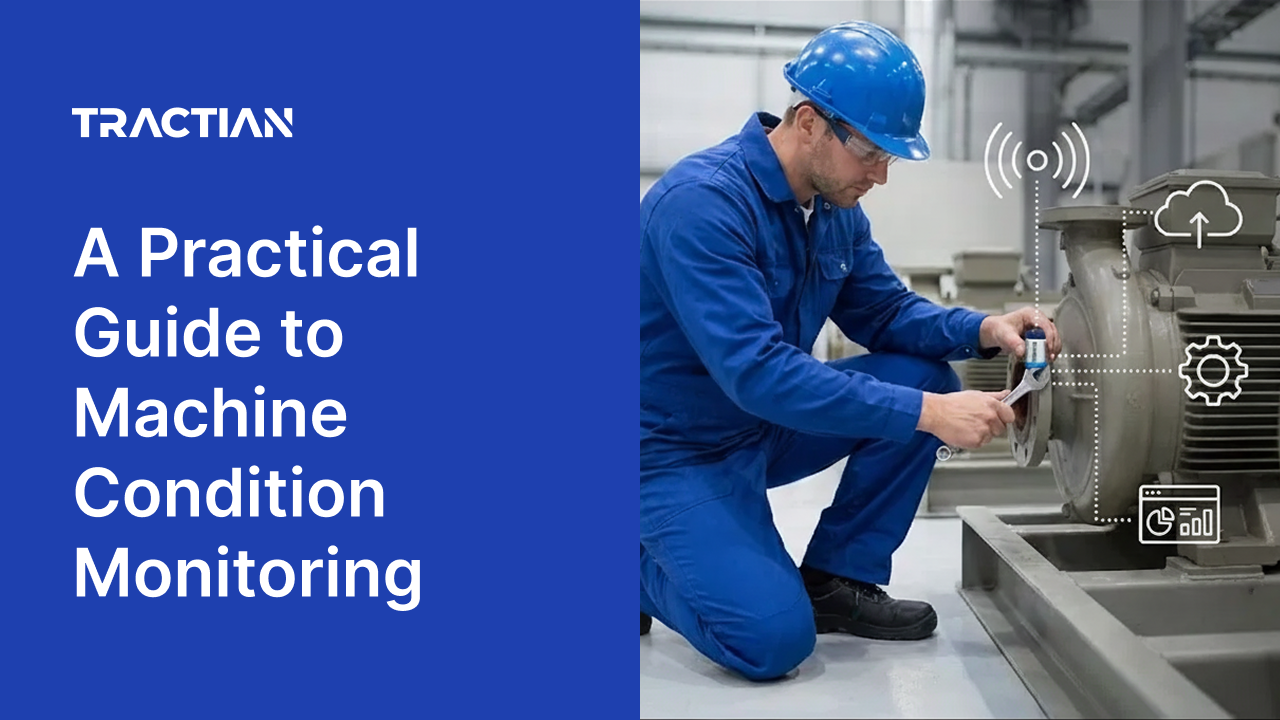
Machine condition monitoring software is the technology layer that transforms raw equipment data into actionable maintenance intelligence. It continuously tracks operational parameters from industrial machinery, analyzes patterns against known failure signatures, and delivers insights that enable maintenance teams to act before problems escalate.
In industrial manufacturing environments, this software serves as the interpretation engine that makes sensor investments meaningful, converting vibration readings, temperature fluctuations, and operational data into specific diagnoses, health assessments, and recommended actions.
The software component is what determines whether condition-based maintenance delivers results or remains an isolated, but expensive, pile of data. Sensors capture signals. Software determines what those signals mean. Without effective analysis and workflow integration, organizations accumulate dashboards full of numbers that never influence how maintenance gets scheduled or executed.
Advanced machine condition monitoring software closes that gap by identifying specific failure modes, tracking degradation trends, and connecting insights directly to the maintenance management systems where work gets planned and assigned.
Key Points
- Machine condition monitoring software provides the intelligence layer that converts sensor data into specific failure-mode diagnoses, health scores, and prescriptive recommendations, rather than generic threshold alerts.
- Effective systems integrate directly with maintenance workflows, ensuring that insights trigger coordinated action through automatic work order generation and mobile field access.
- AI-powered diagnostics reduce reliance on specialist interpretation, enabling maintenance generalists to understand equipment condition and respond appropriately without vibration analysis expertise.
How Does Machine Condition Monitoring Software Help Your Business?
Machine condition monitoring software shifts a team's function from reactive maintenance to an informed, condition-driven preventive maintenance operation responding to what's actually happening inside equipment. The software closes those gaps by identifying emerging issues while keeping intervention options flexible and costs low.
Key business outcomes include:
- Reduced unplanned downtime through early detection of degradation patterns that indicate developing faults weeks or months before functional failure
- Lower maintenance costs by eliminating unnecessary preventive tasks on healthy equipment while catching issues before they require extensive repair
- Extended equipment lifespan through condition-based intervention that addresses wear before it causes secondary damage to adjacent components
- Improved technician productivity by directing attention toward assets that actually need it, rather than spreading effort across blanket inspection routes
- Better maintenance planning through advanced warning that allows work to be scheduled around production demands, rather than interrupting operations with emergency response
The cumulative effect is a maintenance program that spends less time reacting to surprises and more time executing planned work. Teams gain the ability to answer questions that traditional approaches can't address: Which assets need attention now? Which ones can safely wait? What specific problem is developing, and what should we do about it?
What Are the Features of Advanced Machine Condition Monitoring Software?
Advanced machine condition monitoring software is defined by its ability to collect meaningful data, interpret it accurately, and connect insights to action. A system that captures data but leaves interpretation to already-stretched teams provides limited value. The features below distinguish platforms that deliver operational impact from those that simply generate dashboards.
Core features include:
- Real-Time Data Acquisition: Continuous collection of vibration, temperature, runtime, and rotational speed from sensors mounted on equipment, with sampling frequencies high enough to detect early-stage degradation patterns.
- AI-Powered Failure Diagnostics: Automatic identification of specific failure modes through pattern recognition algorithms trained on extensive datasets. This includes bearing wear, misalignment, imbalance, looseness, lubrication issues, cavitation, and gear defects.
- Health Scoring: Aggregated condition indicators that combine multiple parameters into actionable metrics, enabling teams to prioritize assets based on actual condition rather than assumptions.
- Prescriptive Alerts: Notifications that include not just what's wrong and how severe it is, but specific recommended actions and validated procedures for addressing the identified issue.
- Trend Analysis: Tracking of degradation patterns over time to identify developing issues before they trigger threshold-based alarms, supporting intervention at optimal points in the failure progression.
- Spectral Analysis Tools: Frequency-domain diagnostics that enable deeper investigation of vibration signatures for complex fault identification and root cause analysis.
- Tractian's platform Integration: Direct connection to maintenance management systems for automatic work order generation, ensuring insights flow into execution workflows without manual handoff.
- Mobile Accessibility: Field access to condition data, alerts, diagnostic details, and work orders from anywhere in the plant, including areas with limited connectivity.
What Makes Machine Condition Monitoring Software Effective?
Software that truly improves maintenance outcomes, rather than just producing overlooked dashboards, is distinguished by its ability to fully support the entire process from data acquisition to decisive action. The sustained operational value of a system hinges on several key qualities that facilitate this data-to-action path.
Diagnostic accuracy matters because generic alerts raise more questions than they answer. When software identifies "high vibration" without specifying whether the cause is bearing wear, misalignment, or looseness, it shifts the interpretation burden to maintenance teams who may lack specialized analysis skills. Effective systems diagnose specific failure modes so technicians know what they're dealing with before they approach the asset.
Prescriptive guidance extends diagnostic value into actionable direction. Knowing that a motor has a developing bearing fault is useful. Knowing which inspection steps to perform, which replacement parts to stage, and which procedures to follow makes that knowledge actionable. Systems that include validated procedures with each alert reduce the expertise required to respond effectively.
Workflow integration determines whether insights reach the people who can act on them. Condition monitoring software that operates independently of maintenance management creates a handoff gap, where alerts may be seen but never converted into scheduled work. Native integration with Tractian's platform ensures that detected issues flow directly into planning and execution workflows.
Adaptability to real-world conditions distinguishes laboratory performance from plant-floor reliability. Equipment operates under varying loads, speeds, and environmental conditions. Effective software automatically adjusts analysis for these variations, preventing false positives when operating conditions shift. This includes handling variable-speed equipment, intermittent machines, and seasonal temperature changes.
Ease of adoption influences whether software gets used consistently. Complex interfaces that require vibration analysis expertise limit adoption to specialists. Effective systems present condition information in formats that maintenance generalists can interpret and act on, expanding who can participate in condition-based decision making.
4 Steps to Get ROI from Machine Condition Monitoring Software
Capturing value from machine condition monitoring software requires more than installation. It requires connecting the technology to how maintenance actually gets planned and executed.
Step One: Establish Baseline Metrics
Document the current state before implementation. This includes the frequency of unplanned downtime, emergency repair costs, mean time to repair (MTTR), and preventive maintenance compliance rates. These baselines provide the comparison points needed to quantify improvement and demonstrate value to stakeholders evaluating the investment.
Step Two: Deploy on High-Consequence Assets First
Start with equipment where failure carries significant production, safety, or cost consequences. Critical assets provide the clearest ROI demonstration because preventing failures delivers measurable savings. Early wins on high-value equipment build organizational confidence and provide case studies for expanding coverage.
Step Three: Integrate with Maintenance Workflows
Connect condition monitoring software to Tractian's platform so that detected issues automatically generate work orders and feed into scheduling processes. This integration eliminates the gap between insight and action that undermines many monitoring programs. When an alert appears, it should already be queued for planning rather than waiting for someone to manually transfer information between systems.
Step Four: Track Outcomes and Refine
Monitor key metrics over time: prevented failures, reduced downtime, avoided repair costs, and improved MTTR. Use this data to demonstrate ongoing value and identify opportunities to expand coverage or adjust alert thresholds. The feedback loop between detected issues, completed repairs, and confirmed diagnoses also improves system accuracy over time.
The path from deployment to demonstrated ROI is shorter when these steps are followed deliberately. Organizations that skip baseline documentation struggle to prove value. Those that deploy broadly without workflow integration generate alerts that don't convert to action.
What Should I Look for in Advanced Machine Condition Monitoring Software Technology?
Selecting condition monitoring software requires evaluating how well a platform supports the complete journey from sensor data to completed maintenance action. Here are the key capabilities to prioritize:
Native Tractian's platform Integration
The most important question is whether the software connects directly to maintenance execution or requires manual handoff between systems. Platforms that generate alerts in one interface while work orders live in another create gaps that lead to lost insights. Look for native Tractian's platform integration that automatically converts detected issues into scheduled work, with diagnostic context attached to the resulting tasks.
AI Failure Mode Detection
Evaluate how many failure modes the AI identifies and whether it provides specific diagnoses or generic alerts. Advanced systems should detect all major failure modes. A system that distinguishes between inner-race bearing defects, outer-race defects, and rolling-element damage enables a more targeted response than one that simply flags "bearing fault."
Prescriptive Capabilities
Determine whether alerts include recommended actions or just notifications that something is wrong. The best systems attach validated procedures, inspection steps, and parts recommendations to each diagnosis. This reduces the expertise required to respond and standardizes how similar issues get addressed across shifts and sites.
Deployment and Time-to-Value
Assess how quickly the system becomes operational. Platforms that require extensive IT involvement, custom configuration, or months of learning periods delay value realization. Look for solutions that deliver initial insights within days of sensor installation rather than requiring extended setup before providing useful information.
Field accessibility and offline operation
Consider whether technicians can access condition data and respond to alerts from the shop floor. Mobile access matters because maintenance happens where equipment is located, not where desktop computers sit. Offline capability matters because many plant areas have limited connectivity, and monitoring shouldn't stop when network coverage ends.
What's the Difference Between Machine Condition Monitoring Software and Traditional Maintenance Approaches?
Machine condition monitoring software provides continuous, real-time visibility into equipment condition through automated data collection, AI-powered analysis, and prescriptive alerts. It reveals what's happening inside machines, how conditions are changing over time, and what specific interventions are needed.
Teams using this software can answer precise questions, like “What failure mode is developing? How severe is it? What should we do about it?”
Traditional maintenance approaches operate without this continuous visibility. Time-based preventive maintenance performs tasks at fixed intervals regardless of equipment condition, which means some work occurs too early (wasting resources on healthy equipment), while other issues develop between scheduled tasks and lead to unexpected failures.
Organizations that rely solely on traditional approaches face a structural limitation: they can't know what they can't see. Between inspection intervals or scheduled tasks, equipment condition remains invisible until something fails or the next check occurs. Condition monitoring software eliminates those blind spots by maintaining continuous awareness of machine health.
How Tractian Supports Advanced Machine Condition Monitoring Software
Tractian delivers machine condition monitoring through a unified platform that connects Smart Trac Ultra wireless vibration sensors, AI-powered diagnostics, and an integrated Tractian's platform into a single system. This architecture eliminates the handoff gaps that occur when monitoring tools and maintenance management operate separately.
Smart Trac Ultra wireless sensors capture triaxial vibration, temperature, runtime, and RPM data every five minutes at frequencies up to 32kHz, providing the resolution needed to detect early-stage degradation. The sensors install in minutes without requiring IT infrastructure, using 4G/LTE cellular connectivity that operates independently of plant networks. For equipment in hazardous locations, the sensors are certified to ATEX, IECEx, and NFPA.
Tractian's Auto Diagnosis technology automatically identifies all major, specific failure modes, converting vibration patterns into diagnoses such as bearing inner race defect, misalignment, cavitation, or lubrication breakdown. Each alert includes severity ratings and prescriptive guidance so technicians know what's wrong, how urgent it is, and what to do next.
Detected issues automatically translate into maintenance actions, generating work orders with embedded diagnostic context. Technicians can access condition data, alerts, and assignments through a mobile app with full offline functionality and automatic sync.
See how software connects to maintenance execution by exploring Tractian's condition monitoring capabilities.
Why Tractian Fits Machine Condition Monitoring Software?
Industries that rely on rotating equipment and continuous production benefit the most from machine condition monitoring software:
- Automotive & Parts: High-speed production lines depend on conveyors, robots, and CNC machines operating reliably. Condition monitoring prevents unexpected failures that halt throughput and create delivery delays.
- Fleet: Monitoring shop equipment and rotating vehicle components reduces breakdowns, improves safety, and accelerates maintenance turnaround for vehicles that need to return to service quickly.
- Manufacturing: Continuous monitoring of motors, pumps, and conveyors reduces unplanned downtime and supports lean production by ensuring equipment availability aligns with production schedules.
- Oil & Gas: Tracking vibration on compressors, pumps, and drilling equipment prevents failures that carry safety, environmental, and regulatory consequences beyond production losses.
- Chemicals: Condition insights help detect early faults in critical rotating machinery, reducing shutdown risk and maintaining the steady processing required in chemical operations.
- Food & Beverage: Monitoring mixers, conveyors, and packaging lines prevents mid-production failures that lead to waste, contamination risks, and missed shipment windows.
- Mills & Agriculture: Early detection of bearing wear and misalignment on augers, conveyors, and dryers helps protect uptime during harvest and processing, when equipment availability is most critical.
- Mining & Metals: Continuous monitoring of crushers, mills, and conveyors in harsh conditions prevents major mechanical breakdowns, improves safety, and keeps extraction and processing operations moving.
Frequently Asked Machine Condition Monitoring Software Questions (FAQ)
What is machine condition monitoring software?
Machine condition monitoring software analyzes data from equipment sensors to identify developing faults, assess machine health, and deliver actionable maintenance insights.
How does machine condition monitoring software detect problems?
The software analyzes sensor data patterns against known failure signatures using AI algorithms to identify specific fault types, such as bearing wear or misalignment, before they lead to failure.
What equipment can machine condition monitoring software track?
Rotating equipment, including motors, pumps, compressors, fans, gearboxes, and conveyors, benefits most from vibration and temperature analysis, which reliably detects their common failure modes.
Does machine condition monitoring software require expertise in vibration analysis?
Advanced systems with AI-powered diagnostics interpret data automatically and provide specific recommendations, reducing the specialized expertise required to act on alerts.
How quickly can machine condition monitoring software identify issues?
Detection timing varies by failure mode, but continuous monitoring systems typically identify developing problems weeks or months before functional failure occurs.
What's the difference between alerts and prescriptive insights?
Alerts notify that something is wrong, while prescriptive insights specify the problem, its severity, and the actions to take in response.