
Key Points
- Pumps move the product, the coolant, the chemicals, and the water that keep a plant running. When a critical pump fails without warning, the line stops and the costs stack up fast.
- Predictive maintenance of pumps using condition monitoring replaces guesswork with evidence. You fix the asset when the data says to, not on a calendar and not after it breaks.
- The work runs on real signals: vibration, ultrasound, temperature, oil condition, and motor current. Together they catch cavitation, seal wear, bearing failure, misalignment, and unbalance weeks before a breakdown.
- Wireless sensors and AI turned condition monitoring from a monthly clipboard route into a continuous, always on system that flags faults automatically.
- The payoff is concrete: less unplanned downtime, lower energy bills, longer asset life, and a safer plant floor.
Pumps are the assets nobody talks about until one fails. They sit in the background, moving crude across long distances, circulating cooling water through a power plant, feeding chemicals into a process line. They are not glamorous. They are essential. And when a critical pump quits at the wrong moment, the entire operation grinds to a halt.
For decades, maintenance teams managed pumps with two bad options: wait for the failure, or replace healthy parts on a schedule and hope it was worth it. Both leave money and uptime on the table. Predictive maintenance of pumps using condition monitoring offers a third path, and it is now the standard for any operation serious about reliability. This guide breaks down how it works, the technologies behind it, the failures it catches, and the return it delivers.
Why Pumps Decide Whether the Plant Runs
A single critical pump can be the difference between a profitable shift and a six figure loss. When a pump fails outright, the damage rarely stops at the pump. A shattered bearing takes out the casing. The impeller crashes into the volute. What started as a 200 dollar part becomes a 20,000 dollar replacement, plus expedited shipping, plus the lost production while the line sits idle.
That is the real cost of failure, and it is the reason monitoring pump health is one of the highest leverage moves a maintenance team can make.
The Old Maintenance Playbook Is Costing You
To understand why predictive maintenance of pumps using condition monitoring wins, look at what it replaces.
Reactive maintenance, or run to failure. This is the fix it when it breaks approach. It carries zero upfront cost, which is exactly why it is the most expensive strategy in practice. Failures arrive at the worst possible time, cause secondary damage, and force emergency repairs at premium prices. You are not saving money. You are deferring a much larger bill.
Preventive maintenance, or time based. Here the team services equipment on a fixed calendar or runtime schedule, the way you might change the oil in a car every few thousand miles. It beats run to failure, but it is blunt. Research consistently shows that the majority of machine failures are random, which means a calendar cannot predict them. You end up pulling healthy bearings and seals, paying for parts and labor you did not need, and introducing human error into equipment that was running fine.
Predictive maintenance, or condition based. This strategy reads the actual health of the asset in real time. You schedule work only when the data shows degradation, right before a functional failure. No guessing. No waste. Just the right fix at the right time.
What Predictive Maintenance of Pumps Using Condition Monitoring Actually Means
If predictive maintenance is the decision, condition monitoring is the evidence it runs on. Condition monitoring is the continuous or periodic measurement of specific parameters on a machine to catch the changes that signal a developing fault.
Pumps are dynamic machines under constant physical stress: pressure swings, fluid forces, torque, and friction. When a pump starts to degrade, its physical signature shifts. It vibrates a little differently. It emits a high frequency sound. It runs a few degrees hotter. It draws more current. Sensors capture those shifts long before any technician could hear, feel, or see them. That early signal is the entire advantage.
The Technologies Behind Predictive Maintenance of Pumps Using Condition Monitoring
No single sensor catches every failure mode. A strong program layers several technologies and cross references them, so one reading confirms another. Vibration and temperature sensing form the backbone of mechanical monitoring, and the other techniques fill in the gaps. Here is what each one does.
Vibration Analysis
Vibration analysis is the foundation of monitoring any rotating asset. Every pump has a baseline signature, a normal hum. When something goes wrong, that signature changes.
Accelerometers mounted on the bearing housings and motor casing measure the amplitude and frequency of vibration. Software then runs that data through a Fast Fourier Transform to break it into a spectrum, and the spectrum tells the story. A spike at exactly 1x running speed usually points to an unbalanced impeller. A spike at 2x running speed points to shaft misalignment. The technique reliably surfaces bearing defects, mechanical looseness, and bent shafts.
Ultrasonic Acoustic Monitoring
Vibration is excellent for faults that have already taken hold. Ultrasound catches the earliest microscopic wear, before vibration registers it.
Friction produces high frequency sound waves above the range of human hearing, generally over 20 kHz. Ultrasonic sensors listen for those stress waves. A well lubricated bearing is silent in that range. The moment lubrication breaks down or pitting begins on the bearing raceway, the ultrasonic amplitude jumps. Ultrasound is also one of the best ways to detect cavitation and internal seal leaks before any visible damage appears.
Infrared Thermography
Heat is a normal byproduct of friction and electrical resistance. Excess heat is a warning.
Infrared cameras or fixed thermal sensors read the surface temperature of the pump, motor, and electrical components. When a bearing loses lubrication or carries too much load, its temperature climbs. On the electrical side, thermal imaging quickly spots loose connections, phase imbalances, and overloaded circuits that can end in a sudden motor burnout.
Oil and Lubricant Analysis
For large, critical pumps, the lubricating oil works like blood. It carries the story of the machine's internal health.
Samples go to a lab, or in line sensors read the fluid continuously. Analysis checks three things: the condition of the lubricant itself, such as viscosity and oxidation; contaminants like water and dirt; and wear debris. By examining the size, shape, and metal composition of particles in the oil, an analyst can identify exactly which internal component is breaking down.
Motor Current Signature Analysis
Most industrial pumps run on electric motors, and the power supply holds insight into both the motor and the pump.
Motor current signature analysis is a type of condition monitoring technique, and it measures the current the motor draws. Because the pump load couples directly to the motor, mechanical changes in the pump show up as small fluctuations in the current. The method flags electrical faults like broken rotor bars and shorted stator coils, and it catches process side problems too. Flow restrictions, clogged suction lines, and severe cavitation all make the motor load oscillate, and the analysis picks that up immediately.
The Pump Failures You Catch Early
Layer these technologies together and you prevent the failures that do the most damage.
Cavitation. When fluid pressure drops below its vapor pressure, the liquid flashes into vapor bubbles. As those bubbles hit a higher pressure zone near the impeller, they collapse violently, hammering the metal and eating away at the impeller and volute. Ultrasound and vibration analysis detect the gravelly, random, high frequency noise of cavitation early, so you can adjust flow or suction pressure and save the asset.
Mechanical seal failure. Seals keep the pumped fluid from leaking out along the shaft, and seal failure is the most common reason a pump goes offline. It can also mean a chemical spill or an environmental violation. Vibration and ultrasound catch early seal face degradation, while thermography flags dry running conditions where the seal overheats for lack of lubrication.
Bearing degradation. Bearings carry the rotating load. When they fail, the shaft drops, the impeller hits the casing, and the pump is gone. Ultrasound catches poor lubrication first, so the team can grease the bearing before damage starts. If wear has already begun, vibration analysis tracks the progression and gives a clear timeline for replacement.
Misalignment and unbalance. When the motor and pump shafts are not aligned, or the impeller loses balance from uneven wear or debris, the bearings and seals take the stress. Vibration analysis reads the specific frequency signatures of both, so the team can schedule a laser alignment or dynamic balancing during a planned outage instead of an emergency one.
How IoT and AI Made Condition Monitoring Continuous
Condition monitoring sensors are not new. What changed is how the data moves and who reads it.
For years, a trained technician had to walk up to each pump, connect a handheld sensor, take a reading, and analyze it back at a desk. That route based approach was labor intensive and full of blind spots. A pump could fail in the weeks between checks.
Today, wireless, battery powered sensors stay mounted on the pump and collect data around the clock. They send vibration, temperature, and acoustic readings over cellular and other wireless networks to a cloud platform. From there, AI takes over. A large plant might run thousands of pumps generating millions of data points a day, far more than any team can review by hand. Machine learning models learn the normal baseline for every individual asset, detect when the data drifts, classify the fault, rate its severity, and push a clear alert straight to a technician's phone or the plant's maintenance system. That is the leap that makes predictive maintenance of pumps using condition monitoring practical at scale.
The Business Case for Predictive Maintenance of Pumps Using Condition Monitoring
The upfront investment in sensors, software, and training is real. The return is bigger.
Less unplanned downtime. Downtime can cost thousands of dollars a minute. Catch the failure months out and you schedule the repair during a planned outage, while the line keeps moving.
Tighter maintenance budgets. You stop replacing healthy parts on a calendar, and you stop paying for secondary damage. A 200 dollar bearing replaced on time beats a 20,000 dollar pump replaced after the bearing destroyed the casing.
Lower energy bills. Pumps consume roughly a quarter of the electricity used by industrial electric motors worldwide. A pump fighting wear, misalignment, or cavitation draws far more power than a healthy one. Keep it in good condition and the savings show up every month.
Longer asset life. Run a pump inside its design parameters and you extend its lifecycle, which pushes out the next major capital expense.
A safer plant. Sudden pump failures can mean fires, explosions, or chemical leaks. Predicting and preventing them protects the people on the floor and keeps the operation in compliance.
How to Roll This Out
Going predictive is a culture shift as much as a technology one. The mistake is trying to do everything at once. Start focused.
- Run an asset criticality analysis. Do not sensor every pump. Identify the ones that halt production, create safety risk, or cost the most to repair.
- Pilot on a small set. Pick 10 to 20 of those critical pumps and outfit them with wireless vibration and temperature sensors.
- Choose the right partner. Look for a platform that connects cleanly to your maintenance system and gives you AI analytics your team can actually use.
- Bring the team in early. The technology only works if the reliability team trusts the data. Train them, show them how alerts map to real fixes, and let them see the wins.
- Scale on proof. Once the pilot catches a few early failures and proves its return, use those numbers to justify expanding across the rest of the plant.
How Tractian Powers Predictive Maintenance of Pumps Using Condition Monitoring
Everything above points to one conclusion: the days of walking the floor with a clipboard and a screwdriver to the ear are over. The plants that win are the ones that give their pumps a voice and listen before the failure.
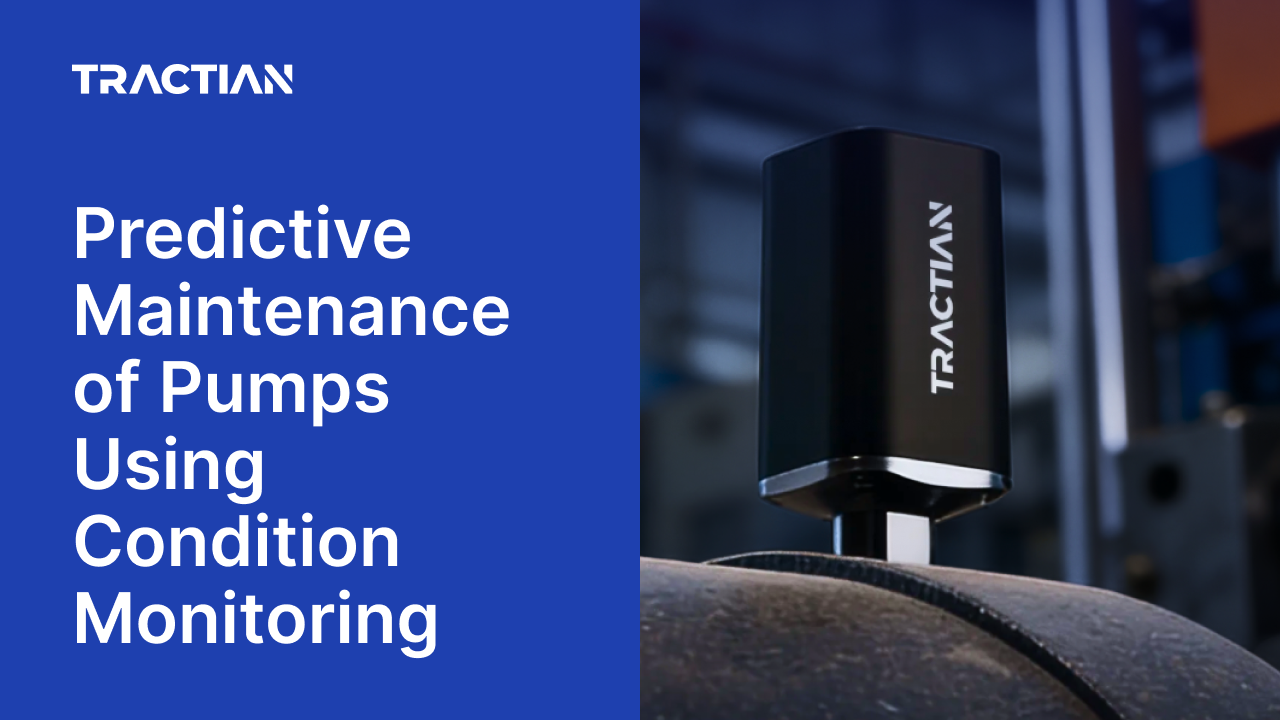
That is exactly what Tractian was built to do. Our Smart Trac sensor combines vibration and ultrasound in a single device, along with temperature and magnetic field sensing, so you get the full picture of pump health from one point. The triaxial accelerometer captures vibration across a wide frequency range, and the ultrasonic transducer catches the early stage wear and cavitation that vibration alone misses. It installs in under three minutes, runs wirelessly, and streams real time data straight to the cloud.
From there, our patented AutoDiagnosis™ engine does the heavy lifting. It learns the normal baseline for each asset and turns that mechanical monitoring data into action, automatically detecting and classifying the faults that take pumps down, including cavitation, unbalance, misalignment, mechanical looseness, lubrication failure, and wear. Instead of a wall of data, your team gets a clear diagnosis and a recommended action, delivered to a phone or directly into your workflow.