
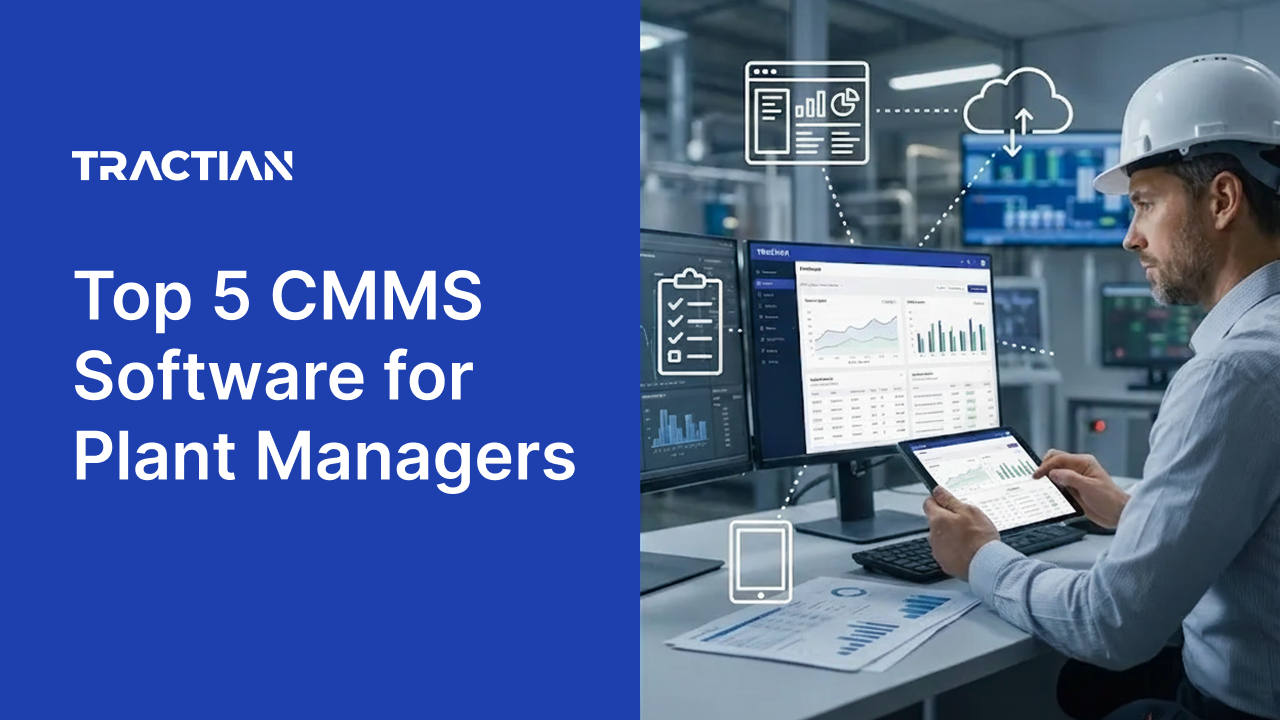
Plant managers are always under pressure to achieve a competitive edge. For industrial manufacturing operations, that means less unplanned downtime, lower maintenance costs, and a clear return on investment (ROI) for leadership. On top of this, budgets get tighter, and teams get smaller.
So, when it comes to maintenance operations, managers who lack clear visibility into how assets are performing and what's happening with those teams inevitably face a cycle of reactive repair decisions. It’s inevitable because it’s the only default mode you can rely on when you don’t have real-time information on the unpredictable and unplanned failures happening. Unfortunately, this inevitably leads to another one, and another. Like a row of dominoes, the unpredictable events follow: cost spikes, missed production goals, damaged customer relationships, revenue gaps, and more.
Fortunately, the right CMMS software gives plant managers the operational clarity and control they need to shift away from that reactive maintenance cycle. The right CMMS software turns that operation into a proactive, planned maintenance strategy that transforms a plant cost center into a bottom-line-impacting competitive advantage. This guide is here to help you evaluate leading CMMS platforms and identify one that delivers real-time KPI visibility, faster time-to-value, and the data-driven insights any plant manager needs to lead with confidence.
What is CMMS Software?
CMMS software centralizes planning, execution, and tracking of all maintenance activities, giving plant managers a single source of truth for asset performance, team productivity, and maintenance costs. These platforms digitize work order workflows, automate preventive maintenance scheduling, and deliver real-time dashboards that surface KPIs like MTBF, MTTR, planned versus reactive maintenance ratios, and overall equipment effectiveness.
For plant managers overseeing complex operations across single or multiple facilities, the right software eliminates the blind spots that lead to production disruptions. Advanced systems integrate with sensors and enterprise tools to trigger condition-based work orders, track spare parts inventory, and generate compliance-ready audit trails that simplify regulatory reporting.
Whether called CMMS (Computerized Maintenance Management System) or maintenance management software, these solutions transform scattered data into actionable intelligence that supports confident decision-making, cost justification, and continuous operational improvement.
How Do Teams Benefit From CMMS Software?
Plant managers adopt CMMS software to gain visibility into maintenance operations, control costs, and make data-driven decisions that protect production targets. As facilities grow in complexity and leadership demands clearer ROI metrics, spreadsheets, and manual tracking become unsustainable.
Plant managers need systems that surface real-time performance data, automate routine administrative work, and provide the documentation required for compliance audits and budget justifications.
- Work Order Management: Track maintenance activity from request through completion with full visibility into team workload, response times, and completion rates across the plant floor.
- Preventive Maintenance Scheduling: Automate recurring maintenance based on time intervals, meter readings, or equipment condition data to reduce unplanned downtime and extend asset life.
- Asset Performance Tracking: Monitor equipment health, maintenance history, and performance trends in one centralized location to identify chronic issues and prioritize capital investments.
- Mobile Execution: Enable technicians to receive assignments, update work orders, and capture inspection data in real time, eliminating paperwork delays and improving data accuracy.
- KPI Dashboards & Reporting: Access real-time dashboards tracking MTBF, MTTR, PM compliance, backlog trends, and maintenance costs to benchmark performance and demonstrate ROI to leadership.
Top 3 Priorities for Plant Managers Selecting CMMS Software
Operational Visibility Without Delays: Plant managers need real-time dashboards that surface KPIs such as downtime, work order backlog, and planned versus reactive maintenance ratios, without waiting for manual report generation or end-of-month summaries. The platform should deliver immediate insight into what is happening on the plant floor.
Fast Implementation and Proven ROI: Extended implementation timelines delay value and tie up resources. Systems that deploy in weeks rather than months, with AI-powered automation that reduces administrative burden, help plant managers demonstrate measurable improvements quickly and build momentum for broader adoption.
Scalability and Enterprise Integration: The solution should integrate with existing ERP systems, sensors, and business intelligence tools while supporting multi-site deployments with standardized workflows and centralized reporting. Plant managers need platforms that grow with operations without requiring complete reconfiguration as complexity increases.
Comparing Best CMMS Software Companies at a Glance
| Feature | Tractian | Accruent | Limble | Fiix | eMaint |
|---|---|---|---|---|---|
| Native Industrial Sensors | ✅ Smart Trac Ultra | ❌ Separate product, HVAC-focused | ❌ | ❌ | ❌ Third-party (Fluke) |
| AI-Powered Diagnostics | ✅ Auto Diagnosis & prediction | ❌ | ❌ | ❌ Historical analytics only | ❌ |
| Implementation Under 90 Days | ✅ 30-60 days | ❌ 3-6 months typical | ✅ | ✅ | ❌ Extended timelines |
| Real-Time KPI Dashboards | ✅ Live MTBF, MTTR tracking | ✅ | ✅ | ✅ | ✅ |
| Offline Mobile Execution | ✅ Full functionality | ❌ Add-on required | ✅ | ✅ | ✅ |
| Multi-Site Management | ✅ | ✅ | ✅ | ✅ | ✅ |
| Compliance Documentation | ✅ | ✅ | ✅ | ✅ | ✅ |
Preferred CMMS Software for Plant Managers
Tractian
Best for: Plant managers who need unified visibility into asset health and maintenance execution, with real-time KPI dashboards, AI-powered diagnostics, and implementation timelines measured in weeks rather than months.
Tractian delivers the operational clarity plant managers need to lead with confidence. The AI-powered CMMS unifies maintenance execution with real-time asset condition monitoring in a single platform, eliminating the data silos that obscure true maintenance costs and equipment performance. Plant managers gain immediate access to live KPI dashboards that track MTBF, MTTR, planned versus reactive work ratios, and maintenance backlog, without waiting for manually compiled reports.
Tractian’s native ecosystem transforms maintenance data into decision-ready intelligence. Smart Trac Ultra wireless vibration sensors continuously monitor equipment health, feeding real-time condition data directly into the CMMS to trigger automated work orders before failures disrupt production. Tractian AI analyzes equipment patterns to identify failure risks, prioritize maintenance by asset criticality, and surface the insights plant managers need for capital planning and resource allocation decisions.
What sets Tractian apart for plant managers is the speed to value. With free onboarding, zero platform fees, and deployments completed in 30-60 days, plant managers can demonstrate measurable ROI quickly and build credibility with leadership.
Tractian CMMS’s drag-and-drop scheduling, automated PM generation, and comprehensive spare parts tracking give plant managers full operational control while AI-generated SOPs convert tribal knowledge into standardized procedures that reduce variability and protect institutional expertise as workforce demographics shift.
Notable Features
- Real-Time KPI Dashboards: Live tracking of MTBF, MTTR, PM compliance, work order backlog, and asset performance with role-based views that give plant managers instant visibility into operational health without manual report generation.
- Integrated Condition Monitoring: Smart Trac Ultra sensors provide continuous vibration, temperature, and runtime monitoring with AI-driven diagnostics that surface equipment risks before they become production-stopping failures.
- AI-Powered SOP Generation: Automatically converts historical maintenance data and technician expertise into standardized procedures, reducing variability across shifts and preserving institutional knowledge as experienced workers retire.
- Rapid Implementation: Complete deployment in 30-60 days with free data migration and hands-on training, enabling plant managers to demonstrate ROI quickly rather than waiting months for value realization.
- Mobile-First Offline Execution: A fully functional mobile app keeps technicians productive regardless of connectivity, with automatic synchronization that keeps data accurate and complete for reporting.
Why real customers choose Tractian’s CMMS Software
- One manager's favorite is that Tracitan “generates warnings in which the machine is not yet in a critical state, but notifies you to be able to perform a more detailed inspection with your vibration team to validate data and the physical condition of the machine,” says Gerardo T., Predictive Maintenance Manager
- Another enterprise manager says, “The centralization of information allows you to visualize all monitored assets in one place and obtain valuable insights in real time. There is always technical support for any queries that may arise. It is easy to install and does not require major transformations within the plant,” says Maria G., Digital Enterprise Maintenance
- “The ease of tracking equipment without having to constantly observe. Tractian does the work for you,” says Jordan D., Maintenance Supervisor, Enterprise
Integrations
Tractian connects to the enterprise systems that plant managers rely on for cross-functional visibility and reporting. Native integrations include:
- ERP Platforms: SAP, Oracle, Microsoft Dynamics, Infor, Oracle NetSuite
- Business Intelligence: Power BI, Tableau, Looker
- Collaboration Tools: Slack, Microsoft Teams
- Legacy CMMS: IBM Maximo
- Accounting Software: QuickBooks, Xero
- Telematics & Fleet Management: Samsara, Motive, Titan, VisionLink, WasteVision
- Identity Management: Azure Active Directory
- Data & Reporting: SQL, Excel, Google Sheets
- Service Management: ServiceNow
- Design & Documentation: Autodesk
These integrations eliminate manual data transfers between maintenance and finance, ensure asset performance data flows into enterprise dashboards, and support the cross-functional reporting plant managers need to justify budgets and demonstrate operational improvements to leadership.
What Industries are using Tractian's CMMS Software?
Tractian CMMS is deployed throughout maintenance-intensive industries, such as the following, including facilities and fleet management:
- Mining and Metals plant managers gain centralized visibility across remote sites and mobile fleets, with compliance documentation that simplifies MSHA reporting and cost-per-ton tracking that supports capital allocation decisions.
- Chemical plant managers maintain process reliability, visibility, and audit-ready documentation for PSM and RMP compliance, while leveraging real-time asset health data to support MOC reviews and turnaround planning.
- Mills and Agriculture plant managers ensure equipment availability during critical harvest and processing windows, with seasonal readiness tracking and throughput metrics that protect yield targets.
- Manufacturing plant managers gain real-time OEE visibility and line-level performance tracking, with planned versus reactive ratios that quantify the shift from firefighting to proactive maintenance.
- Oil & Gas plant managers maintain operational control across distributed facilities with centralized dashboards, HSE compliance documentation, and asset integrity data that support API and OSHA reporting requirements.
- Heavy Equipment plant managers track fleet utilization and maintenance costs across job sites, with TCO visibility that informs lease-versus-buy decisions and equipment replacement planning.
- Food & Beverage plant managers maintain audit-readiness for FSMA, SQF, and HACCP inspections, with sanitation task documentation and equipment reliability data that protects food safety and production schedules.
- Automotive and Parts plant managers sustain JIT production schedules with real-time line-uptime visibility, takt-time protection, and predictive insights that prevent cascading disruptions that halt assembly operations.
Tractian CMMS is trusted by companies like DHL, Ingredion, CP Kelco, and CZM, where plant managers require unified operational visibility, regulatory compliance documentation, and the ability to demonstrate maintenance ROI across global operations.
Accruent
Best for: Organizations with established maintenance processes seeking traditional CMMS functionality and compliance documentation for multi-site operations.
Accruent CMMS provides work order management, preventive maintenance scheduling, and asset lifecycle tracking with audit trails for compliance documentation. Its platform is considered a legacy system.
The software includes ERP integrations with SAP, Oracle, and Microsoft Dynamics through pre-built connectors. However, plant managers should note that mobile capabilities require MC Kinetic as a separate add-on at additional cost, rather than being included in the base subscription. Condition monitoring also requires a separate product, but it’s focused on HVAC, refrigeration, and building management systems rather than on industrial rotating equipment such as motors, pumps, and compressors. Organizations requiring vibration monitoring for production machinery would need to source third-party sensors and configure separate integrations.
The platform also provides maintenance KPI reporting dashboards, but it does not include AI-powered diagnostics for automatic failure prediction or intelligent work-order prioritization based on asset conditions. Plant managers evaluating Accruent should plan for implementation timelines of 3-6 months, which may require third-party consultants for complex deployments, and should factor mobile licensing costs into total cost of ownership calculations.
Notable Features
- Site Management: Centralized administration across locations with site-specific workflow configurations, localized language support, and consolidated reporting for cross-facility performance comparisons.
- Compliance Documentation: Audit trails and regulatory reporting capabilities that support FDA 21 CFR Part 11 and ISO documentation requirements through the MC Compliance add-on module.
- ERP Integration: Connectors for SAP, Oracle, Microsoft Dynamics, Infor, and Sage enable data synchronization between maintenance and enterprise financial systems.
Potential Downsides
- Extended Implementation Timelines: Deployments typically require 3-6 months with significant configuration effort, and complex implementations may need third-party consultants, delaying time-to-value and ROI demonstration for plant managers under pressure to show results.
- Separate Condition Monitoring Product: Accruent Observe operates as a distinct platform focused on facilities systems like HVAC and refrigeration rather than industrial production equipment, requiring plant managers to source and integrate third-party sensors for rotating machinery monitoring.
- Additional Costs for Mobile Access: The MC Kinetic mobile app is a separate add-on at $58 per month per professional subscription, and the base platform does not include native AI diagnostics, making the total cost of ownership difficult to predict as operational requirements expand.
Limble
Best for: Small to mid-size operations that need straightforward work order management and visual dashboards for preventive maintenance scheduling.
Limble CMMS provides a cloud-based platform with dashboards, mobile work order access, and QR code scanning for asset identification. The platform allows users to configure data displays, reports, and KPI views based on role preferences. However, plant managers should be aware that the platform's customization capabilities require significant configuration effort during implementation. Teams may need extended time to structure asset hierarchies, workflows, and report templates before the system delivers operational value.
The software supports calendar- and meter-based scheduling, as well as automated work order generation for recurring maintenance tasks. Yet users report that data does not refresh in real time in the mobile app, requiring technicians to manually refresh to see the latest information, which can create visibility gaps for plant managers monitoring live operations.
The platform doesn’t currently include native condition-monitoring hardware or AI capabilities for predictive failure analysis and automated work-order prioritization. Plant managers requiring real-time equipment health data or intelligent maintenance optimization based on asset conditions would need to configure third-party integrations. Users also report occasional slow load times, interface bugs, and system glitches that require browser refreshes, and the lack of an undo feature means configuration changes are applied immediately with no rollback option.
Notable Features
- Dashboards: A visual interface that allows users to configure data displays and KPI tracking based on role-specific needs, with location-based filtering for multi-site operations.
- Maintenance Automation: Calendar and meter-based scheduling triggers automated work order generation for recurring maintenance tasks across equipment categories.
- QR Code Access: Generate and scan QR codes to access asset information and maintenance history, reducing time spent searching for equipment records.
Potential Downsides
- Data Refresh Limitations: Information in the mobile app does not update in real time and requires manual refreshes, creating potential visibility gaps for plant managers who need current operational data to make timely decisions.
- Configuration Complexity: The platform's customization options require significant setup effort, and teams may need extended time to structure asset hierarchies and reporting templates before achieving the operational visibility plant managers expect.
- No Native AI or Condition Monitoring: The platform lacks AI-driven failure prediction, intelligent work-order prioritization, and integrated equipment sensors, leaving plant managers with reactive insights rather than predictive operational intelligence.
What real customers say about Limble’s CMMS Software
- “Very easy to use interface made integration and setup very quick and easy. Customer support is very responsive when you have quick questions,” says Scott K., Director of Capital Assets
- “I would love to see more options for widget creation. Once you choose what you'd like to report on, the options change. Whether you're graphing, reporting on time spent, etc. it is usually a struggle to get the options just right to see what you are wanting to see,” says Verified User in Pharmaceuticals
- “Requirement for unique asset names for every asset their child assets. The data doesn't refresh in the app in real time and has to be manually refreshed for the app users to see the most up to date data. The app closes when the tablet screen auto-rotates.” says Verified User in Construction
Fiix
Best for: Mid-sized operations that want analytics capabilities for historical maintenance data analysis and reporting across multiple facilities.
Fiix provides a cloud-based CMMS with work order management, preventive maintenance scheduling, and asset tracking. However, plant managers should note that Fiix does not manufacture condition monitoring hardware. Organizations that require equipment health monitoring must procure third-party sensors separately and configure integrations, adding procurement complexity and potentially creating gaps between detection and maintenance action. The software can analyze historical maintenance data for patterns and anomalies, and users can access pre-built reporting templates for tracking maintenance costs and asset performance. Yet, users report sluggish system performance and interface response times that affect productivity, particularly during peak operational periods when generating reports or navigating between modules.
The platform offers inventory management and ERP integration options, though connecting multiple business systems often requires additional configuration beyond basic setup. Plant managers evaluating Fiix should verify that the mobile app supports their field execution requirements, as reviews indicate functionality gaps compared to desktop features. The free plan restricts access to integrations and advanced capabilities, requiring paid upgrades to unlock features that some competitors include at entry-level tiers, which can complicate budget planning as operational needs expand.
Notable Features
- Fiix Foresight Analytics: Analyzes asset performance data to identify anomalies and patterns based on historical maintenance records for reporting and trend analysis.
- Parts Forecasting: Predicts spare parts requirements by analyzing historical consumption data to support inventory planning and reduce stockout risk.
- Report Library: Report templates and report builder for analyzing maintenance costs, asset performance, and operational KPIs across facilities.
Potential Downsides
- System Performance Issues: Users report sluggish interface response times and slower system performance compared to competing platforms, which can delay report generation and impact productivity when plant managers need timely operational data.
- No Native Condition Monitoring: Fiix does not provide integrated sensors for equipment health monitoring, requiring plant managers to source third-party hardware and configure separate integrations to enable predictive maintenance.
- Cost Escalation for Advanced Features: The free plan restricts access to integrations and analytics capabilities, and unlocking features requires paid upgrades, making the total cost of ownership difficult to forecast as reporting and integration requirements grow.
What real customers say about Fiix’s CMMS Software
- “Very good program for the maintenance department” says Verified User in Food Production
- “Navigating is not simple would be nice to be more user-friendly” says Verified User in Electrical/Electronic Manufacturing
- “Cost for everything. Any help you need comes at a cost.” says Jeremy R., Validated Reviewer
eMaint
Best for: Organizations in regulated industries that need configurable compliance documentation and audit trail capabilities for multi-site operations.
eMaint provides work order management, preventive maintenance scheduling, and asset tracking with configurable fields, workflows, and interface layouts. However, implementation and configuration demand significant time and technical expertise, with users reporting longer-than-expected deployment timelines and steep learning curves that delay time-to-value for plant managers seeking a quick ROI demonstration. The software connects to Fluke condition monitoring sensors and testing equipment to trigger automated work orders, though this requires separate hardware procurement and configuration.
eMaint includes regulatory reporting and audit trails that support compliance documentation across multiple sites. While configurability enables adaptation to complex requirements, plant managers should note that the resulting interface can be difficult to navigate, particularly for users without technical backgrounds or during initial onboarding. Reporting setup requires substantial effort, and teams frequently cite the need for ongoing vendor support to maintain custom configurations or troubleshoot workflow issues.
The platform does not include AI-driven diagnostics for automated failure prediction or intelligent work-order prioritization based on asset conditions. Plant managers without dedicated CMMS administrators or IT resources may find that configuration overhead and support dependencies consume time and budget that could otherwise be used to demonstrate operational improvements to leadership.
Notable Features
- Sensor Connectivity: Integration with Fluke sensors, vibration analyzers, and testing equipment enables data collection for triggering work orders based on equipment readings.
- Workflows: Customizable fields, dashboards, and report structures allow adaptation to specific operational requirements and compliance documentation standards.
- Site Administration: Centralized management across locations with site-specific language, currency, and workflow configurations from a master account structure.
Potential Downsides
- Extended Implementation Timelines: Deployment requires significant configuration effort and technical expertise, with users reporting longer-than-expected timelines and steep learning curves that delay the ROI visibility plant managers need to justify the investment.
- Ongoing Administrative Burden: The platform's configurability creates complexity that often requires dedicated CMMS administrators or recurring vendor support, consuming resources that plant managers may not have budgeted for ongoing operations.
- No Native AI Capabilities: The system lacks AI-powered diagnostics for failure prediction or intelligent maintenance prioritization, leaving plant managers with traditional reporting rather than predictive insights that enable proactive decision-making.
What real customers say about eMaint’s CMMS Software
- Numerous training libraries and the reps available to assist you in whatever initiative you have. The asset selection process is overwhelming for operators.” Verified User in Manufacturing
- Very easy to use. PM setup is straightforward and allows for custom tailoring for us. Reporting be difficult to come up with what you want to see. Since you have to use "hard dates" like WO Date, or Close Date you have to export data to excel to actually view what you want.” Jason B., Plant Project Engineer
- “There are a few items that we are not overjoyed about. Searching for assets can be a bit of a hassle when it comes to getting the results you are looking for. Our Parts area of Emaint took almost a year to get fixed after issues occurred during implementation.” Verified User in Facilities Services
Plant Managers Prefer Tractian in Head-to-Head Comparisons
Plant managers evaluating CMMS platforms face a fundamental question. “Will this system give me the visibility and control I need to lead operations confidently, or will it create new administrative burdens while delivering the same reactive insights I already have?”
When examined through the lens of what plant managers actually need, the differences are clear. They can be summarized as:
- Real-time KPI visibility without manual report generation
- Implementation timelines that deliver ROI before the next budget cycle
- Predictive intelligence that prevents production disruptions rather than just documenting them
- Total cost of ownership that remains predictable as operations scale
Most CMMS platforms handle work orders and preventive scheduling adequately. The divergence occurs in how quickly plant managers gain operational clarity, whether the system surfaces actionable intelligence or just raw data, the inclusion of advanced AI-powered analytics and processing, and the amount of ongoing administrative effort required to maintain value.
Here is how Tractian compares head-to-head with each competitor:
Tractian v. Accruent: Accruent Maintenance Connection offers a traditional CMMS with compliance and multi-site administration, suited to organizations with established processes. However, ROI is delayed by a 3-6 month implementation. The separate condition-monitoring tool, Accruent Observe, focuses on HVAC/refrigeration, not industrial rotating equipment. Plant managers needing motor, pump, or compressor health visibility must integrate third-party sensors.
Tractian deploys in 30-60 days with Smart Trac Ultra sensors that monitor industrial equipment and feed real-time condition data directly into maintenance dashboards, giving plant managers unified visibility without the integration complexity or extended time-to-value.
Tractian v. Fiix: Fiix provides CMMS functionality with Fiix Foresight for historical data analysis and over 100 report templates. However, Fiix does not manufacture condition monitoring hardware, requiring plant managers to procure third-party sensors and configure integrations separately. Users report system performance issues that slow report generation when timely data is most important.
Tractian eliminates that complexity with integrated sensors that automatically detect equipment anomalies, diagnose root causes using AI, and generate work orders within the same platform, providing the real-time operational intelligence plant managers need without waiting for manual analysis or troubleshooting slow interfaces.
Tractian v. Limble: Limble provides customizable dashboards and straightforward work order management for organizations seeking basic CMMS adoption. However, the platform lacks AI capabilities for predictive failure analysis or intelligent work order prioritization, and users report that mobile data does not refresh in real time, creating visibility gaps for plant managers monitoring live operations.
Tractian uses AI to analyze asset criticality, predict failure timelines, and surface the KPIs plant managers need without manual refresh cycles or configuration delays, delivering operational clarity that Limble's traditional approach cannot match.
Tractian v. eMaint: eMaint provides configurable compliance documentation and Fluke sensor connectivity for regulated industries. However, the platform's configurability creates complexity that often requires dedicated administrators or ongoing vendor support, and implementation timelines extend longer than plant managers under pressure to demonstrate results can afford. The system does not include AI-driven diagnostics for failure prediction or intelligent prioritization.
Tractian provides full offline functionality, AI-powered diagnostics that identify failure risks weeks in advance, and rapid deployment, enabling plant managers to deliver measurable improvements quickly rather than spending months on configuration before realizing value.
By now, it’s very clear that Tractian was built differently. Equipment health monitoring, AI-driven diagnostics, and maintenance execution operate as one unified system, delivering the real-time clarity plant managers need to lead with confidence, control costs, and prove ROI to leadership without the complexity and delays that undermine competing platforms.
Ready to see how Tractian gives plant managers the visibility and control they need?
Request a demo and discover what operational clarity looks like when equipment intelligence, AI diagnostics, and maintenance execution work together in a single platform.
Best CMMS Software FAQs
- Why does native condition monitoring matter for plant managers evaluating CMMS platforms?
Native integration means that sensors and software operate as a unified system, with equipment anomalies automatically surfacing in dashboards and triggering work orders without manual data transfers. For plant managers, this eliminates visibility gaps that occur when sensor data lives separately from maintenance execution. Third-party integrations require separate procurement, API configuration, and threshold setup, which delays time-to-value and creates ongoing administrative overhead.
- How does AI in CMMS software help plant managers make better decisions?
AI analyzes equipment data to predict failures before they disrupt production, prioritize work orders by asset criticality, and surface trends that inform capital planning. For plant managers, AI transforms maintenance data from historical documentation into forward-looking intelligence. This enables ROI justification with concrete cost avoidance data rather than reactive metrics that only document what has already gone wrong.
- How does offline mobile capability affect operational visibility for plant managers?
Offline functionality determines whether maintenance data remains accurate when technicians work in areas with unreliable connectivity. Systems with robust offline capabilities allow technicians to update work orders and capture data without internet access, with automatic synchronization when connectivity returns. Platforms requiring constant connectivity create data gaps that undermine the real-time visibility plant managers need.
- How quickly can plant managers expect to see ROI from CMMS implementation?
Implementation timelines vary significantly and directly impact how quickly plant managers can demonstrate value to leadership. Comprehensive systems with sensors, AI diagnostics, and ERP integration typically require 30 to 90 days. Plant managers should evaluate time-to-value, not just go-live dates. Platforms with 3-6 month implementation cycles delay ROI demonstration and consume resources that could otherwise show operational results.