
Key Points
- Condition monitoring is a financial decision before it is a technology decision: the real cost is not the system you buy, but the unplanned failures you absorb without one.
- Five distinct system types exist on a spectrum from basic sensor networks to closed-loop platforms, and the gap between them is measured in execution speed, diagnostic labor, and integration cost, not just features.
- A closed-loop system that connects detection to diagnosis to work order completion in one native platform eliminates the hidden costs that erode ROI in fragmented monitoring programs.
Every manufacturing plant has equipment that will fail. The question is whether that failure arrives as a surprise at 2 a.m. with emergency parts, overtime labor, and lost production, or as a planned repair scheduled during the next maintenance window.
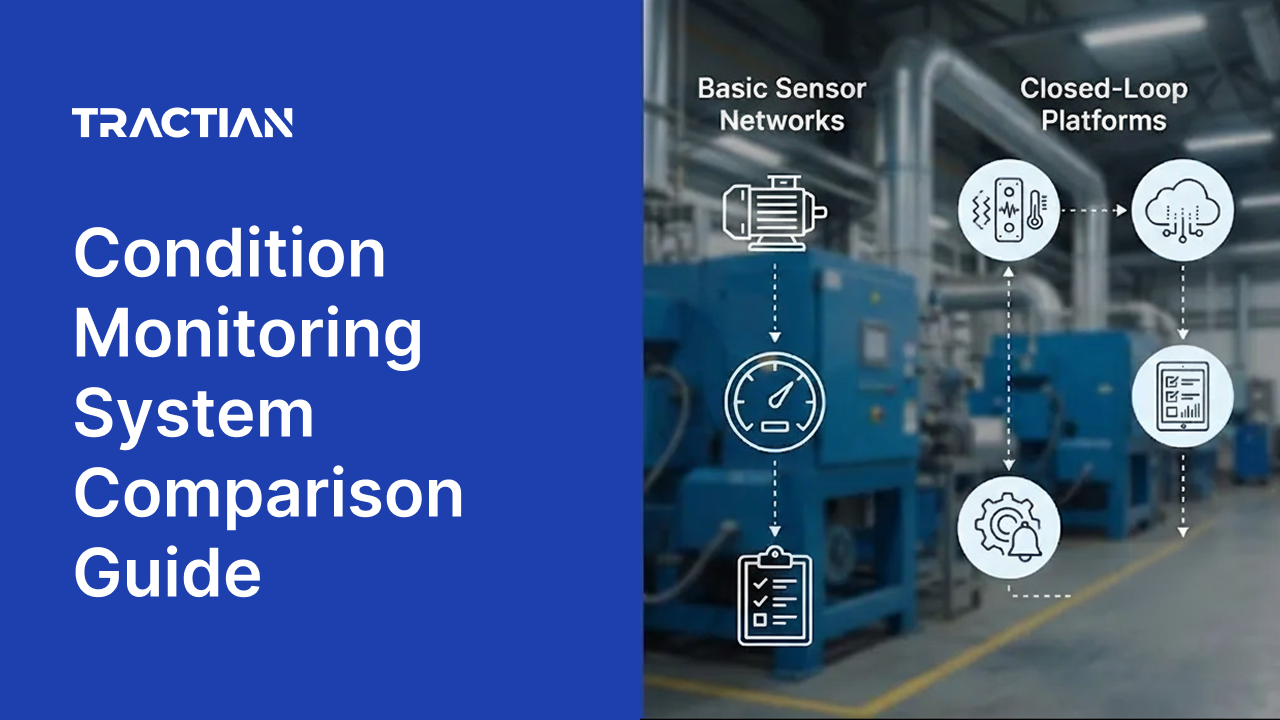
Condition monitoring systems exist to shift failures from the first category to the second. But the range of what qualifies as a "condition monitoring system" is wide enough to create real confusion during procurement. A sensor network that sends threshold alerts to a dashboard and a closed-loop platform that auto-generates work orders from AI-diagnosed faults both carry the label, but they deliver fundamentally different business outcomes.
This guide compares five types of condition monitoring systems, from most basic to most comprehensive, and maps each one to the business outcomes that matter: how fast a detection becomes a completed repair, how much internal labor the system absorbs versus creates, and what it costs when the system's gaps are filled by your team instead of the platform.
The Business Case for Condition Monitoring
Before evaluating system types, plant directors and VPs of maintenance should anchor the decision in three financial realities.
The cost of doing nothing is not zero. Industry data shows unplanned downtime costs manufacturing plants between $5,000 and $50,000 per hour depending on the operation. A facility running 200 critical assets with no continuous monitoring typically experiences 5 to 15 unplanned failures per year that early detection would have caught. The cumulative cost of those preventable events, including emergency parts, overtime labor, lost production, and secondary damage, often exceeds the annual cost of a full monitoring program.
Monitoring programs have hidden costs beyond the subscription price. The sticker price of sensors and software is the visible cost. The invisible costs are the analyst hours to interpret alerts, the labor to create work orders in a separate system, the integration fees to connect monitoring data to your maintenance's platform, and the training hours to get your team proficient. A $200/month-per-asset monitoring subscription that requires 20 hours per week of analyst interpretation is not a $200/month program.
The ROI calculation has two sides: cost avoided and cost created. Every system type on the spectrum prevents some failures. But simpler systems also create new labor demands: manual alert triage, diagnostic investigation, work order creation in separate tools, and follow-up to confirm the repair was completed. The net financial impact is avoided downtime cost minus the new operational burden the system introduces.
What Is a Condition Monitoring System?
A condition monitoring system is the combination of hardware, software, and diagnostic logic that detects changes in equipment health and translates them into information a maintenance team can act on. A sensor by itself collects data. A system does something with it.
The threshold where hardware becomes a system is the point where data acquisition connects to interpretation. At minimum, this means sensors paired with a platform that receives their output, applies some form of analysis (even if only against static thresholds), and presents the result to a user.
Condition-based maintenance programs depend on this capability. Instead of maintaining equipment on fixed time intervals (which leads to both over-maintenance and missed failures), CBM uses real-time machine health data to trigger maintenance only when conditions warrant it.
Types of Condition Monitoring Systems
Condition monitoring systems exist on a spectrum defined by two structural factors.
The first is diagnostic autonomy: who or what interprets the data. This ranges from the user alone (reviewing threshold alerts) to a dedicated human analyst to an AI engine to a combination of AI with closed-loop learning.
The second is execution proximity: how far an insight has to travel before it becomes a completed maintenance action. This ranges from fully manual (the user takes the finding to a separate tool or process) to fully native (the platform generates the work order automatically within the same interface).
These two factors define five system types. Each one represents a structural step up in capability, not just in features, but in how much of the condition monitoring workflow the system handles without adding steps, tools, or dependencies.
The types, from most basic to most comprehensive:
- Sensor Network with Threshold Alerting
- Analyst-Driven Monitoring Service
- Diagnostic Platform with Managed Expert Overlay
- Assembled Monitoring and Maintenance Ecosystem
- Closed-Loop Condition Intelligence and Execution Platform
Sensor Network with Threshold Alerting
A sensor network with threshold alerting is a condition-monitoring system where the hardware collects machine data and a cloud platform displays it for the user to evaluate. The system notifies the user when a measured value (vibration amplitude, surface temperature, or a derived metric) crosses a preset threshold. Beyond that notification, the system does not diagnose the fault, recommend a repair, or connect to any downstream workflow.
The diagnostic responsibility belongs entirely to the user. The system tells you something changed. It does not tell you what changed, why it changed, or what to do about it.
Key technologies
- Wireless vibration and temperature sensors: Compact devices mounted to equipment that capture acceleration, velocity, and surface temperature at configurable intervals.
- Communication gateway: A bridge device that receives sensor data via short-range wireless protocol (typically Bluetooth Low Energy or similar) and transmits it to the cloud.
- Cloud dashboard: A web or mobile interface for viewing real-time and historical trends, setting threshold values, and receiving email or push notifications when thresholds are exceeded.
- Basic anomaly detection: Some platforms in this category use simple pattern recognition to flag when a data point falls outside a normal range, but the output is typically limited to "anomaly detected," without specifying the cause or severity.
Business impact
This system type provides visibility but not velocity. You know something is changing, but the work to determine what, how urgent, and what to do about it falls entirely on your team. For operations with experienced vibration analysis staff who can interpret raw data, this may be sufficient for a small number of assets. For operations scaling monitoring across dozens or hundreds of machines, the labor cost of manual interpretation becomes the bottleneck, and alerts that sit undiagnosed create a false sense of coverage.
Cost-of-gap consideration: Every hour your team spends interpreting a threshold alert is an hour not spent on planned maintenance or reliability improvement. If your average response time from alert to diagnosis is 4+ hours, multiply that by your annual alert volume to see the hidden labor cost this system type creates.
Company match: Relay (Sensemore)
Relay (formerly Sensemore) provides wireless IIoT sensors with accelerometer, magnetometer, and thermometer capabilities. The sensors communicate via Bluetooth Low Energy to a gateway, which transmits data to a cloud platform for visualization and trend monitoring. The platform supports basic anomaly detection and data export. The system does not include automated fault diagnosis, prescriptive recommendations, or CMMS integration.
Analyst-Driven Monitoring Service
An analyst-driven monitoring service adds a human diagnostic layer to the sensor-and-platform foundation. The technology stack still includes wireless sensors, a communication gateway, and a cloud platform, but a certified vibration analyst (typically CAT III or IV) reviews the data and delivers specific maintenance recommendations.
The value proposition is outsourced expertise: the vendor provides both the hardware to collect data and the human specialist to interpret it. The analyst reviews platform data on a regular schedule and communicates findings through reports or in-platform notifications.
Key technologies
- Wireless vibration and temperature sensors: Triaxial accelerometers paired with temperature measurement, mounted to rotating equipment and transmitting data to a cloud platform.
- Communication hub: A local device that aggregates sensor data and transmits it to the cloud via Wi-Fi or cellular connection.
- Cloud platform with AI-assisted risk ranking: Software that ingests sensor data, applies anomaly detection algorithms, and presents asset health indicators (often color-coded severity levels) for the analyst to review.
- Dedicated human analyst: A certified vibration analyst assigned to the customer's facility, who reviews platform data and delivers prescriptive maintenance recommendations through in-platform communication or reports.
Business impact
This system type trades internal labor cost for vendor service cost. Instead of requiring your team to interpret raw data, the vendor's analyst provides diagnostic conclusions. The constraint is throughput: a human analyst covering a large asset population will prioritize the most urgent findings and may not review every machine at every measurement interval. Detection speed is limited by analyst availability, not data collection frequency.
Cost-of-gap consideration: Analyst-driven services typically charge per asset per month, with costs increasing as you scale. A 200-asset program with analyst interpretation can cost significantly more than the same sensor count with automated diagnostics. Additionally, the analyst's review cadence creates a response lag: a bearing fault that develops between review cycles may progress to failure before the next analysis window.
Company match: AssetWatch
AssetWatch provides a condition monitoring service that bundles wireless vibration and temperature sensors with a cloud platform and a Condition Monitoring Engineer (CME) assigned to each facility. The sensor captures triaxial vibration data at a configurable frequency limit of up to 10 kHz. The platform includes anomaly detection and asset risk ranking, while the CME reviews data and delivers recommendations through in-platform communication. The system does not include a native CMMS, and work order creation requires third-party tools or manual processes.
Diagnostic Platform with Managed Expert Overlay
A diagnostic platform with a managed expert overlay is a condition-monitoring system where software performs automated fault detection, root-cause identification, and prescriptive recommendations using trained machine-learning models. The software handles the bulk of diagnostic work, but the delivery model layers human expert review on top to validate, prioritize, and handle complex cases.
The platform may include portfolio-level dashboards, risk scoring, and severity classification, but the path from diagnostic insight to maintenance action typically involves a handoff to the customer's existing maintenance platform or a manual process rather than a direct workflow trigger within the same system.
Key technologies
- Multi-sensor hardware: Sensors capturing vibration, temperature, and in some cases magnetic field data, providing multiple data streams per monitored asset.
- AI-powered fault detection: Machine learning models trained on equipment failure patterns that automatically classify anomalies by failure mode and severity.
- Prescriptive recommendations: Automated outputs that identify not just the fault, but the recommended corrective action, reducing the diagnostic burden on the maintenance team.
- Managed expert layer: Vendor-employed analysts who review AI-generated diagnoses, validate complex cases, and serve as an escalation point for edge conditions the model has not yet learned.
Business impact
This system type significantly reduces the diagnostic labor compared to threshold-only or analyst-only models. The AI handles routine fault detection at machine speed, while the expert overlay catches edge cases. The gap is in execution: the diagnostic output still needs to travel to a separate maintenance platform or manual process before it becomes a work order. That handoff creates delay, introduces re-entry labor, and risks findings getting lost between systems.
Cost-of-gap consideration: The diagnostic quality may be high, but if converting a diagnosis into a completed repair requires 3 to 5 manual steps across 2 different platforms, the response time from detection to repair is longer than the diagnostic speed alone would suggest. For plants where a bearing fault can progress from detectable to catastrophic in 48 to 72 hours, this execution gap matters.
Company match: Augury
Augury provides machine health monitoring with vibration, temperature, and magnetic field sensing delivered as a managed service. The sensors communicate via Bluetooth mesh to gateways. A separate ultrasonic sensor monitors equipment operating between 1 and 150 RPM. The platform performs automated fault detection and provides diagnostic recommendations, supported by vendor analysts who review findings. The platform does not include a native CMMS or APM module, and maintenance execution requires integration with third-party systems.
Assembled Monitoring and Maintenance Ecosystem
An assembled monitoring and maintenance ecosystem is a condition-monitoring system where the vendor offers both monitoring hardware and maintenance platform/maintenance management software within its portfolio. The components may cover the full workflow from sensor to work order, but they were typically acquired separately and connected through integration rather than built as a single native system.
The practical effect is that the pieces exist to close the loop from detection to repair, but the connections between them may introduce friction: separate databases, different user interfaces, inconsistent data models, or manual steps to move information between monitoring and maintenance modules.
Key technologies
- Wireless vibration and temperature sensors: Hardware that collects machine health data and transmits it to the monitoring platform.
- Cloud analytics platform: Software that processes sensor data, applies diagnostic algorithms, and presents equipment health summaries.
- Maintenance's platform within vendor portfolio: A separate maintenance management platform, often acquired through corporate acquisition, that handles work orders, asset records, and maintenance scheduling.
- Integration layer: APIs, middleware, or manual workflows that connect the monitoring platform's diagnostic output to CMMS, maintenance platform, or work order system.
Business impact
This system type addresses the execution proximity gap by offering both monitoring and maintenance management under one vendor. The business advantage is a single procurement relationship and a potential path to workflow integration. The business risk is that "assembled" does not mean "unified": if the monitoring platform and maintenance platform were built independently, the integration between them may require configuration, produce data inconsistencies, or add steps that a natively built system would not have.
Cost-of-gap consideration: Evaluate the actual workflow, not the vendor brochure. Ask: when the monitoring platform detects a bearing fault, how many clicks, screens, or manual entries does it take before a technician has a work order with diagnostic context and recommended repair steps? If the answer involves copy-pasting between interfaces, the assembled ecosystem has an integration tax your team pays on every work order.
Company match: Fluke Reliability
Fluke provides condition monitoring through a vibration sensor connected to CMMS and analytics platform assembled through separate acquisitions. The sensor combines a piezoelectric sensor with two MEMS sensors to capture triaxial vibration and temperature data across a frequency range of 2 to 10,000 Hz. The gateway communicates via Wi-Fi or Ethernet and supports up to 20 sensors.
Closed-Loop Condition Intelligence and Execution Platform
A closed-loop condition intelligence and execution platform handles the full workflow from detection to diagnosis to work order to completed repair within a single native system. Every component, sensors, connectivity, AI diagnostics, maintenance platform, and asset performance management (APM), was designed and built to work together from the ground up rather than assembled through integration.
The defining characteristic is the feedback loop: when a technician completes a work order generated from an AI diagnosis, that outcome feeds back into the diagnostic model. The system learns whether its diagnosis was correct and adjusts its confidence and classification for future detections. This loop improves diagnostic accuracy over time, which reduces false positives, increases trust, and accelerates response.
Business outcomes first
Before examining the technology stack, here is what this system type needs to deliver at the business level:
- Faster response: Detection to work order completion happens in one system with no handoffs, re-entry, or platform switching. A bearing fault detected at 2 a.m. generates a prioritized work order with diagnostic context and recommended repair steps before the morning shift arrives.
- Lower total program cost: No analyst fees scaling with asset count. No integration costs to connect monitoring to maintenance platform. No labor hours lost to manual alert interpretation or work order creation in separate systems.
- Reduced false positive burden: The diagnostic feedback loop means the system gets more accurate with every completed repair, reducing wasted inspection trips and building technician trust in the alerts they receive.
- Budget predictability: Fixed per-asset cost with no hidden charges for analyst services, integration middleware, or premium diagnostic tiers.
- Scalability without headcount: Adding 100 monitored assets does not require hiring additional analysts or vibration specialists. The AI handles diagnostic volume at machine speed.
Key technologies
- Multi-modal wireless sensors: A single sensor device incorporating vibration measurement (sampling rate up to 64 kHz), ultrasound (up to 200 kHz for early-stage lubrication issue detection), magnetometer (for high-precision RPM measurements up to 15,000 RPM), and surface temperature measurement (-40 F to 250 F). Multi-modal sensing in one device eliminates the need for separate sensors to cover different detection techniques.
- Sub-GHz wireless communication with cellular backhaul: Sensors communicate via IEEE 802.15.4g on sub-GHz frequencies to an industrial receiver, which transmits to the cloud over 4G/LTE. This architecture eliminates dependence on plant Wi-Fi and supports up to 100 sensors per receiver, with an indoor range of 330 feet and a line-of-sight range of approximately 0.6 miles.
- AI-powered auto-diagnosis with patented fault detection: Algorithms trained on over 3.5 billion collected samples that automatically identify major failure modes, generate specific diagnoses, classify severity, and attach prescriptive maintenance procedures to each finding.
- Native maintenance platform with automatic work order generation: When the AI diagnoses a fault, a work order is created automatically within the same platform, complete with the diagnostic context, severity classification, and recommended repair steps. No third-party CMMS required. No copy-paste. No re-entry.
- Built-in APM with FMEA, RCA, and failure libraries: Asset performance management tools that connect diagnostic findings to failure mode and effects analysis, root cause analysis workflows, and documented failure libraries, providing institutional knowledge that persists beyond individual team members.
- Closed-loop diagnostic feedback: Completed work orders feed outcomes back into the diagnostic model, continuously improving accuracy, reducing false positives, and building a reliability knowledge base specific to each facility's equipment.
- Hazardous area certification (ATEX/IECEx), standard: Intrinsic safety certification included by default, not as a premium add-on.
Company match: Tractian
Tractian provides a closed-loop condition intelligence and execution platform built from the ground up as a single native system. The platform combines multi-modal wireless sensors (vibration, ultrasound, magnetic field, temperature), sub-GHz wireless communication with cellular backhaul, AI-powered auto-diagnosis, a native maintenance platform with automatic work order generation, and built-in APM.
The platform is designed so that the entire path from a sensor detecting a vibration anomaly to a technician completing a repair happens within one system, with no third-party tools, manual handoffs, or external analyst services required.
How to Determine Which Condition Monitoring System Fits Your Operation
Selecting the right condition monitoring system depends on where your maintenance program stands today and where it needs to be in the next 12 to 24 months. Before evaluating vendors, answer these questions internally.
Diagnostic confidence
- When your team receives an alert, do they have enough information to act on it immediately, or do they need to investigate further before deciding what to do?
- If your current system flags an anomaly, does the person reading the alert know the specific failure mode, its severity, and the recommended corrective action?
- How much time does your team spend confirming whether an alert is real before they begin planning a response?
Execution proximity
- When a condition-monitoring insight identifies a problem, how many steps, tools, handoffs, or platforms are required before a technician receives a work order with clear instructions?
- Does your team re-enter diagnostic findings from one system into another to create a maintenance task?
- If a sensor detects a bearing fault at 2 a.m., how long does it take for someone to be assigned to address it, and is the process automatic or does it wait for a human to initiate it?
- Can your technicians see machine health data and their assigned work orders in the same interface, or do they switch between tools throughout the day?
Internal capability
- Does your team include certified vibration analysts (CAT III/IV) who can interpret raw frequency spectra and identify fault patterns?
- If your current monitoring vendor's analyst goes on vacation, does your team have the skills to interpret alerts independently?
- How many of your reliability engineers are within five years of retirement, and what happens to diagnostic capability when they leave?
Financial impact
- What does one hour of unplanned downtime cost your operation in lost production, emergency parts, and overtime labor?
- How many unplanned failures per year on critical rotating equipment could monitoring have caught?
- What is the total annual cost of your current monitoring program, including subscription fees, analyst services, integration maintenance, and internal labor to bridge system gaps?
- If you could prevent two additional unplanned failures per quarter, what would that be worth in production value?
Scalability
- If you needed to add 50 monitored assets in the next six months, how would that change your staffing requirements under each system type?
- Does your current monitoring cost scale linearly with asset count, or does each additional asset require proportionally more internal support?
Condition Monitoring System Comparison Table
| Feature | Relay | AssetWatch | Augury | Fluke | Tractian |
|---|---|---|---|---|---|
| Type | Type 1 (Sensor Network with Threshold Alerting) | Type 2 (Analyst-Driven Monitoring Service) | Type 3 (AI-Diagnostic Platform with Managed Expert Overlay) | Type 4 (Assembled Monitoring and Maintenance Ecosystem) | Type 5 (Closed-Loop Condition Intelligence and Execution Platform) |
| Wireless Vibration and Temperature Sensors | Yes | Yes | Yes | Yes | Yes |
| Cloud Platform with Trend Visualization | Yes | Yes | Yes | Yes | Yes |
| Threshold-Based Alerting | Yes | Yes | Yes | Yes | Yes |
| Dedicated Analyst Interpretation | Yes | Yes | Yes | Yes | |
| AI-Powered Fault Detection | Yes | Yes | Yes | ||
| Prescriptive Alerts with Maintenance Procedures | Yes | Yes | |||
| Magnetic Field Sensing | Yes | Yes | |||
| Maintenance's Platform within Vendor Portfolio | Yes | Yes | |||
| Integrated Ultrasound Sensing | Yes | ||||
| Sub-GHz Wireless with Cellular Backhaul | Yes | ||||
| Native Maintenance's Platform with Automatic Work Order Generation | Yes | ||||
| Built-In APM (FMEA, RCA, Failure Libraries) | Yes | ||||
| Closed-Loop Diagnostic Feedback | Yes | ||||
| Hazardous Area Certification (ATEX/IECEx), Standard | Yes |
Why Now: Three Pressures Driving Condition Monitoring Investment
The decision to invest in condition monitoring is increasingly driven not by technology curiosity but by operational necessity. Three pressures are converging.
Workforce expertise is declining faster than it can be replaced
Experienced vibration analysts and reliability engineers are retiring at a rate that exceeds the pipeline of qualified replacements. A 2024 Deloitte manufacturing workforce study found that 2.1 million manufacturing jobs could go unfilled by 2030 due to skills gaps. Plants that built their reliability programs on the expertise of two or three senior analysts are discovering that expertise cannot be replicated through hiring alone. Systems that automate diagnostic interpretation reduce the dependency on specialized human knowledge and preserve institutional expertise in the platform's learning models.
Equipment complexity is increasing while maintenance windows are shrinking
Modern manufacturing equipment operates at higher speeds, tighter tolerances, and with more integrated control systems than the equipment it replaced. At the same time, production schedules are pushing toward higher utilization with shorter planned downtime windows. The result is less room for error: a failure that would have been a four-hour inconvenience on legacy equipment can cascade into a multi-shift production loss on modern integrated lines. Continuous monitoring that catches early-stage faults provides the lead time to schedule repairs within available windows.
The cost of unplanned downtime continues to rise
Supply chain constraints have extended lead times for critical spare parts, meaning a failure that previously required a two-day repair now requires a two-week wait for components. At the same time, lean inventory practices have reduced the on-hand safety stock that once buffered against unexpected failures. The financial impact of each unplanned event is larger than it was five years ago, which shifts the ROI calculation in favor of monitoring investments that would not have cleared the hurdle rate previously.
Building the Financial Case: ROI Framework for Condition Monitoring
For plant directors, VPs of maintenance, and operations leaders building a business case, here is a framework for quantifying the return on a condition monitoring investment.
Step 1: Calculate your unplanned downtime cost
Identify the per-hour cost of unplanned downtime for your operation. Include: lost production value, overtime labor for emergency repairs, expedited shipping for emergency parts, secondary damage to adjacent equipment, and quality/scrap costs from uncontrolled shutdowns. For most manufacturing operations, this number falls between $5,000 and $50,000 per hour.
Step 2: Count preventable events
Review your maintenance history for the past 12 months. How many unplanned failures on rotating equipment (motors, pumps, compressors, fans, gearboxes) resulted in production impact? Of those, how many involved failure modes that continuous vibration analysis, ultrasonic testing, or temperature monitoring would have detected in advance? Common detectable failure modes include bearing degradation, misalignment, imbalance, lubrication breakdown, and electrical faults. In most facilities, 60% to 80% of unplanned mechanical failures produce detectable symptoms weeks or months before catastrophic failure.
Step 3: Calculate avoided cost
Multiply the number of preventable events by the average downtime cost per event. This is the gross avoided cost. Then subtract the annual cost of the monitoring program (subscription, hardware, installation, and any internal labor required to operate the system). The difference is your net ROI.
Example: A plant with $25,000/hour downtime cost, 8 preventable events per year averaging 4 hours each, and a monitoring program cost of $150,000/year:
- Avoided cost: 8 events x 4 hours x $25,000 = $800,000
- Program cost: $150,000
- Net ROI: $650,000 (5.3x return)
Step 4: Factor in total program cost, not just subscription price
Compare system types by total annual cost of ownership:
- Type 1 (Sensor network): Subscription + internal analyst labor to interpret alerts + maintenance platform integration cost
- Type 2 (Analyst service): Subscription (includes analyst) + maintenance platform integration cost + response lag cost
- Type 3 (AI + expert overlay): Subscription + maintenance platform integration cost + handoff labor
- Type 4 (Assembled ecosystem): Subscription + integration maintenance between monitoring and maintenance platform modules
- Type 5 (Closed-loop): Subscription (all-inclusive: sensors, AI, maintenance platform, APM, no analyst fees, no integration cost)
What Industries Benefit from Closed-Loop Condition Monitoring Systems?
Condition monitoring applies wherever rotating equipment operates, but the business case for closed-loop systems is strongest in industries where the cost of an unplanned failure includes consequences beyond the direct repair.
- Manufacturing plants running continuous or semi-continuous production lines face cascading losses when a single machine goes down. A motor failure on a bottleneck asset does not just stop one machine; it idles every downstream process waiting for its output. Closed-loop monitoring matters here because the detection-to-repair speed determines how much production is lost.
- Oil and gas facilities operate high-value rotating equipment (compressors, pumps, turbines) in environments where unplanned failures create safety and environmental exposure. The cost of an unplanned compressor trip includes not just repair costs, but flaring, environmental reporting, and potential regulatory action. Systems that close the gap between detection and repair reduce that exposure window.
- Energy generation facilities must maintain grid commitments and avoid unplanned capacity reductions. A turbine bearing failure that forces a generating unit offline has financial consequences that extend beyond repair cost to include replacement power purchases, grid penalty charges, and capacity payment losses.
- Food and beverage plants operate under sanitation and quality constraints that make unplanned failures particularly expensive. Equipment failures that contaminate product in process create waste beyond the mechanical repair, including product disposal, line cleaning, and potential quality holds.
- Mining and metals facilities operate crushers, conveyors, and mobile equipment in extreme conditions across remote, rugged locations. Failures are dangerous, access is difficult, and the cost of an unplanned stoppage on a primary crusher or haul conveyor cascades through the entire production chain.
- Chemical plants operate pumps, mixers, and compressors under tightly controlled process conditions, often in hazardous production areas where equipment failure can lead to safety incidents. Early detection must directly lead to prioritized maintenance actions without sitting on a dashboard waiting for manual work order creation.
- Mills and agriculture processors face compressed production windows during harvest and peak seasons where equipment availability determines whether output targets are met. There is no margin to absorb the delay between detecting a fault and completing the repair.
- Packaging and logistics operations depend on high-speed, high-throughput lines where a bearing or drive failure on a single machine can halt an entire fulfillment process. Monitoring systems that deliver both detection and execution speed are essential in environments where throughput losses are measured in missed shipments.
Condition Monitoring Techniques Within These Systems
The five system types above define how monitoring data is collected, interpreted, and acted on. The underlying measurement techniques determine what types of faults the system can detect. Most condition monitoring systems use one or more of the following:
- Vibration analysis: Measures mechanical vibration patterns to detect imbalance, misalignment, bearing wear, looseness, and resonance issues. The most widely used technique for rotating equipment. Higher sampling rates detect a broader range of fault frequencies.
- Ultrasonic monitoring: Detects high-frequency acoustic emissions produced by friction, turbulence, and electrical discharge. Particularly valuable for early-stage lubrication degradation and slow-speed bearing faults that vibration analysis may not catch until they progress further.
- Oil analysis: Examines lubricant samples for wear particles, contamination, and chemical degradation. Provides information about internal component wear that external sensors cannot directly measure. Typically performed through lab analysis or inline sensors.
- Infrared thermography: Uses thermal imaging to detect temperature anomalies in electrical systems, mechanical components, and process equipment. Effective for identifying hot spots caused by electrical faults, friction, or insulation breakdown.
- Motor current analysis: Measures electrical current patterns in motors to detect rotor bar cracks, stator faults, air gap eccentricity, and power supply imbalances. Provides electrical fault detection that vibration-only systems miss.
The breadth of measurement techniques a system supports directly affects its detection coverage. A system limited to vibration and temperature will catch the majority of common rotating equipment faults but may miss early-stage lubrication issues (detected by ultrasound), electrical faults (detected by magnetic field or current analysis), or internal wear patterns (detected by oil analysis).
Improving Mean Time Between Failure with Condition Monitoring
The operational metric most directly affected by condition monitoring is MTBF. By detecting faults in their early stages, when the repair scope is small and can be scheduled during planned windows, condition monitoring extends the useful life of components and reduces the frequency of unplanned failures.
The connection to overall equipment effectiveness is direct: fewer unplanned failures mean higher availability, which is the first factor in the OEE calculation. Plants that implement closed-loop monitoring programs consistently see availability improvements as the system catches failures that previously progressed undetected to the point of forced shutdown.
Predictive maintenance strategies built on condition monitoring data also improve the quality factor in OEE by catching degradation that would otherwise produce out-of-spec output before it triggers a hard failure.
FAQs About Condition Monitoring Systems
What is the difference between a condition monitoring sensor and a condition monitoring system?
A sensor is a hardware device that collects data from a machine. A condition monitoring system combines that sensor with software, diagnostic logic, and a path to action, whether manual or automated. The more of that path a system handles natively, the less manual effort your team needs to convert data into completed maintenance work, and the faster you reduce unplanned downtime costs.
Does every condition monitoring system require a separate maintenace platform?
Most do. Systems in the first three categories on the spectrum rely on third-party maintenance platforms or manual processes to convert diagnostic findings into work orders. Only closed-loop platforms include native maintenance management, which eliminates the handoff between detection and execution and reduces the time from fault detection to completed repair.
Can a simpler system type be enough for our operation?
It depends on how much manual interpretation and external tooling your team can absorb. Simpler systems require more labor to bridge the gap between an alert and a completed repair. If your team is lean, your asset count is growing, or your vibration expertise is limited, those gaps compound quickly into production losses.
What if we already have maintenance software from another vendor?
Tractian integrates with existing enterprise systems via an open API. Teams can adopt individual capabilities alongside their current maintenance software and still benefit from automated diagnostics and prescriptive alerts. If the decision is made later to consolidate into a fully native closed-loop program, the transition is simpler because the monitoring data, diagnostic history, and asset context are already in place.
How long does a condition monitoring system take to install?
Installation timelines vary by system type. Sensor-only networks can be mounted and transmitting within hours per asset. Systems requiring Wi-Fi infrastructure or gateway configuration typically take longer per zone. Tractian sensors use sub-GHz wireless with cellular backhaul, which eliminates the need for plant network configuration and allows full deployment across a facility in days rather than weeks.
What is the difference between condition monitoring and predictive maintenance?
Condition monitoring is the process of continuously measuring machine health indicators such as vibration, temperature, and ultrasound. Predictive maintenance is the strategy that uses condition monitoring data to schedule repairs before failures occur. A condition monitoring system provides the data; a predictive maintenance program is what you do with it.
Do condition monitoring systems work on all types of equipment?
Most condition monitoring systems are designed for rotating equipment: motors, pumps, compressors, fans, and gearboxes. The effectiveness depends on the sensing capabilities. Systems limited to vibration and temperature cover standard rotating assets. Multi-modal systems that add ultrasound and magnetic field sensing extend coverage to slower-speed equipment and a broader range of failure modes.
Can condition monitoring detect electrical faults?
Some systems can. Sensors that include magnetic field measurement can detect electrical anomalies in motors and drives, including stator faults, rotor bar issues, and power supply imbalances. Systems limited to vibration and temperature typically cannot identify electrical faults until they produce a secondary mechanical symptom.
What data connectivity do wireless condition monitoring sensors need?
This depends on the communication architecture. Sensors using Bluetooth or Wi-Fi require plant network infrastructure and IT involvement. Sensors using sub-GHz wireless with cellular backhaul operate independently of the plant network, which simplifies deployment and eliminates IT dependencies.
How do condition monitoring systems handle false alarms?
False alarm rates vary significantly by system type. Threshold-based systems generate the most false positives because static limits cannot account for variable operating conditions. AI-driven systems reduce false alarms through pattern recognition and learned baselines. Closed-loop systems with diagnostic feedback further reduce false positives by learning from verified maintenance outcomes.
What certifications should a condition monitoring system have for hazardous environments?
For hazardous areas classified under ATEX (EU) or IECEx (international) standards, sensors must carry intrinsic safety certification appropriate to the zone classification. Some vendors offer hazardous area certification as a standard inclusion; others provide it as an add-on or do not support it.
Can a condition monitoring system replace route-based vibration collection?
Continuous wireless monitoring can replace most route-based vibration collection activities. The transition eliminates the manual labor cost of routes, removes data collection gaps between visits, and provides continuous coverage that catches fast-developing faults. Handheld route-based collection may still be useful for spot checks or assets not included in the wireless monitoring scope.
What is the typical ROI timeline for a condition monitoring system?
ROI depends on the system type and the cost of unplanned downtime in the facility. Operations where a single unplanned failure costs $50,000 or more can achieve payback from one prevented event. Facilities with lower per-event costs typically see payback within 3 to 12 months as the system prevents multiple smaller failures across a larger asset population.
How much does unmonitored equipment cost a manufacturing plant?
Industry data shows unplanned downtime costs manufacturing plants between $5,000 and $50,000 per hour depending on the operation. A facility running 200 critical rotating assets with no continuous monitoring typically experiences 5 to 15 unplanned failures per year that could have been detected early. The cumulative cost of those preventable events often exceeds the annual cost of a full monitoring program.
What should a plant director evaluate beyond features when selecting a condition monitoring system?
Plant directors and VPs should evaluate three business dimensions beyond the feature list: execution speed (how quickly a detection becomes a completed repair), total cost of program (including integration, analyst fees, and internal labor to bridge system gaps), and scalability (whether the system can expand to cover more assets without proportionally increasing headcount). A system that scores well on features but requires significant manual effort to operate creates hidden costs that erode the ROI.
Why are more plants investing in condition monitoring now?
Three converging pressures are driving adoption: experienced reliability engineers are retiring faster than replacements are trained, equipment is becoming more complex with tighter tolerances, and the cost of unplanned downtime continues to rise as supply chains offer less buffer. Plants that relied on periodic inspections and tribal knowledge are finding those approaches cannot keep pace with current operational demands.
How does a closed-loop system reduce total maintenance cost compared to simpler monitoring?
Closed-loop systems reduce total maintenance cost through three mechanisms: they eliminate the labor cost of manually interpreting alerts and creating work orders in separate systems, they reduce false positive rates through diagnostic feedback which prevents wasted inspection trips, and they catch failures earlier when the repair scope is smaller. The net effect is fewer emergency repairs, lower parts costs from planned procurement, and less overtime labor.
What is the difference between condition monitoring and vibration analysis?
Vibration analysis is one technique within condition monitoring. Condition monitoring is the broader discipline that can include vibration, ultrasound, oil analysis, infrared thermography, and other measurement methods. A condition monitoring system may use one or several of these techniques depending on the equipment types and failure modes it is designed to detect.
Take the Next Step
Every day without continuous monitoring is a day your critical assets are generating data your team cannot see. The faults developing inside your motors, pumps, and compressors right now will either be caught early and repaired on your schedule, or they will announce themselves as unplanned failures on theirs.
See how Tractian's closed-loop platform connects detection to diagnosis to repair in one system.