
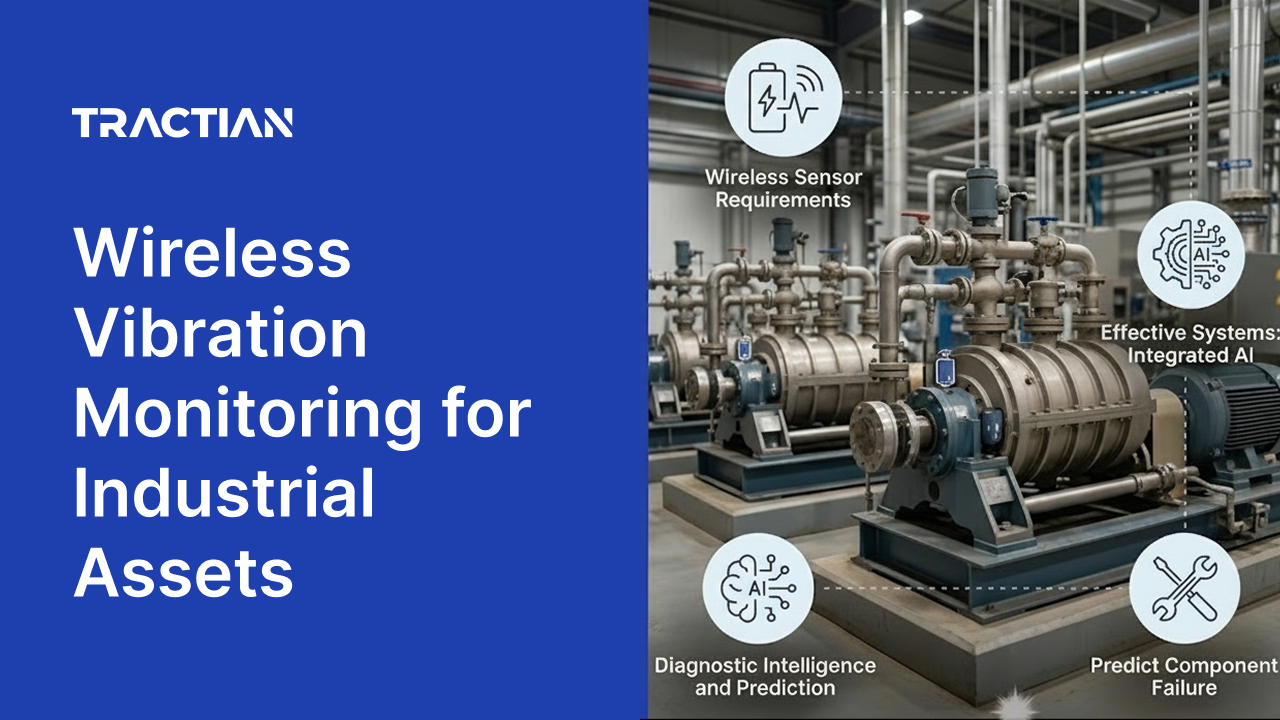
Key Points
- Wireless vibration monitoring is the foundational layer of condition-based maintenance for industrial rotating equipment, replacing the structural limitations of route-based collection with continuous, scalable data capture.
- Vibration carries more diagnostic information than any other single parameter for rotating assets, but its value multiplies when combined with complementary signals like ultrasound, temperature, and magnetic field data.
- The difference between effective wireless vibration monitoring and basic sensor deployment comes down to data quality, diagnostic intelligence, and whether the system produces decisions or just alerts.
- Wireless vibration monitoring delivers its full value not in isolation, but as the starting point of a system that contextualizes, correlates, and prioritizes asset health into actionable, decision-grade intelligence.
Foundations of Wireless Vibration Monitoring
Vibration monitoring has been the primary technique for assessing the health of rotating equipment for decades. The underlying physics hasn't really changed. Every mechanical fault in a rotating asset produces a vibration signature, and capturing that signature early enough to act on it remains the foundation of any credible condition-based maintenance program.
What has changed is how that data gets captured, how fast it moves, and what happens to it once it arrives. On one hand, the shift from periodic, manual collection with handheld analyzers to continuous, wireless monitoring with cloud-connected sensors seems like a natural, incremental improvement. But they’re much more than that. They’ve brought (demanded) architectural changes in how facilities build and sustain visibility into equipment health.
Changes of this magnitude are significant and usually high-stakes. Poor maintenance strategies can reduce a plant's overall productive capacity by 5 to 20 percent, and unplanned downtime costs industrial manufacturers an estimated $50 billion annually.
For many facilities, the question is no longer whether to monitor vibration, but whether their current approach captures enough data, frequently enough, with enough diagnostic intelligence to actually prevent failures rather than just document them.
This article explains what wireless vibration monitoring for industrial assets entails, what separates effective implementations from basic ones, and how vibration monitoring connects to the broader condition-monitoring architecture that produces trusted, actionable decisions.
What Wireless Vibration Monitoring Is (and What It Replaces)
There are several different types of vibration monitoring equipment. Wireless vibration monitoring uses permanently mounted wireless sensors to continuously capture vibration data from industrial rotating equipment and transmit it wirelessly to a cloud platform for automated analysis. The sensors are installed directly on the machine housing and collect data at configurable intervals, from every few minutes to every 30 minutes, depending on the diagnostic mode. Data transmits over cellular networks or sub-GHz radio protocols to receivers, then to the cloud, where algorithms process the signals and surface actionable insights.
This architecture replaces the traditional route-based vibration-monitoring approach. In a route-based program, a technician walks a designated path through the plant to collect vibration readings with a handheld analyzer on a recurring schedule. Depending on the facility and staffing, that schedule might be weekly, monthly, or quarterly. Each collection point provides a snapshot of vibration levels at that moment.
The constraints of route-based programs are structural, not a reflection of technician skill. Collection frequency is limited by labor availability, which means fast-developing faults can emerge and progress between collection cycles. A bearing cage defect, for example, can move from first indication to functional failure in days, well within the gap between monthly readings. Data quality depends on the technician's consistency in sensor placement and measurement conditions. And the program scales only by adding headcount to the route.
These constraints are compounding under workforce pressure. U.S. manufacturing could need up to 3.8 million workers between 2024 and 2033, with more than 1.9 million positions at risk of going unfilled. Nearly one quarter of the manufacturing workforce is age 55 or older, and the specialized vibration analysts who underpin route-based programs are among the hardest roles to replace.
Wireless vibration monitoring resolves these constraints by decoupling data collection from human availability. Sensors collect continuously, data transmits without requiring plant Wi-Fi infrastructure, and automated diagnostics process signals without an on-site analyst.
The result is a fundamentally different coverage model, one where critical assets are monitored around the clock, faults are detected as they develop rather than at the next scheduled visit, and the system scales by adding sensors rather than headcount.
Why Vibration Is the Foundational Signal
Vibration analysis occupies a unique position among condition-monitoring techniques because it carries the highest diagnostic density for the broadest range of rotating industrial equipment. Every mechanical fault produces a characteristic signature in the frequency domain, and for the most common faults in motors, pumps, compressors, gearboxes, fans, and similar assets, vibration is the first and most information-rich indicator.
The four most prevalent faults in rotating equipment illustrate why.
- Imbalance produces elevated vibration at one times (1x) running speed in radial directions.
- Misalignment generates vibration at 1x and 2x running speed with a significant axial component.
- Bearing defects produce vibration at calculated defect frequencies (Ball Pass Frequency Outer Race, or BPFO, and Ball Pass Frequency Inner Race, or BPFI, among others) that are distinct from other fault sources and often detectable weeks or months before functional failure.
- Mechanical looseness produces multiple harmonics with unstable patterns.
Each of these leaves a fingerprint that trained analysts or automated algorithms can identify with high specificity when the data quality is sufficient.
But vibration alone doesn't tell the complete story. Increased diagnostic confidence and fewer false positives are achieved by using complementary parameters.
- Ultrasound is highly sensitive to friction, early-stage wear, cavitation, and micro-impacts, and is especially effective for low-speed equipment where traditional vibration analysis has inherent limitations.
- Temperature data reveals overheating and lubrication degradation.
- Magnetic field measurement enables precise RPM tracking for variable-speed equipment, a critical context for accurate vibration interpretation on machines driven by variable-frequency drives (VFDs).
When these signals are captured together, correlated, and analyzed as a unified dataset, the system can differentiate between fault types with greater accuracy.
A multimodal approach doesn't replace vibration as the primary signal. It surrounds it with the context that turns a vibration reading into a confident diagnosis. Systems that rely on a single parameter or capture only overall vibration levels without spectral analysis provide a narrower, less actionable view of asset health.
What Makes Wireless Vibration Monitoring Effective at Scale
Not all wireless vibration monitoring systems deliver the same outcomes. The gap between basic implementations and effective ones shows up in four areas that determine whether the system produces decisions or just data.
Data quality and resolution
Frequency range, sampling rates, and spectral resolution determine whether the system can isolate individual fault frequencies from background noise. A sensor capturing data at low resolution may detect that overall vibration levels have increased, but it can't differentiate between a bearing defect, misalignment, and looseness.
This distinction requires sufficient bandwidth for early-stage bearing faults, multi-axis measurement for complete fault characterization, and configurable sampling modes that balance continuous coverage with deep diagnostic detail.
Connectivity and infrastructure independence
Systems that depend on plant Wi-Fi inherit the reliability, congestion, and IT approval constraints of the existing network. When connectivity drops, data gaps follow. Systems transmitting over cellular (4G/LTE) or dedicated sub-GHz radio protocols bypass these dependencies entirely, with sub-GHz frequencies offering longer range and better penetration through steel, concrete, and heavy machinery.
The connectivity architecture often determines how much of the deployment timeline is spent on IT coordination versus actually monitoring assets.
Diagnostic intelligence
This is where the most consequential gap exists. Basic systems alert on threshold crossings, such as vibration exceeding a preset level or triggering a notification. Advanced systems diagnose the actual fault and deliver notifications such as “the vibration pattern matches a bearing outer race defect at a specific severity”, along with a recommended corrective action and supporting evidence.
The difference determines whether the team acts with confidence or defaults to sending an analyst with a handheld tool to confirm what the wireless sensor flagged. If every alert requires manual validation by a specialist, the wireless system hasn't replaced the labor bottleneck. It has added a notification layer on top of it.
Criticality-based alerting adds another dimension by adjusting warning sensitivity based on asset importance, ensuring critical machines trigger earlier warnings while less critical assets allow more scheduling flexibility without creating alert fatigue.
Scalability without proportional labor
The promise of wireless monitoring is coverage that scales independently of headcount. But the delivery requires more than adding sensors. It requires plug-and-play deployment, a platform with plain-language diagnostics and mobile-first interfaces designed for frontline teams, and automated analysis that doesn't require vibration certification to interpret. If the system scales sensor count but not the team's ability to act on the data, coverage increases while decision quality stays flat.
Deloitte's research underscores the potential: predictive maintenance can increase productivity by 25%, reduce breakdowns by 70%, and lower maintenance costs by 25%. But those outcomes depend on whether the monitoring system produces the diagnostic clarity teams need to act, not just alerts telling them something changed.
How Wireless Vibration Monitoring Connects to the Larger System
Wireless vibration monitoring generates the foundational data. That data becomes decision-grade when it passes through a system designed to do four things.
Contextualize
The same vibration reading can indicate a fault or a normal operating state depending on the machine's load, speed, and ambient conditions. A system that accounts for operating states, environmental factors, and historical baselines for each specific asset turns raw data into meaningful signals.
Correlate
When multiple sensing technologies capture data from the same asset, and multiple sensors at different measurement points are synchronized, the resulting picture is more complete than any single parameter viewed alone. Correlation reduces false positives and increases diagnostic specificity.
Prioritize
Not every alert deserves equal urgency. Systems that align alert timing with the potential-failure-to-functional-failure (P-F) curve based on asset criticality ensure the team's attention goes where it matters most. Without prioritization, flat alert lists at scale become overwhelming, and overwhelmed teams hesitate rather than act.
Connect to execution
An insight that sits in a dashboard isn't a decision. When condition monitoring feeds directly into a maintenance execution platform, the insight becomes a work order with a procedure, a parts list, and a priority level attached.
The quality of the sensor and the data it produces determines the quality of everything downstream. But the sensor alone isn't the system. The question isn't just "how good is the sensor?" It's "what does this sensor feed, and does that system produce decisions we can trust and act on?"
How Tractian Delivers Wireless Vibration Monitoring for Industrial Assets
Tractian's approach to wireless vibration monitoring reflects the principles outlined above: high-fidelity data capture, diagnostic intelligence that produces decisions rather than alerts, and a unified platform that connects condition monitoring to maintenance execution.
The Smart Trac wireless vibration sensor captures vibration (0 to 64 kHz triaxial, up to 60 g), ultrasound (up to 200 kHz via piezoelectric transducer), magnetic field data (RPM estimation up to 15,000 RPM), and surface temperature in a single device. One sensor captures the complementary signals needed for confident diagnosis. Data transmits over sub-GHz radio to a Smart Receiver, then via 4G/LTE cellular to the cloud, with no reliance on plant Wi-Fi.
The sensor is IP69K-rated, ATEX/IECEx/NFPA 70 certified for hazardous locations, and installs in minutes with adhesive or drill-and-tap mounting. Patented features address real-world complexity: Always Listening activates data capture for intermittent machines, RPM Encoder tracks variable speeds from 1 to 48,000 RPM without external tachometers, and Ultrasync correlates signals from multiple sensors on the same asset.
The condition-monitoring platform is where data becomes intelligence. Tractian's patented Fault-Finding Auto Diagnosis identifies all major specific failure modes with prescriptive recommendations, not threshold-based alerts. Every insight tells the team what is wrong, how severe it is, and what to do next, backed by spectral evidence and a Procedures Library of validated maintenance actions.
The AI is trained on over 3.5 billion samples collected globally and continuously adapts with human-in-the-loop feedback. Within five days of installation, the platform produces an Initial Health Report for each asset, and criticality-based alerting ensures the right urgency without alert fatigue.
The unified platform ties it together. Tractian's condition monitoring feeds natively into its maintenance execution platform, creating a closed loop from insight to work order to resolution. The mobile app works offline with QR code access and built-in team communication. An Asset Performance Management (APM) module adds Failure Mode and Effects Analysis (FMEA), Root Cause Analysis (RCA), and failure libraries for continuous reliability improvement, with benchmarking across self, intra-company, and industry-wide levels against a database of over 6 million motors and 70,000 bearing models.
Tractian reports payback on condition monitoring in as little as 3 months, with published benchmarks including a 11% increase in availability and a 30% decrease in preventive maintenance costs. The platform is trusted by Kraft Heinz, Cargill, Hyundai, Carrier, and Caterpillar, among others, and holds Forbes AI 50 recognition, SOC 2 Type II, and ISO 27001 certifications.
Explore Tractian condition monitoring solutions to see how decision-grade data quality transforms your vibration monitoring equipment into AI-powered maintenance execution workflows.
Which Industries Benefit from Improved Machine Vibration Monitoring?
Improvements to machine vibration monitoring deliver the greatest measurable impact in industries where unplanned failures carry steep consequences and maintenance teams operate under pressure to act quickly with limited resources.
Facilities that invest in better diagnostic intelligence, contextual data, and tighter integration between monitoring and maintenance execution see faster returns because every improvement compounds. Fewer false positives mean less wasted labor, more specific diagnoses mean shorter repair times, and prioritized alerting means the right equipment gets attention first.
- Automotive and Parts: High-speed production lines leave no room for interpretation delays, so improving condition monitoring means ensuring every alert arrives with a specific diagnosis and priority level that technicians can act on without pulling machines offline to verify.
- Fleet: Shop equipment reliability determines vehicle turnaround speed, and stronger condition monitoring gives service teams trusted, bay-level visibility into developing faults so they can schedule interventions between jobs instead of reacting to breakdowns.
- Manufacturing: Dense asset populations generate high data volumes, and improving your monitoring approach means replacing raw signal noise with contextualized, equipment-specific diagnostics that reduce the time between detection and corrective action.
- Oil and Gas: Remote and hazardous assets make physical verification costly and dangerous, so better condition monitoring means reaching diagnostic confidence at the platform level, where teams can commit to action without dispatching someone to confirm what the system already identified.
- Chemicals: Process stability depends on catching deviations early, and improved monitoring provides tighter contextual intelligence that distinguishes a genuine developing fault from normal operational variation that can trigger unnecessary shutdowns.
- Food and Beverage: Compressed maintenance windows and sanitation requirements leave little margin for diagnostic ambiguity, so improving condition monitoring means delivering prescriptive, ready-to-execute guidance that fits within existing production schedules.
- Mills and Agriculture: Seasonal processing creates high-stakes windows where every hour of uptime counts, and better monitoring enables criticality-based prioritization, directing limited maintenance resources toward harvest-critical equipment first.
- Mining and Metals: Harsh conditions and heavy-duty equipment produce complex vibration profiles, and improved monitoring enables AI-driven diagnostics with sufficient contextual depth to distinguish genuine faults from environmental noise without requiring specialist review.
- Heavy Equipment: Variable loads and inconsistent operating cycles make static baselines unreliable, so better condition monitoring means adaptive systems that adjust to real-time operating context and build the diagnostic trust teams need to act decisively.
- Facilities: Distributed assets across multiple locations demand centralized visibility with local relevance, and improving your monitoring approach means replacing raw, site-level signal data with prioritized, actionable guidance that doesn't require manual translation at each location.
FAQs: Frequently Asked Questions About Vibration Monitoring Equipment
- What is wireless vibration monitoring?
Wireless vibration monitoring uses permanently mounted sensors to continuously capture vibration data from industrial equipment and transmit it wirelessly to a cloud platform for automated analysis. It replaces the coverage and frequency limitations of periodic, route-based data collection with real-time, scalable visibility into asset health. Tractian's Smart Trac sensor adds ultrasound, temperature, and magnetic-field data alongside vibration data for multi-modal diagnostics.
- Why is vibration monitoring important for industrial assets?
Vibration is the most information-rich signal for diagnosing mechanical faults in rotating equipment. Changes in vibration patterns indicate developing issues like bearing wear, misalignment, imbalance, and looseness, often weeks or months before failure. Tractian's platform automatically detects 75+ failure modes and provides prescriptive guidance on next steps.
- What is the difference between route-based and wireless vibration monitoring?
Route-based monitoring collects data manually at scheduled intervals, providing periodic snapshots limited by technician availability and consistency. Wireless monitoring collects data continuously from permanently mounted sensors, capturing fast-developing faults that periodic collection can miss. Tractian's wireless sensors transmit over cellular networks, bypassing plant Wi-Fi and enabling continuous monitoring without changes to IT infrastructure.
- How does wireless vibration monitoring reduce maintenance costs?
By detecting faults early, wireless monitoring enables teams to schedule repairs before failures escalate into costly breakdowns or emergency shutdowns. It also reduces unnecessary preventive maintenance tasks by confirming the actual condition of assets rather than relying on fixed time-based schedules. Tractian reports payback on condition monitoring in as little as three months.
- What types of industrial equipment can wireless vibration sensors monitor?
Wireless vibration sensors are designed for virtually any critical rotating asset, including motors, pumps, compressors, gearboxes, fans, turbines, conveyors, generators, and similar equipment found across manufacturing environments. Tractian's Smart Trac sensor supports both high-speed and low-speed equipment, with RPM tracking from 1 to 48,000 RPM and ultrasonic capability for assets where traditional vibration analysis has limitations.
- What should I look for when evaluating a wireless vibration monitoring system?
Evaluate the system considering data quality (such as frequency range, resolution, and multi-axis features), its independence from connectivity (whether it relies on cellular or Wi-Fi), diagnostic intelligence (whether it can identify faults or merely alert based on thresholds), and scalability (its ability to monitor critical assets without requiring proportional increases in staff). Tractian's platform integrates all these aspects into a single ecosystem, featuring patented AI diagnostics and seamless integration with its maintenance management platform.
