
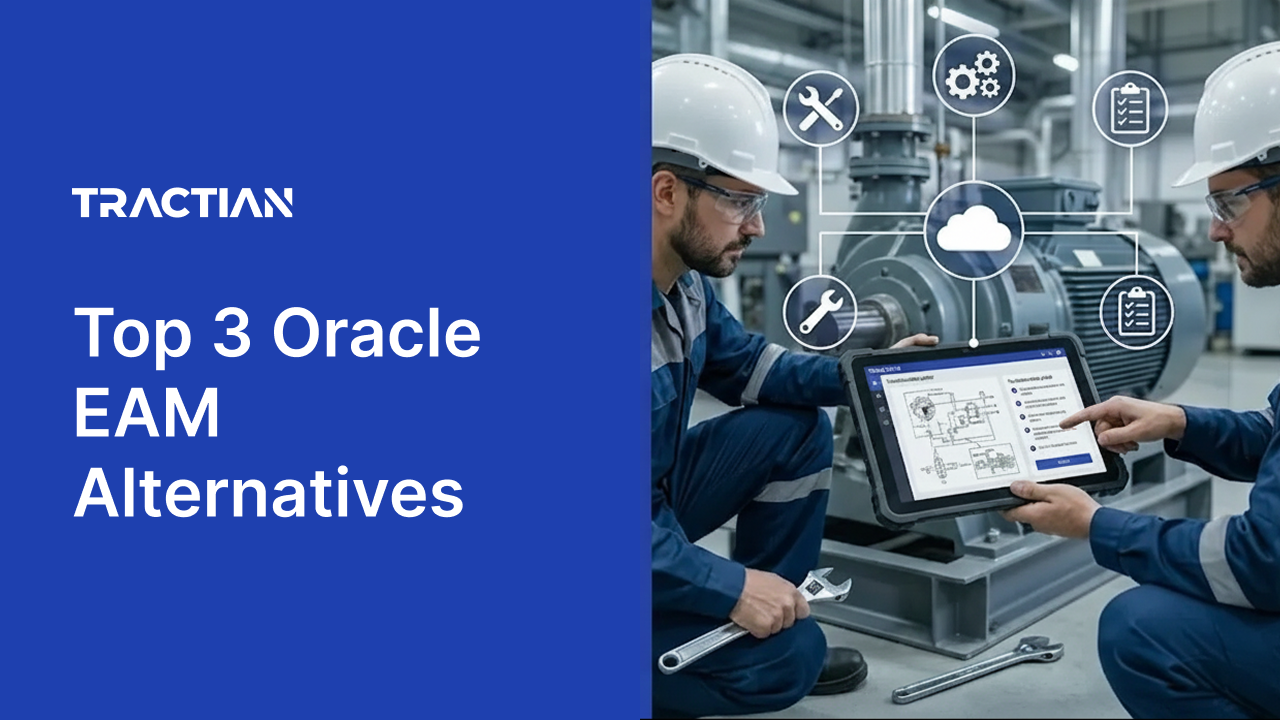
Oracle EAM is a module within Oracle's business suite that provides work order management, preventive maintenance scheduling, equipment tracking, and maintenance cost analysis. The system operates within the Oracle ecosystem and requires integration with modules including purchasing, inventory, financials, and human resources. Oracle EAM uses meter-based maintenance triggers, asset hierarchy, and cost tracking at the asset level. The platform is available in both on-premises and cloud versions within the business suite.
However, as maintenance operations demand faster response times, mobile-ready tools, and predictive capabilities, some teams find that Oracle EAM's architecture and interface present obstacles to adoption and efficiency. The sections below examine where Oracle EAM creates friction for maintenance organizations and what capabilities to prioritize when evaluating alternatives.
Why Teams Are Exploring Oracle EAM Alternatives
Oracle EAM provides asset management functionality within the Oracle ecosystem, but teams evaluating alternatives often cite recurring friction points that affect daily operations and long-term costs. The following issues appear consistently across user feedback and platform reviews.
- Interface Complexity: Users report that the interface requires significant training and involves multiple steps to complete basic tasks. As one reviewer noted, "The system is not as user friendly as other systems on the market, especially if shared between sites. It can be difficult to create documents and run reports as the system is not intuitive."
- Cost and Annual Price Increases: Licensing costs are high, and the solution's annual price increases. One user stated, "The tool is very expensive. The solution increases the cost by eight percent every year."
Potential Problems Teams Face with Limited Solutions
When evaluating alternatives, teams using Oracle EAM may encounter additional limitations that affect adoption and long-term usability. The following represent potential friction points to consider when seeking a more comprehensive EAM solution.
- UI Modernization Gaps: Interfaces that are not browser-based and reflect older design patterns can slow down workflows. User experience improvements in areas including finance, supply chain, and administration features may be limited.
- Mobile App Reliability: Mobile applications may throw errors during deployment and regular usage, requiring multiple patches and support requests to function properly. Interface stability on mobile devices can affect field technician adoption.
- Search and Asset Processing Limitations: Searching by asset number or location may be difficult. Inability to process multiple assets simultaneously adds friction to routine maintenance workflows.
Key Capabilities to Prioritize When Replacing Oracle EAM
Organizations evaluating Oracle EAM alternatives for enterprise asset management maintenance and reliability teams should focus on capabilities that eliminate friction points that hinder maintenance teams and technicians.
- Intuitive Mobile Experience: Prioritize platforms with mobile apps that run reliably, with no crashes or deployment errors. Look for offline functionality and interfaces that technicians can use without extensive training.
- Simplified Search and Asset Access: Look for quick asset lookup via QR codes or barcode scanning that reduces navigation steps and eliminates the multi-click search processes users report in Oracle EAM.
- Real-Time Condition Monitoring Integration: Prioritize platforms that integrate with IoT sensors to automatically capture vibration, temperature, and runtime data without requiring manual meter readings or data entry.
- AI-Assisted Diagnostics and Work Order Generation: Look for systems that analyze equipment data and automatically generate maintenance recommendations with prescribed procedures attached, moving beyond manual work order creation.
Oracle Alternatives at a Glance
| Feature | Oracle EAM | Tractian | IBM Maximo | SAP |
|---|---|---|---|---|
| Mobile Reliability | Mobile apps require frequent patches and throw deployment errors during regular usage | Mobile app built offline-first with automatic sync when connectivity returns | System can feel overwhelming for end users with steep learning curve noted in reviews | Apps provide mobile access, but functionality is limited compared to desktop version |
| AI-Powered Diagnostics | Tracks assets and work orders, but does not diagnose equipment faults or generate repair procedures | Auto Diagnosis detects all major failure modes and attaches specific repair steps to each alert | Provides conversational queries but does not automatically diagnose faults or prescribe repairs | Includes scheduling capabilities, but diagnostic intelligence requires additional configuration |
| Integrated Condition Monitoring | Requires third-party tools and integration projects to connect sensor data to maintenance workflows | Smart Trac Ultra sensors connect directly to CMMS with automatic work order generation | Monitor module available through AppPoints licensing but adds to implementation complexity | Condition monitoring requires separate configuration and integration with PM module |
| Asset Search and Navigation | Searching by asset number or location is difficult according to user reviews and multiple assets cannot be processed simultaneously | Instant asset lookup by number, location, or QR code scan with no complex query structures | Interface requires multiple clicks to complete basic tasks and navigation between modules can be overwhelming | Multi-screen workflows and transaction codes create navigation complexity for maintenance tasks |
| Configuration Independence | System is not intuitive and creating documents or running reports requires technical expertise | Teams configure workflows and build reports without coding or external consultant dependency | Complex setup requiring specialized technical expertise with ongoing configuration often needing certified resources | Implementation requires SAP-certified consultants and significant configuration effort |
| Deployment Timeline | Implementation complexity noted with extensive training requirements due to non-intuitive interface | Full deployment in 30 to 60 days with onboarding support included | OpenShift environment setup and AppPoints licensing add complexity that extends deployment timelines | Initial setup is time-consuming with migration from legacy versions, adding project risk and cost |
Best 3 Oracle EAM Alternatives
Tractian
Best for: Maintenance and reliability teams in manufacturing, food and beverage, mining, and industrial operations seeking a unified platform that combines AI-powered condition monitoring, mobile-first CMMS, and reliability analytics.
Tractian delivers an integrated approach to asset management that unifies condition monitoring, maintenance execution, and reliability engineering into a single platform. The system connects Smart Trac Ultra wireless vibration sensors directly to its CMMS module, creating a closed loop from fault detection to work order completion.
When sensors detect anomalies in vibration, temperature, or runtime patterns, the platform automatically generates prioritized work orders with diagnostic context and prescriptive guidance. This eliminates handoffs between monitoring tools and maintenance systems, which can create delays in traditional environments.
The platform's Reliability module extends beyond basic maintenance management to provide failure mode libraries, root cause analysis tools, and asset health scoring based on criticality. Teams can manage inspections, track failure events, and compare reliability metrics across assets from a single interface.
Tractian's approach positions maintenance programs as strategic revenue protection, whereas traditional programs are treated as cost centers. With real-time KPIs including MTBF, MTTR, and backlog visibility calculated automatically from operational data, the game truly changes. Customer deployments report ROI within 12 months, with implementation timelines of 30-60 days rather than the extended rollouts typical of legacy EAM platforms.
Key Features
- Real-Time Vibration Analysis: Smart Trac Ultra wireless sensors detect equipment anomalies and feed data directly into the CMMS, where AI algorithms identify specific failure modes and automatically generate work orders with diagnostic context and repair procedures. No separate monitoring software or manual alert-to-task handoffs required.
- Advanced Asset Performance Management: The platform provides a unified APM layer that continuously monitors asset health, analyzes failure trends, and guides maintenance strategies with actionable insights. Teams can identify high-risk equipment, adjust reliability plans based on real-time condition data, and optimize maintenance priorities across the entire operation without siloed tools or manual interpretation. APM drives proactive decision-making that elevates uptime and extends asset life while aligning maintenance execution with broader performance goals.
- AI-Powered Fault Diagnostics: Patented machine learning algorithms analyze vibration and temperature patterns to identify all major failure modes, from bearing wear and misalignment to cavitation and lubrication issues. Each alert includes severity ratings, root-cause analysis, and plain-language prescriptive recommendations, without requiring specialized analysis expertise.
- Real-Time KPIs Without Manual Data Entry: MTBF, MTTR, backlog metrics, and PM compliance updates are automatically generated as technicians complete work orders. Managers gain instant visibility into maintenance performance across sites without waiting for monthly reports to be compiled or requiring SQL report development.
- Condition-Driven Preventive Maintenance: Preventive maintenance schedules automatically adjust based on real-time asset condition rather than fixed calendars or manual meter readings. Sensor data and AI diagnostics prioritize the right work at the right time, reducing unnecessary PMs while preventing failures before they escalate.
Why real customers choose Tractian over Oracle
- “Tractian is a software totally prepared for maintenance area, is possible to notice since the first time that it was developed for people that knows what the maintenance team needs.” Abel R., Maintenance and Faclities Manager
- “It's easy to use and navigate the site. The team checks in regularly to see how they best can support. I use the platform at least twice a week and the team is receptive to user feedback for platform continuous improvement.” Verified User in Manufacturing
- Another review writes, “The infrastructure they provide is very beneficial. It allows for the establishment of a wireless communication network between multiple devices, facilitating continuous inspection 24 hours a day, 7 days a week. This frees people from the task of manually checking a large number of pieces of equipment.” Domingo O., Mid-Market Engineer
Why companies choose Tractian over Oracle
- "We tried other tools, but they all felt disconnected from the reality of our daily work. Tractian was different-it's simple, complete, and built for people who actually do the work." Abel G., Maintenance Manager, PCC Fasteners
- “With everything centralized in one platform, within Tractian CMMS, we finally had the visibility to act fast, plan smarter, and show real results.” Paul M., Director of Maintenance
- “We had the right team and strong procedures, but everything felt disconnected. With Tractian, we finally have a centralized system that gives us the visibility and speed to stay ahead of issues and keep our fleet running.” Fabiano J., Fleet Manager
Pro and Cons at a Glance
How much does Tractian cost?
Tractian uses transparent per-sensor and per-user pricing, without platform fees or hidden integration charges. All plans include AI-powered diagnostics, offline mobile execution, multi-site visibility, and condition monitoring capabilities.
IBM Maximo
Best for: Organizations with multi-site operations using configurable EAM workflows across SaaS, cloud, or on-premise deployments.
IBM Maximo provides enterprise asset management through a modular platform that includes work order management, preventive maintenance, inventory control, and procurement capabilities. The platform includes architectural layers that organizations should evaluate carefully. Implementation requires technical expertise, including initial setup of the WebSphere environment and infrastructure configuration, which often necessitates IBM consultants or certified partners.
Maximo uses an AppPoints licensing model with deployment options including SaaS, dedicated cloud, and on-premise installations. The platform includes capabilities through an IBM WatsonX integration, providing conversational interfaces and predictive analytics for organizations that license those modules. However, users have reported that the system can feel intimidating and that it creates a steep learning curve. Support responsiveness has been noted as a concern in user reviews, and license costs remain at the higher end of EAM solutions, which may impact the total cost of ownership for organizations comparing alternatives.
Key Features
- Application Suite: Includes separate applications for asset management, health monitoring, predictive maintenance, and visual inspection, licensed individually through AppPoints.
- Conversational Interface: Provides a conversational interface for querying asset data, generating reports, and summarizing maintenance information using natural language inputs.
- Deployment Options: Supports SaaS, dedicated single-tenant cloud, and on-premise installations.
Real customer gaps with Maximo
As of December 2025, teams implementing IBM Maximo have identified several operational considerations to evaluate before deployment.
- Interface complexity for frontline workers: The system can be overwhelming for maintenance technicians, often requiring overlay tools or customized work centers to simplify daily tasks.
- Version fragmentation and upgrade complexity: Many organizations continue to run legacy versions because upgrading is labor-intensive, creating inconsistencies across sites.
- Support responsiveness and technical requirements: IBM technical support has been noted as occasionally closing tickets prematurely, and the database structure requires technical proficiency to fully leverage reporting capabilities.
Pro and Cons at a Glance
How much does Maximo cost?
IBM Maximo uses an AppPoints licensing model, a credit-based system where organizations purchase points that can be allocated across users and applications based on access level. Exact costs depend on the deployment model and scope.
SAP EAM
Best for: Operations using SAP infrastructure that require asset management functions connected to existing SAP ERP modules.
SAP S/4HANA Asset Management is a module within SAP's ERP platform that provides work order processing, preventive maintenance scheduling, and equipment tracking. The module operates within SAP's architecture, which means organizations must navigate SAP's implementation methodology and may require SAP-certified consultants for configuration. Organizations without existing SAP infrastructure face additional complexity because asset management functions depend on foundational SAP components and licensing.
The module has received updates, including priority-matrix tools and failure-mode data capture. However, accessing these features and realizing value from updates often requires configuration work and familiarity with SAP's release cycle. Teams evaluating the platform should assess how ongoing SAP platform changes and version dependencies affect long-term maintenance of their asset management configuration.
Key features
- Mobile Applications: Provides maintenance task management through SAP Fiori apps with an offline mode for field use
- ERP Module Connection: Connects asset data with finance, procurement, and inventory modules within the SAP environment
- Predictive Maintenance Hooks: Integration with SAP Asset Performance Management allows work orders to be triggered from condition data
Real Customer Gaps with SAP
As of December 2025, teams implementing SAP S/4HANA Asset Management are likely to discover several operational gaps in their maintenance management deployment.
- Automated diagnostic intelligence: The module processes work orders and schedules, but it won't tell you why a pump is failing or what steps to take next. Diagnosis and repair guidance still fall to your team or require separately licensed SAP products to fill the gap.
- Integrated condition monitoring: If you want real-time sensor data flowing directly into maintenance workflows, you'll need additional SAP modules, third-party tools, and integration projects. There's no native path from asset alert to work order without extra layers.
- Self-service deployment and scaling: Need to adjust a workflow, expand to a new site, or add assets? That typically means engaging SAP-certified consultants and working through formal change processes. Your team's ability to move fast depends on external availability and budget.
Pro and Cons at a Glance
How much does SAP cost?
SAP S/4HANA Asset Management pricing varies based on deployment model, user count, and licensing structure. Costs extend beyond base licensing to include implementation consultants, customization, training, and ongoing upgrades. Organizations should evaluate the total cost of ownership across multi-year periods when comparing alternatives.
Why Tractian is the Smarter Choice Compared to Oracle
Oracle EAM was built as a module within an enterprise system designed for administrators and IT teams. Tractian was designed for maintenance teams working on the floor.
- Unified platform from sensors to work orders. Smart Trac Ultra sensors connect directly to Tractian's CMMS, enabling automatic alert-to-action workflows without middleware, patching cycles, or integration projects.
- AI-powered diagnostics that explain the problem and the fix. Auto Diagnosis identifies failure modes and attaches specific repair procedures, replacing guesswork with documented, repeatable guidance.
- Mobile-first design that works offline. Technicians execute work orders, scan assets, and capture data from anywhere on the plant floor without app crashes, deployment errors, or patch dependencies.
- Intuitive search and navigation. Find any asset instantly by number, location, or QR code scan. No multi-screen workflows or complex query structures required.
- Transparent pricing without annual escalation. Subscription includes hardware, software, and support with no surprise cost increases year over year.
For Plant Managers: Oracle EAM's licensing costs often increase annually, and extracting actionable insights requires navigating a system designed for ERP administrators rather than maintenance leaders.
Tractian provides plant managers with direct visibility into asset health, maintenance KPIs, and work order progress through real-time dashboards that automatically surface intelligence. Justify maintenance investments with concrete ROI data, identify risks before they escalate, and allocate resources based on actual equipment condition rather than manually assembled reports or tribal knowledge.
For Maintenance Managers: Oracle EAM's interface complexity creates friction in daily planning and scheduling. Running reports, processing multiple assets, and searching by location often require workarounds or additional clicks that slow decision-making.
Tractian consolidates scheduling, diagnostics, and technician communication into a single interface. AI-generated insights prioritize the most critical work, drag-and-drop scheduling adapts to changing conditions, and real-time KPIs like MTTR and backlog update automatically without manual data entry. Maintenance managers spend more time on strategy and less time fighting the system.
For Technicians: Oracle EAM's mobile apps require frequent patches, throw deployment errors, and lack the reliability technicians need on the floor. Searching for assets is difficult, and the interface was designed for desktop users, not frontline workers moving between machines.
Tractian was built for technicians first. The mobile app works offline in low-connectivity areas, provides instant asset access via QR code scanning, and delivers AI-generated checklists and procedures directly within the workflow. Technicians know what to fix, how to fix it, and can document completion without navigating multiple screens or returning to a desktop.
See why maintenance teams are making the switch.
Explore Tractian's ROI calculator to estimate your potential savings, or book a demo and see what your team can achieve with Tractian on your side.
FAQs about Oracle EAM
- Does Oracle EAM provide AI-powered diagnostics for equipment failures?
Oracle EAM tracks assets and work orders but does not automatically diagnose equipment faults or generate repair procedures. Tractian's Auto Diagnosis detects all major failure modes and attaches specific repair steps directly to each alert.
- Can Oracle EAM connect directly to condition monitoring sensors?
Oracle EAM requires third-party tools and integration projects to connect sensor data to maintenance workflows. Tractian's Smart Trac Ultra wireless vibration sensors connect directly to the CMMS, enabling automatic alert-to-action workflows without middleware or custom integration.
- Does Oracle EAM support offline mobile functionality for field technicians?
Oracle EAM's mobile applications depend on connectivity and require patches for deployment and regular usage. Tractian's mobile app was built offline-first, allowing technicians to access work orders, scan assets, and complete tasks regardless of network conditions.
- How long does Oracle EAM implementation typically take compared to alternatives?
Oracle EAM implementations require extensive configuration, technical expertise, and training due to the complexity of interfaces. Tractian deploys fully in 30 to 60 days with onboarding support included, enabling teams to realize value quickly without prolonged implementation cycles.